
Britain
18th century British drawings

William Dickinson (1671-1725), design for a reredos for Hampton Court Chapel, 1710, pen-&-ink and pencil, 28.5 x 19.2 cm., © The Trustees of the British Museum
‘Architectural draughtsman; joined Wren’s drawing office as a measurer in 1696, worked with Hawksmoor on St Paul’s, and worked on various churches and at Whitehall, St James’s and Hampton Court; from 1711 Deputy Surveyor of Westminster Abbey where he is buried in the north porch; documented his drawings carefully…
…Design for a reredos in Hampton Court Chapel; alternative designs for an altarpiece for the Tudor chapel, with a communion table and ceremonial objects in the centre, to left and right, Corinthian columns supporting an entablature and segmental pediment, to left, a small niche, and below design a plan of the sanctuary….

Charles Wild (1781-1835), The Chapel, Hampton Court Palace, showing the reredos as executed, watercolour, Royal Collection Trust. RCIN 922125
The BM drawing shows alternatives for the design of the reredos; the left version was adopted for the final design and drawn more carefully as a full elevation… The carved enrichment, around the reredos panel and within the end-panels of the broken tympanum, which is shown on the preliminary design, was carved on the reredos itself, presumably by Grinling Gibbons.’
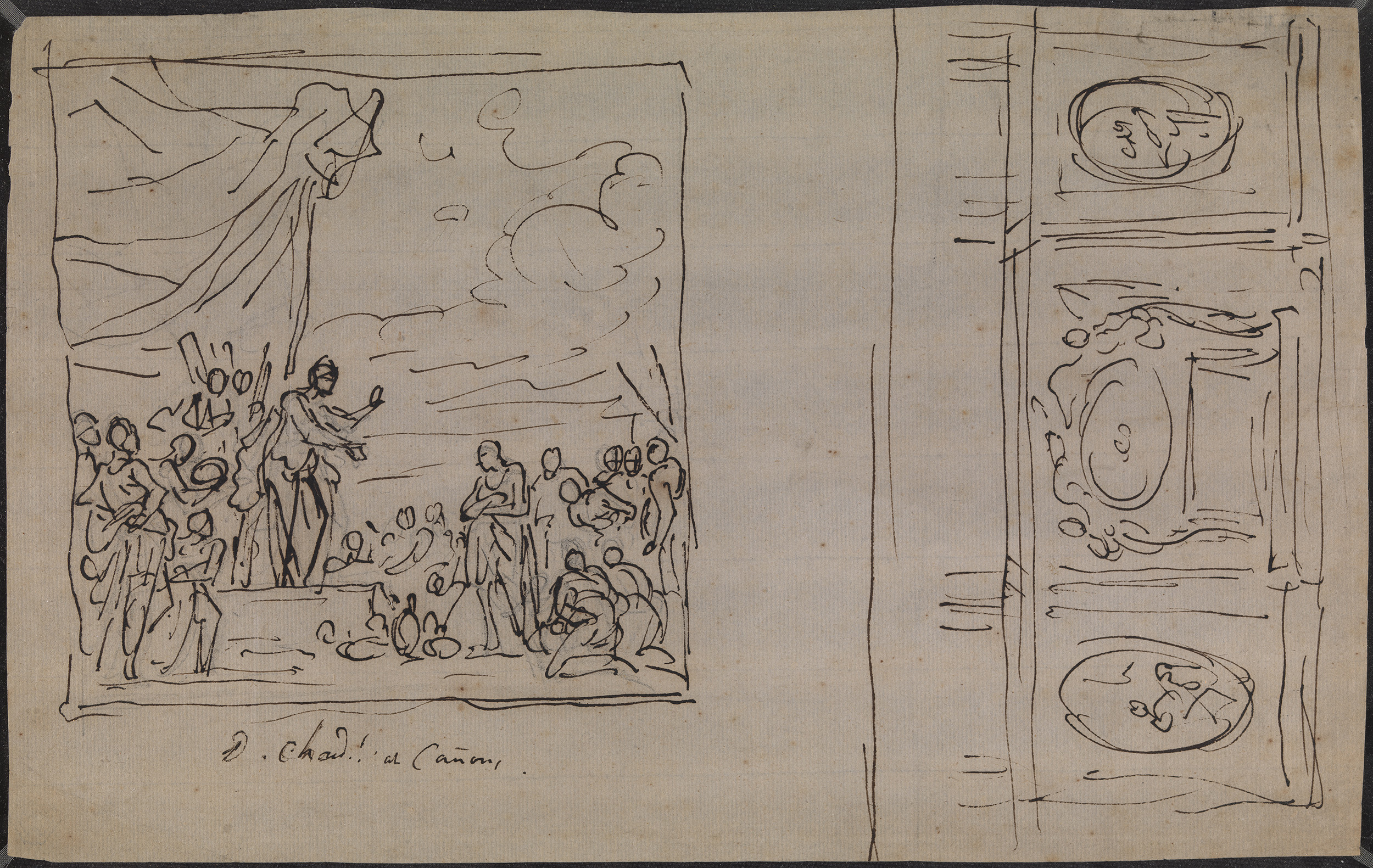
Sir James Thornhill (1675-1734), design for decoration at Canons, pencil, pen-&-ink, 19.3 × 30.8 cm., Lowell Libson & Jonny Yarker Ltd
Inscribed, ‘D. Chands a Canons’
‘This is an early design for the decoration of the staircase at Canons, Little Stanmore in Middlesex, which was one of the early eighteenth century’s great palaces of art. Canons was built between 1714 and 1723 by James Brydges, 1st Duke of Chandos to designs by James Gibbs… Canons… was sold before being dismantled for building material in about 1750.
This dynamic sheet is the only preparatory study recognised by both Osmun and Croft-Murray for Thornhill’s decorations at Canons…
The right-hand section of the sheet shows Thornhill’s scheme for ground-level architectural painting. At its centre, winged figures stand either side of a rectangular space [which is] probably intended as the east end of a chapel and may be associated with the church of St Lawrence, near Canons, which served as the Brydges family chapel and was extensively rebuilt by the Duke of Chandos in 1714-16…’
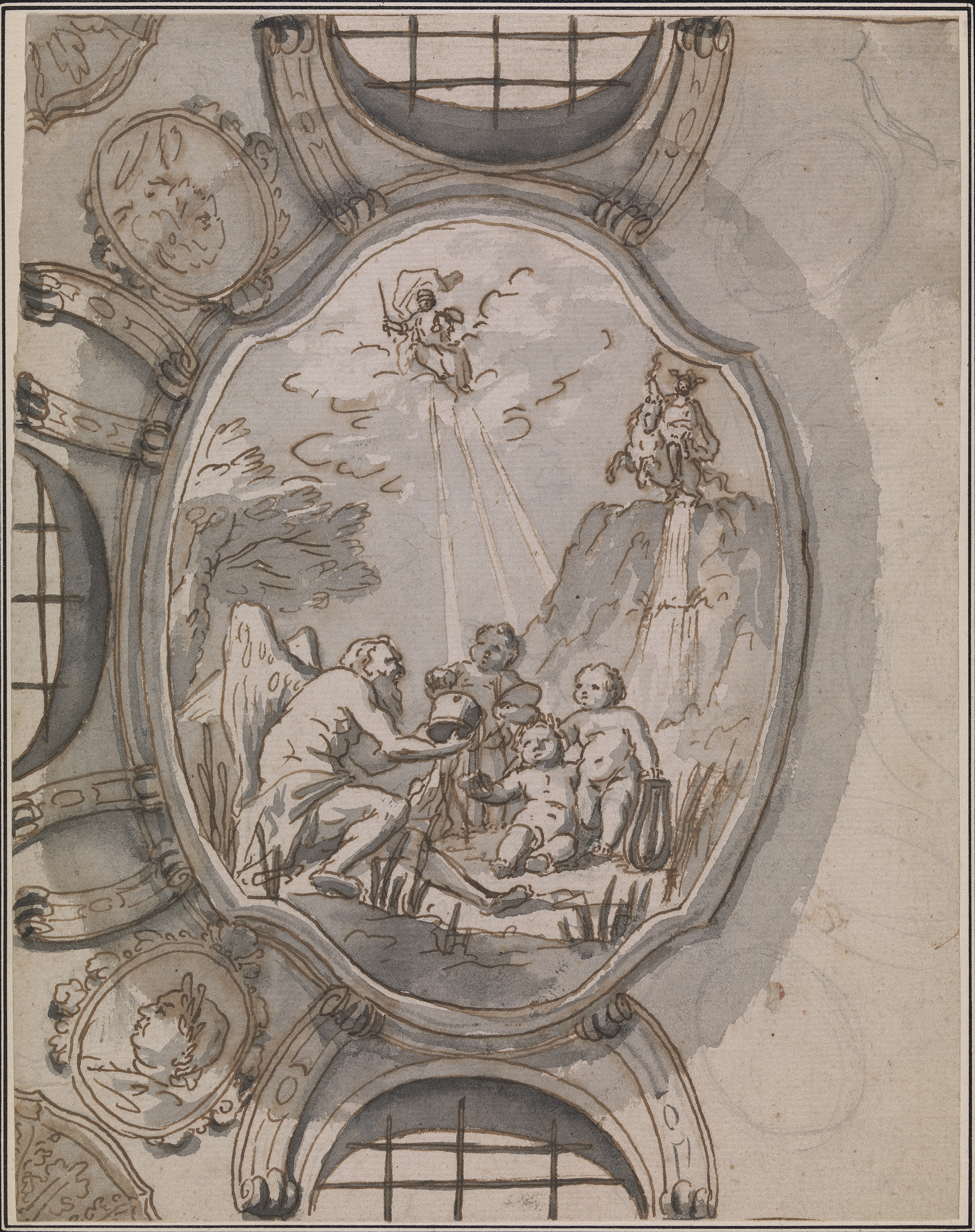
Sir James Thornhill (1675-1734), design for a ceiling: The encouragement of the Arts, c.1720, pencil, pen-&-ink, wash, 24.5 x 19.5 cm., Lowell Libson & Jonny Yarker Ltd
‘ …The shape of the central compartment of this ceiling is uncommon in Thornhill’s work and it is likely that this was one of many drawings that Thornhill made in the 1720s as an intellectual exercise, rather than as part of a commissioned project.’
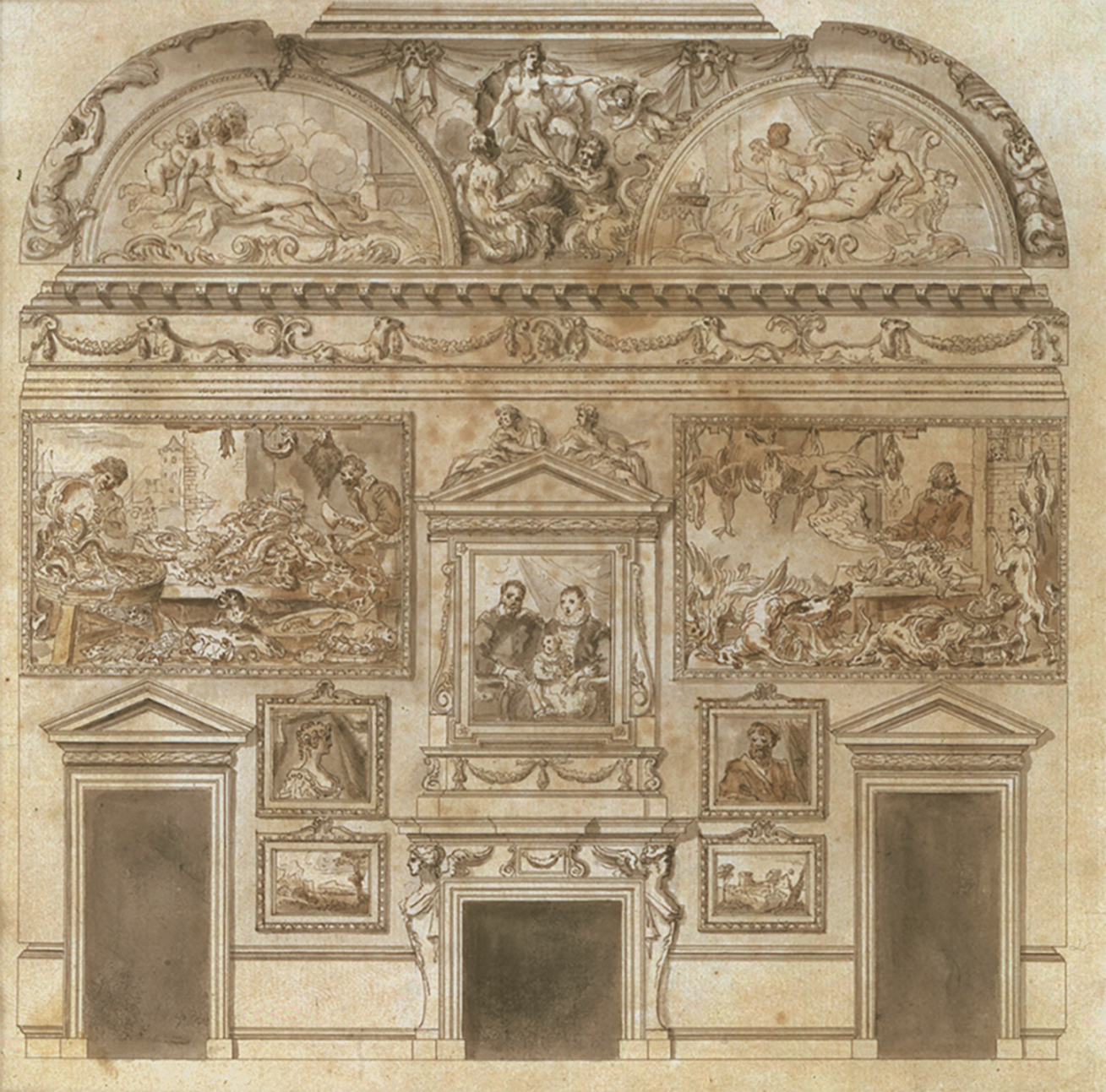
William Kent (1685-1748), design for the north wall of the Red Saloon, Houghton Hall, showing a proposed picture hang, 1725, private collection

William Kent (1685-1748), design for the south wall of the Red Saloon, Houghton Hall, showing a proposed picture hang, 1725, private collection
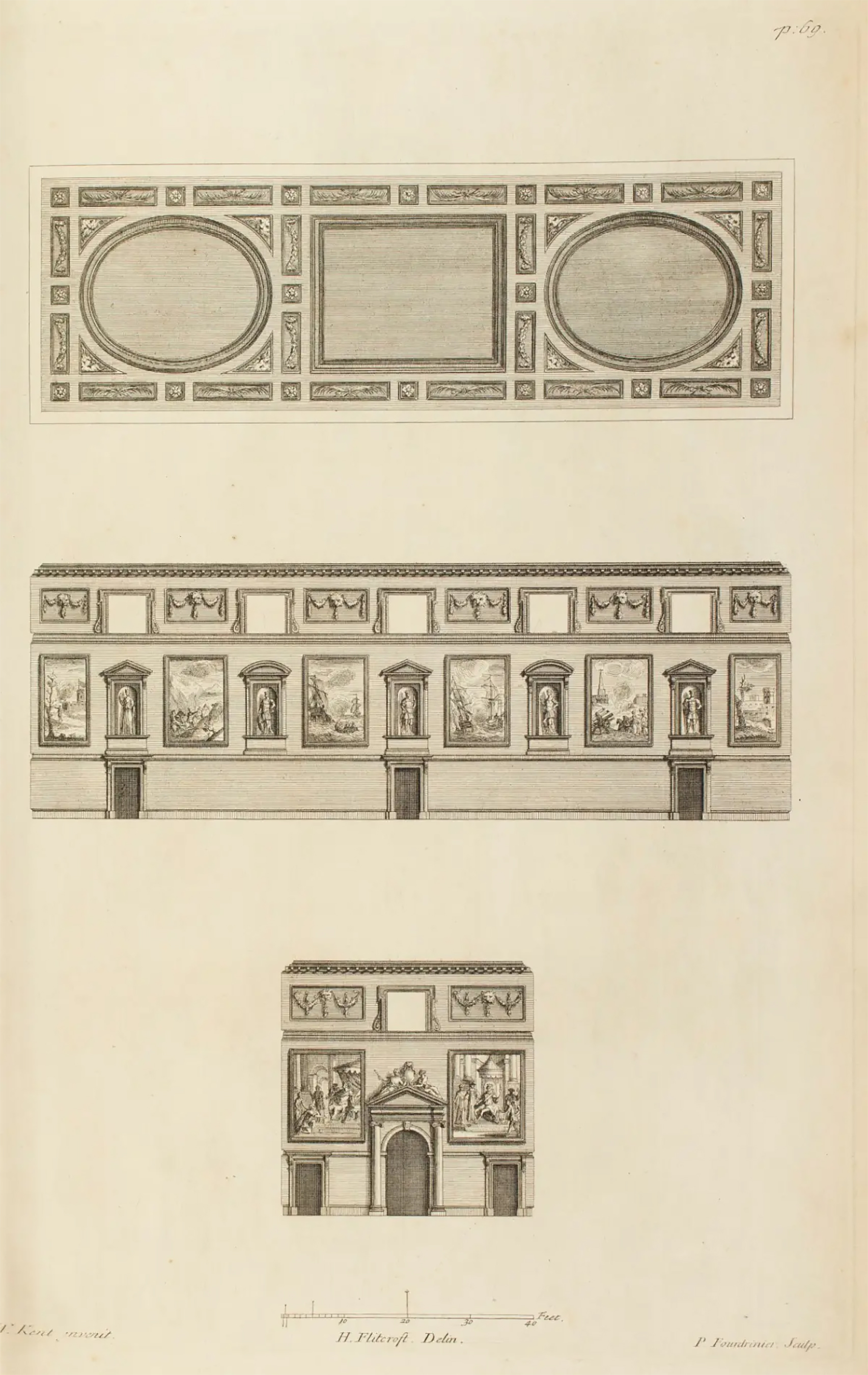
William Kent (1685-1748), design for a public gallery, drawn by Henry Flitcroft, engraved by Paul Fourdrinier, 1727, 37.4 x 25.4 cm., from The Designs Of Inigo Jones, Consisting of Plans and Elevations For Publick and Private Buildings, pub. by William Kent, ‘With some Additional Designs’, The First Volume (Second Volume), London, 1727; Royal Academy
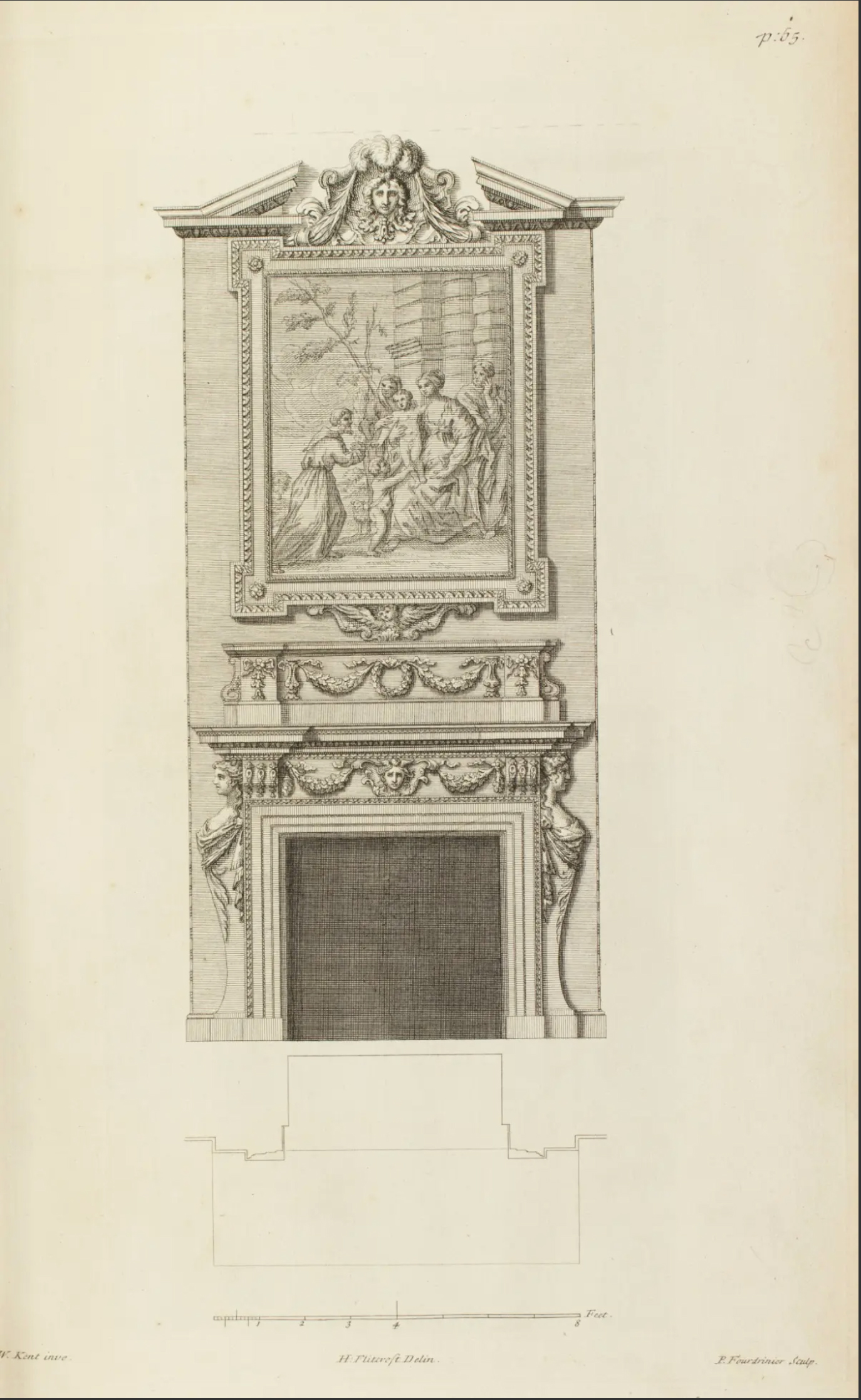
William Kent (1685-1748), chimneypiece in the drawing-room, Kensington, drawn by Henry Flitcroft, engraved by Paul Fourdrinier, 1727, 37.4 x 25.4 cm., from The Designs Of Inigo Jones, Consisting of Plans and Elevations For Publick and Private Buildings, pub. by William Kent, ‘With some Additional Designs’, The First Volume (Second Volume), London, 1727; Royal Academy
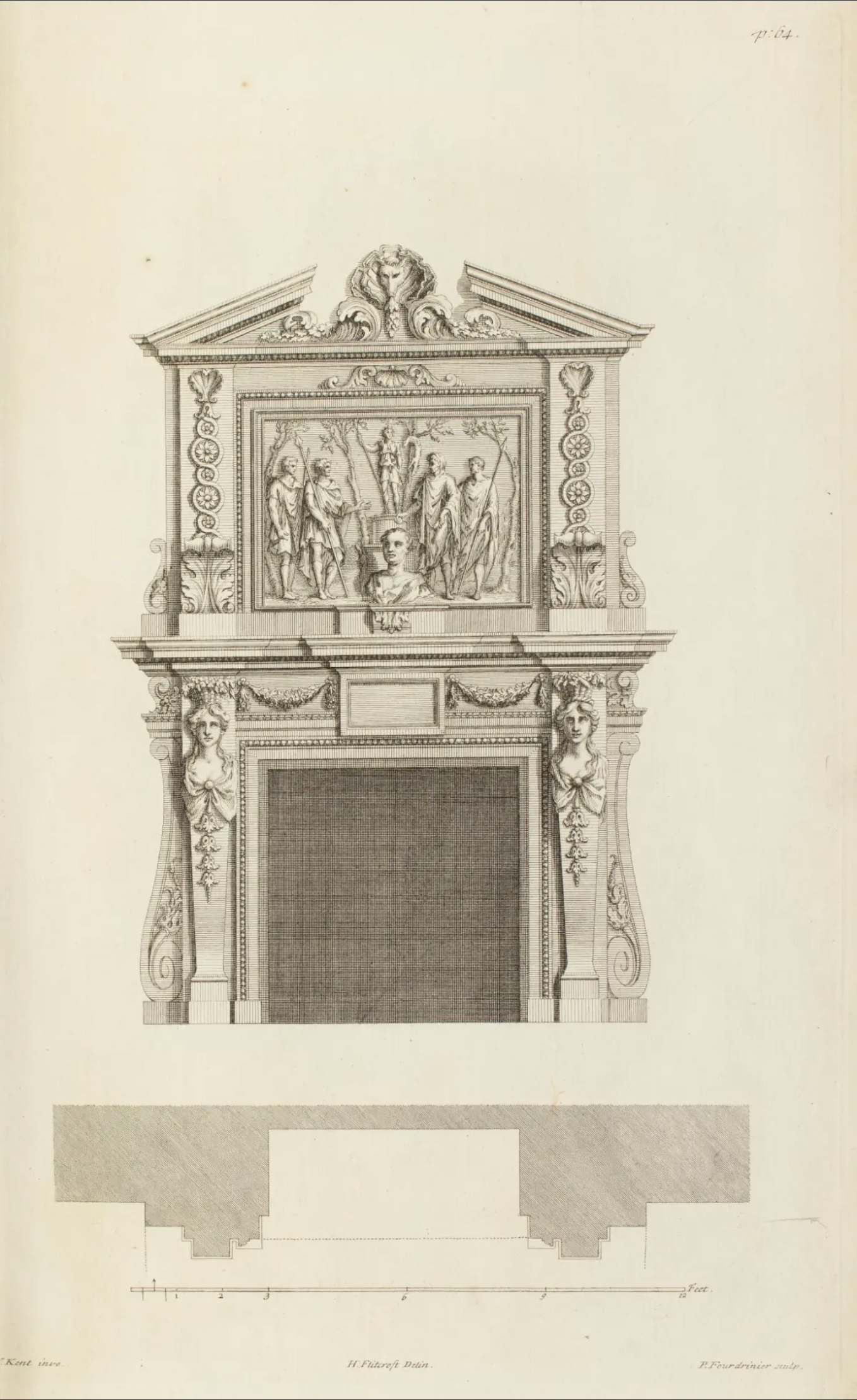
William Kent (1685-1748), chimneypiece at Houghton Hall, drawn Henry Flitcroft, engraved Paul Fourdrinier, 1727, 37.4 x 25.4 cm., from The Designs Of Inigo Jones, Consisting of Plans and Elevations For Publick and Private Buildings, pub. by William Kent, ‘With some Additional Designs’, The First Volume (Second Volume), London, 1727; Royal Academy
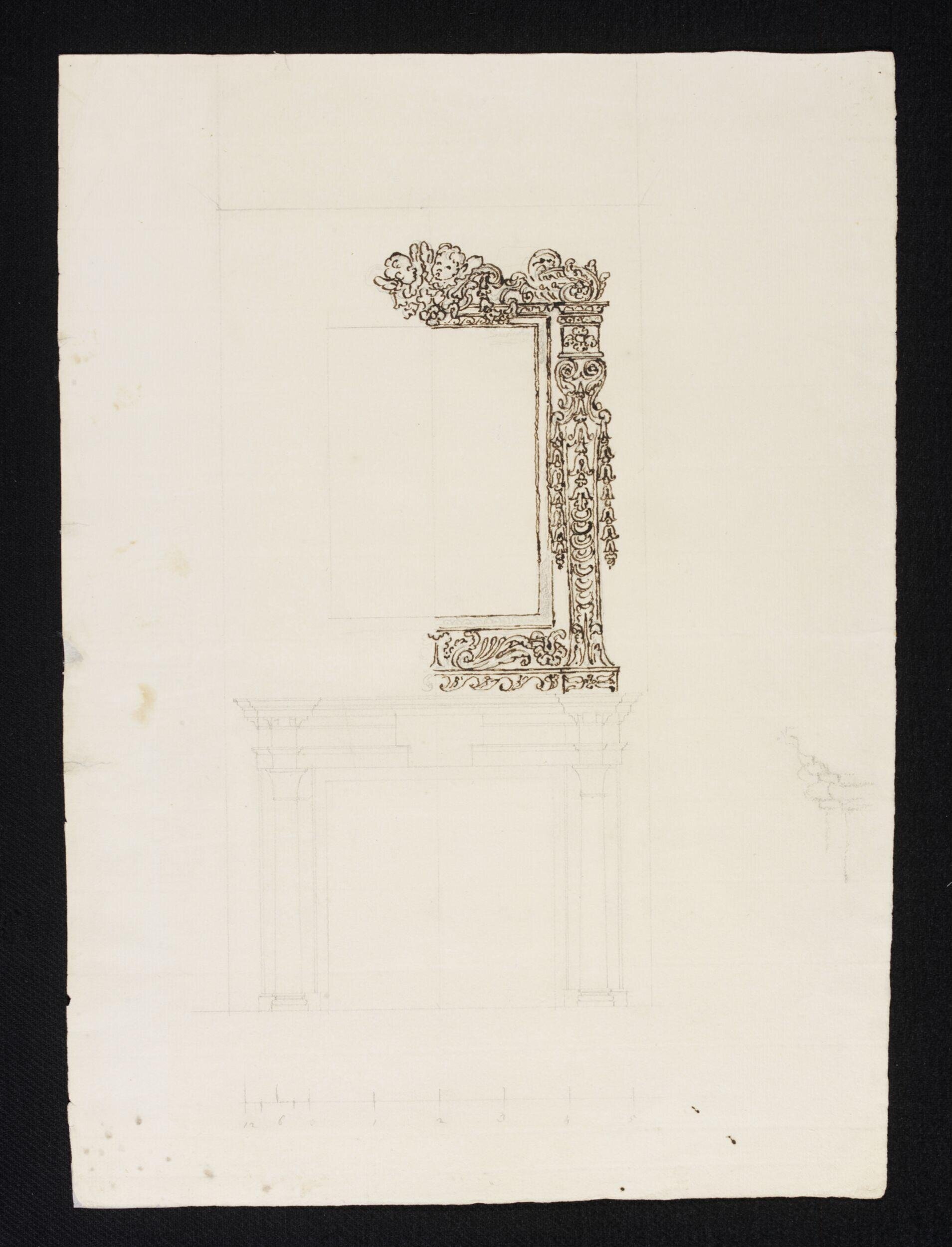
William Kent (1685-1748), design for a chimneypiece with overmantel frame, 1730-35, pencil, pen-&-ink, 38.1 x 27.5 cm., V & A
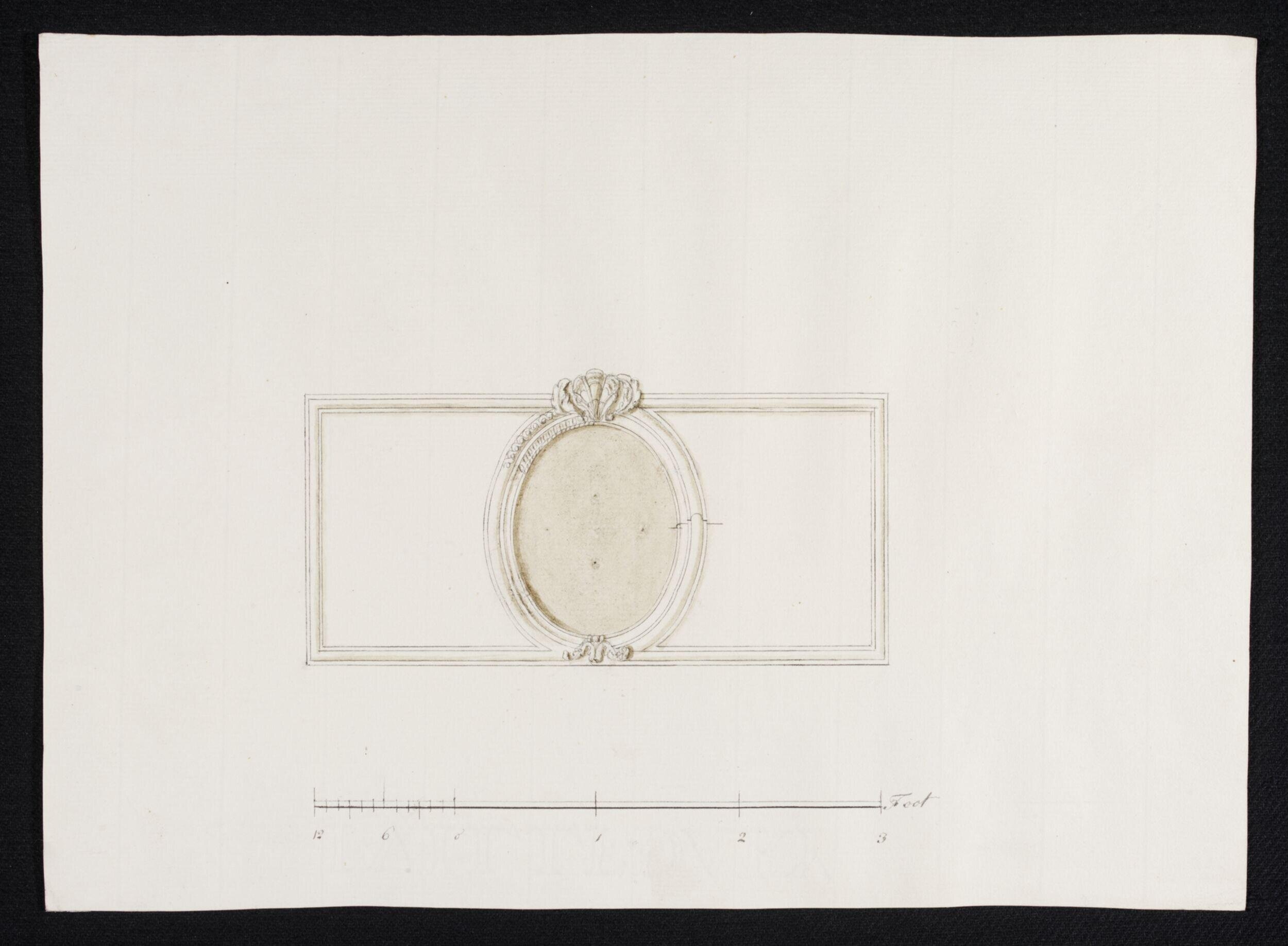
William Kent (1685-1748), design for an oval framed panel, c.1730-35, pen-&-ink, wash, 23.4 x 32.4 cm., V & A
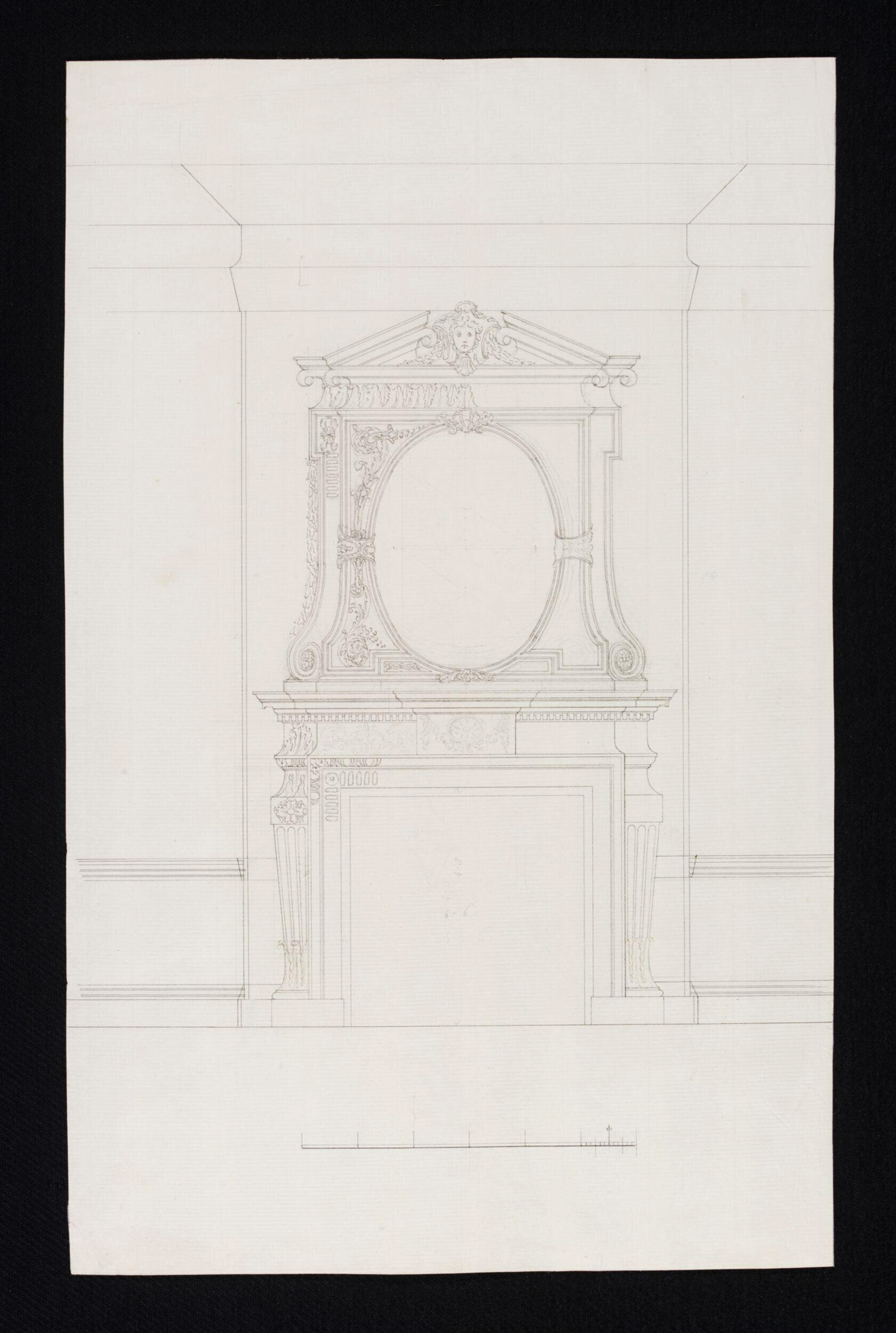
William Kent (1685-1748), design for a chimneypiece with fluted pilasters and pedimented overmantel, c.1730-35, pencil, pen-&-ink, 37.2 x 23.5 cm., V & A

William Kent (1685-1748) and Henry Flitcroft (1697-1769, scheme for walls, chimneypiece and ceiling of a room at Stowe House for Viscount Cobham, 1728-32, pencil, pen-&-ink, wash, 38.4 x 31.8 cm., Yale Center for British Art
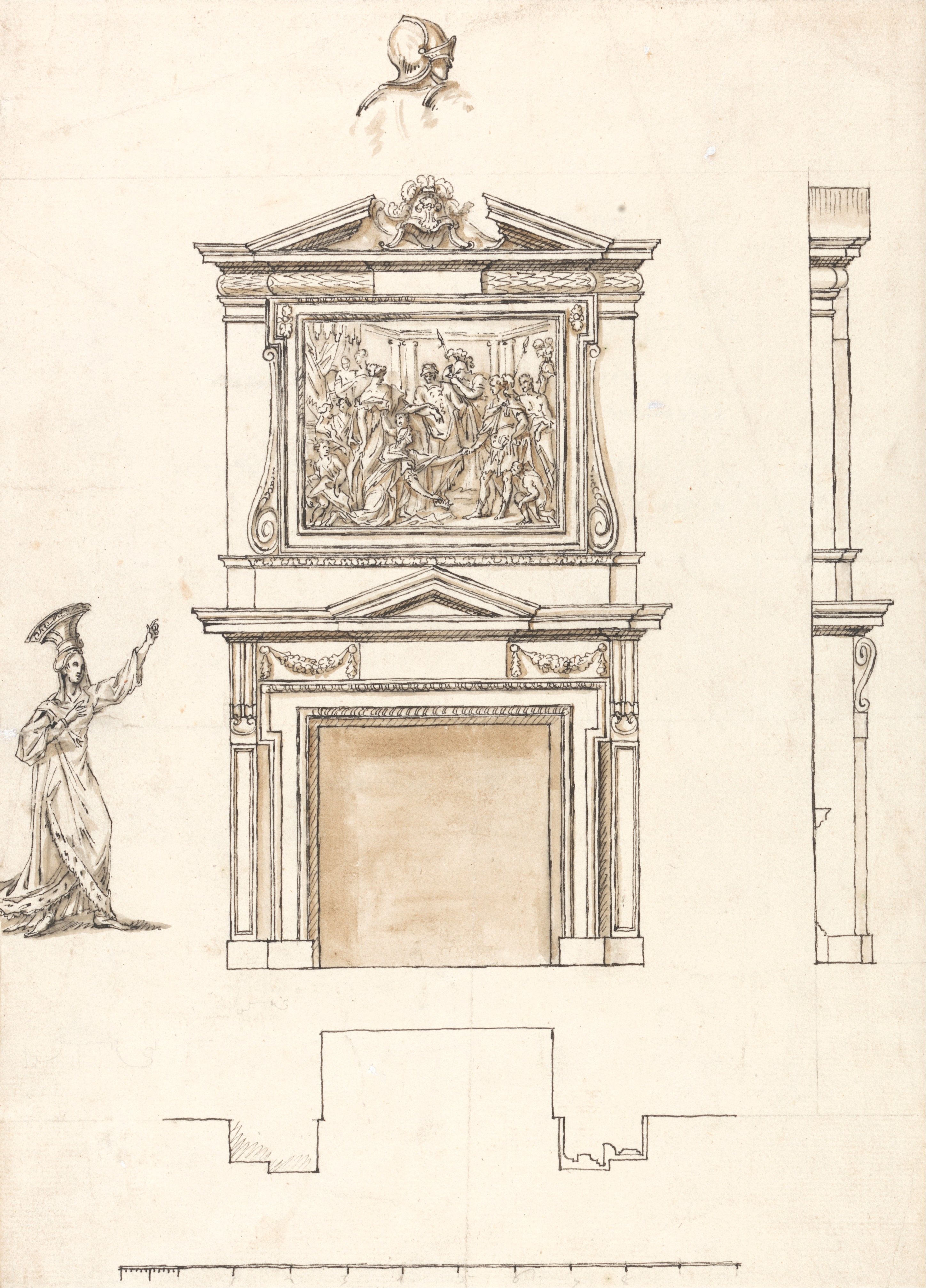
William Kent (1685-1748), design with elevation and plan for chimneypiece in the hall, Stowe House, c.1733, pencil, pen-&-ink, wash, 29.2 x 21 cm., Yale Center for British Art
Inscribed on verso,
‘For Lord Cobham WK
STOWE HOUSE’
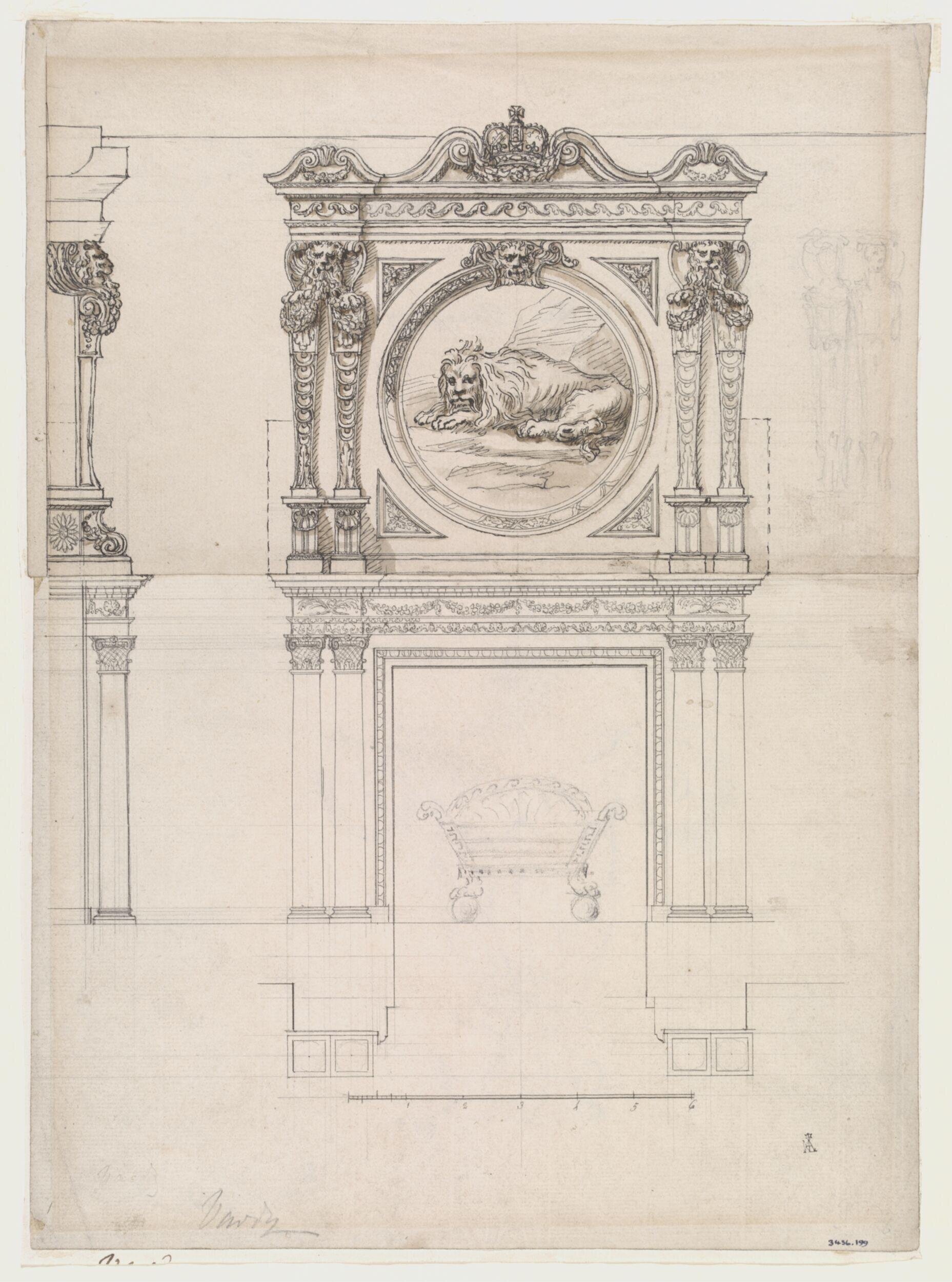
William Kent (1685-1748), design with elevation and profile for the chimneypiece in the Board Room, the New Treasury, 1733-36 (the fireplace drawn by John Vardy), pencil, pen-&-ink, wash, 32.8 x 23.8 cm., V & A
‘Design (elevation and profile) for the chimneypiece of the Board Room in the New Treasury built by architect and designer William Kent, 1733-1736. The carved overmantel contains a circular oil-painting of a reclining lion, instead of the bust which was later inserted. On two sheets joined. The upper sheet, containing the drawing of the overmantel and picture, is the work of Kent, but the lower sheet, containing the fireplace, is by John Vardy. On the upper sheet are pencil sketches of caryatids, probably intended as alternatives to features shown in the design. On the back of the lower sheet is a pencil sketch of an urn.’
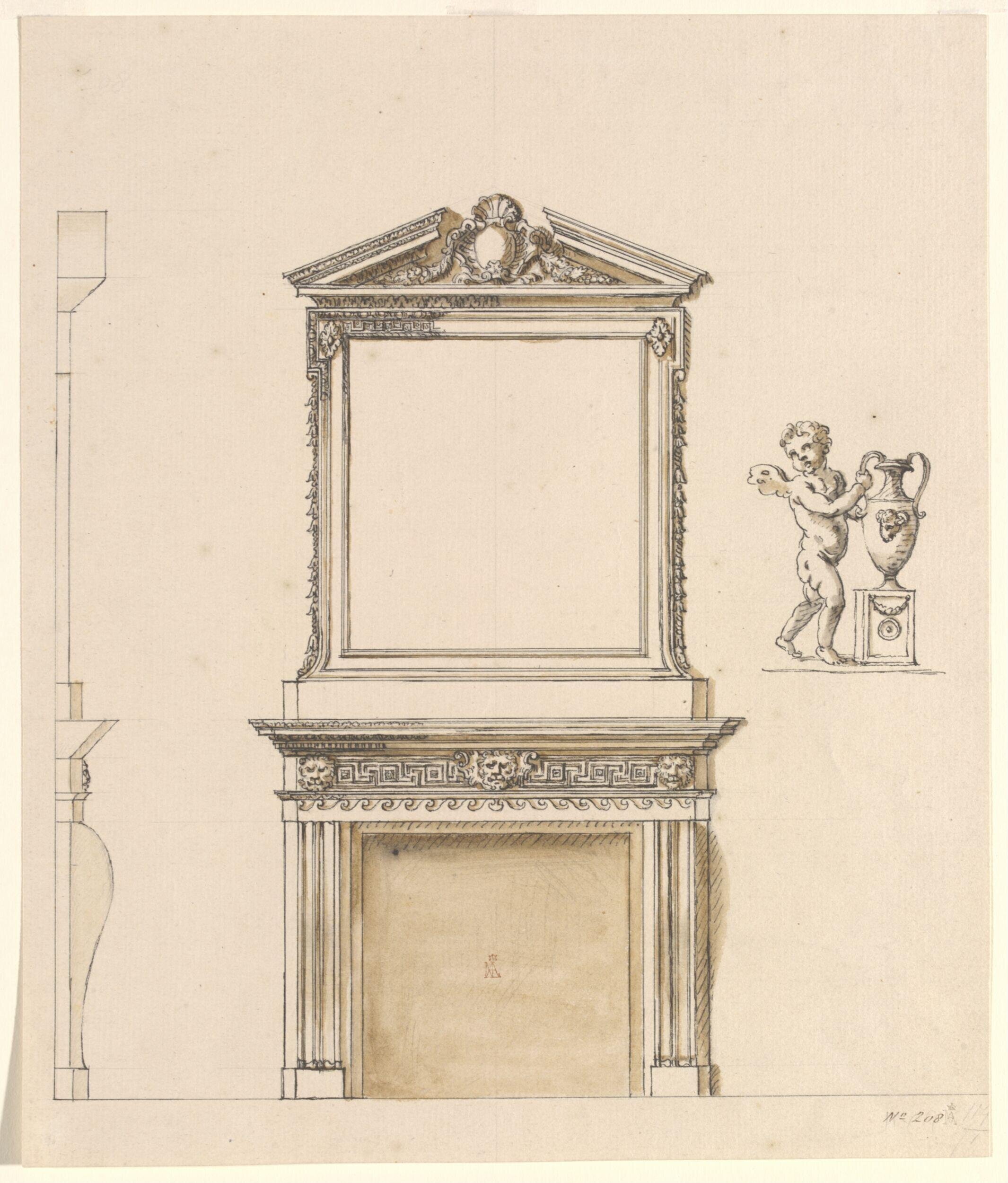
William Kent (1685-1748), design with elevation and profile for a chimneypiece and square overmantel frame with open pediment, first half 18th century, pen-&-ink, wash, 25.4 x 21.2 cm., V & A

William Kent (1685-1748), initial ‘B’, opening Book I of Pope’s Dunciad, etched by Paul Fourdrinier, 1735, etching, 4.9 x 4.9 cm., Royal Academy
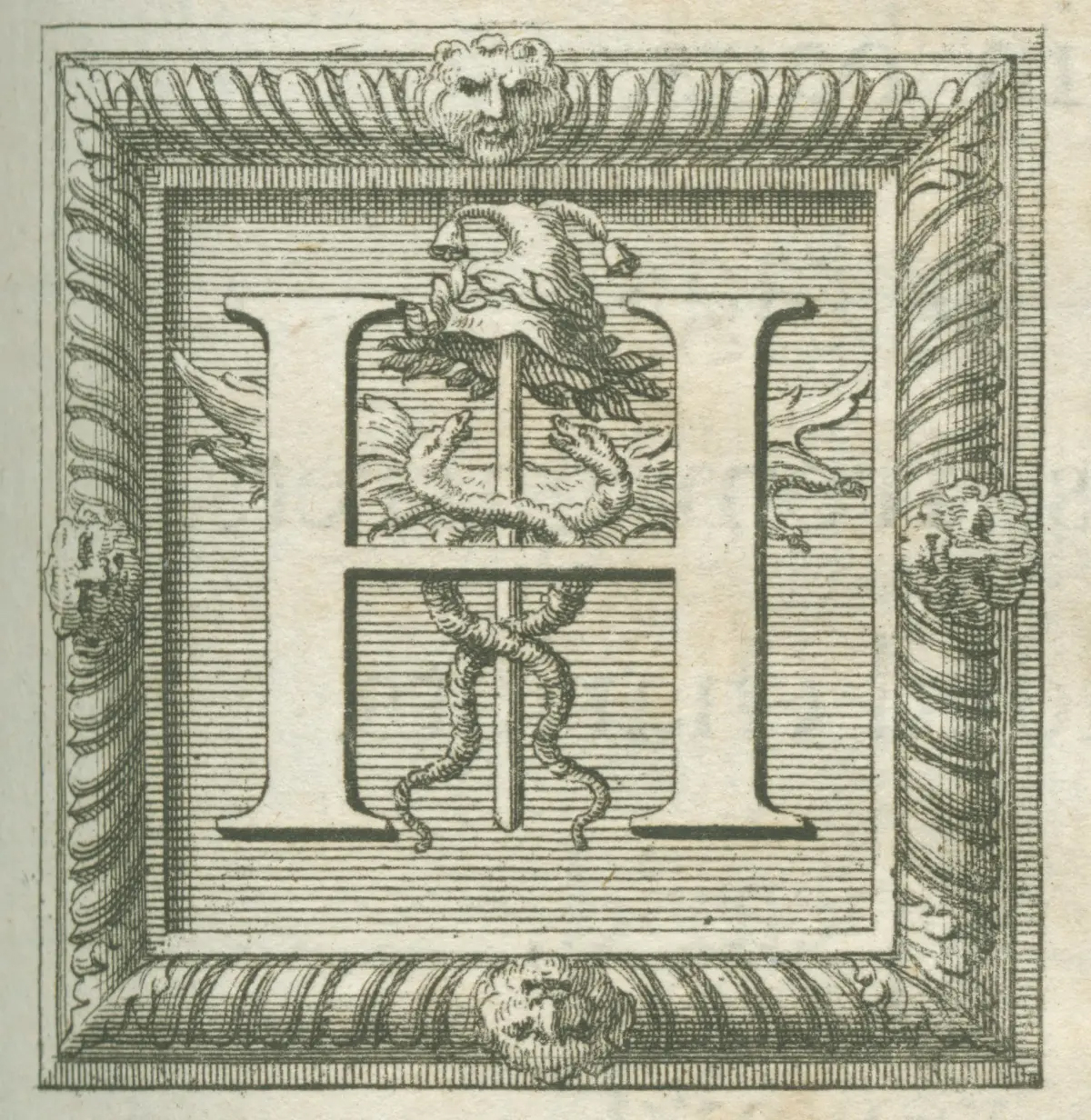
William Kent (1685-1748), initial ‘H’, opening Book II of Pope’s Dunciad, etched by Paul Fourdrinier, 1735, etching, 4.8 x 4.8 cm., Royal Academy
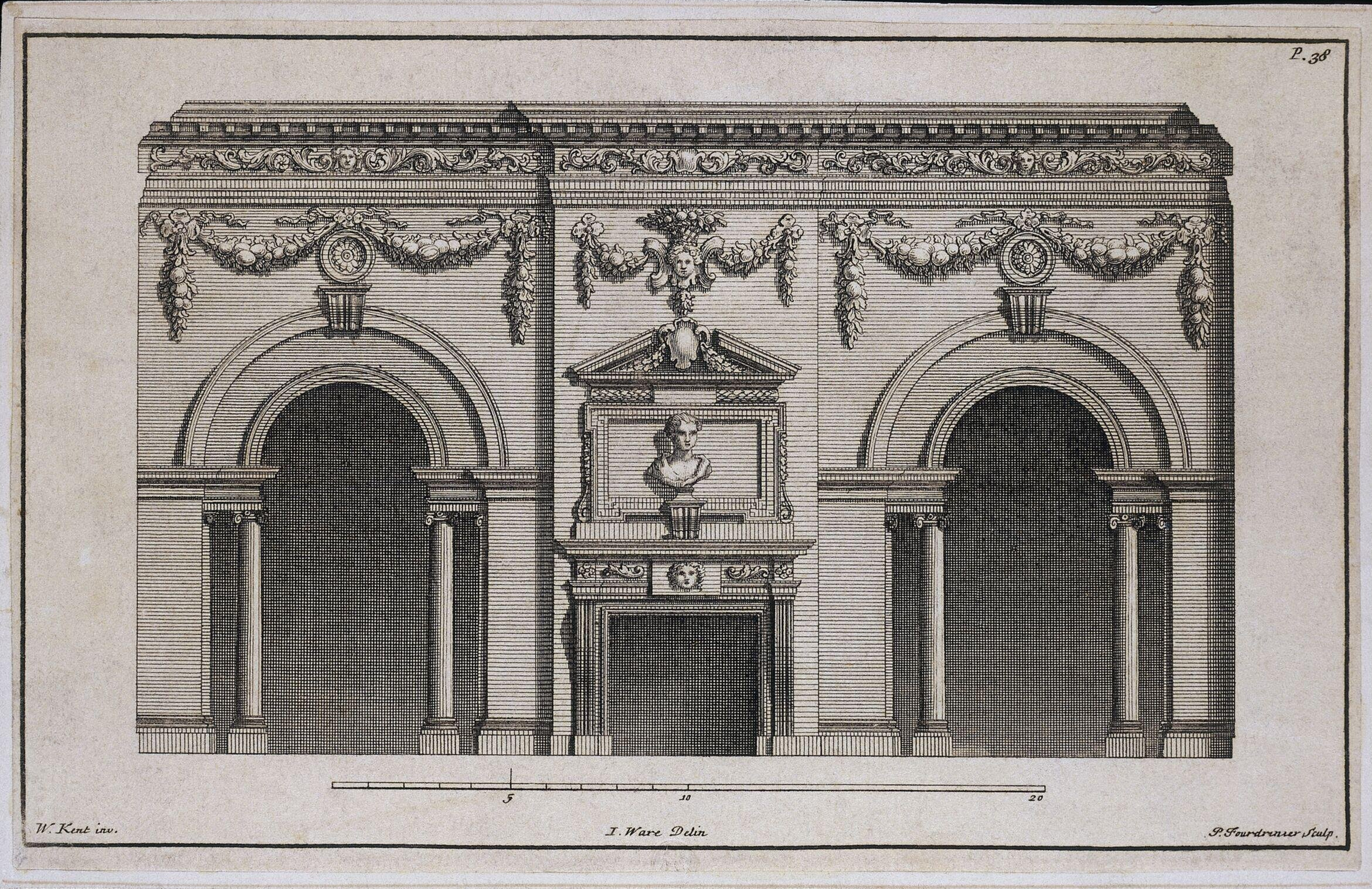
William Kent (1685-1748), the Great Dining Room, Houghton Hall, etched by Paul Fourdrinier, published by Isaac Ware, 1743, 12 x 19 cm., V & A
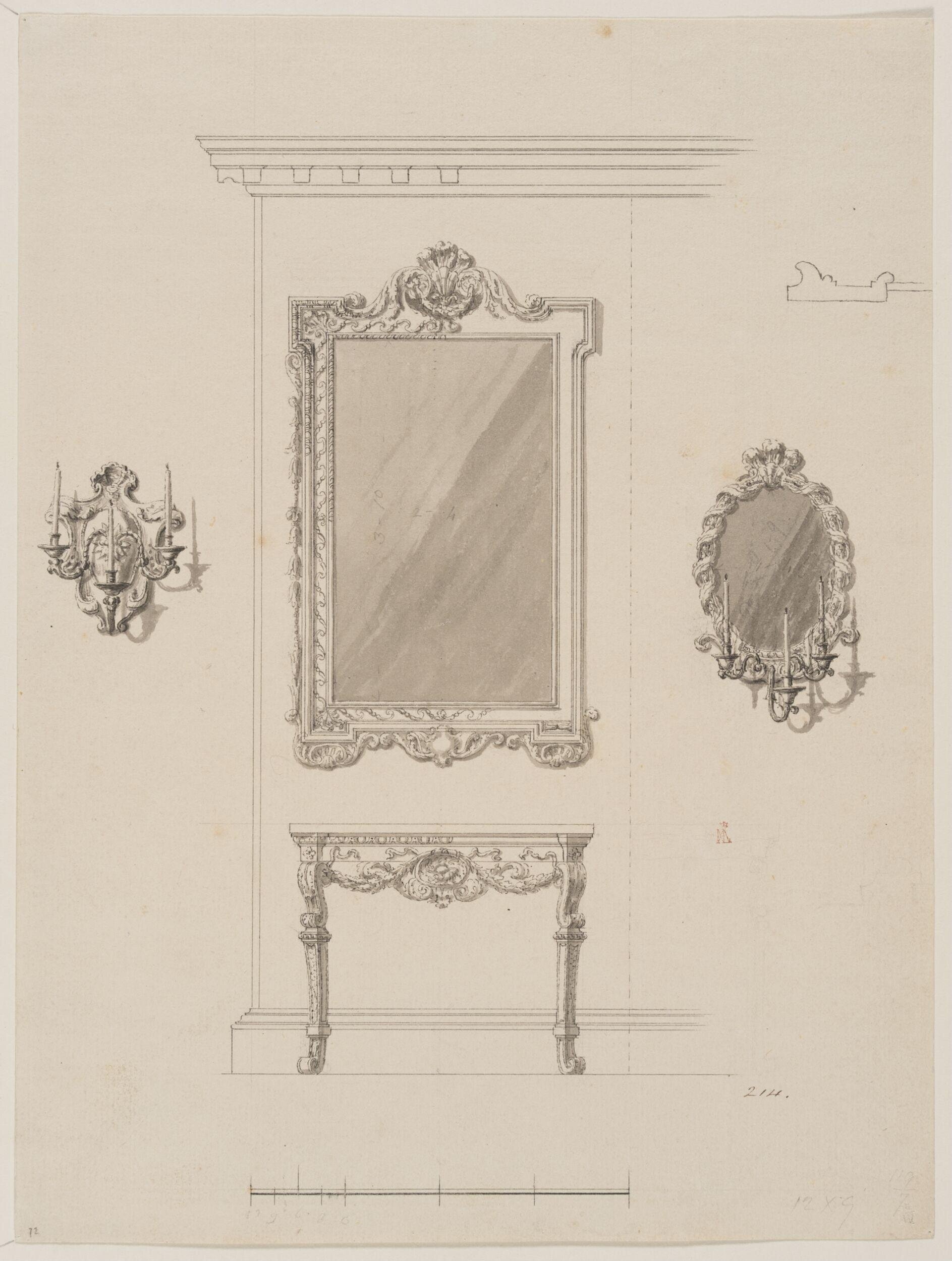
William Kent (circle of; 1685-1748), design for a pier glass, console, candle sconces, and oval side glass with sconces, the glasses with the Prince of Wales’s feathers, c.1740, pen-&-ink, wash, 29.5 x 22 cm., V & A
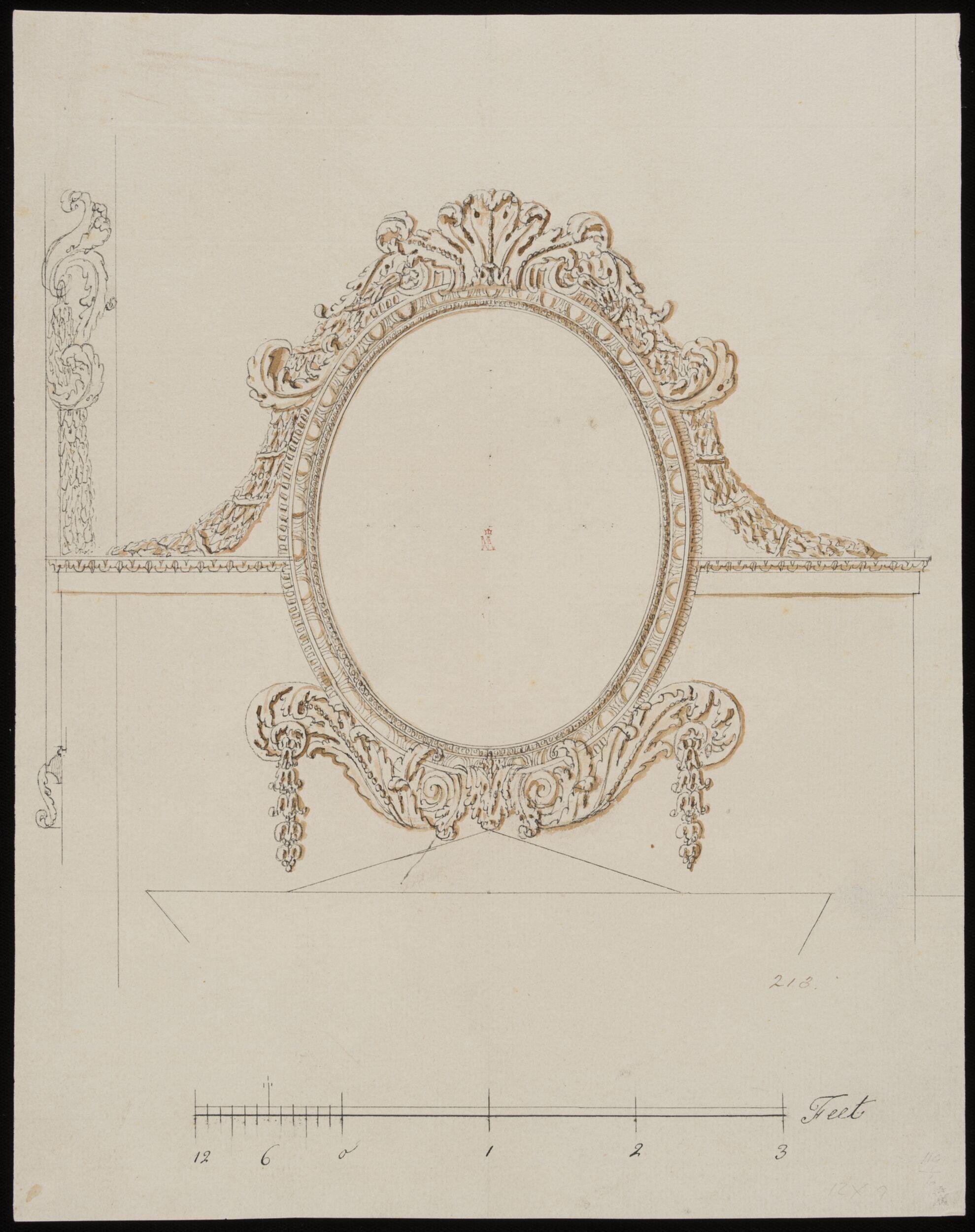
William Kent (circle of; 1685-1748), design for an oval frame, 18th century, pen-&-ink, wash, 28.9 x 22.7 cm., V & A

William Kent (circle of; 1685-1748), design for a chimneypiece after Inigo Jones, 18th century, pen-&-ink, wash, 21.1 x 14.8 cm., V & A
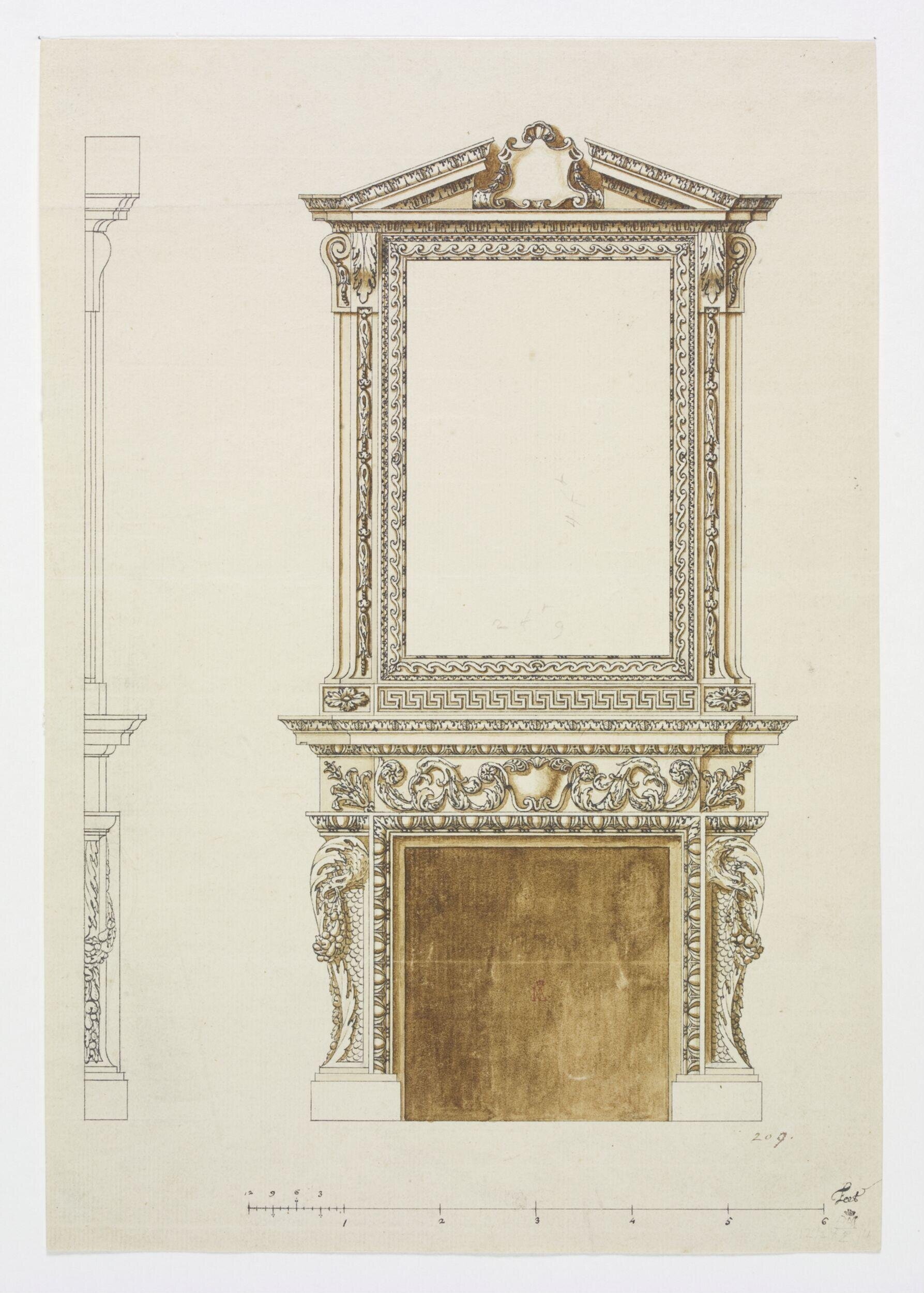
William Kent (circle of; 1685-1748), design with elevation & profile for a chimneypiece with morphing eagles’ heads at each side and a pedimented overmantel glass, 18th century, pen-&-ink, wash, 30.2 x 20.8 cm., V & A
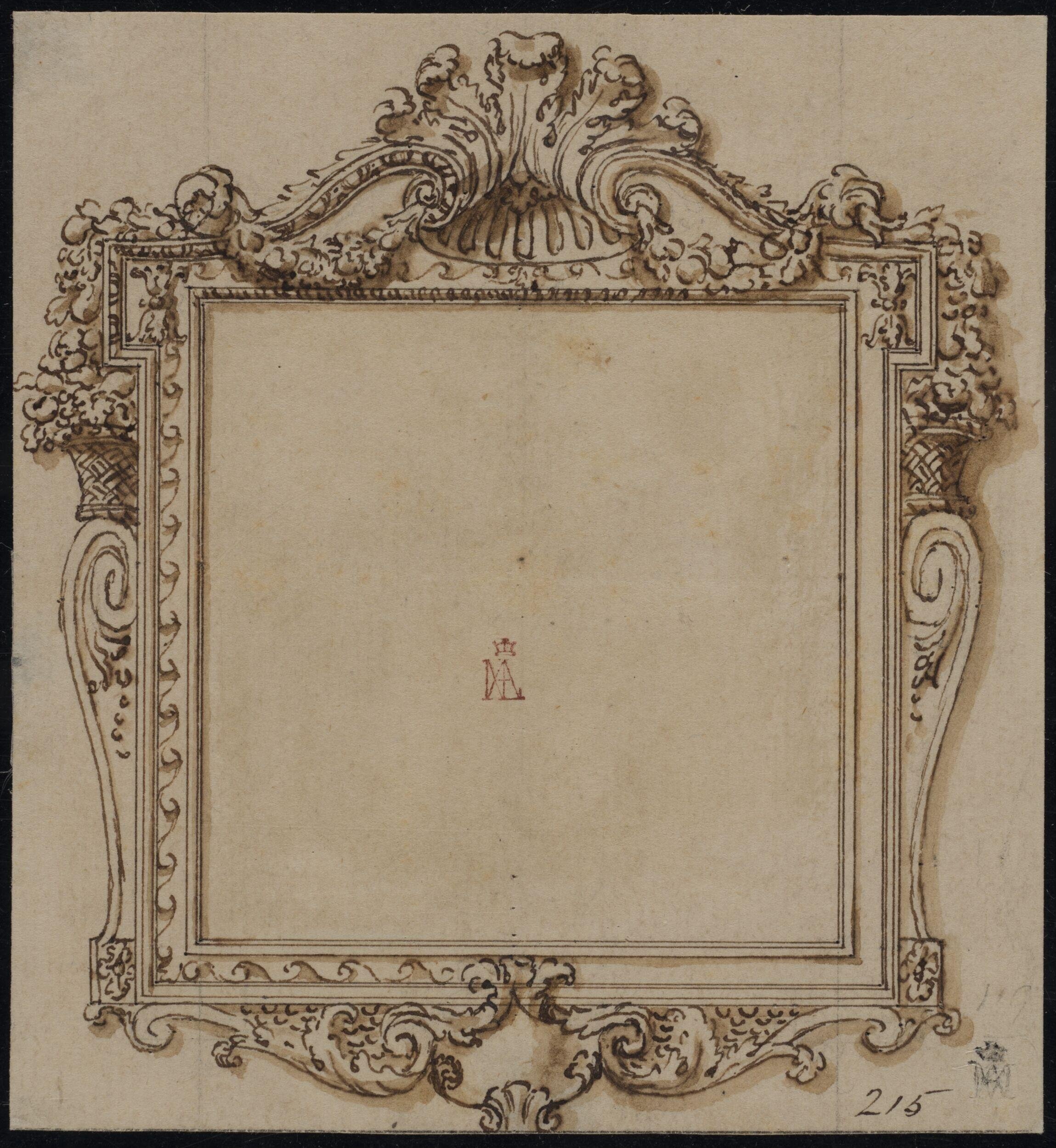
William Kent (circle of; 1685-1748), design for a square frame with baskets of fruit & flowers on the lateral brackets, 18th century, pen-&-ink, wash, 9.4 x 8.7 cm., V & A
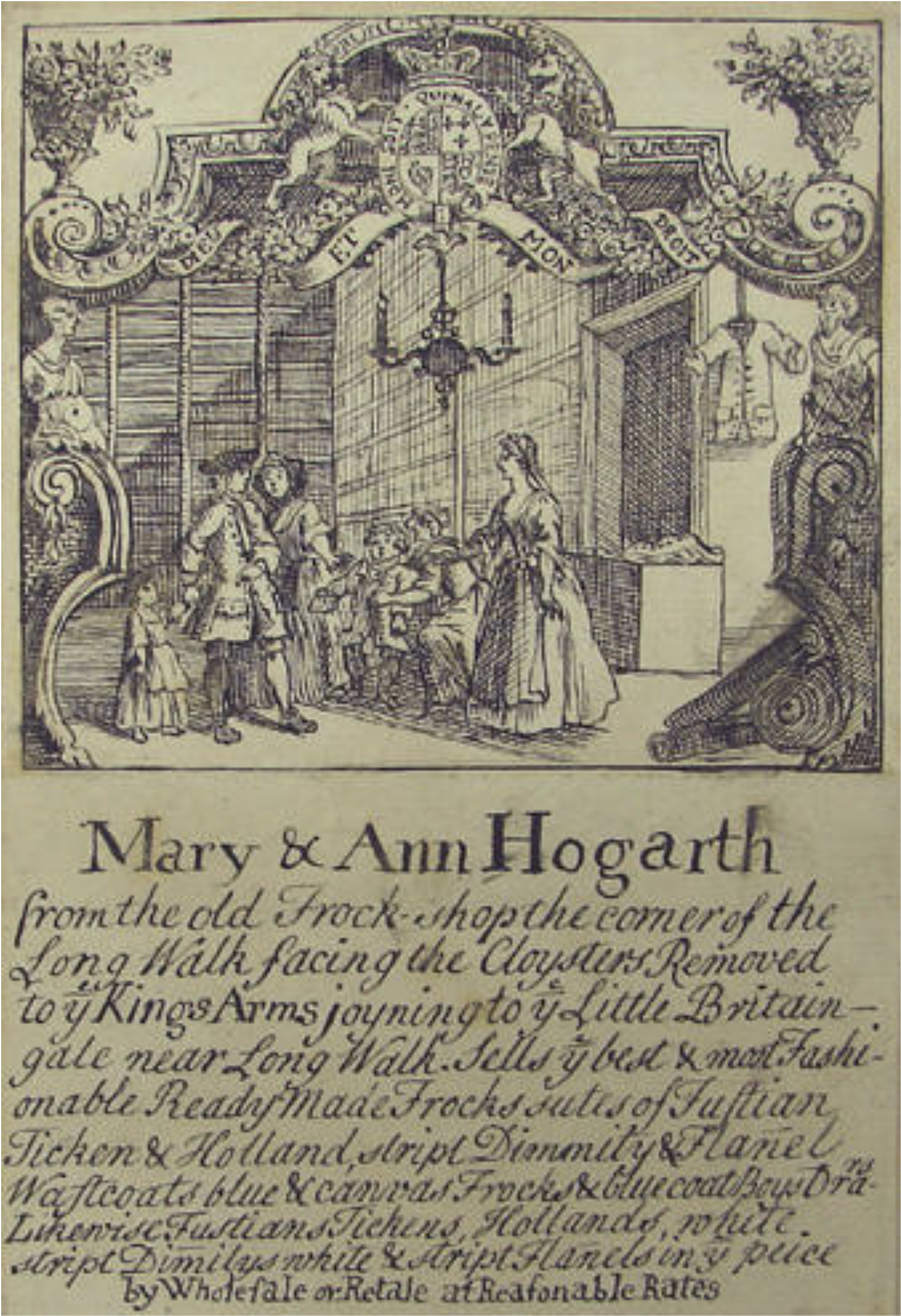
William Hogarth (1697-1764), design for a shop card for Mary & Ann Hogarth, c.1730, pencil, ink, 18.5 x 11 cm., Dunedin Public Art Gallery
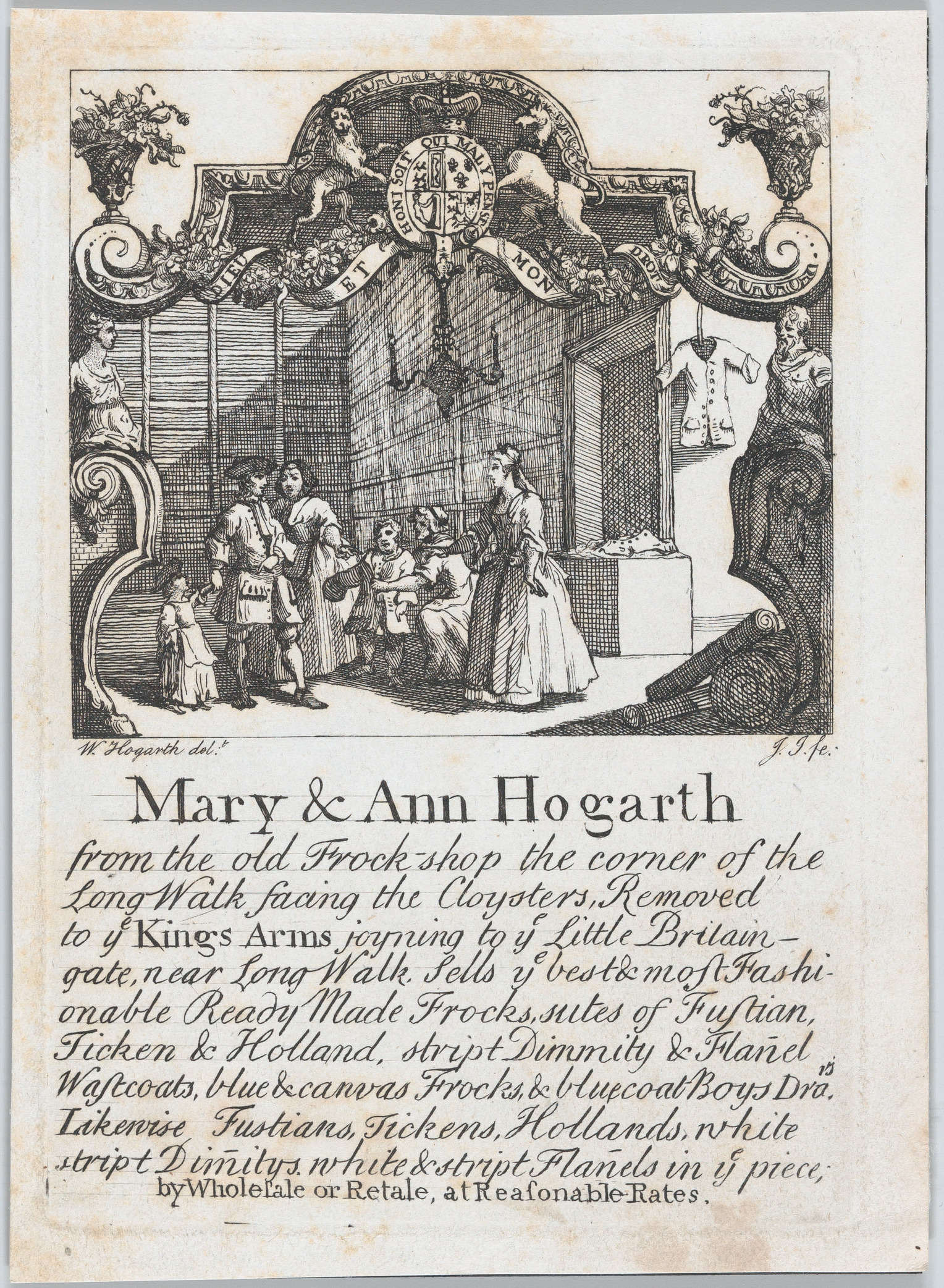
William Hogarth (1697-1764), printed shop card after his design for Mary & Ann Hogarth, c.1730, etching, 17.2 x 12.5 cm., Metropolitan Museum, New York

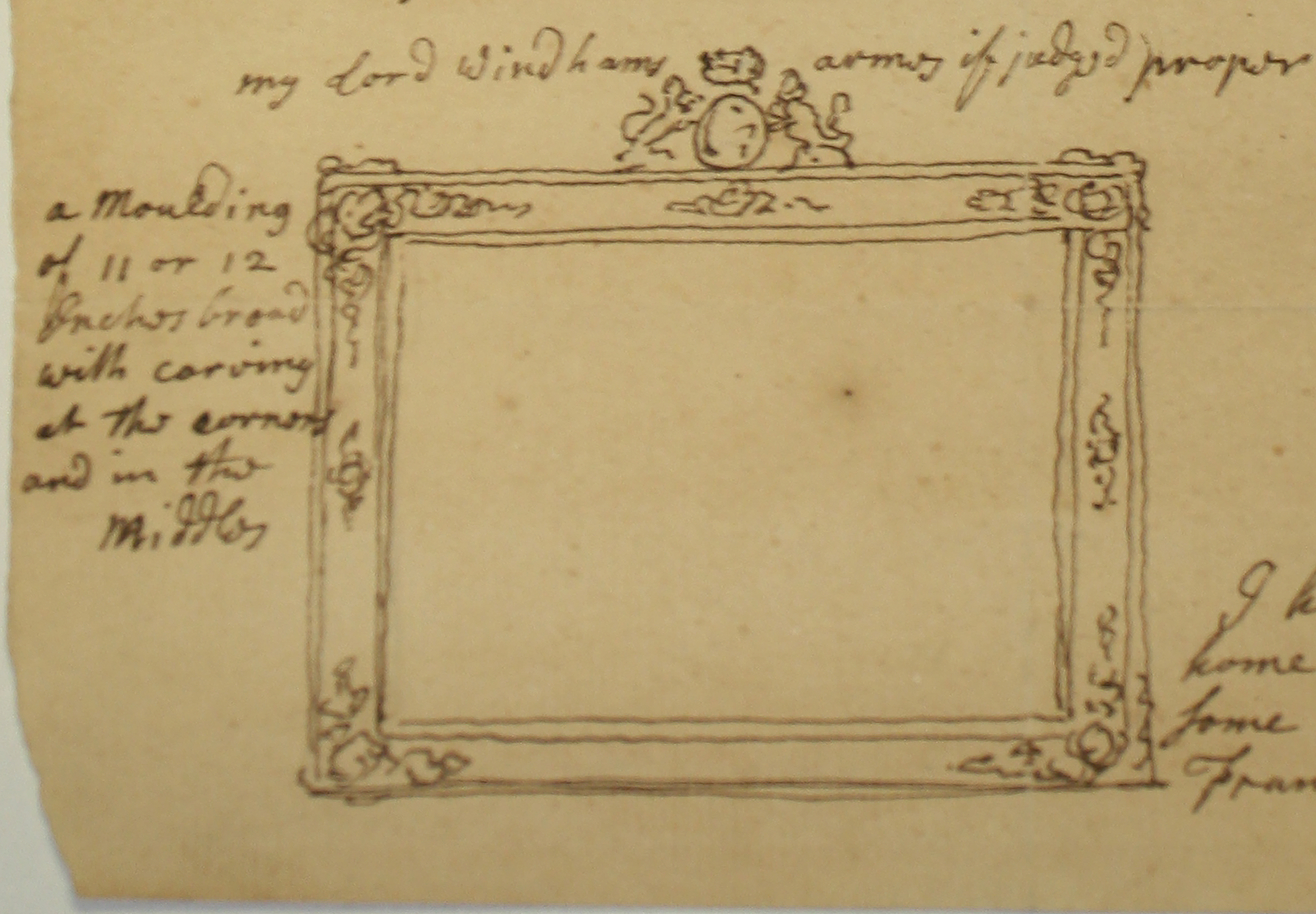
William Hogarth (1697-1764), autograph letter (28 June 1748 ) with sketch for the frame of Paul before Felix, 1748, Lincoln’s Inn; letter, Archive ref M9 3, Lincoln’s Inn Library
Part of the letter reads:
‘… it being thus Inclin’d will make ornaments on the sides improper, so that a Frame only is necessary. I have enquired of Mr Gosset a Frame Maker in Barwick [sic] Street about the price of one some what in the manner of the sketch below, he believes it may come to about 30 pound Guilt, to about half as much unguilt and about five pounds less if my Lord Windhams [sic] armes are omitted. Frames may be carried up to a great expense but he thinks one cannot be made in proportion to the picture for less.’
The sketch of the frame is annotated on the left:
‘a Moulding of 11 or 12 Inches broad with carving at the corners and in the Middle’, and at the top: ‘my Lord Windhams armes if judged proper’.
There is also a postscript:
‘I have removed the picture home again in hopes of making some improvements whilst the Frame is making.’ [see Jacob Simon, ‘Hogarth’s framemaker‘]
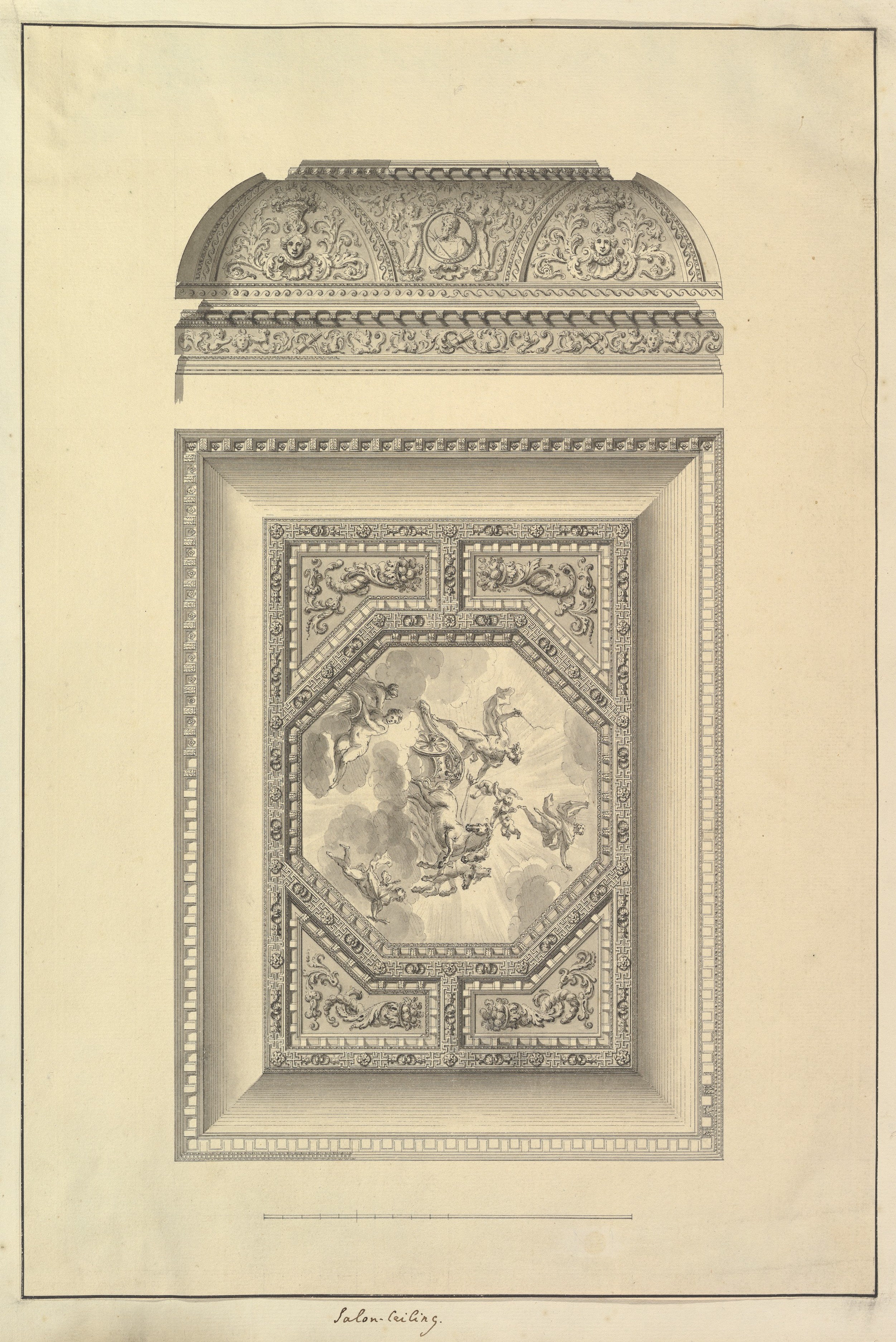
Isaac Ware (pre-1704-1766), design for the ceiling of the salon, Houghton Hall, 1735, pen-&-ink, wash, 44 x 29.5 cm., Metropolitan Museum, New York
‘Design for a ceiling with decorative carving in the vault, and an octagonal painting of Apollo in his chariot. This drawing relates to Isaac Ware’s and Thomas Ripley’s book, The Plans, Elevations and Sections, Chimney-pieces and Ceilings of Houghton in Norfolk (first published 1735; second edition 1755 with added ‘Description of the Pictures at Houghton’ by Horace Walpole).’
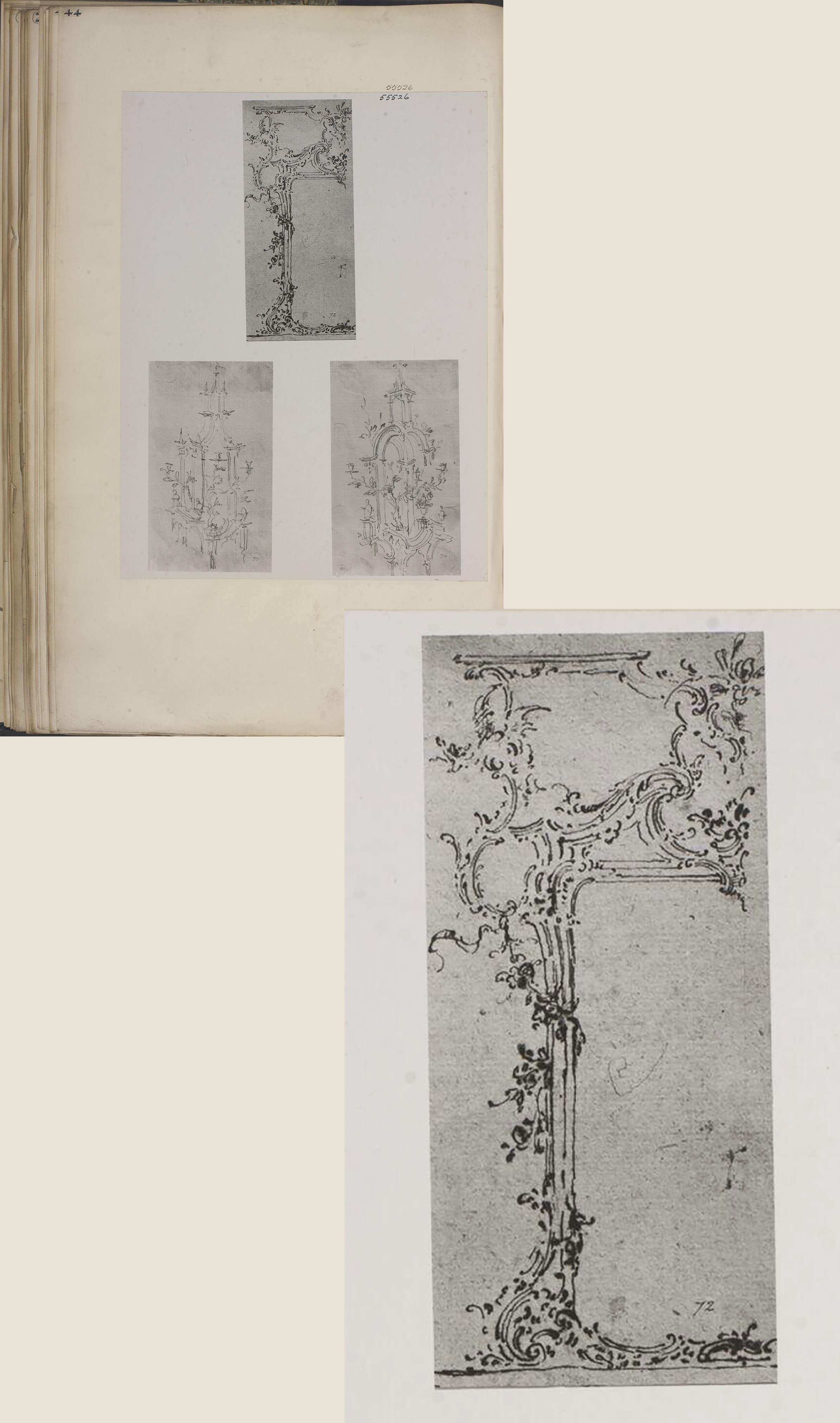
Matthias Lock (c.1710-d.1765), design for a Rococo frame, 1740-65, pen-&-ink, 19.6 x 8.9 cm., V & A
‘Matthias Lock was the first to publish Rococo designs in England and can be credited with first mastering the Rococo style, imparting an ‘English’ flavour to his designs….
This design came to the Museum in an album of designs entitled Original Designs by Matts Lock, Carver 1740 – 1765. The album was bought from a descendant, George Lock, and had been exhibited by him at the International Exhibition held at South Kensington in 1862. It seems to have been compiled after Lock’s death in 1765, as it includes ephemera from his workshop, designs by Chippendale, and NeoClassical designs associated with a later Matthias Lock, probably his son.’
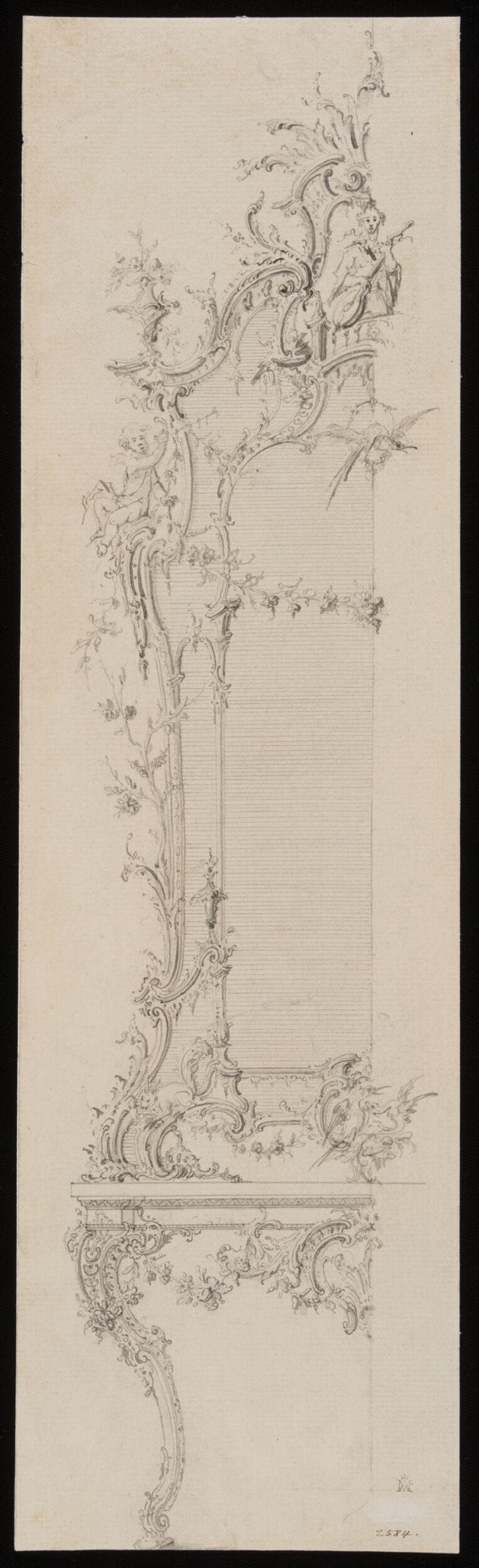
Matthias Lock (c.1710-d.1765), design for a Rococo pier glass and matching console, 1740-65, pen-&-ink, 40 x 11.5 cm., V & A

Thomas Chippendale (1718-79), design for a pier glass frame, in Chippendale drawings, vol. I, c.1753-62, pencil, 21.5 x 12.2 cm., Metropolitan Museum, New York
‘Design for a pier glass with oval compartment. Not published in Thomas Chippendale’s Gentleman and Cabinet Maker’s Director.’
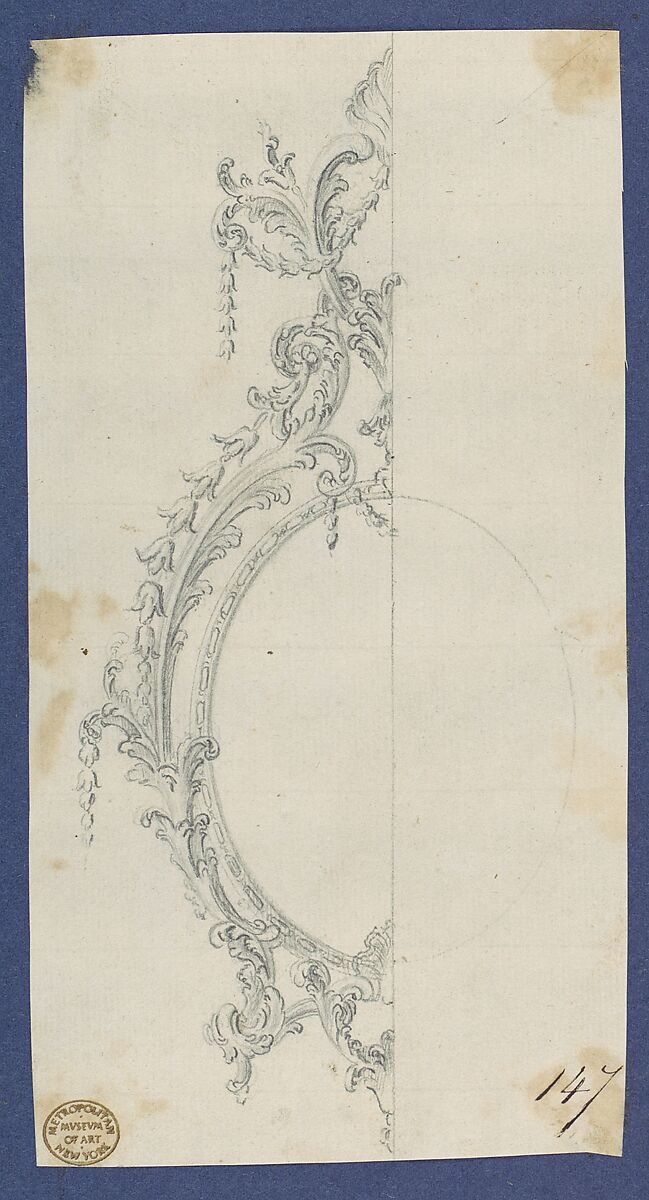
Thomas Chippendale (1718-79), design for a pier glass frame, in Chippendale drawings, vol. I, c.1753-62, pencil, 19.1 x 10.2 cm., Metropolitan Museum, New York
‘Design for a pier glass with oval compartment. Not published in Thomas Chippendale’s Gentleman and Cabinet Maker’s Director.’
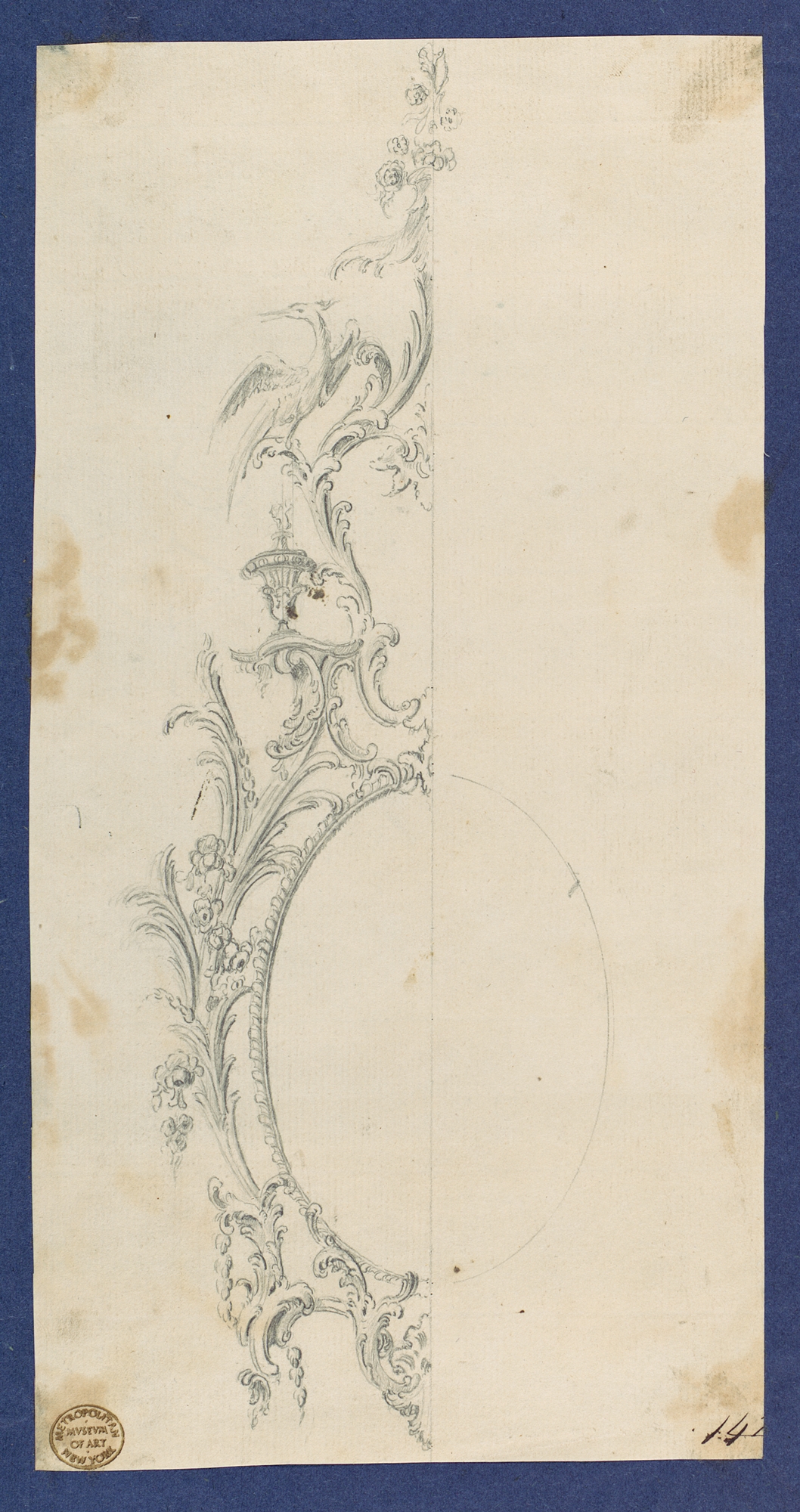
Thomas Chippendale (1718-79), design for a pier glass frame, in Chippendale drawings, vol. I, c.1753-62, pencil, 24.8 x 10.2 cm., Metropolitan Museum, New York
‘Design for a pier glass with oval compartment. Not published in Thomas Chippendale’s Gentleman and Cabinet Maker’s Director.’

Thomas Chippendale (1718-79), design for a chimneypiece, in Chippendale drawings, vol. I, c.1753-62, pencil, 17.5 x 8.4 cm., Metropolitan Museum, New York
‘Design for a chimneypiece. Not published in Thomas Chippendale’s Gentleman and Cabinet Maker’s Director.’ See also another chimneypiece.

Thomas Chippendale (1718-79), design for an overmantel, in Chippendale drawings, vol. I, c.1753-62, ink, wash, watercolour, 15.2 x 13.7 cm., Metropolitan Museum, New York
‘Design for an overmantel. Not published in Thomas Chippendale’s Gentleman and Cabinet Maker’s Director.’ See also another overmantel.
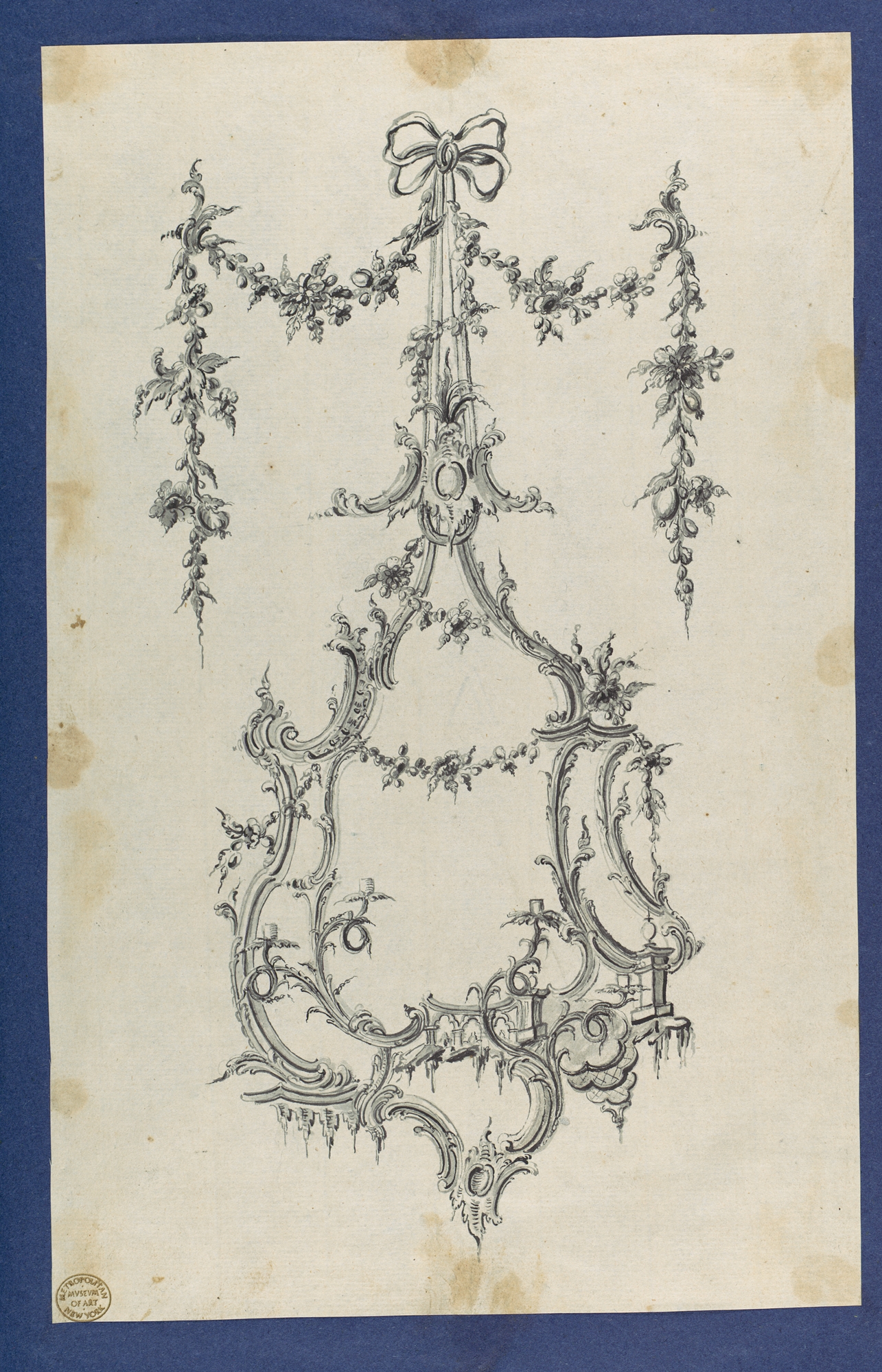
Thomas Chippendale (1718-79), design for a looking-glass and sconces, in Chippendale drawings, vol. I, c.1753-62, ink, wash, 29.1 x 18.4 cm., Metropolitan Museum, New York
Design for a looking-glass with sconces. Not published in Thomas Chippendale’s Gentleman and Cabinet Maker’s Director. See also another looking-glass with sconces.

Thomas Chippendale (1718-79), design for a looking-glass, in Chippendale drawings, vol. I, c.1753-62, ink, pencil, 31.6 x 19.4 cm., Metropolitan Museum, New York
Design for a looking-glass. Not published in Thomas Chippendale’s Gentleman and Cabinet Maker’s Director. Inscription:
Top margin: ‘For Cop. Warre Bampfyld at Hestercomb near Taunton Somerse’; lower right: ‘213’; bottom margin: ‘Either of these must be at least 6 feet high & 3 wide Mr. Knight at Mrs. Freke’s in Charles Street, St. Jas. Square’; on blue paper: ’83’

Thomas Chippendale (1718-79), design for a NeoClassical chimneypiece with monogram, in Chippendale drawings, vol. I, c.1760-70, pen-&-ink, wash, pencil, 35.8 x 21.3 cm., Metropolitan Museum New York
‘Design for a NeoClassical chimneypiece with the initials ‘TC’. Not published in Thomas Chippendale’s Gentleman and Cabinet Maker’s Director‘.
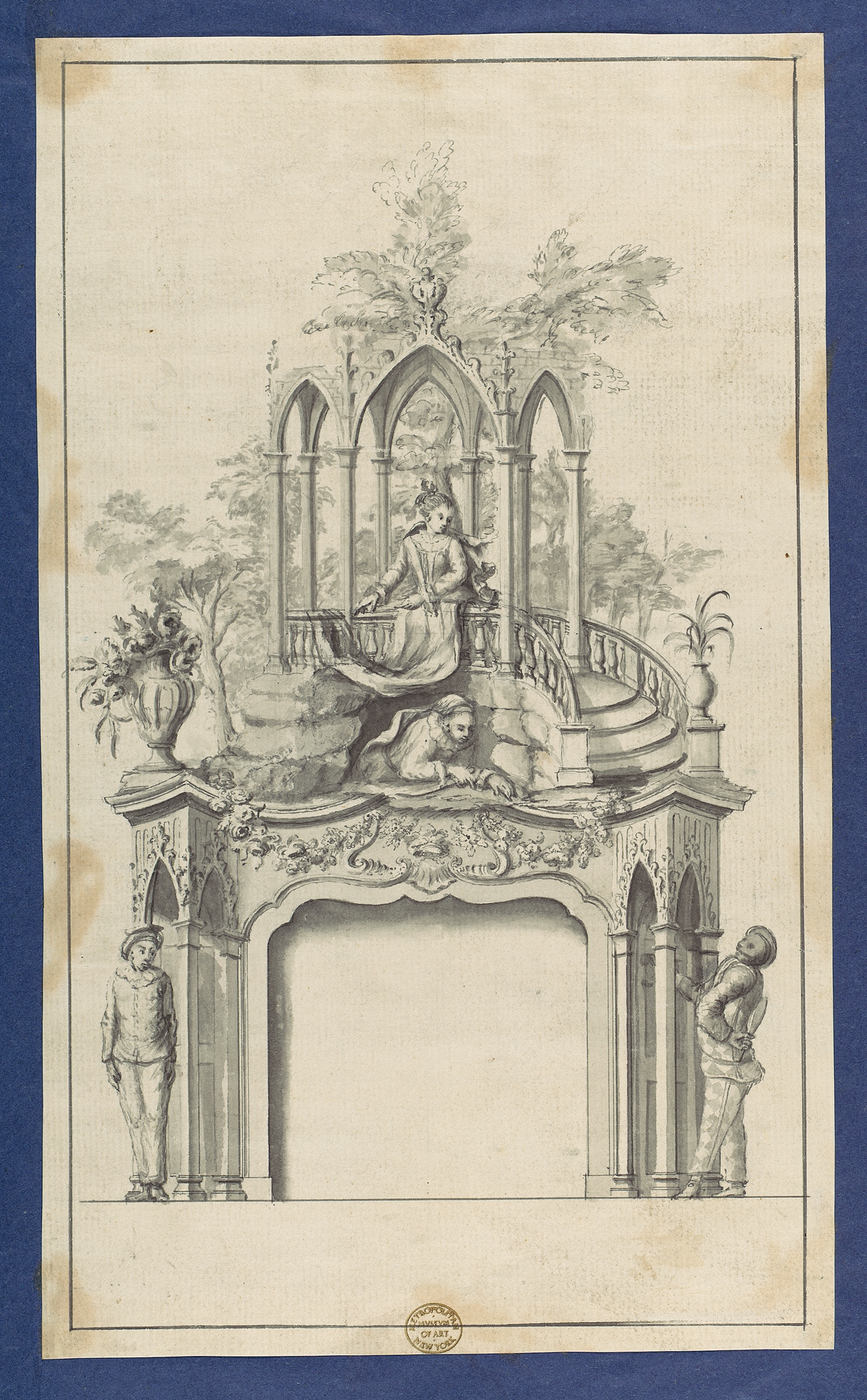
Thomas Chippendale (1718-79), design for a Gothick chimneypiece in Chippendale drawings, vol. I, c.1760-70, pen-&-ink, wash, 29.1 x 17.5 cm., Metropolitan Museum, New York
‘Design for a Gothick chimneypiece with Commedia dell’Arte figures. Not published in Thomas Chippendale’s Gentleman and Cabinet Maker’s Director.’

Thomas Johnson (1723-99), design for a chinoiserie girandole, c.1755, pen-&-ink, 19 x 9.5 cm., Lowell Libson & Jonny Yarker Ltd
‘This drawing shows an especially fantastical Rococo design for a girandole, a piece of furniture with which Johnson was closely associated.
On his arrival in London in 1755, Johnson launched his career by carving a girandole ‘in a taste never before thought on; the principle of it was a ruinated building, with cattle, &c…. this taste being so well received, I immediately published a small book of designs for girandoles’ [Jacob Simon, ‘Thomas Johnson’s ‘The Life of the Author”, Furniture History, 2003, vol. 39, p. 51].Several books of furniture and ornament designs appeared in the 1750s by Matthias Lock, Thomas Chippendale, William Ince and John Mayhew. Johnson’s books were distinguished by his inclusion of sixty mirror and girandole designs, double the number by Chippendale or Ince and Mayhew.’

Robert Adam (1728-92), design for the chimneypiece in the dining room, Syon House, for the 1st Duke of Northumberland, 1762, pencil, pen-&-ink, wash, 47.1 x 31.4 cm., Sir John Soane’s Museum
Inscribed,
‘Chimney Piece for the Dining room at Sion The P*** Relief 4.6’
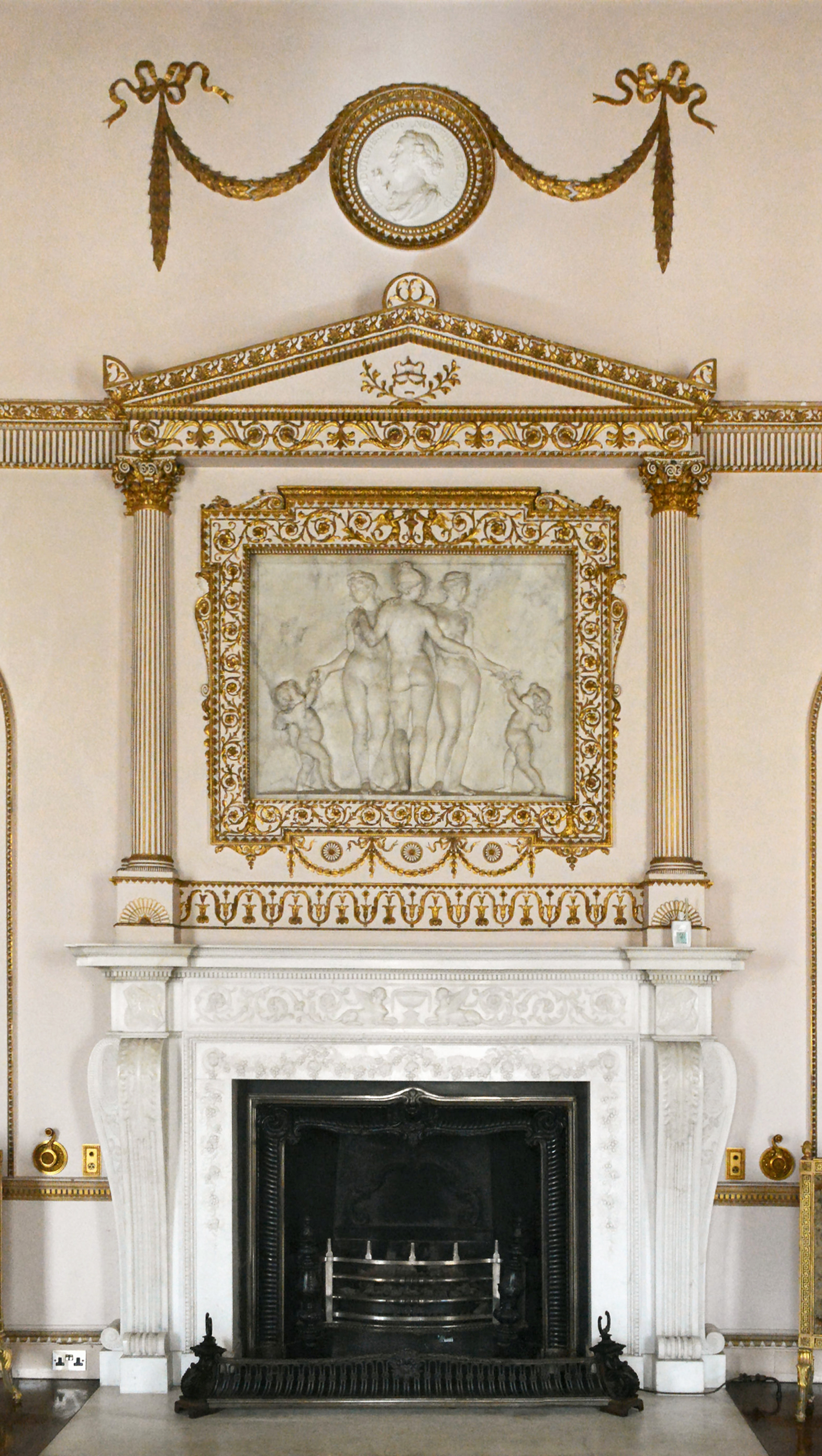
The chimneypiece in the Dining-room of Syon House today, with marble relief of The three Graces by Luc-François Breton (1731-1800)
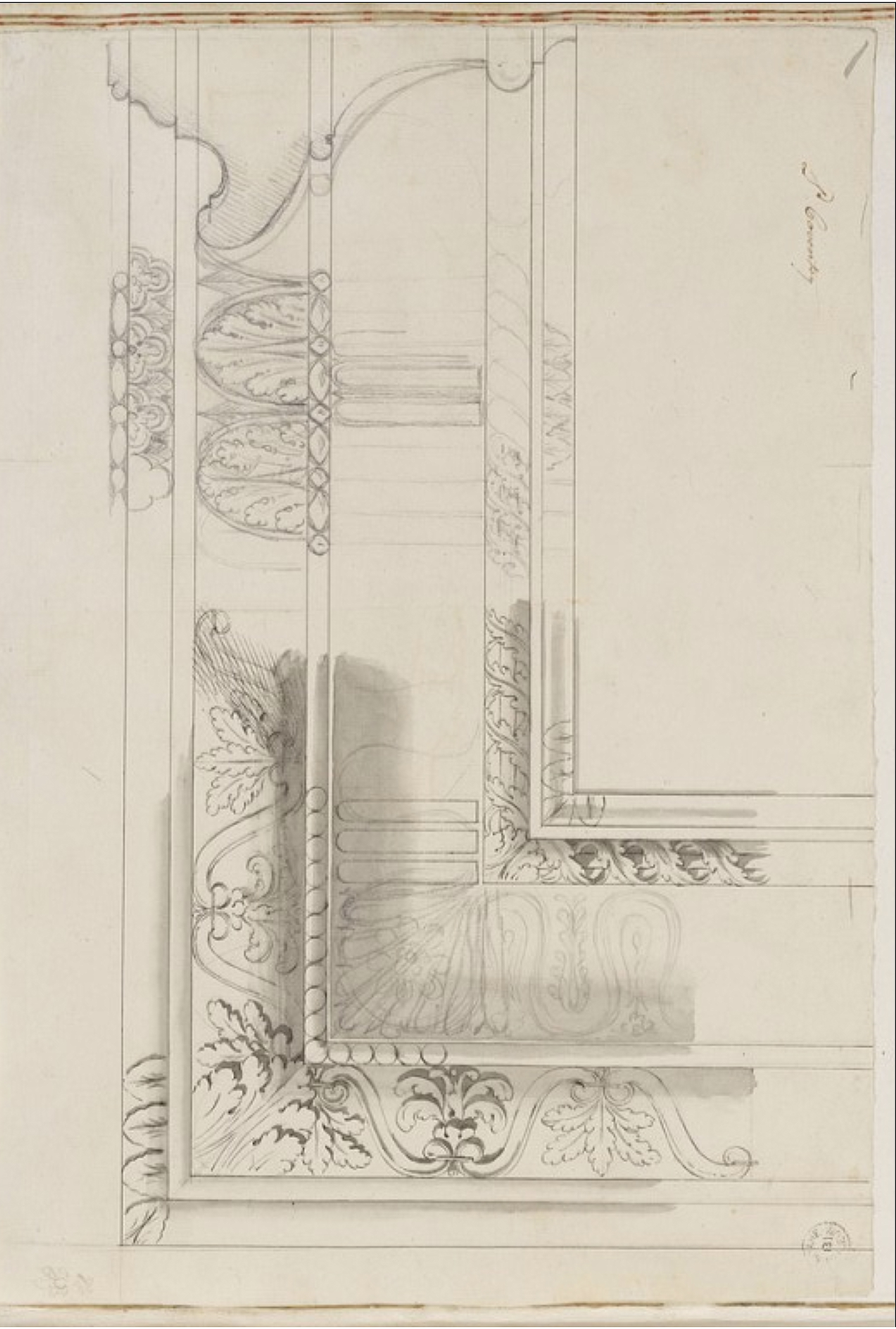
Robert Adam (1728-92), design with elevation and profile for a picture frame, with different choices of ornament on the back edge, top edge and concave frieze, for the 6th Earl of Coventry, for Croome Court or 29 Piccadilly, c.1764-70, pencil, pen-&-ink, wash, 25 x 35.7 cm., Sir John Soane’s Museum
Inscribed, ‘Ld Coventry’
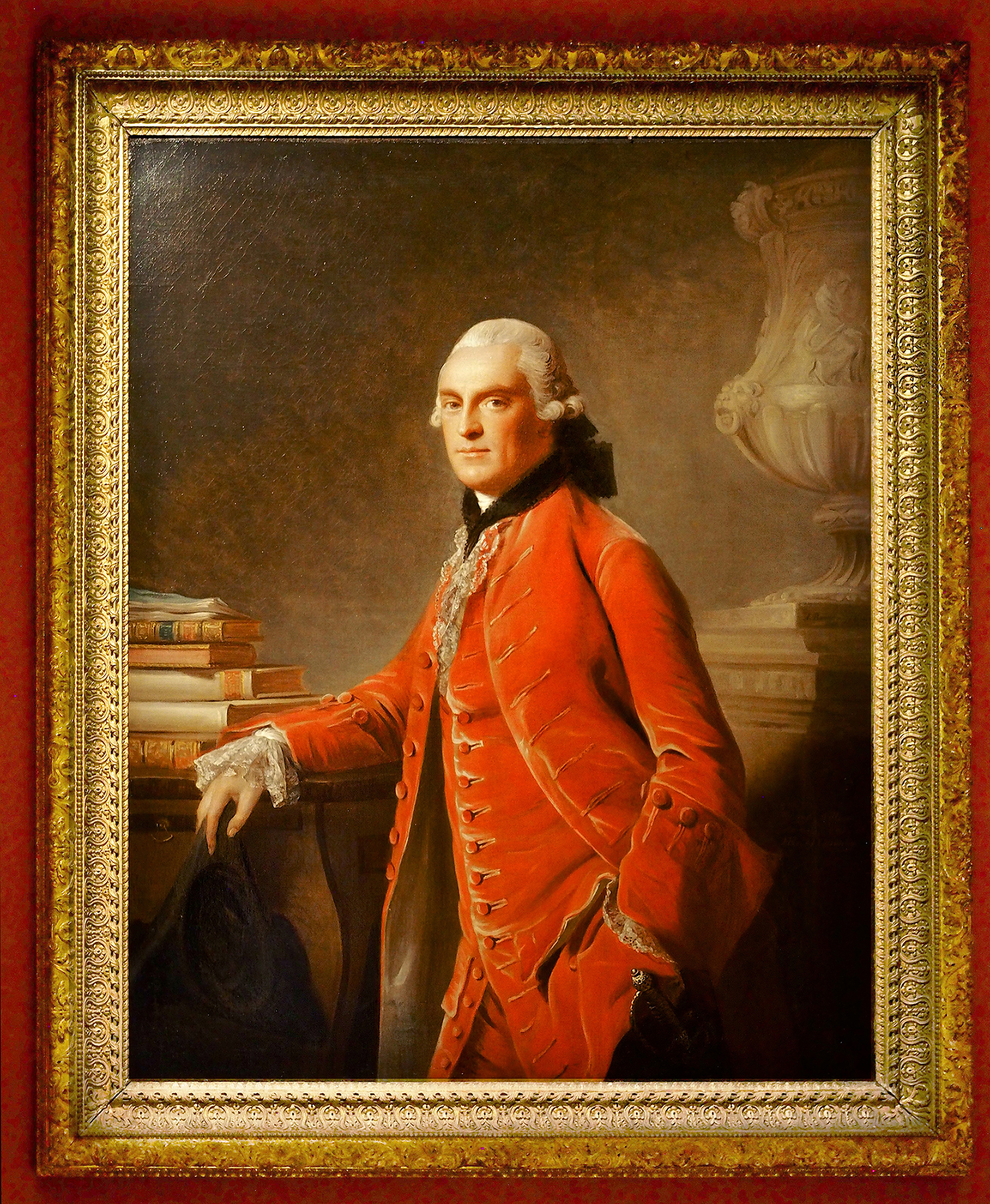
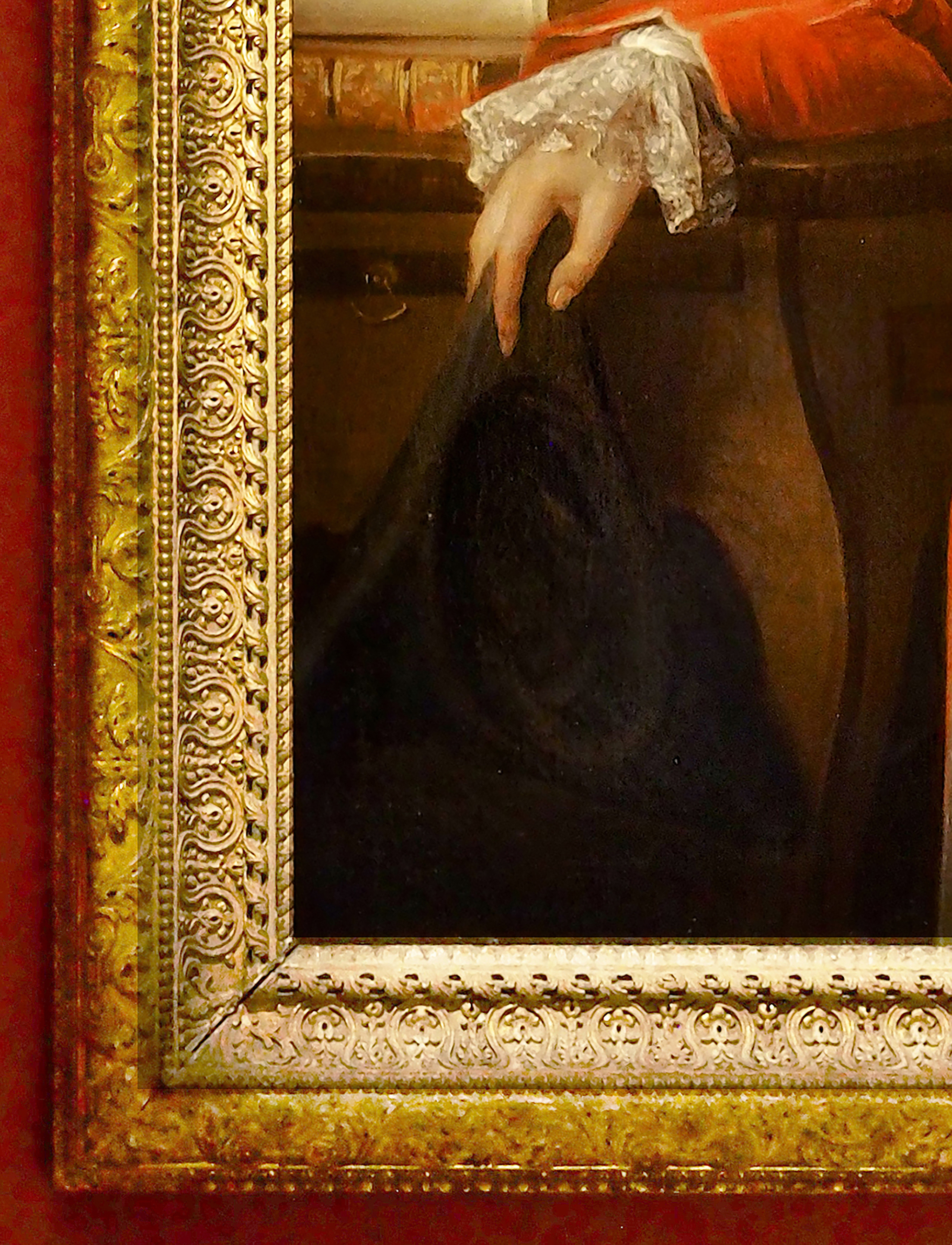
Allan Ramsay (1713-84), George William Coventry, 6th Earl of Coventry, 1764, o/c, 127 x 101.6 cm., and detail, Croome Park, Worcestershire
‘It is worth drawing attention to the magnificent early NeoClassical frame on Ramsay’s portrait of the 6th Earl of Coventry, painted in 1764 at a cost of fifty guineas. This was designed by Robert Adam and made by Sefferin Alken, the leading carver working for the Adam brothers. It was probably intended to hang over the Library chimneypiece at Lord Coventry’s Worcestershire house, Croome Court, where Robert Adam had assumed responsibility for the interior decoration in 1760. The Library has since been dismantled and the bookcases, with carving by Alken, set up in the Victoria and Albert Museum, but old photographs show the portrait hanging in this room. Robert and James Adam billed Lord Coventry 3 guineas under the date June 1764 for the ‘Design of a picture frame & part at large’, while Alken charged the very large sum of £32. 10s for a frame of the appropriate size and description on 16th June 1764, ‘A frame to Picture 6 Members very Richly Carved and finish’d in Whiteing for Burnish Gold. To 18ft at £1. 5. 0 pr. ft £22. 10s. 0d. Gilders Bill for D.o £10. 0s. 0d’.’
From Jacob Simon, ‘Allan Ramsay & picture frames’, The Burlington Magazine, vol.136, no 1096, July 1994, p.450-51.

Robert (1728-92) and James (1732-94) Adam, a finished drawing for an oval looking-glass frame with two candle branches, 1765, pen, watercolour, 44 x 29.1 cm., Sir John Soane’s Museum
Inscribed, in William Adam’s hand,
‘Glass frame for the Duke of Manchester at Kimbolton Castle’

Robert (1728-92) and James (1732-94) Adam, design for an oval looking-glass frame for Lady Betty Macfarlane, 1765, pencil, pen-&-ink,wash, 42.2 x 24.1 cm., Sir John Soane’s Museum
Inscribed, in William Adam’s hand,
‘Glass frame for Lady Betty Macfarlane’
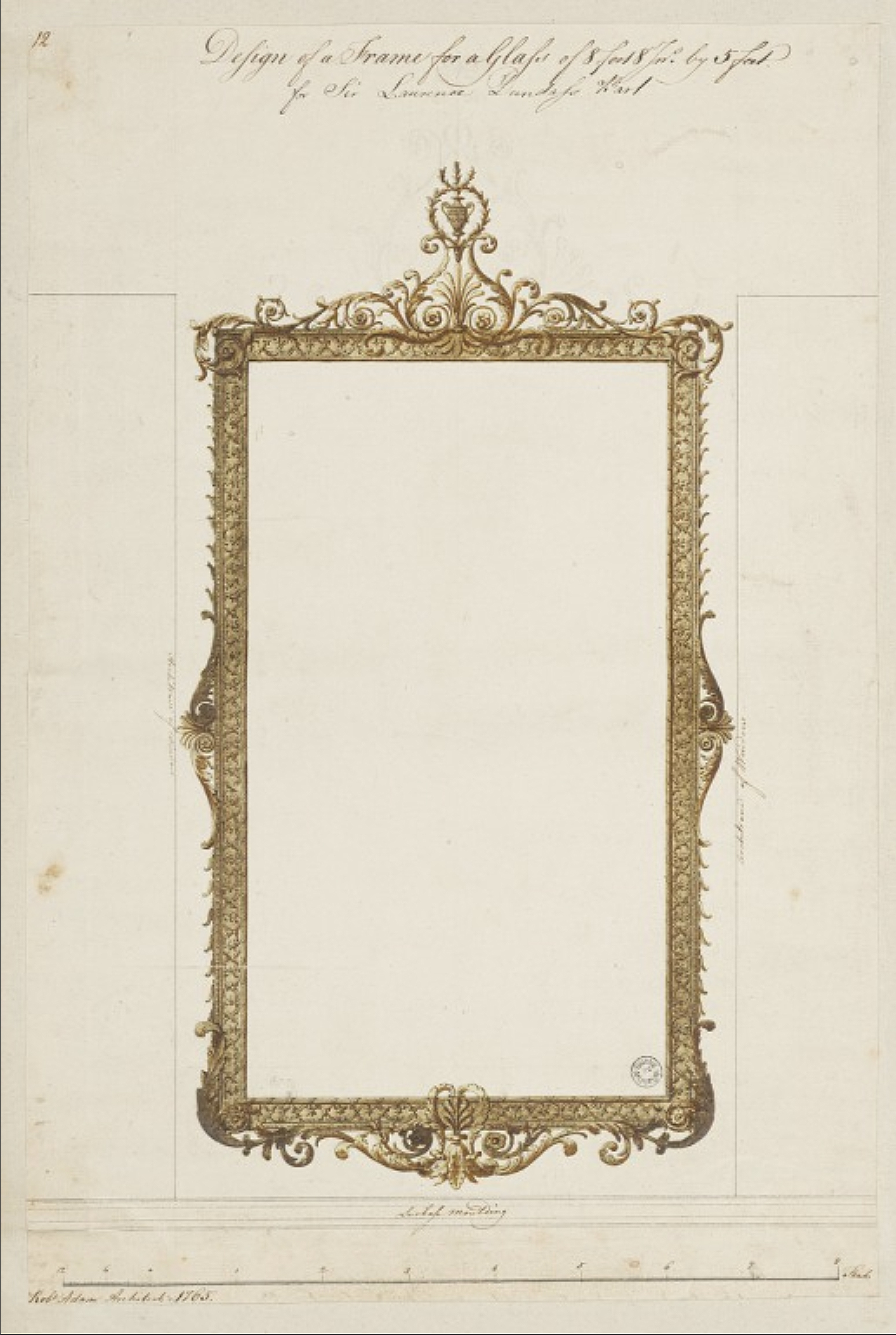
Robert (1728-92) and James (1732-94) Adam, design for a pier glass frame for Sir Lawrence Dundas, 19 Arlington Street, 1765, pencil, pen-&-ink, watercolour, 56 x 37.3 cm., Sir John Soane’s Museum
Inscribed,
‘Design of a Frame for a Glass of 8 feet 8 ins by 5 feet for Sir Laurence Dundass Bart Surbase Moulding’
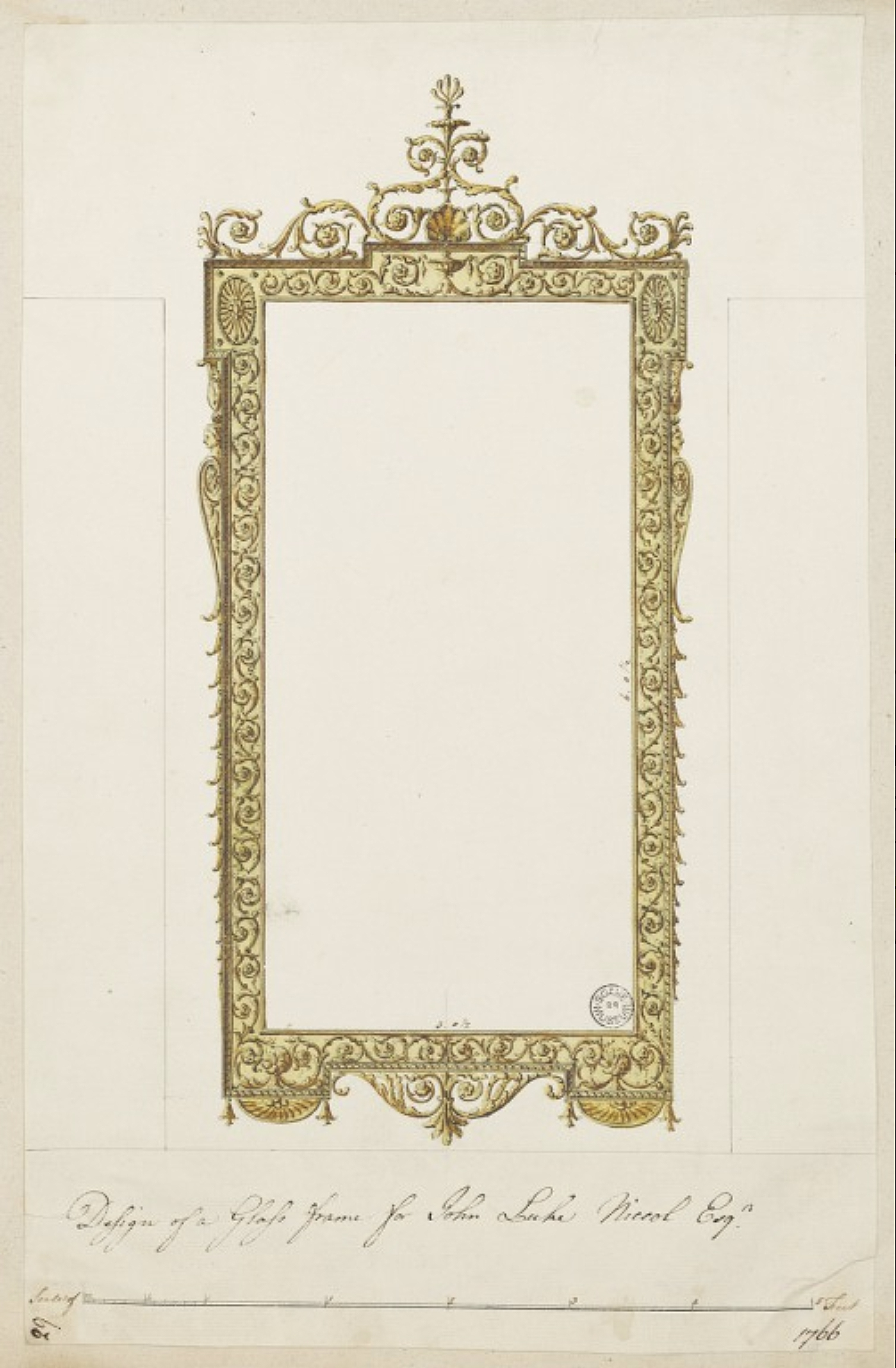
Robert (1728-92) and James (1732-94) Adam, finished drawing for a pier glass frame for J.L. Nichol, Esq., 1766, pencil, pen-&-ink, watercolour, 41.6 x 26.8 cm., Sir John Soane’s Museum
Inscribed,
‘Design of a Glass frame for John Luke Niccol Esqr’

Robert Adam (1728-92), preliminary sketch with elevation and profile for a carved frame for the 1st Earl of Mansfield, Kenwood, London, c.1767-83, pencil, pen-&-ink, 26.9 x 17.6 cm., Sir John Soane’s Museum
Inscribed with the dimensions of the glass – 5 feet [60 ins] x 48 ins.
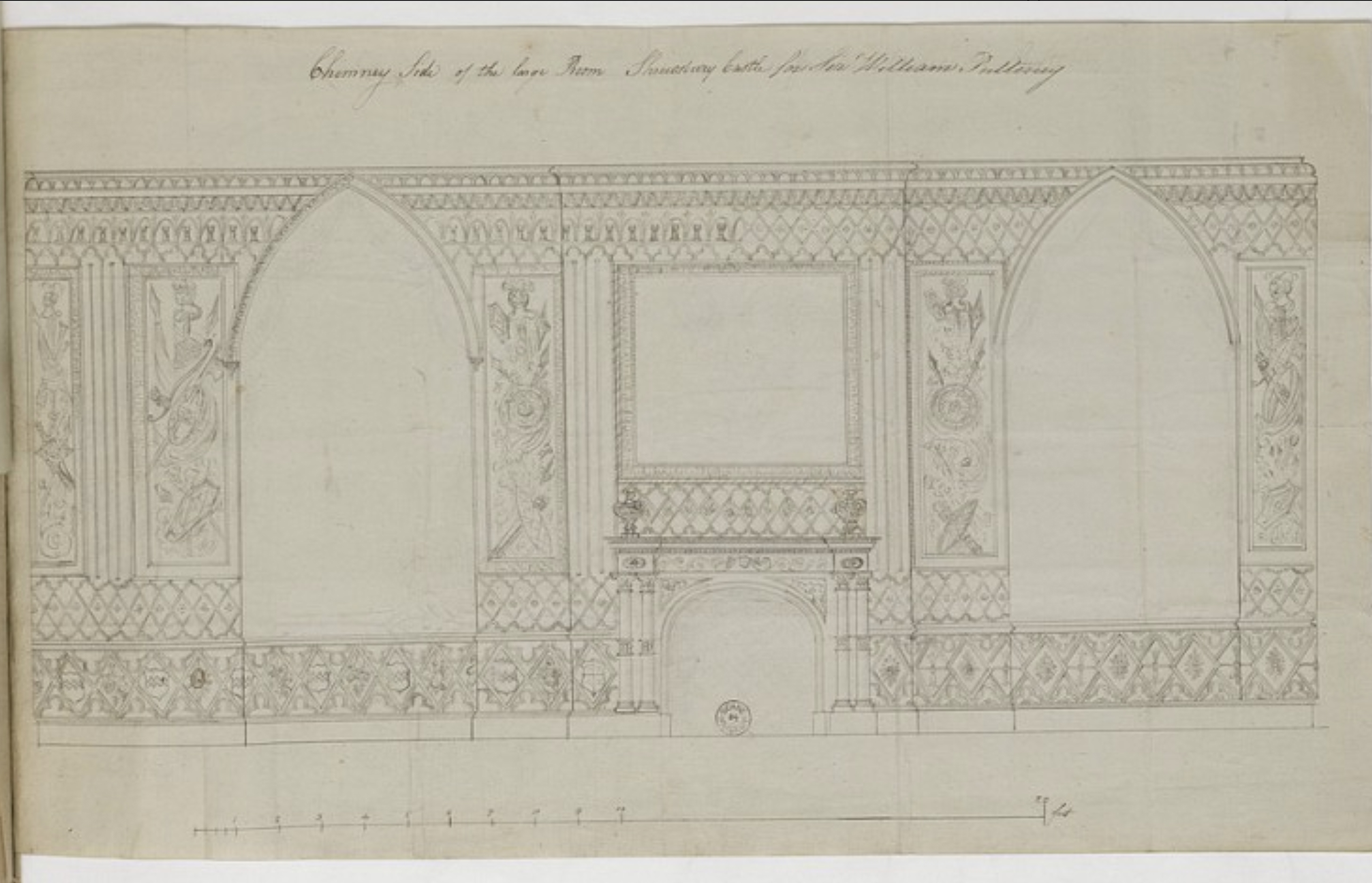
Robert Adam (1728-92), design for the elevation of a wall in the Great Room, Shrewsbury Castle, for Sir Willam Pulteney, 1768-87, pencil, 32.6 x 54.2 cm., Sir John Soane’s Museum
Inscribed,
‘Chimney Side of the large room Shrewsbury Castle for Sir William Pulteney’
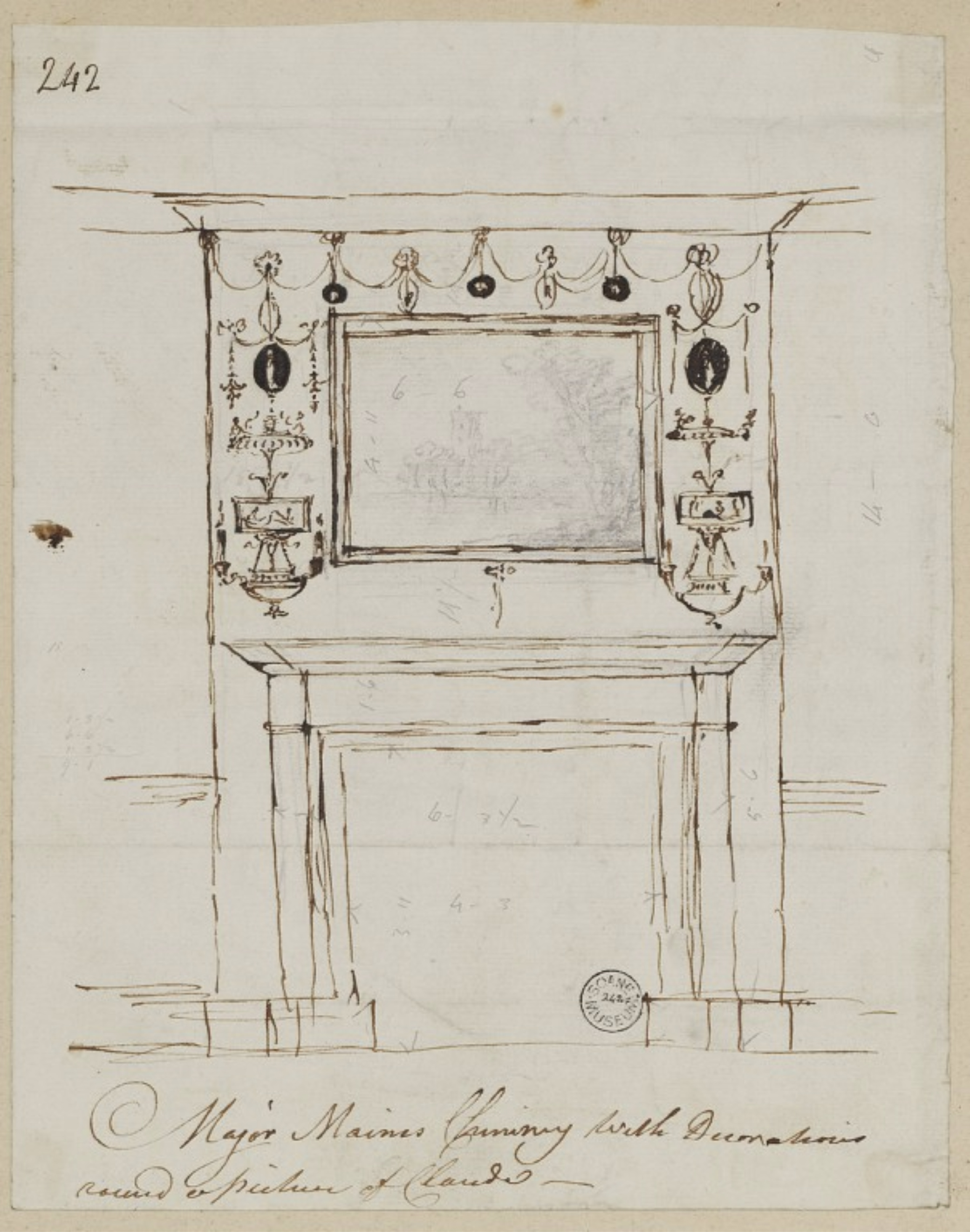
Robert Adam (1728-92), preliminary sketch for a chimneypiece and overmantel frame for a painting, for Col. Sir William Mayne, Bt., c.1771, pencil, pen-&-ink, 26.1 x 20.7 cm., Sir John Soane’s Museum
Inscribed,
‘Major Maines Chimney With Decorations round a picture of Claude’
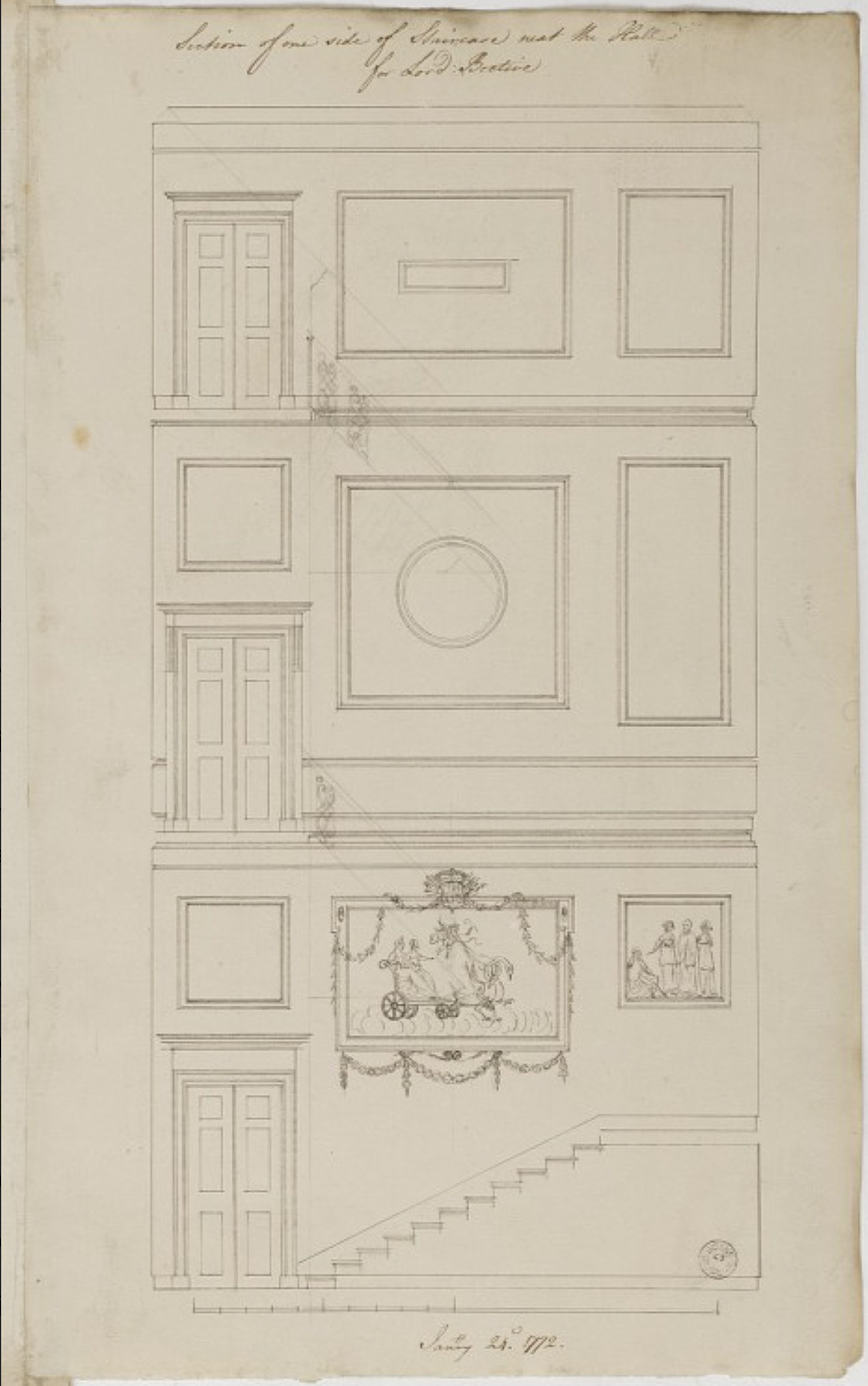
Robert (1728-92) and James (1732-94) Adam, design for a stairwell elevation for Thomas Taylor, 1st Earl of Bective, Headfort House, County Meath, 1772, pencil, pen-&-ink, 48.8 x 27.9 cm., Sir John Soane’s Museum
Inscribed,
‘Section of one side of Staircase next the Hall for Lord Bective’

Robert Adam (1728-92), design for mouldings on the staircase, Headfort House, County Meath, 1772, pencil, pen-&-ink, 53.2 x 32.7 cm., Yale Center for British Art
Inscribed,
Moulding for the Center Pannels in the upper part of the Staircase
Moulding for side Pannells & Pannells over Doors & Windows
Mouldings for the Center Pannells in the one pair Story of Staircase
Moulding for large Pannell in bottom part of Staircase
For the Earl of Bective’

Robert Adam (1728-92), George Richardson (c1738-c.1813), finished elevation of the chimney side of the eating parlour, Headfort House,1771, pen-&-ink, wash, 36.8 x 65.1 cm., Yale Center for British Art
Inscribed,
‘Design for finishing the Chimney Side of the Eating Parlor. For the Right Hon.ble The Earl of Bective’

Robert (1728-92) and James (1732-94) Adam, design for a wall elevation for the eating parlour (later the ballroom) for the 1st Earl of Bective, Headfort House, County Meath, 1775, pencil, pen-&-ink, 49.3 x 59.9 cm., Sir John Soane’s Museum
Inscribed,
‘Design for finishing the Chimney side of the Eating Parlor, for The Right Honble. The Earl of Bective dark green Light green Ruin Picture Picture Ruin’

One of the chimneypieces in the eating parlour, Headfort House, County Meath, from World Monuments Fund

Robert Adam (1728-92), preliminary sketch for a looking-glass frame with glazed panelled frame & caryatides over a console table for 6th Duke of Bolton, the drawing-room of Bolton House, Southampton Row, 1772, pencil, 21.1 x 18 cm., Sir John Soane’s Museum

Robert Adam (1728-92), design, with elevation and profile, for a frame for Lord Edward Stanley’s house, 23 Grosvenor Square, 1774, pencil, pen-&-ink, 22.5 x 20.2 cm., Sir John Soane’s Museum
Inscribed,
‘Frame for Mrs Angelica’s Two pictures over the doors in the first Drawing room at Lord Stanleys. Gros Sqr’.
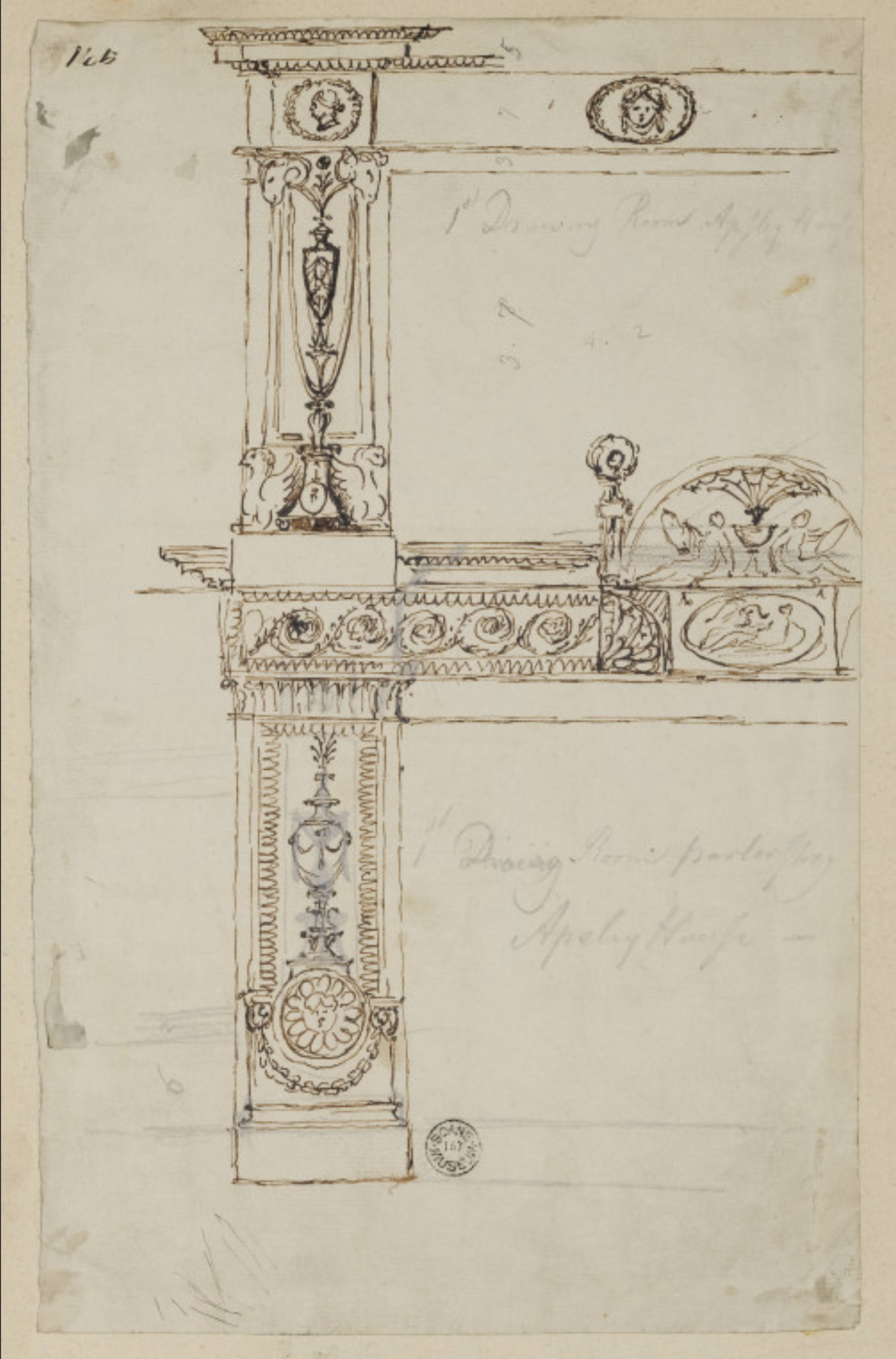
Robert Adam Adam (1728-92), preliminary design for chimneypiece and overmantel glass for the Drawing room, Apsley House, c.1774, pencil, pen-&-ink, 32.1 x 20.4 cm., Sir John Soane’s Museum
Inscribed,
‘1st Drawing Room Apsley House
1st Drawing Room parlor story / Apsley House’
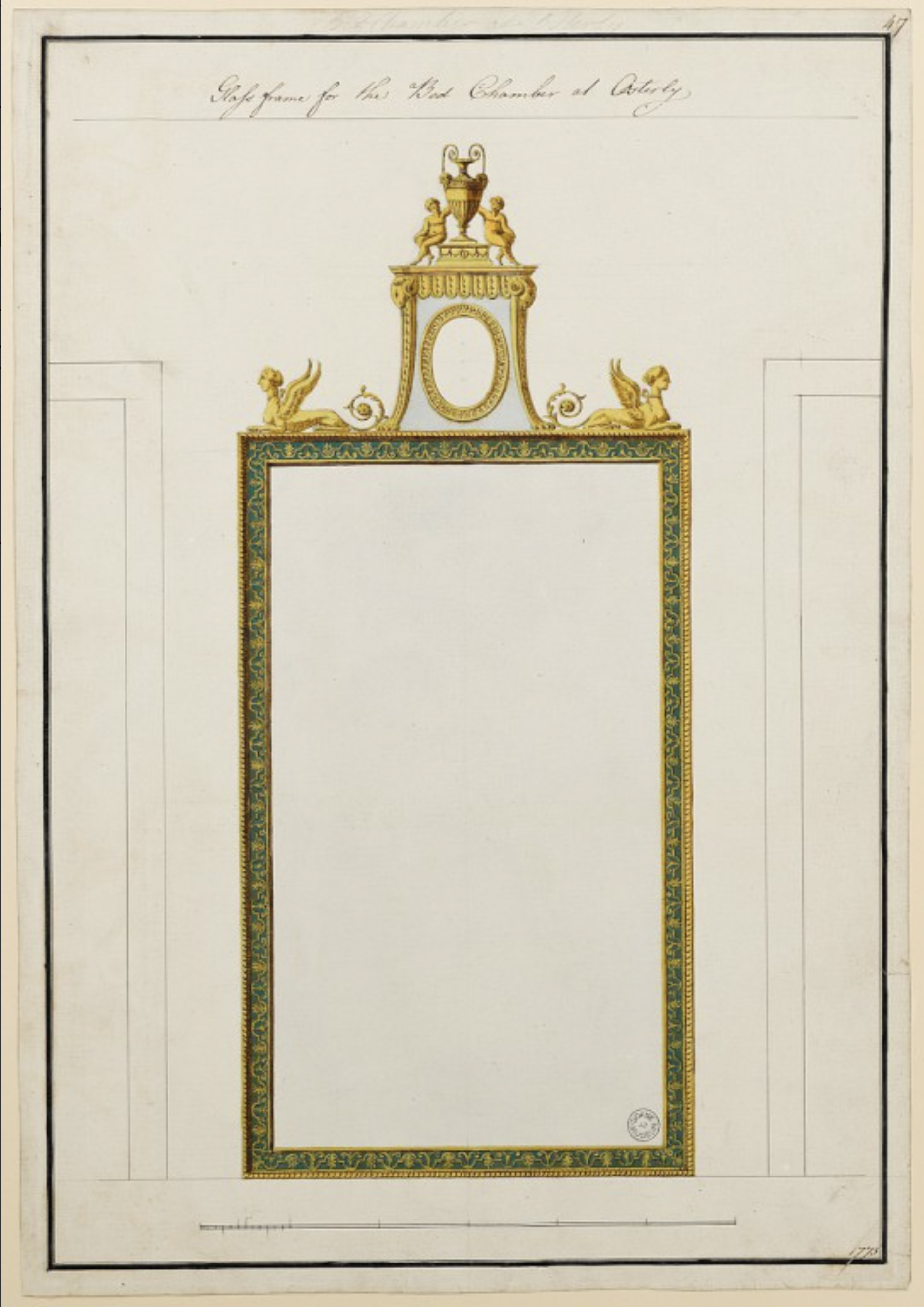
Robert Adam (1728-92), design for a pier glass frame for the State Bedchamber, Osterley Park, 1775, pencil, pen-&-ink, watercolour, 54.1 x 47.5 cm., Sir John Soane’s Museum
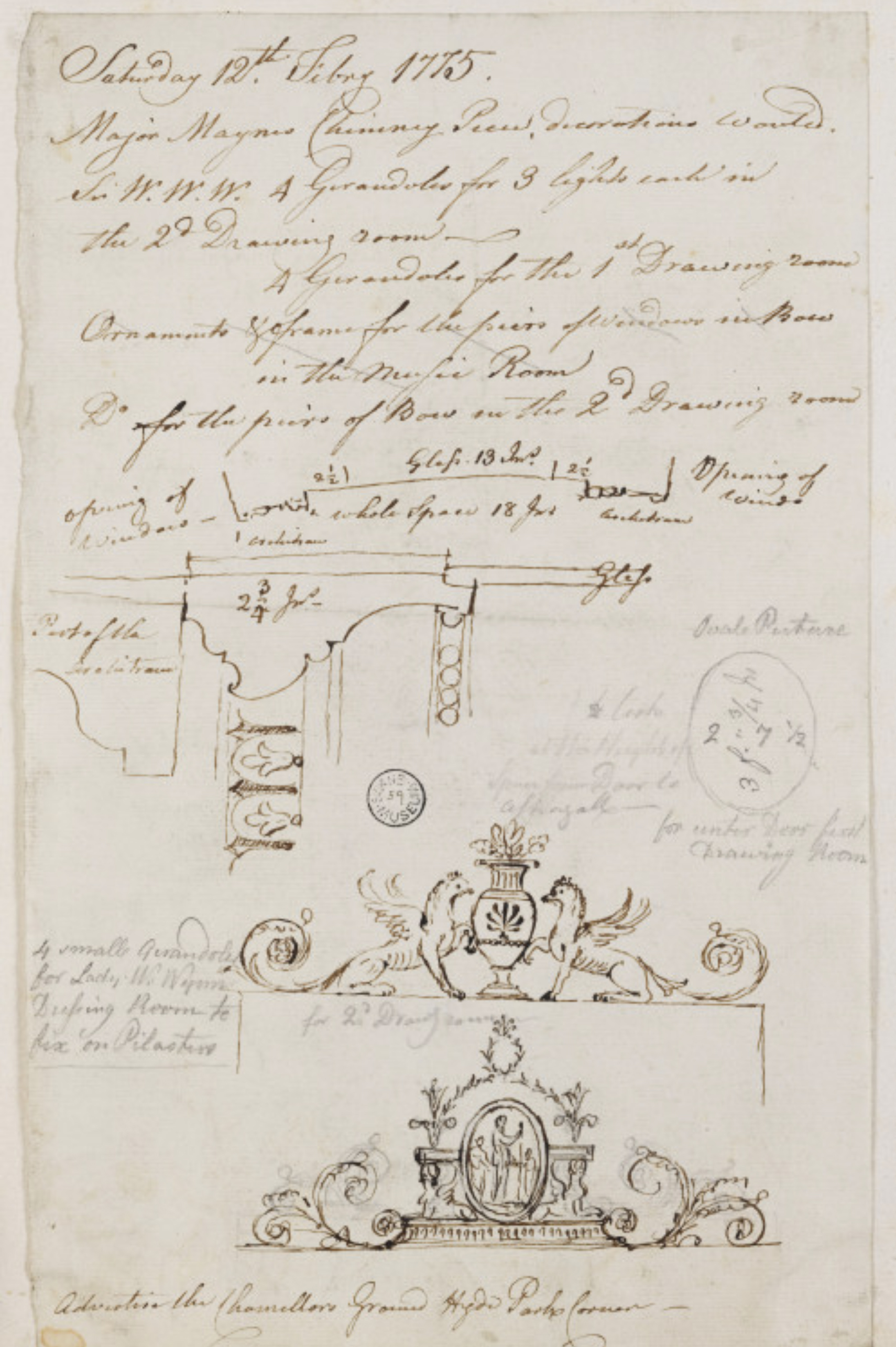
Robert Adam (1728-92), preliminary designs for girandoles and looking-glass frames with ornamented profiles and crest motifs, for Sir Watkin Williams-Wynn, 20 St James’s Square, 1775, pencil, pen-&-ink, 31.8 x 20 cm., Sir John Soane’s Museum
Inscribed,
‘Major Maynes Chimney Piece decorations would. / Sir W. W. W. 4 Girandoles for 3 lights each in / the 2d Drawing room – / 4 Girandoles for the 1st Drawing room / Ornaments & frame for the piers of windows in Bow / in the Music Room / Do for the piers of Bow in the 2d Drawing room
opening of windows- Glass. 13. Ins. / Opening of winds / 1 Architrave / whole Space 18 feet / Architrave
Part of the Architrave / Glass
Oval Picture / Look / at the Heights of / Space from Door to [_ _ _ _] all- / for center Door first / Drawing Room
4 Small Girandoles for Lady. W. Wynn Dressing Room to fix on Pilasters
for 2d Drawg Room-
Advertise the Chancellors Ground Hyde Park Corner-‘
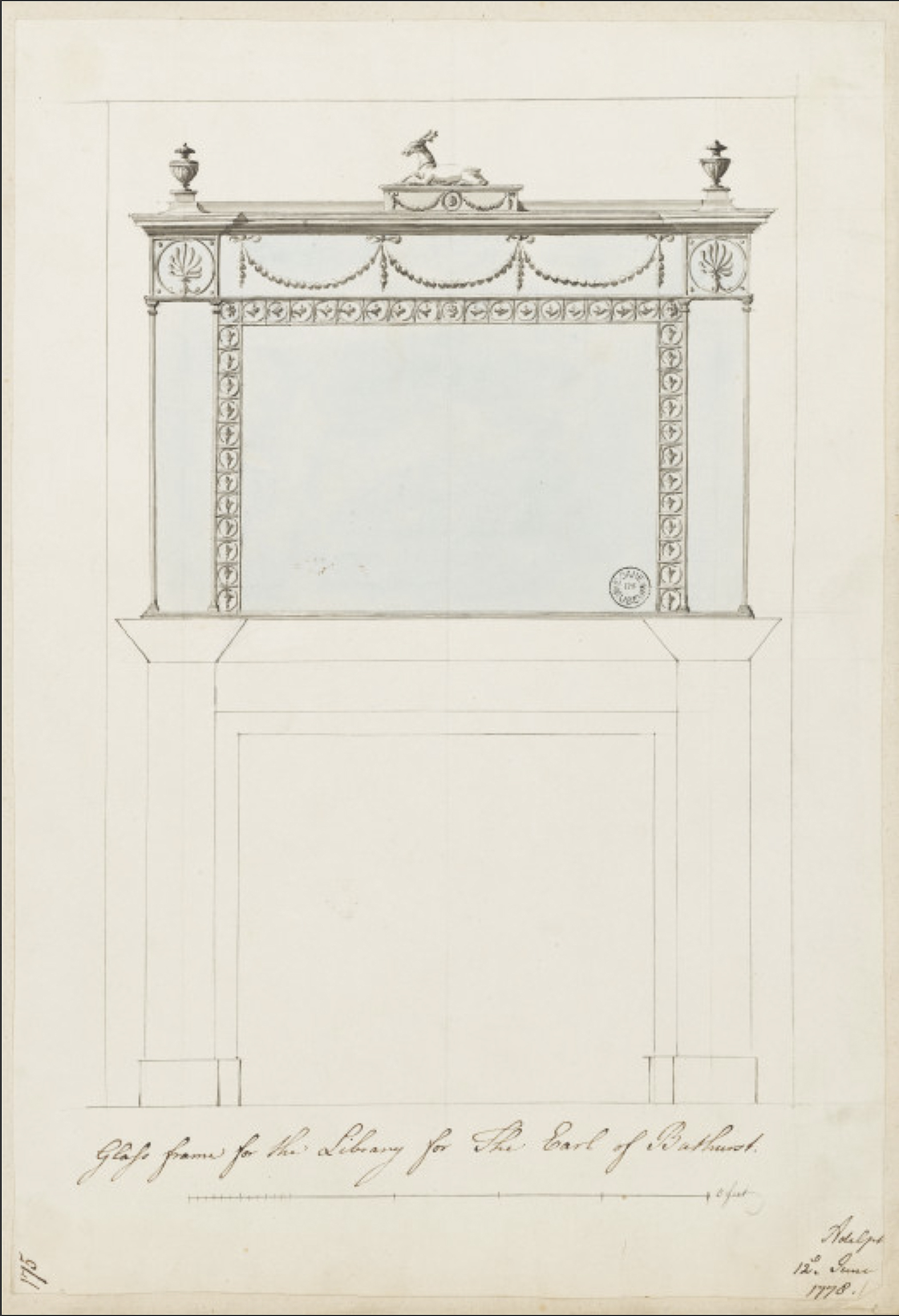
Robert (1728-92) and James (1732-94) Adam, design for an overmantel looking-glass with glazed panelled frame and heraldic stag at crest for Lord Bathurst, Apsley House, 1778, pencil, pen-&-ink, wash, 42.7 x 29 cm., Sir John Soane’s Museum
Inscribed,
‘Glass frame for the Library for The Earl of Bathurst’

Robert (1728-92) and James (1732-94) Adam, design for a pier glass frame & console for Sir Abraham Hume, Wormleybury, Hertfordshire, 1778, pencil, pen-&-ink, watercolour, 44.7 x 29.8 cm., Sir John Soane’s Museum
Inscribed,
‘Glass and Table frame for the Pier in the eating room at Wormleybury’

Robert (1728-92) and James (1732-94) Adam, design for a picture frame with a military trophy for Sir Abraham Hume, either for Wormleybury or 31 Hill Street, 1779, pencil, pen-&-ink, watercolour, 36.2 x 53.9 cm., Sir John Soane’s Museum
Inscribed,
‘Design of a Picture frame for Sir Abraham Hume Bart. Adelphi 20. July 1779’
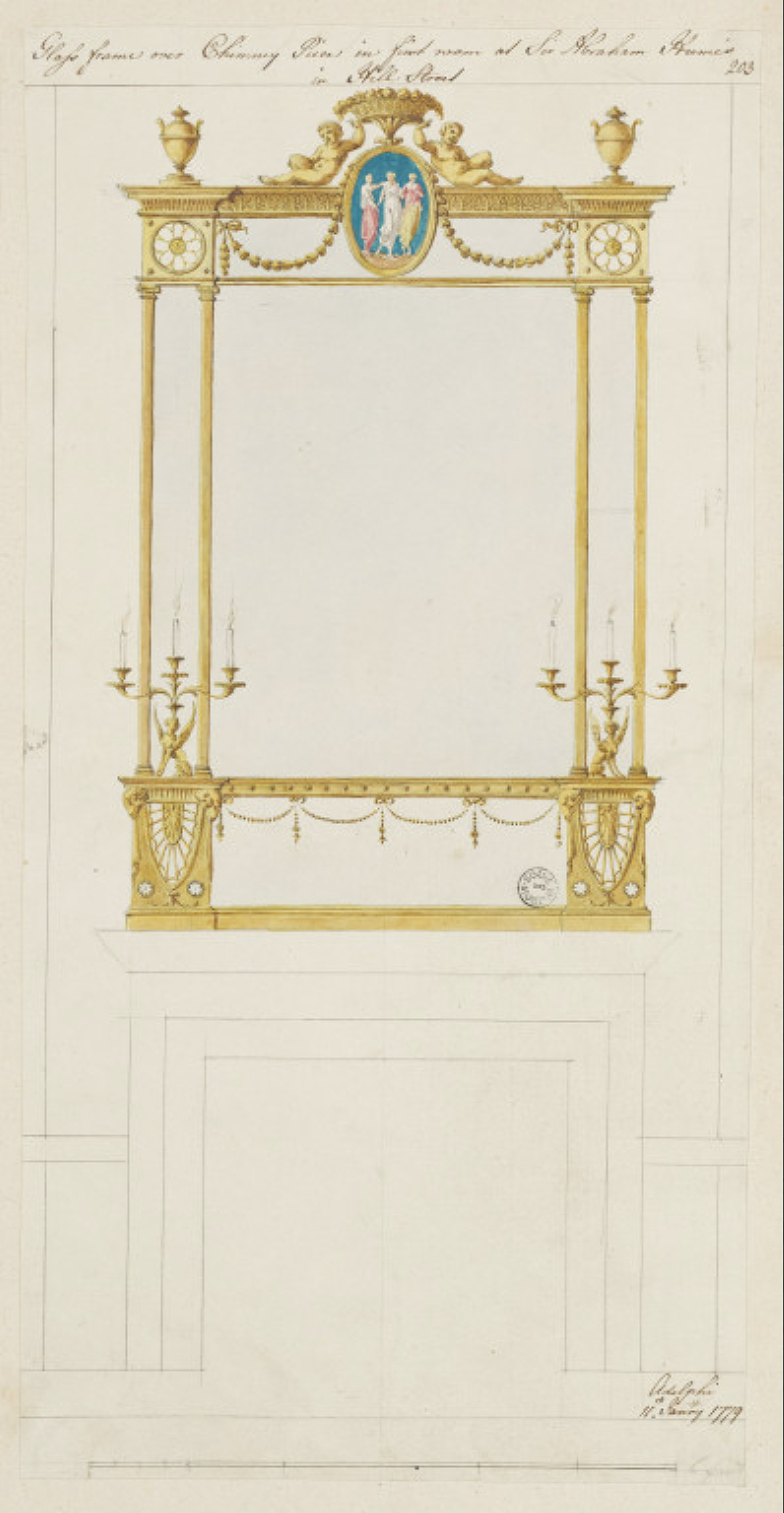
Robert (1728-92) and James (1732-94) Adam, design for an overmantel glazed frame & looking-glass for Sir Abraham Hume, 31 Hill Street, London, 1779, pencil, pen-&-ink, watercolour, 49.8 x 25.6 cm., Sir John Soane’s Museum
Inscribed,
‘Glass frame over Chimney Piece in first room at Sir Abraham Hume’s in Hill Street’
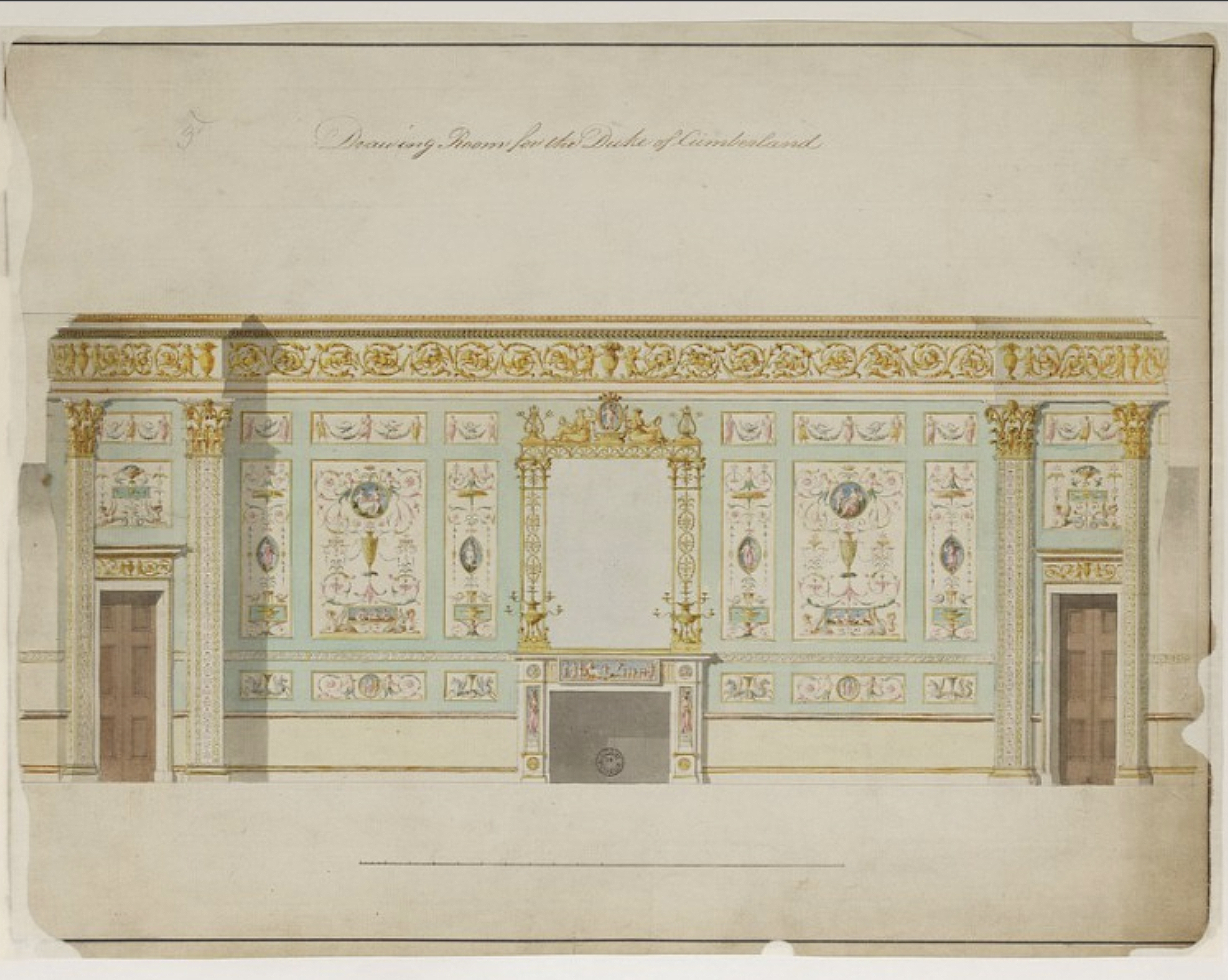
Robert (1728-92) and James (1732-94) Adam, design for the Duke of Cumberland for the wall of the third drawing-room, Cumberland House, Pall Mall, 1780-85, pen, watercolour, 46.2 x 60.7 cm., Sir John Soane’s Museum
Inscribed,
‘Drawing Room for the Duke of Cumberland’
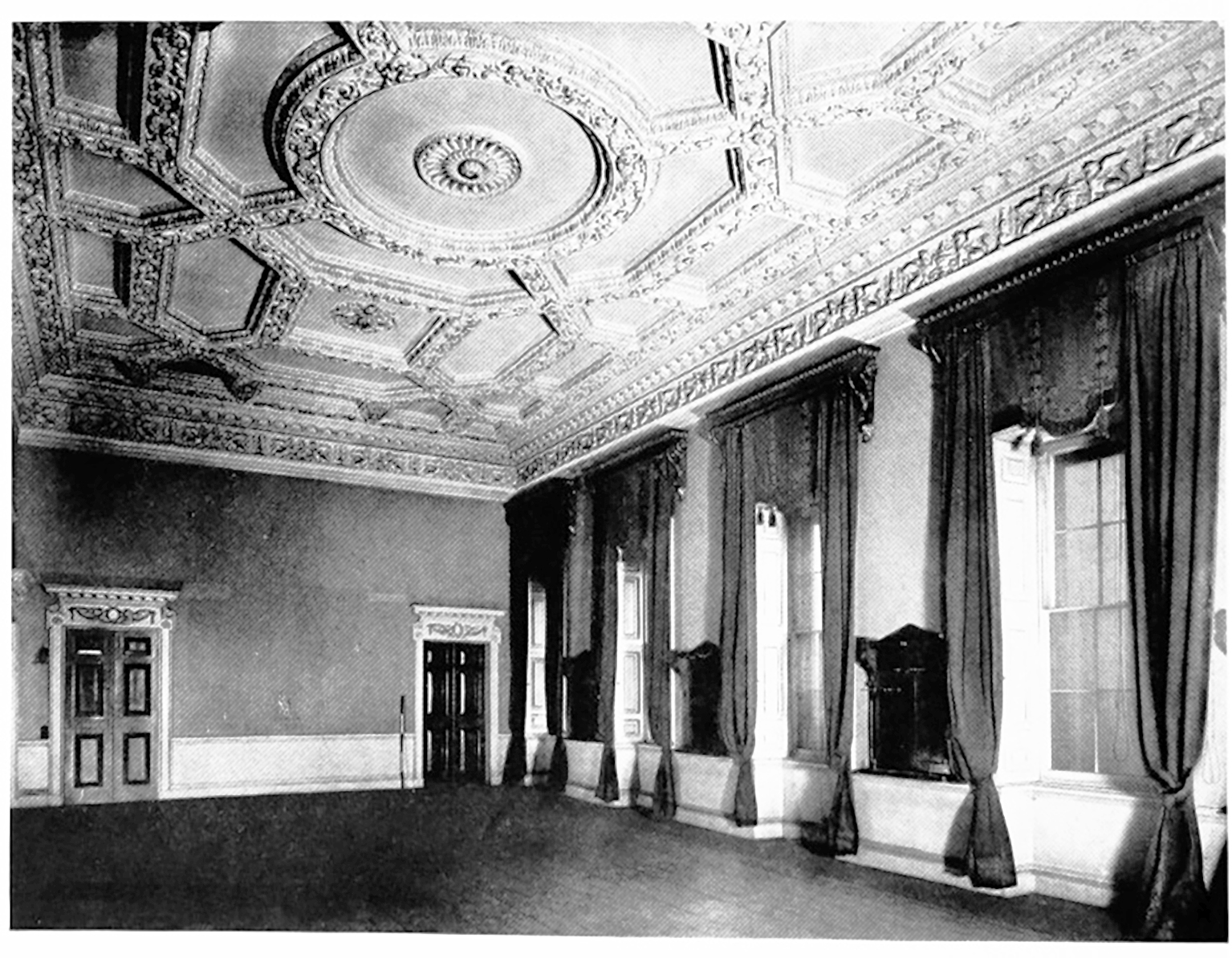
View of the third drawing-room, Cumberland House, in 1907 before its demolition. Photo: British History Online https://www.british-history.ac.uk/survey-london/vols29-30/pt1/plate-216
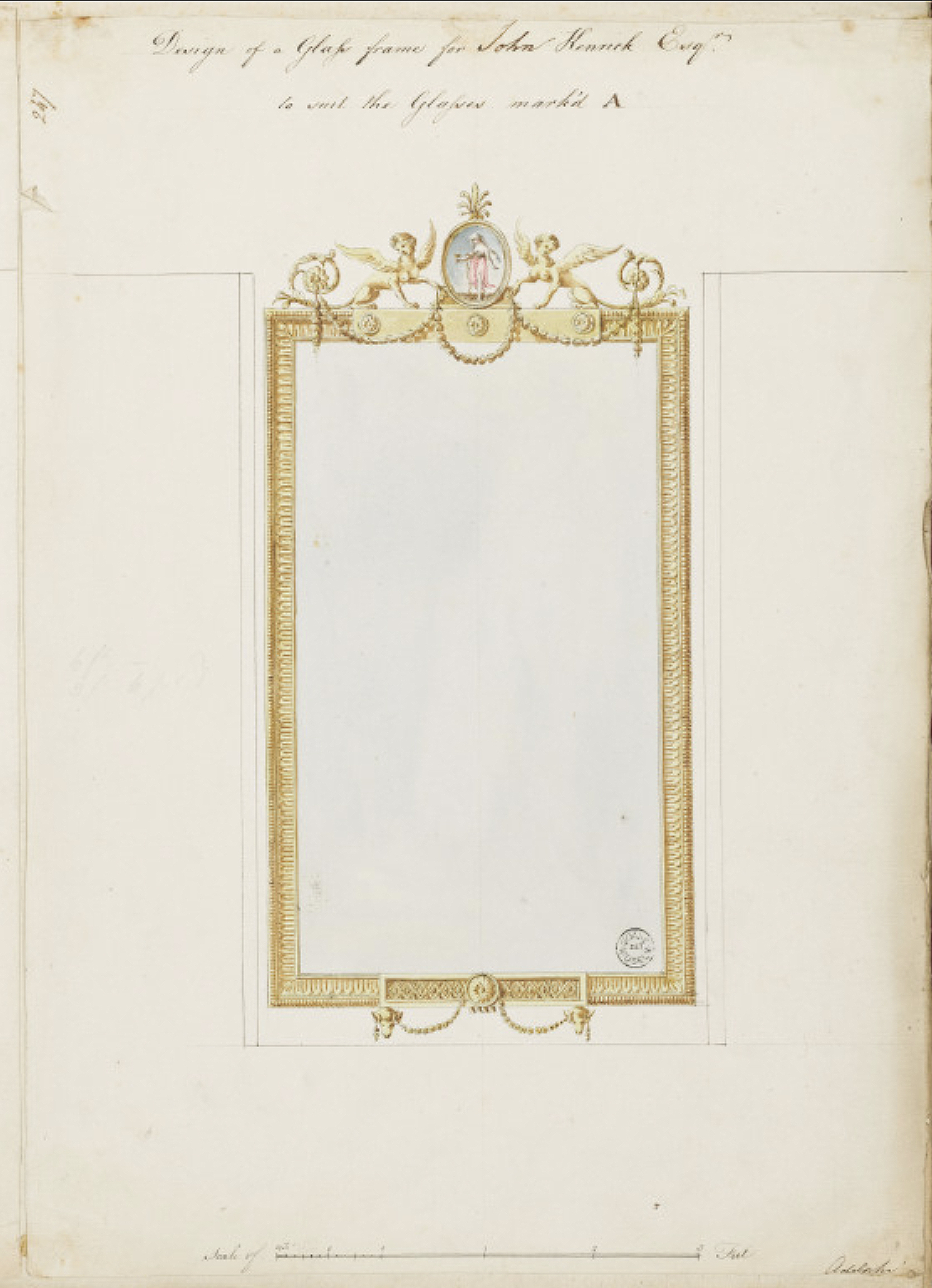
Robert (1728-92) and James (1732-94) Adam, finished drawing for a pier glass frame for John Kenrick, 1783, pencil, pen-&-ink, watercolour, 44.6 x 32.4 cm., Sir John Soane’s Museum
Inscribed,
‘Design of a Glass frame for John Kenrick Esqr. to suit the Glasses mark’d A’

Robert (1728-92) and James (1732-94) Adam, unfinished design for a tripartite looking-glass frame for the Tower of London, 1783, pencil, pen-&-ink, watercolour, 42.5 x 28.5 cm., Sir John Soane’s Museum
Inscribed,
‘Mr Weaver 241 Mr Fentham [?] Estimates – Glass £10.15- Frame 5- Painting- 1- ornament painting 5.5 – £22.0’

Robert Adam (1728-92), design of 1784 for the frame of John Singleton Copley, The death of Major Peirson, pencil, pen-&-ink, watercolour, 37.2 x 51.7 cm., Sir John Soane’s Museum
‘Elevation of a picture frame surmounted by ornamentation, with a central portrait oval surmounted by crenellations forming a mural crown, and flanked by a recumbent lion and unicorn surrounded by military trophies. There are further portrait roundels to the left and right, surmounted by a stag with a thistle, and a lion with a rose respectively, and each of the portraits is linked with festoons.’
Inscribed:
‘Design of an Ornament for the top of a picture frame for Mr Alderman Boydell/ 253’.
The scale at the bottom indicates that the frame was intended for a painting of about 12 feet (144 inches) in width, corresponding to the width of The death of Major Peirson, which had been commissioned from Copley by John Boydell in 1781, immediately after the battle in which Peirson was shot. John Boydell (1719/20-1804) was an engraver and printseller in Cheapside, London, who had huge ambitions, and rose from Alderman to become Lord Mayor of London. He wanted to publicize and enhance sales of the prints he sold, and chose to open a gallery above his shop where he could exhibit paintings by contemporary artists, which were engraved for him by James Heath.
He commissioned the frame for Copley’s painting from Robert Adam, and portraits by Gilbert Stuart of three of the people involved for the ovals mounted on the top. These show Copley in the centre, Heath the engraver, and Josiah Boydell, Boydell’s nephew and partner. As the Soane’s description implies, the decorations at the top of the frame around these ovals – the lion and unicorn, military trophies, stag with a thistle and lion with a rose – symbolize the British military exploit in which Peirson died. When the painting was unveiled at the gallery in Cheapside, the Morning Herald of 6 August 1784 reported that the frame was a ‘beautiful piece of carved-work. Three ovals are placed on the top of the frame, in the centre of which is Mr Copley’s portrait, painted by that able artist Mr Stuart. The portrait of Mr Heath, who is to engrave the subject, is on one side, and that of Mr Josiah Boydell, who is to make the drawing on the other’ (see Eileen Harris, ‘Robert Adam’s ornaments for Alderman Boydell’s picture frames’, Furniture History, vol. 26, 1990, pp. 93-98).
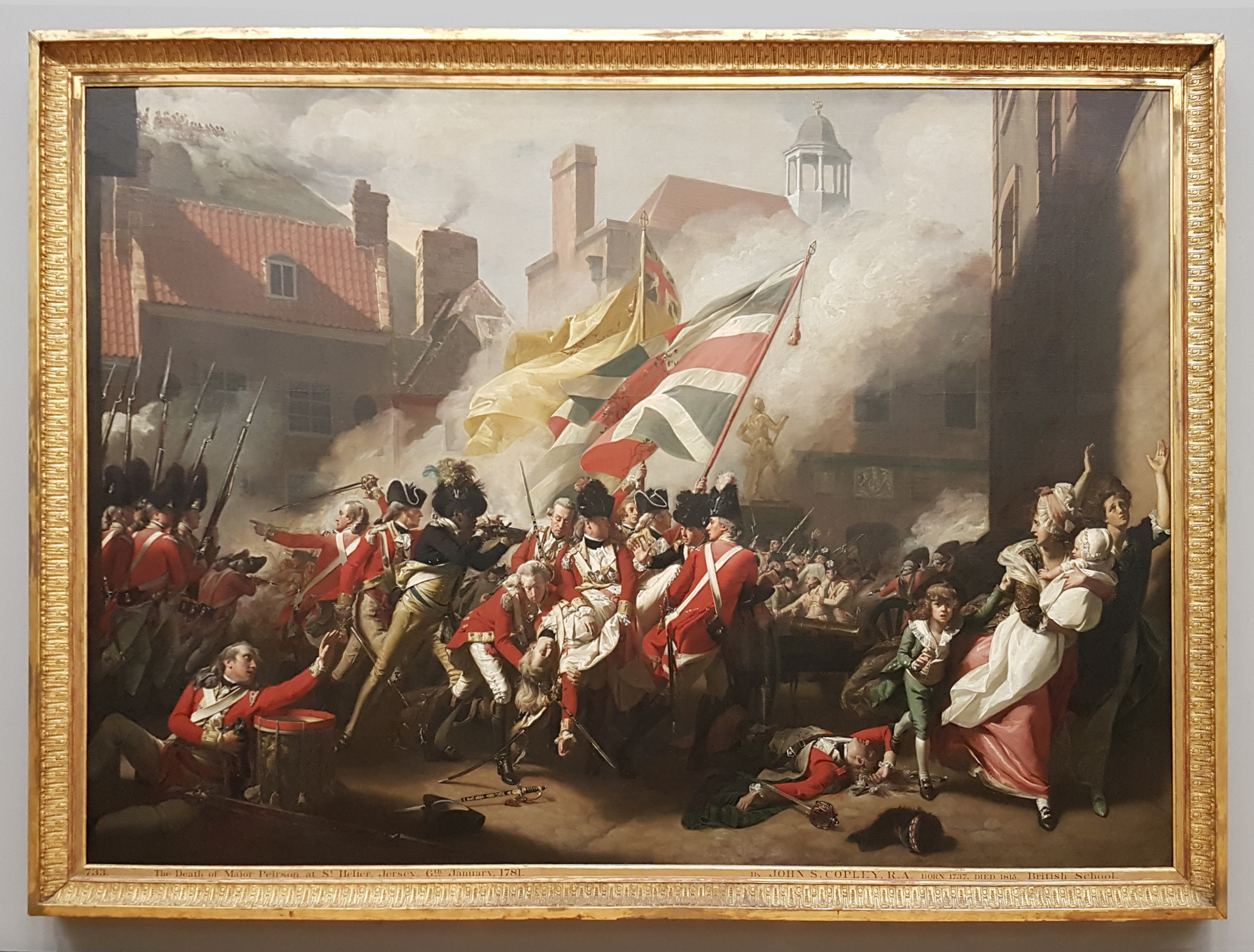
John Singleton Copley (1738-1815), The death of Major Peirson, 1782-84, o/c, 251.5 x 365.8 cm. (99 x 144 ins), Tate Britain
Copley’s painting today. It shows the French invasion of Jersey in the Channel Islands, in the course of which Peirson died and the French were defeated.
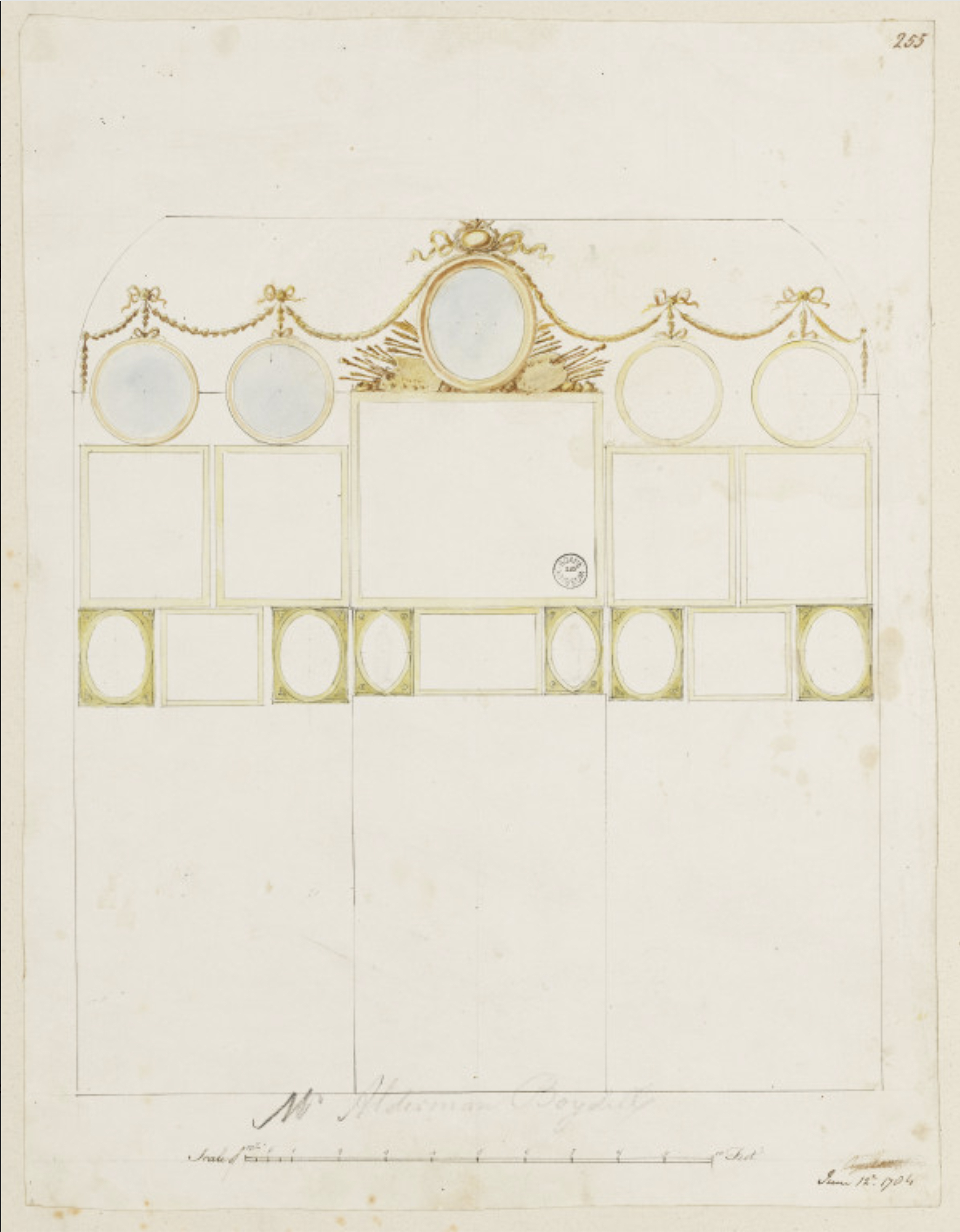
Robert (1728-92) and James (1732-94) Adam, design for picture frames for John Boydell, 1784, pencil, pen-&-ink, watercolour, 47.3 x 36.4 cm., Sir John Soane’s Museum
Inscribed, ‘Mr Alderman Boydell’
This shows the elevation of a wall in Boydell’s gallery in Cheapside, with round and oval frames at the top; these may have contained more of Gilbert Stuart’s portraits, as he painted a number of his peers for Boydell, including Benjamin West (possibly the 1781 portrait in the Tate, although that is rectangular) and Ozias Humphrey. The central oval, supported on a nest of palettes and paintbrushes, would have held the portrait of Joshua Reynolds. The rectangular frames beneath were for examples of their work, of which Boydell would have sold the prints.
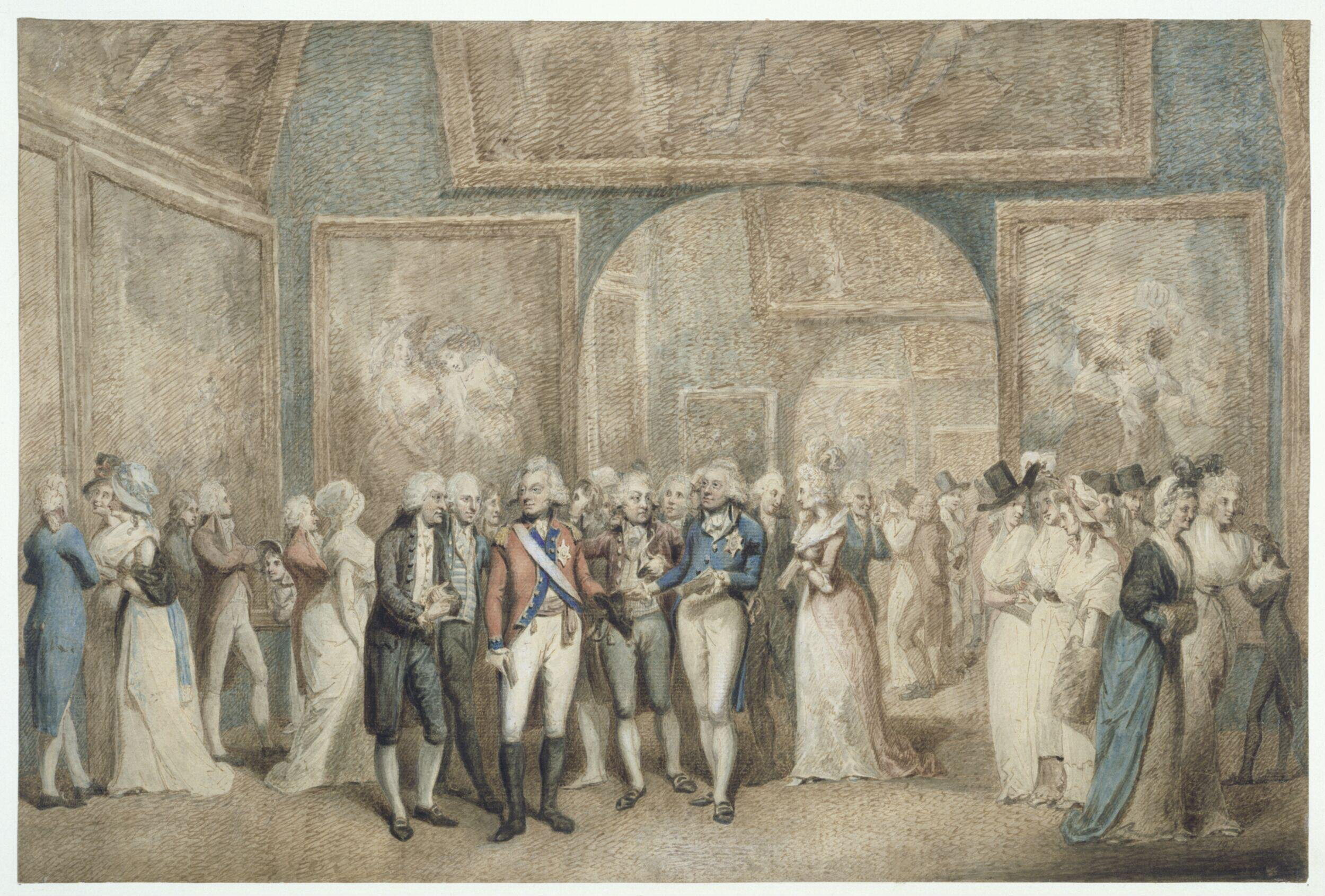
Francis Wheatley, RA (1747-1801), The interior of the Shakespeare Gallery, 1790, watercolour, 45 x 61.7 cm., V & A
Boydell went on to open a gallery of works inspired by Shakespeare at 52 Pall Mall, London, in 1789; it was recorded by Francis Wheatley, who shows Joshua Reynolds and two of George III’s sons amongst the visitors.

Robert Adam (1728-92), preliminary design for a overmantel glass for Mr Hamilton, c.1787, pencil, 47.9 x 32.5 cm., Sir John Soane’s Museum
Inscribed, in Robert Adam’s hand,
‘Mr Hamilton St Martins Lane Pannel Chimney’

Robert Adam (1728-92), design for a wall-mounted funerary monument in the Egyptian taste, no client named, no date, pencil, pen-&-ink, 22.4 x 25.2 cm., Sir John Soane’s Museum
There are more designs by Adam for looking-glasses and room elevations in Sir John Soane’s Museum than appear here, as many of them share similar elements of profile, structure or ornament.
 John Linnell (1729-96), design for Rococo chinoiserie pier-glass, second half 18th century, pencil, pen-&-ink, wash, 22 x 13.8 cm., V & A
‘Design for a pier-glass in pencil, pen and wash, from a volume of designs for furniture, interior decoration and architectural fittings: A Miscellaneous Collection of Original Designs, made, and for the most part executed, during an extensive Practice of many years in the first line of his Profession, by John Linnell, Upholsterer Carver & Cabinet Maker. Selected from his Portfolios at his Decease, by C. H. Tatham Architect. AD 1800.’

John Linnell (1729-96), design for Rococo overdoor frame, second half 18th century, pencil, pen-&-ink, wash, 22.4 x 13.4 cm., V & A
Design for the frame of a pastoral painting for an overdoor, from A Miscellaneous Collection of Original Designs, the album referred to above.

John Linnell (1729-96), design for a Rococo overmantel glass, c.1755, pen-&-ink, watercolour, 19.9 x 15.7 cm., V & A
Design for the frame of a chinoiserie overmantel with glazed panels and supports for porcelain, from A Miscellaneous Collection of Original Designs, the album referred to above.
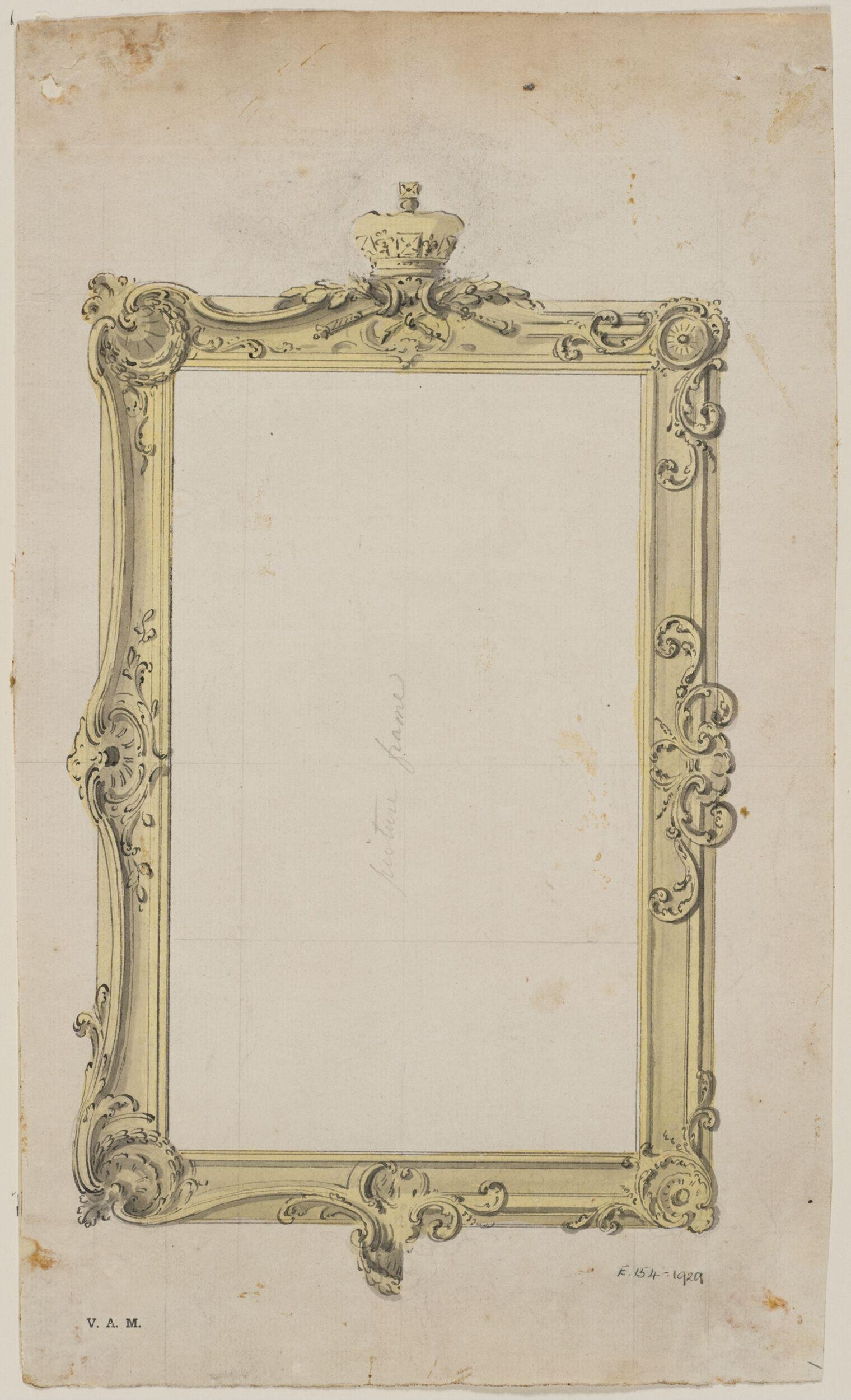
John Linnell (1729-96), design for a giltwood Rococo picture frame, pencil, pen-&-ink, wash, 57 x 34 cm., V & A
Design for a picture frame with options for different centres and corners, and a coronet at the crest, from A Miscellaneous Collection of Original Designs, the album referred to above.
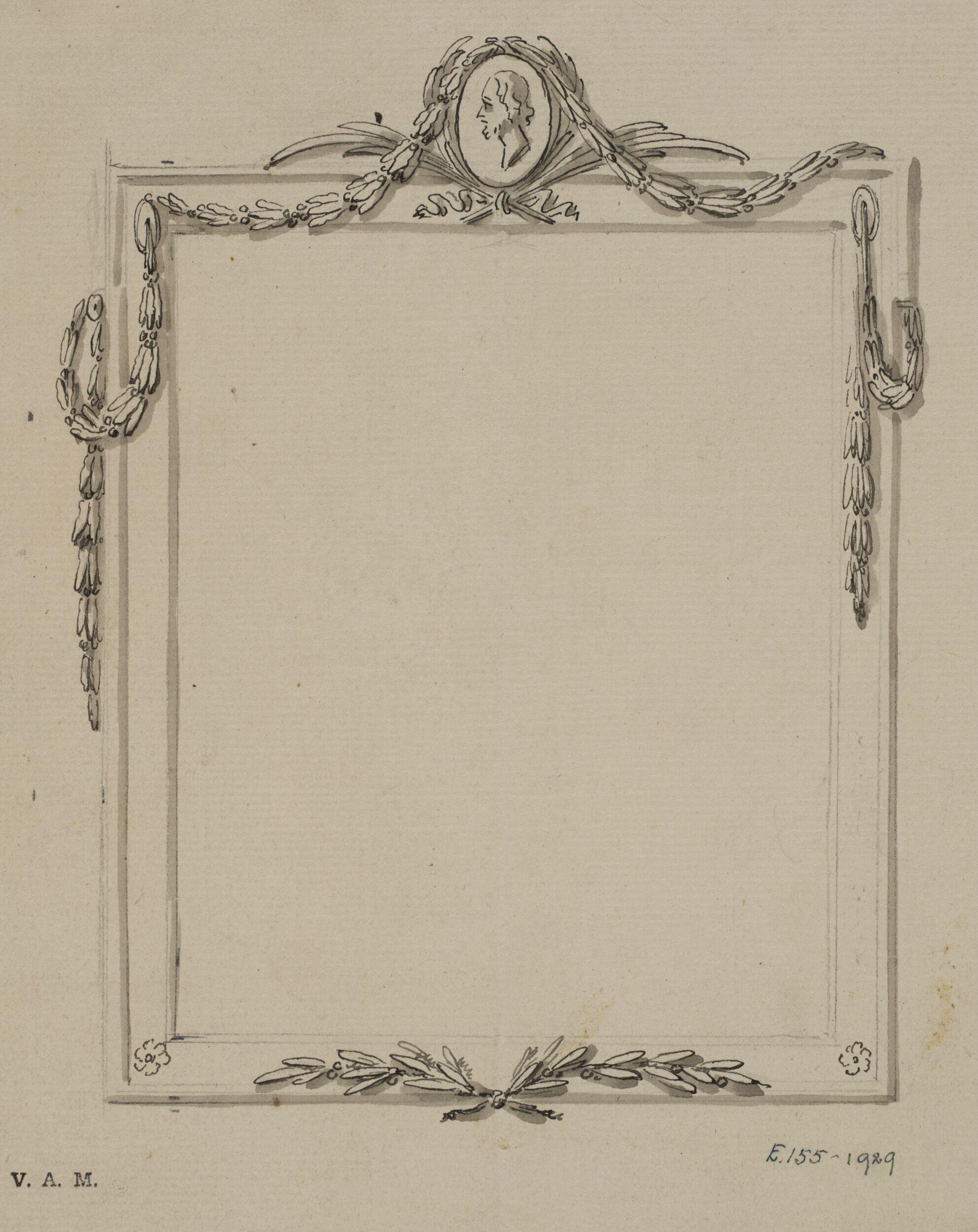
John Linnell (1729-96), design for a NeoClassical frame, pencil, pen-&-ink, wash, 57 x 34 cm., V & A
Design for a NeoClassical picture or looking-glass frame with bay leaf festoons and a portrait medallion, from A Miscellaneous Collection of Original Designs, the album referred to above.

John Linnell (1729-96), design for two NeoClassical picture frames, late 18th century, pencil, pen-&-ink, watercolour, 34 x 56.8 cm., V & A
Design for two NeoClassical picture frames with upper corners and horizontal centres outset, and classical motifs, from A Miscellaneous Collection of Original Designs, the album referred to above.

John Linnell (1729-96), design for a NeoClassical picture frame, late 18th century, pencil, pen-&-ink, watercolour, 56.8 x 34 cm., V & A
Design for a NeoClassical portrait frame with upper corners outset, ribbon fronton and bay leaf or floral festoons, from A Miscellaneous Collection of Original Designs, the album referred to above.
Inscribed,
‘This Drawing sent up from Castle Howard -‘

John Linnell (1729-96), design for a Rococo chinoiserie pier glass, c.1760, pen-&-ink, 20.2 x 15 cm., V & A

John Linnell (workshop; 1729-96), designs for a number of frames, annotated with workshop numbers, clients’ names, finish, dates, dimensions, &c., 1773, pencil, pen-&-ink, watercolour, 31 x 52.5 cm., V & A

John Linnell (workshop; 1729-96), design for a number of frames, annotated with workshop numbers, clients’ names, finish, dates, dimensions, &c., 1773, pencil, pen-&-ink, watercolour, 31.8 x 54 cm., V & A
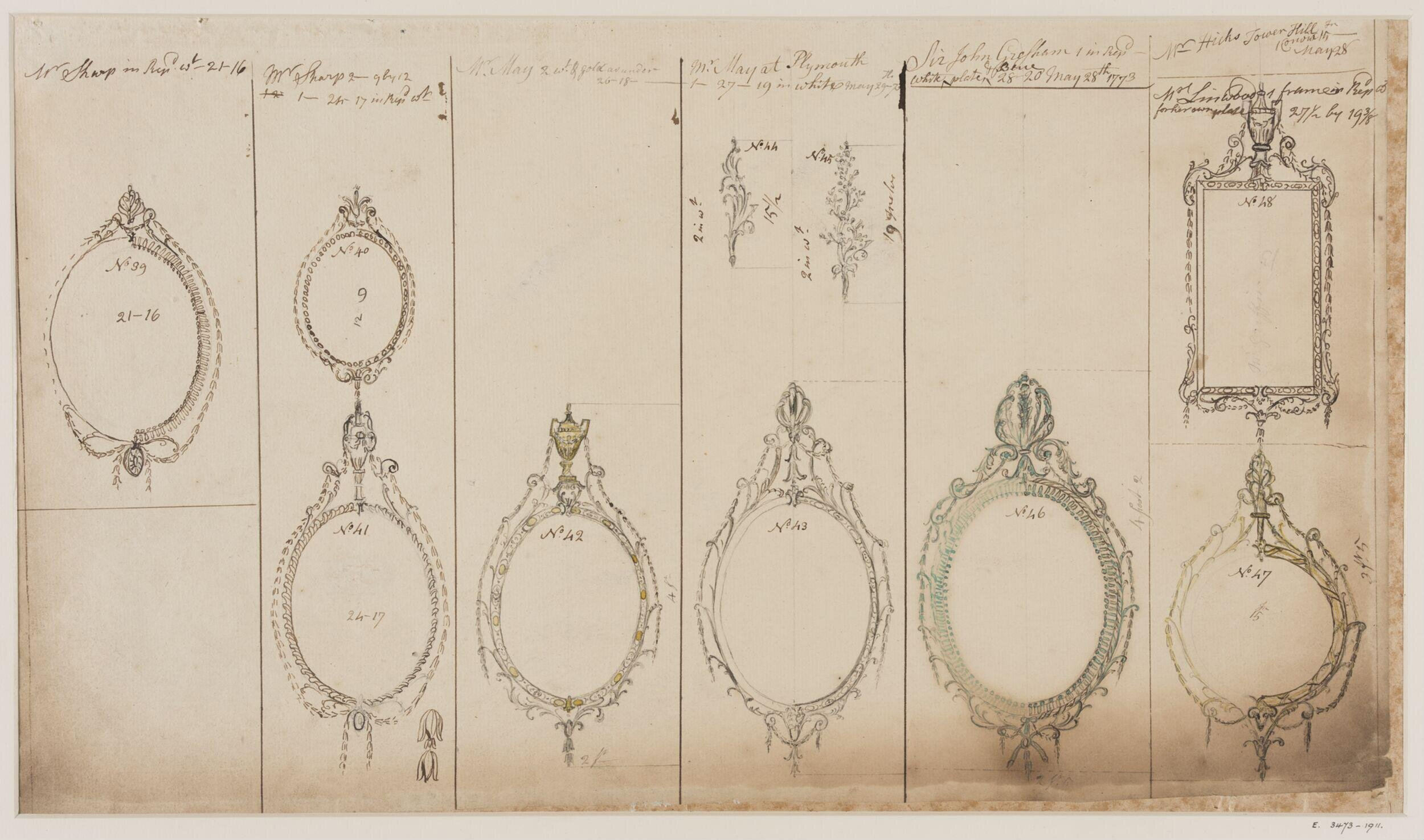
John Linnell (workshop; 1729-96), designs for a number of frames, annotated with workshop numbers, clients’ names, finish, dates, dimensions, &c., mid-1770s, pencil, pen-&-ink, 31.3 x 54.5 cm., V & A
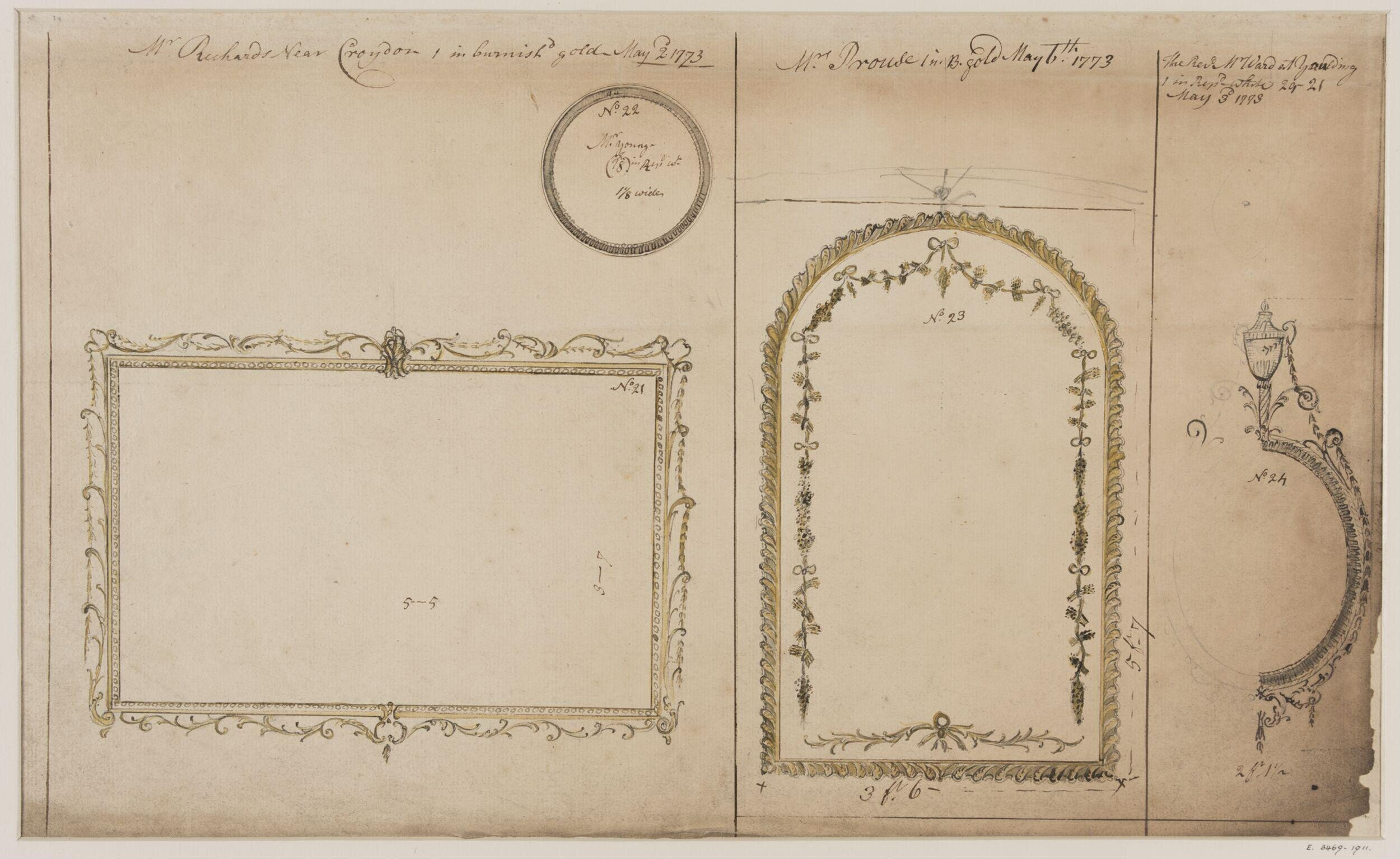
John Linnell (workshop; 1729-96), designs for a number of frames, annotated with workshop numbers, clients’ names, finish, dates, dimensions, &c., mid-1770s, 30.8 x 51 cm., V & A
There are many more of these Linnell workshop designs for frames in the V & A; around 900 individual patterns, apparently. There are also further designs by Linnell himself for single painting and looking-glass frames. The drawings collected here show a fairly representative selection, from flamboyant Rococo to NeoClassical.

Benjamin West (1738-1820), design for south wall, Chapel of Revealed Religion, c.1780, pen-&-ink, wash, 23.6 x 51.9 cm., Royal Collection Trust. RCIN 917862
‘A pen and ink and wash design for the south wall of the Chapel planned by George III for Windsor Castle. Niches left blank, flanked by pairs of angels.
The American-born history painter Benjamin West enjoyed many years of patronage under George III, and was President of the Royal Academy and Surveyor of the King’s Pictures. In the 1780s he was involved with the refurbishment of St George’s Chapel, Windsor, making designs for stained glass and for an altarpiece that were removed in the 19th century. In 1780, West was also commissioned by the King to produce paintings for another Royal Chapel at Windsor. The intended location of this chapel remains unclear, and the project was never completed, with the King withdrawing funding in 1801.’

Benjamin West (1738-1820), design for north wall, Chapel of Revealed Religion, c. 1780, pencil, 21.8 x 37.3 cm., Royal Collection Trust. RCIN 925172
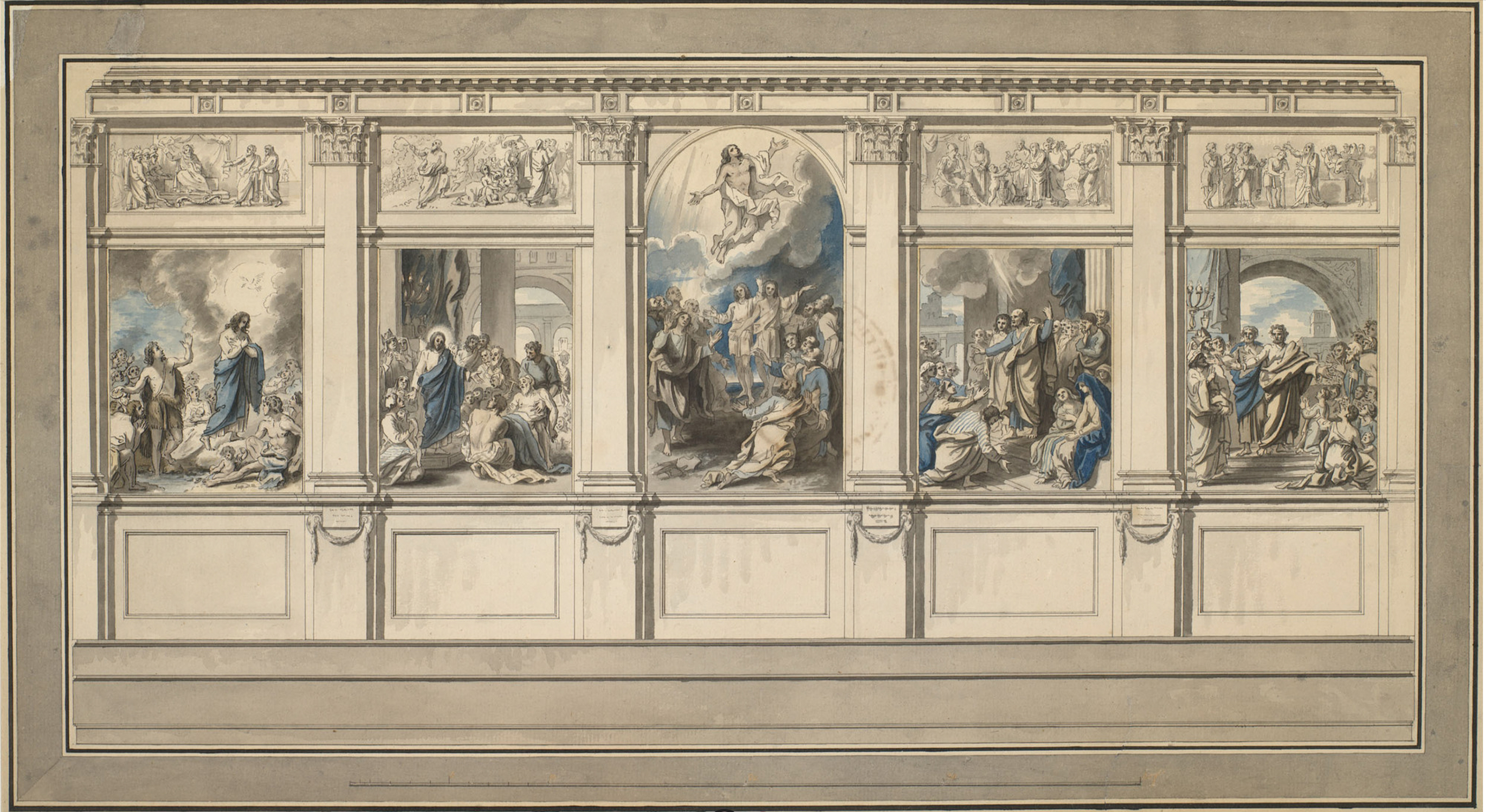
Benjamin West (1738-1820), design for north wall, Chapel of Revealed Religion, c.1780, pen-&-ink, watercolour, wash, 31.9 x 57.9 cm., Royal Collection Trust. RCIN 917861
West called this project ‘the great work of my life’, working on the paintings for over twenty years and exhibiting all of the eighteen paintings he executed for it at the Royal Academy, but they were never installed in the chapel, instead remaining in his studio until his death. West described the series as illustrating ‘the progress of Revealed Religion, from its commencement to its completion’ (John Galt, The Life and Works of Benjamin West, 1820). The decorative scheme included moments from the Old and New Testaments. West produced many preparatory studies and oil sketches for the project. For more information on the Chapel, see Jerry D. Meyer, ‘Benjamin West’s Chapel of Revealed Religion: A Study in Eighteenth-Century Protestant Religious Art’, The Art Bulletin, Vol. 57, No. 2 (Jun., 1975), pp. 247-265′.

Benjamin West (1738-1820), design for Chapel of Revealed Religion, c.1780, pen-&-ink, wash, watercolour, 29.3 x 48 cm., Royal Collection Trust. RCIN 918992
‘A pen and ink and watercolour design for decoration of a window wall in the Chapel planned by George III at Windsor Castle window. With five blank niches with figures above, and scenes from the New Testament’.
 The Frame Blog