Framing emptiness: an exhibition of inscribed Renaissance frames

Tanja Lemke-Mahdavi and Olaf Lemke describe their exhibition of 15th and 16th century Italian and Spanish frames with painted and gilded inscriptions, all of which once had an intimate connection with the paintings they held, explaining and commenting on them. The exhibition runs from 22 November 2024- 22 March 2025 at Antike Rahmen & Antiquitäten, Eisenacher Str. 7, 10777 Berlin.

Introduction: the exhibition

Frames with inscriptions represent a special category within the frame types of the late mediaeval period and the Renaissance. They are often richly decorated and of a high quality of craftsmanship, and (like frames with specific carved or painted motifs) they are amongst the frames which, through their inscriptions, provide clues to the original paintings and subjects which they once contained. The words and phrases which decorate them are taken from the Bible – for instance, from the Psalms and the Song of Solomon – and from other Christian liturgical texts. Now they are fragments of dismantled works of art which once united images, texts and frames.

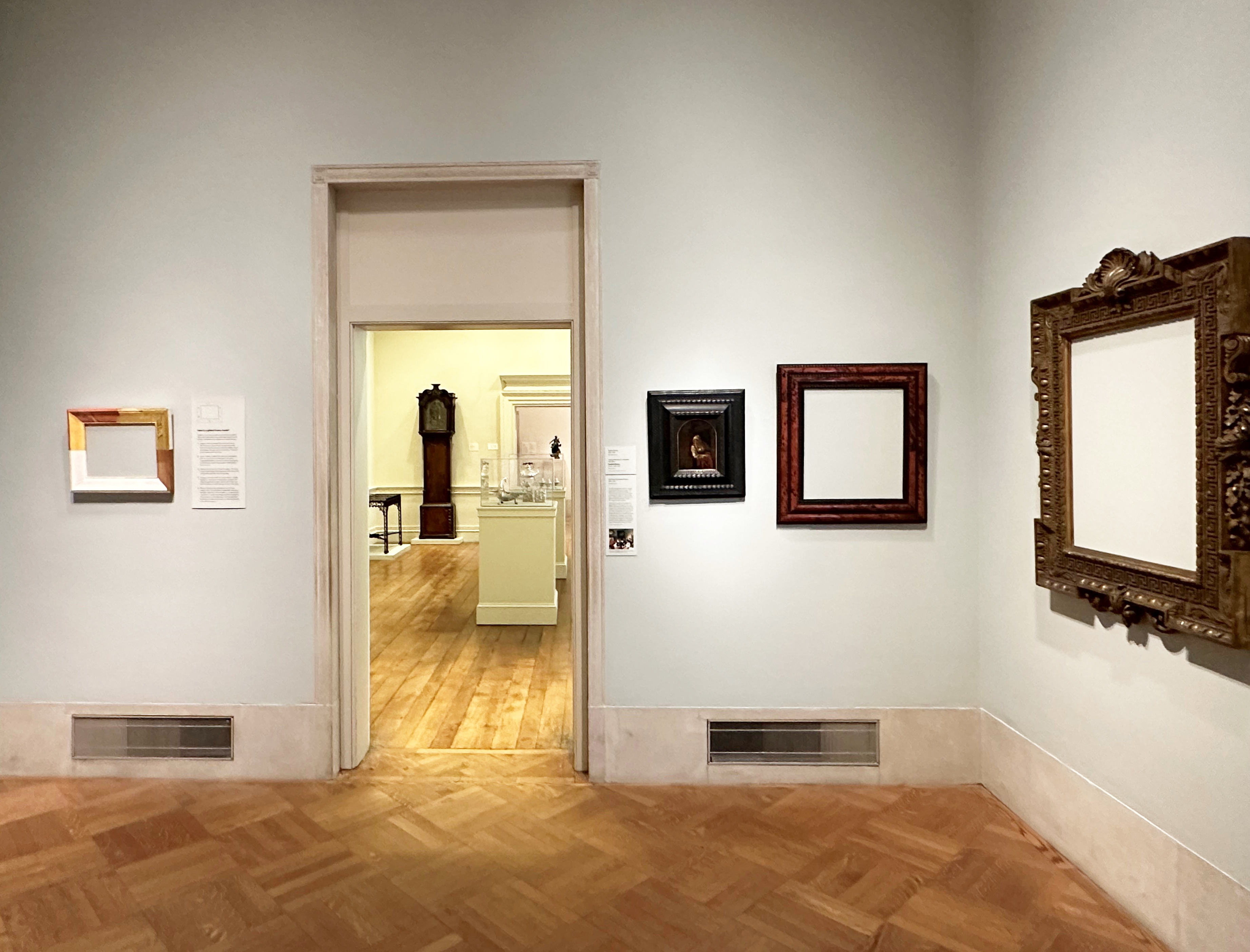
View of two rooms in the exhibition, January 2025. Photo: Tanja Lemke-Mahdavi

These inscriptions, comparable to the caption to a picture, are linked to the subjects of their lost paintings and establish a direct relationship with what was depicted. Whether on altarpieces or rectilinear frames, the inscriptions were applied on the flat frieze between the outer and inner mouldings (often all around it), either in polychrome using the sgraffito technique or in mordant gilding on a dark background; and Renaissance artists of every degree – great and minor – made use of them.

Mid-16th century Spanish cassetta, pine, 114 x 91 cm., parcel-gilt with black frieze decorated in sgraffito with scrolling foliate corners and centres; inscription in Spanish, the Antiqua capitals pre-scored, decorative serifs, the letters on a faux-textured ground; antique hanger and metal corner fitments

The exhibition displays twenty-six Italian and Spanish inscribed Renaissance frames. Most of the frames come from our own collection, but without the loans from our frame colleagues and collectors from London, Rome, Basel and Munich, the exhibition would not be so extensive and varied. We are showing a wide range of frames, from the early Renaissance with their classical mouldings, rainsills, black letter script and quotations from the Old Testament, to the late Renaissance, with richly carved mouldings, already displaying signs of the Baroque.

Late 15th century Italian cassetta with sill, pine, 112 x 88 cm., polychrome with black ground and continuous inscription in Latin in reddish-brown from Lamentations, 1:12; antique hanger

Late 16th century Spanish cassetta, pine, centred gadrooning on top edge, astragal-&-triple bead at sight edge, 101 x 118 cm., parcel-gilt with dark green frieze decorated in sgraffito with scrolling foliate corners and centres, and continuous inscription in Latin from a Gregorian chant; antique hanger

We translated the inscriptions into German and placed each one in the centre of its frame, fixing them directly on the wall. By showing no paintings, only the texts, the viewer is drawn into conjuring up the theme of the lost image, whilst, on the other hand, we leave the subject open to interpretation.

The frame, with its different mouldings, decorations, inscriptions and patina, communicates so much information about its time of creation that one can sense the craftmanship and ideas which imbue it.

Mid-16th century Spanish cassetta, pine, 109 x 87 cm., parcel-gilt with black frieze decorated in sgraffito with scrolling foliate corners and centres, each terminating in a carnation flower,  and continuous inscription in Spanish, the capitals with ligatures, an ornate letter ‘R’

There are frames with sgraffito motifs – for example, these carnations – which are also referred to in the inscription, and which possibly played a rôle in the painting, as well [1]; and the different typographies of the inscriptions tell of the development of Antiqua fonts, which flourished in the middle of the 15th century with the beginning of letterpress printing.

Mid-16th century Spanish cassetta, pine, 43 x 31 cm., parcel-gilt with dark red frieze decorated in sgraffito with small scrolling floral corners, and continuous inscription in Latin from Matthew 16:19, the capitals pre-scored

The Latin or Spanish inscriptions read like poetry. These frames are, fundamentally, vehicles of stories and emotions. The verses appear simple, timeless and universal. They refer to people’s most emotional moments – birth and joy, death and pain, love and longing, justice and hope.

Mid-16th century Spanish cassetta, pine, outer measurements: 76 x 57 cm., parcel-gilt with black top mouldings and frieze decorated in sgraffito with arabesque corners, and continuous inscription in Latin from Psalms 45:5

Renaissance frames and their inscriptions: an historical overview

Picture frames as the bearers of inscriptions seem to be a natural extension of architectural inscriptions, and are closely linked to the development of altars in the Middle Ages. Altarpieces developed into elaborately carved multi-panelled reredoses, often with two (sometimes many more) wings, which might stand against the walls or were free-standing in church interiors. Their frames were part of the overall construction and had the task not only of stabilizing and protecting the picture panels, but also of enabling the opening or closing of the various shutters depending on the liturgical occasion.

Agnolo Gaddi (1350-96) and Lorenzo Monaco (c.1370-c.1425), Triptych with the Madonna & Child enthroned and SS John the Evangelist, John the Baptist, James & Bartholomew, 1388, panel, right wing 186 x 70 cm., and details of inscriptions, Gemäldegalerie, Berlin. Photo: Jörg P. Anders

The inscriptions on these frames identified the Christian figures or described the scenes depicted in the paintings. Whilst the tradition of combining text and image originated in illuminated manuscripts from the scriptoria of monasteries, this was then developed further and transferred to the frames in a concise form.

15th century Thuringian School, Triptych of the Resurrection, c.1430, panel and detail, from Arnstadt,  now Gemäldegalerie, Berlin

The inscriptions were usually on the frieze of the plinth, between the main level and the predella, or extended all round the panel, either in a raised script applied in pastiglia, like letters in icing on a cake, or painted in polychrome, inscribed in sgraffito, or added in mordant gilding. The predominant script in the late Middle Ages was Uncial or a broken script such as Textura in various country-specific forms, usually written in Latin. In the work immediately below, expanded for a Burgundian patron, the motto is in French – ‘en esperance’ – in hope.

Hugo van der Goes (c.1440-82) & another unknown artist, Triptrych with the Madonna & Child, saints and donors, c.1475-90, o/panel, 30 x 11.6, 23.8 x 17.4, 30.1 x 11.6 cm., and detail, Städel Museum, Frankfurt

Heinrich Füllmaurer (1497-1548), Gotha Altarpiece, 1540, comprising 157 separate paintings, Herzogliches Museum, Schloss Friedenstein, Gotha

The polychrome or gilded altar frames were either made of simple mouldings with straight and linear profiles or consisted of frame mouldings with carved Gothic ornaments. The panel and frame were often made from the same wood, and because they were nailed directly to the panel, these frames had no rebate. The colour scheme of the frames mirrored that of the paintings – gold, red, blue, black.

Hans Holbein the elder (c.1460-c.1524), The Virgin as the Mother of Sorrows, 1495, o/panel, 66.9 x 47.6 cm., and detail of Latin inscription : ‘I am the mother of beautiful love and fear, and of knowledge and holy hope. In me is all grace of the way and of truth; in me is all hope of life and virtue. Come to me, all you who desire me, and you will be filled with my creations. 1495’, Gemäldegalerie, Berlin

Hans Memling (c.1433-94), Portrait of a woman, 1480, 38 x 26.5 cm., in rainsill frame with trompe l’oeil banner scrolling from the sitter’s fingers, and inscribed in Latin: ‘Behold, you, beast, will be crushed [and] the Lord will be born on the earth and the womb of the Virgin will be the salvation of the nations; the invisible word will become tangible’, Sint-Janshospitaal, Bruges

A striking feature of frames from the mediaeval period is the ‘rainsill’, a relic from architecture in which the lower side of the frame is canted like a windowsill – an obvious association with a view to the divine heavens. The rainsill is found on altarpiece frames or portraits of saints from the early mediaeval period until the Renaissance, and served as an ideal surface for inscriptions below the picture.

The Renaissance saw the transition from the mediaeval to the modern period. It was characterized by influences from Greek and Roman antiquity and by flourishing scientific inquiry. Picture frames were carved with columns, architraves, and cornices or pediments imitating those of antiquity; they increasingly attained a position of their own, but at the same time continued to support and emphasise the paintings which they contained.

Andrea Mantegna (c.1431-1506), Madonna & Child (Simon Madonna), c.1455-60, size/canvas, 48.4 x 32.2 cm., frame not original, Gemäldegalerie, Berlin

An early form of Renaissance frame, the tabernacle or aedicule, was inspired by architecture; it very often framed the motif of the Madonna and Child and was inscribed ‘Ave Maria Gratia’ or ‘Ave Maria Gratia Plena’ (from the opening of the ‘Hail Mary’), amongst other phrases.

Neroccio de’ Landi (1447-1500), Madonna & Child with saints, with The dead Christ above, c.1490, Metropolitan Museum of Art, New York. Photo: Sailko

Botticelli (1445-1510), Madonna & Child, c.1469-70, panel, 120 x 65 cm., Galleria degli Uffizi

The inscriptions are reminiscent of those from monumental architecture, in Capitalis Monumentalis script. The letters, written only in capitals, were placed either in the entablature above the picture or on the base below. Most of the inscriptions appear in sgraffito, in gold revealed through a polychrome painted surface.

During the 15th century, there was an ever-increasing focus on the construction and decoration of frames. The exploration of perspective, proportions, man and nature was reflected
in both the paintings and frames. Humanism in particular gave rise to new pictorial content and techniques. The historic collaboration between framemakers and painters continued: an increasing number of workshops specialising in the craft of framing emerged from the guilds of carpenters, joiners, sculptors, turners and gilders.

Carlo Braccesco (fl. 1478-1501), Triptych of the Annunciation, 1490-1500, central panel 158 x 107 cm., part of a polyptych from a church in (?)Genoa, Musée du Louvre. Photo: Mbzt

Italian and Spanish inscribed frames in cassetta form show the new influences of the time. In order to direct the perspective even more strongly towards the pictorial surface, the profile of the frame was constructed with a higher moulding on the outer (top) edge, decreasing visually to a lower moulding at the sight. These mouldings framed a flat surface (the frieze), which was finished with coloured paint, gold or silver leaf, and decorated with complex ornaments and inscriptions in sgraffito, mordant gilding or a different colour; the frieze might often have additional decoration in punchwork.

Carlo Braccesco, Triptych of the Annunciation, details of inscription from the frame of the central panel: ‘Ecce ancilla Domini. Fiat mihi secundum verbum tuum (‘Behold the handmaid of the Lord. Be it done unto me according to Thy word’), from the Hail Mary

The inscriptions were very decorative, colourful and substantial in text. In terms of content, they featured prayers (above, from the Hail Mary), liturgical and biblical texts which, although still predominantly in the typographical tradition of Capitalis, already displayed clear stylistic elements of the finely drawn letters of Venetian Renaissance Antiqua. They derived their character from the serifs and the contrast between bold and fine scripts. Mixing characteristics from monumental script and handwriting was typical of the period. Ligatures, for example, have a long tradition in handwritten texts. Here they were particularly useful in order to utilize fully the available space on frame mouldings. Capital letters were sometimes pre-scored into the gilding in order to distribute the letters evenly around the frame.

Quinten Massys (1465-1530), Ecce Homo, 1518-20, o/panel, 160 x 120 cm., the frame inscribed in Latin: ‘O all you who pass by on the way, take heed and see if there is any pain like my pain’, Museo del Prado

Many forerunners of modern Antiqua typefaces were created during the transition from mediaeval handwritten scripts to moveable metal type. Venice was an important centre for the first book printers in the mid-15th century: scholars, publishers and printers from all over Europe met there for the purpose of printing books, and in the process to develop new and refine existing fonts. Aldus Manutius, Conrad Sweynheym and the Speyer brothers, to name just a few, were amongst the most important designers of type, and were involved in the development of the first widely accepted Antiqua font, the Renaissance Antiqua.

Details of frame inscriptions in Latin and Spanish, showing ligatures

The lettering of frame inscriptions clearly shows these influences. On the one hand, font preferences differed regionally: for example, the fine Antiqua fonts on the Italian cassetta, in contrast to German inscriptions, which favoured a Gothic script. On the other hand, writing styles could also prevail across borders, such as the humanist Antiqua on Netherlandish, German or Italian frames, which mostly used Latin. These differences were analogous to the regional characteristics in frames themselves – such as the species of wood, methods of construction, and (not least) the development of surface designs. Whilst Italian frames, for example, were finely carved from poplar wood, and were rich in ornament and finished in gold and polychrome, Netherlandish frames in the Renaissance were generally characterised by their simplicity and austerity. They were painted in plain colours or veneered in ebony or rosewood. Further country-specific techniques are evident in the different joints at the corners of frames.

Albrecht Dürer (1471-1528), Emperor Charlemagne, c.1511-13, o/panel, 215 x 115 cm., and details of inscription, Germanisches Nationalmuseum, Nuremberg

German artists such as Albrecht Dürer also used the written word as part of the whole work of art. His portrait of Charlemagne has an inscription around the frame in Old German, written in Gothic script:

‘Dis ist der gstalt vnd biltnus gleich / kaiser karlus der das Remisch reich. Den teitschen under tenig macht / Sein kron vnd klaidung hoch geacht / zaigt man zu nurenberg alle Jar / Mit andern haltum offenbar ’

which translates as:

‘Charlemagne reigned for 14 years. He was the son of the Frankish King Pippin, and Roman Emperor. He made the Roman Empire subject to German rule. His crown and garments are put on public display annually in Nuremberg, together with other relics’ [2].

Nicolas Neufchatel (fl. 1539-67), The Nuremberg writing master, Johann Neudörffer the Elder, and a student, 1561, o/c, 102.3 x 92.5 cm., Germanisches Nationalmuseum, Nuremberg

Dürer worked with the Nuremberg master scribe Johann Neudörffer the Elder, who made a significant contribution to the development of German Gothic script at the beginning of the 16th century. A frame with a more classical form of inscription on the portrait of Neudörffer, above, by the painter Nicolas Neufchatel has been preserved:

‘Johannes Neudörffer, famous through Europe for the infinite [number of his] students of mathematics and [the art of] writing, an unrivalled example of diligence, a great ornament to his fatherland, the Republic of Nuremberg, to whom this image of the highly sought-after citizen aged 63 was by the [artist] Nicolaus Neuchâtel, his guest, dedicated in gratitude 1561’.

In addition to ecclesiastical buildings, the picture frame also found its way into middle-class homes. Domestic altarpieces, as well as portraits of wealthy citizens, became increasingly popular. The content of inscriptions likewise changed with the advent of portrait and history painting in the Renaissance. It is noticeable that the more humanistic the patrons or artists, the more secular the frame texts become.

Frans Floris the elder (1519/20-70), The Berchem family, 1561, o/panel, 130 x 227 cm., Stadts Museum, Lier

One example of this is the portrait of the Van Berchem family by Frans Floris, where the scene is summed up in the  inscription around the frieze of the frame:

‘As nothing in life can be happier than an harmonious chamber, and a bed without strife: so there is nothing more delightful than to behold one’s children in harmony, enjoying the peace of an innocent breast’ [3].

Jan Gossaert (1478-1532), Diptych of Jean Carondelet with the Madonna and Child, 1517, o/ panel, 42.5 x 27 cm., Musée du Louvre

Small-format panel paintings, often constructed as diptychs, displayed inscriptions when open (on the frames) or when closed (on the backs of the paintings), relating to the sitters or their heavenly patrons. The left-hand frame of the Carondelet Diptych identifies the sitter:

‘A depiction of M. Jean Carondelet, Mayor of Besançon, at the age of 48 – made in the year 1517’

…and the right-hand frame has his prayer to the Virgin:

‘Our intercessor, who after God is our sole hope, speak for me to your Son – Johannes of Melbogie [Maubeuge/Mabuse/Malbode] painted this’

Some frames still have hangers on the top moulding for a curtain, so that even single painted panels could thus be ‘opened’ or ‘closed’.

Jan van Eyck  (fl.1422- d.1441), Portrait of a man  (self-portrait?), 1433, o/panel, 26 x 19 cm., National Gallery

It was not only self-confident patrons who wished to immortalise themselves in paint and words; artists themselves also dated and signed their pictures on the frame [4]. The best-known examples are the works of the Flemish artist Van Eyck, who signed many of his paintings with his name and date on the frame. This may be one of the reasons why almost all of his paintings have survived with their original frames. The frame of the portrait above is inscribed:

‘Als ich kan’ (as I can; or – phonetically – as Eyck can) at the top, and ‘Johannes*de*Eyck*me*fecit *anno MCCCC * 33*21*Octobris’ (Jan van Eyck made me in the year 1400+33, 21 October) at the bottom

This original relationship, with painting and frame preserved as an inseparable unit, is exceptionally rare. Over the centuries, frames were frequently changed, and changed again, by their owners, dealers or museums. It was not until the late 19th century that institutions and private collectors developed an interest in historical authenticity in the framing of their pictures.

Inscriptions on frames are part of the tradition of merging image and text to reinforce a message or communicate it in a more targeted way. We use this type of communication every day. We create digital messages with text and images within seconds today. In the Renaissance, this process took months, even years. Every aspect of production was associated with specialized knowledge and craftsmanship. Examining this process scientifically and comparing its development within Europe encompasses a broad spectrum of research fields such as epigraphy, the craft of framing, religious studies, art history and fine art. Many questions remain unanswered. Wouldn‘t it be interesting, using these inscribed frames to reflect on these complex connections and develop them collaboratively in the context of ‘today’?

Tanja Lemke-Mahdavi

November 2024

*****************************

Tanja Lemke-Mahdavi is a communication designer. For over 25 years she has been working independently as a designer and project manager for companies, organizations, and institutions, or collaboratively in free projects in culture and business. Typography always plays a major rôle in her work, not just for the sake of pure legibility, but as an expression of individuality and communication between people. The way we ‘present’ words says a lot about us. Through typography, we give the content of the texts a personality and attitude. Over the last few years, Tanja has developed processes and products for publishing textual works simultaneously in analogue and digital form.

She has a very personal relationship with frames. She grew up with hundreds of empty antique frames in her parents’ shop (Olaf Lemke’s Antike Rahmen), spent her holidays on their business trips all over Europe, restored frames as a teenager for her first pocket money, and got to know works of art from museums at the closest possible. She has been engaged with inscribed Renaissance frames for years – first from a love of typography, and later from enthusiasm for the ‘stories’ that paintings, frames and inscriptions can tell.

*****************************

A Van Eyck tail note

Jan van Eyck (c.1390–1441) & workshop assistant, The Crucifixion and The Last Judgment, c.1436-38, o/c from panel, each: 56.5 x 19.7 cm, Metropolitan Museum of Art, New York

The Met has recorded the restoration of the frames of these two Van Eyck panels, their original colours and their inscriptions by the Museum conservators in 2019; you can read hsort essays on the project here:

Part 1: Unlocking the mysteries of two Jan van Eyck frames

Part 2: Imaging the hidden details

Part 3: Addressing questions of display

Part 4: What does the text mean?

*****************************

[1] See ‘Fruit, flowers, foliage: the symbolism of Renaissance frames‘. The meaning of the carnation in Christian symbolism is very various, ranging from its representation of the Crucifixion (because, according to Giles Laval, ‘pinks smell like cloves, cloves look like nails, nails were used to crucify Jesus’ – see linked article), through the interpretation of the name of its genus, dianthus or ‘flower of Zeus’, as ‘flower of God’, because it grew from the Madonna’s tears beneath the Cross, to the derivation seen here of carnation from the Latin ‘carnis‘ or ‘of the flesh’

[2] Translation from Web Gallery of Art

[3] ‘Ut nil concordi thalamo felicius omni in vita esse potest, et sine lite toro: / sic mage iucundum nihil est, quam cenrere gnatos concordeis niveo pectore pace frui’

[4] Signing and dating of their works by artists, carvers and gilders is known from an early period: for example, the Monteoliveto Altarpiece (now Museum of Fine Arts, Budapest), has a pastiglia inscription with the date, 1385, and the names of Simone the woodworker, Gabriel the gilder and Spinello the painter. See ‘Painters & woodcarvers in early Renaissance Italy