
France
16th century French frames

Jacques Androuet Du Cerceau (1510/12-1585), design for a monumental archway, 16th century, pen-&-ink, wash, traces of black chalk, 41.9 x 64 cm., Metropolitan Museum, New York
‘Design for a monumental archway with five bays in the Corinthian order, decorated with reliefs of military scenes and statues of warriors in niches, and surmounted with further figures and statues of horses.’
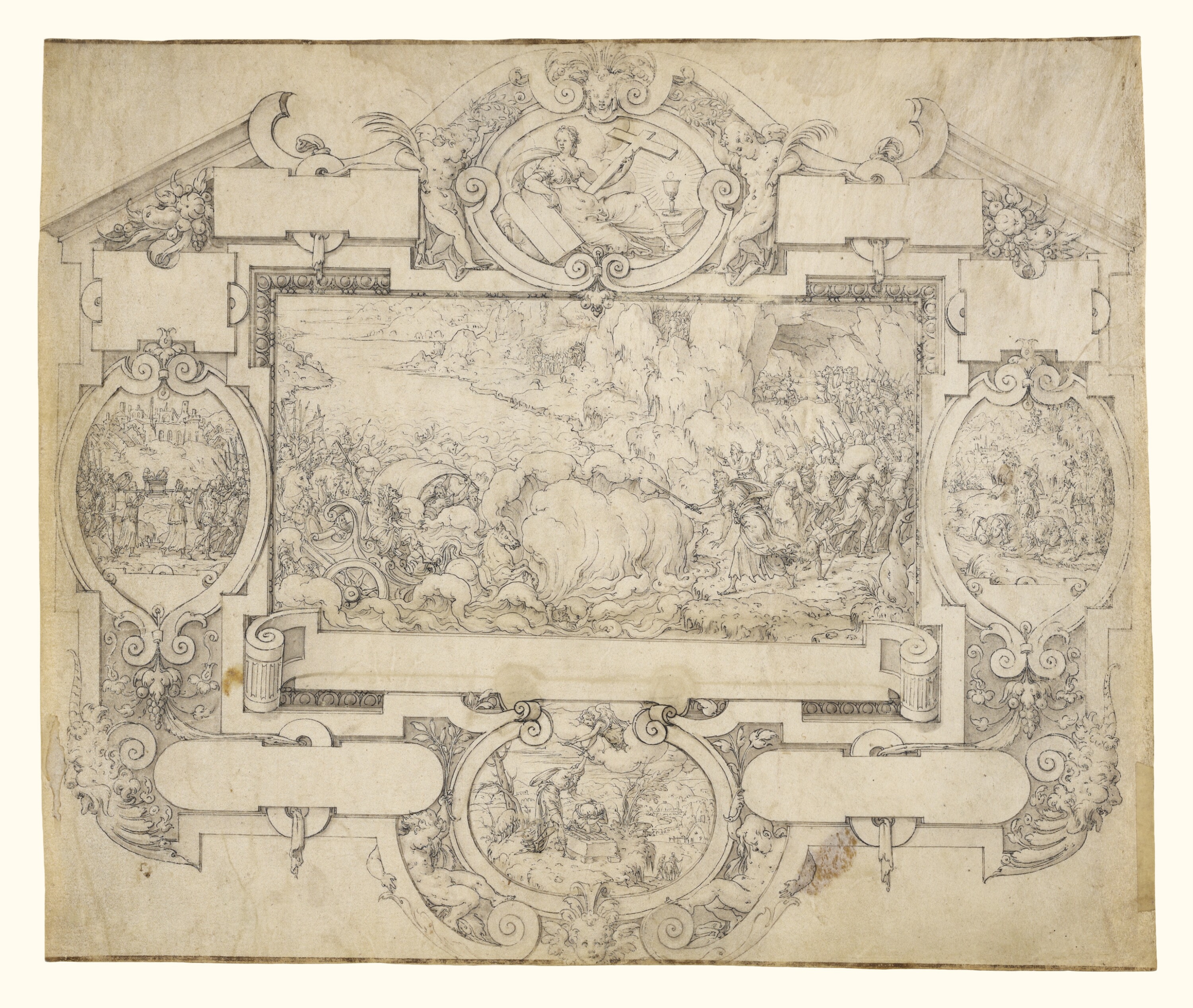
Baptiste Delaune (c.1520-75), The destruction of Pharaoh’s army, &c., in a cartouche, c.1560-70, pen-&-ink, wash, on vellum, 25.9 x 31 cm., J. Paul Getty Museum
‘Beneath a seated personification of Faith, each of these images focuses on a specific act of faith from the Old Testament. In the centre, Moses causes the waters of the Red Sea to drown Pharoah’s army. In the two side ovals, Joshua and the Israelites bring down the walls of Jericho, and Gideon chooses his soldiers according to whether they lapped water, rather than kneeling down to drink. At the bottom, Jacob sacrifices his son Isaac.
Étienne Delaune [sic] delineated the strapwork cartouche in minute detail, with its ornamental putti, the grotesque masks at the lower corners, and the bunches of fruit. He carefully applied areas of wash to give the blank plaques and curling strapwork the impression of three-dimensionality. He probably intended the drawing as a design for a wall decoration. The elaborate frame of the drawing would have been sculpted in stucco relief, and the various empty spaces would have contained inscriptions’.


Baptiste Pellerin (c.1520-75), 3 out of 17 examples of designs for a series of tapestries illustrating the life of St Bartholomew, all save one incorporating integral borders (‘bordures’), 1570-71, ink, wash, Bibliothèque nationale de France, Gallica. With thanks to Christophe Defrance

Antonio Fantuzzi (fl.1537-1545/47), 16th century school of Fontainebleau, classical statue in a garland frame, 1542-43, engraving, Bibliothèque nationale de France, Gallica
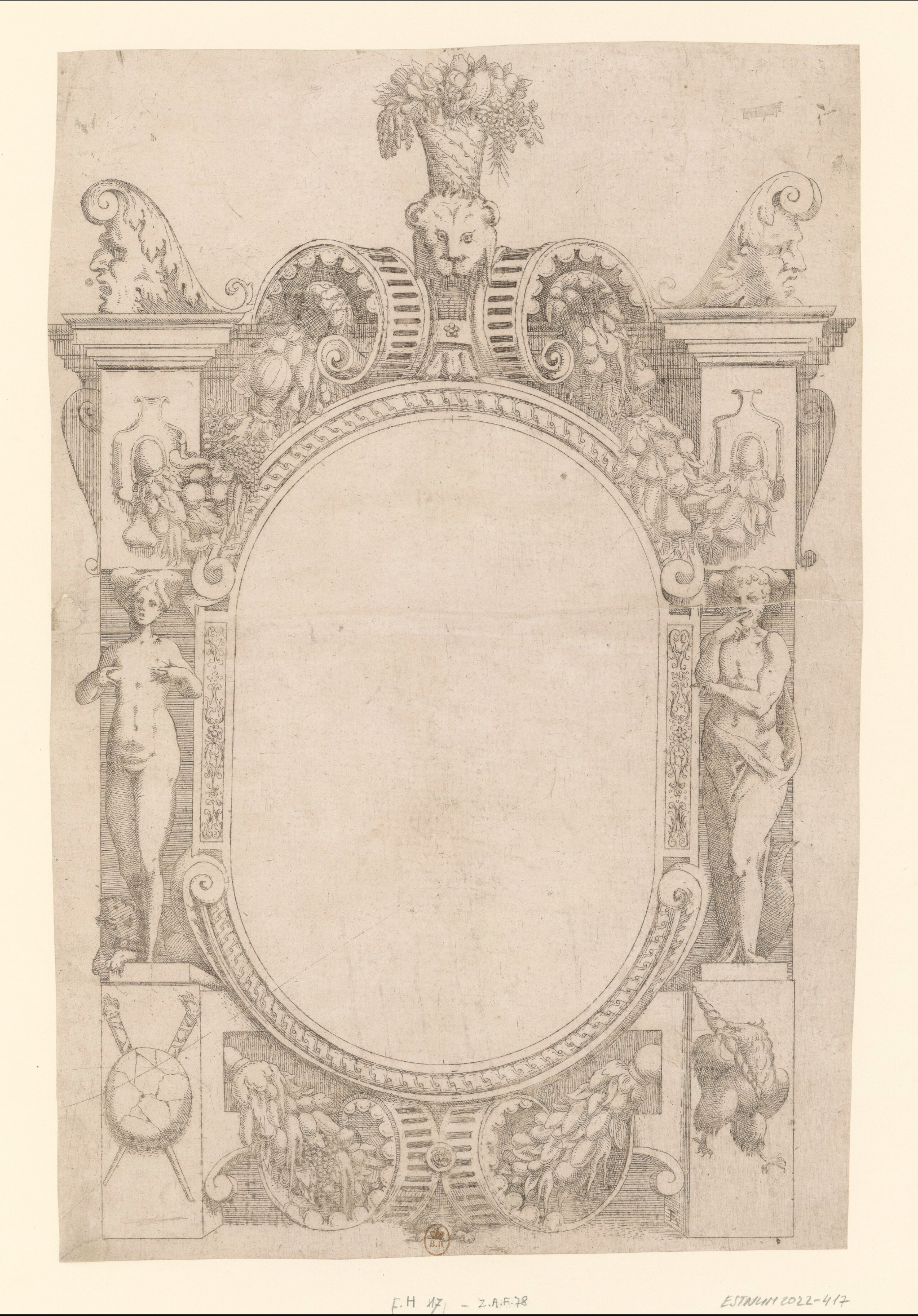
Antonio Fantuzzi (fl.1537-1545/47), 16th century school of Fontainebleau, ornamental frame with two caryatides, etching, 42.5 x 28.5 cm., Recueil: Oeuvre d’Antonio Fantuzzi, Bibliothèque nationale de France, Gallica

Toussaint Dubreuil (1561-1602), design for an octagonal ceiling with the Nine Muses, pen-&-ink, wash, traces black chalk, 27.5 x 27.4 cm., Département des Arts graphiques, Musée du Louvre
‘In addition to the central subject, this drawing includes, around the perimeter, corresponding to each side of the octagon, trapezoidal compartments which alternate arabesque panels decorated with mascarons and figurative scenes… this is an unidentified ceiling project, probably representing the Muses, of which other fragments exist (Louvre, INV 11096 and 11096 BIS) and of which two studies show the overall articulation. One is kept in Paris (Bibliothèque nationale, Cabinet des Estampes, B 2 res. fol. 10 or B 5 a res.) and the other in Stockholm (Nationalmuseum, CC1700)’.

Toussaint Dubreuil (1561-1602), design for the decoration of walls and ceiling, with the monogram of the French king (Henri III or IV), c.1580-1600, pen-&-ink, wash, white heightening, black chalk, 35.9 x 24.8 cm., Metropolitan Museum, New York
‘Design for the decoration of a wall and ceiling, most likely with a barrel vault. On the bottom of the sheet (part of) a wall elevation is shown decorated with a large rectangular compartment in which a landscape scene is depicted. The decorations along the frame of the compartment were most probably meant to be executed in stucco. To the right, cursory indications of a window bay are painted in wash. Above the wall elevation, the ceiling is divided in two parts. On the left side, a large rectangle represents the main body of the barrel vault; at its centre a trompe l’oeil painting of a balcony and oculus are indicated, and are surrounded by grotesque decorations reminiscent of the Fontainebleau School designs of Rosso Fiorentino and Leonard Thiry. To the right, above the window bay, a narrower strip shows a cartouche with the letter H in the centre and a small compartment with a landscape scene at either end.’

Léonard Thiry (fl. 1530-50), design for a wall decoration with a river god, c.1530-47, pen-&-ink, wash, red chalk, 32 x 28.2 cm., Metropolitan Museum, New York
‘The complex layering, extreme flatness, ornamental line, compression and crowding of forms in the design of this work are all characteristic of the style which evolved at the château at Fontainebleau during the reign of Francis I. At his palace in the woods outside Paris, the king had assembled such talented Italian artists as Rosso Fiorentino (1494–1540) and Francesco Primaticcio (1504–1570) to head a workshop dedicated to every facet of the palace’s decoration. The technique of this drawing seems closest to that of one of Rosso’s collaborators, Léonard Thiry (1500-c.1550), particularly his designs for engraved book illustrations.’

Anon., French school, top left-hand corner of an altarpiece, 1537, ink, wash, 29.5 x 16.5 cm., Städel Museum, Frankfurt
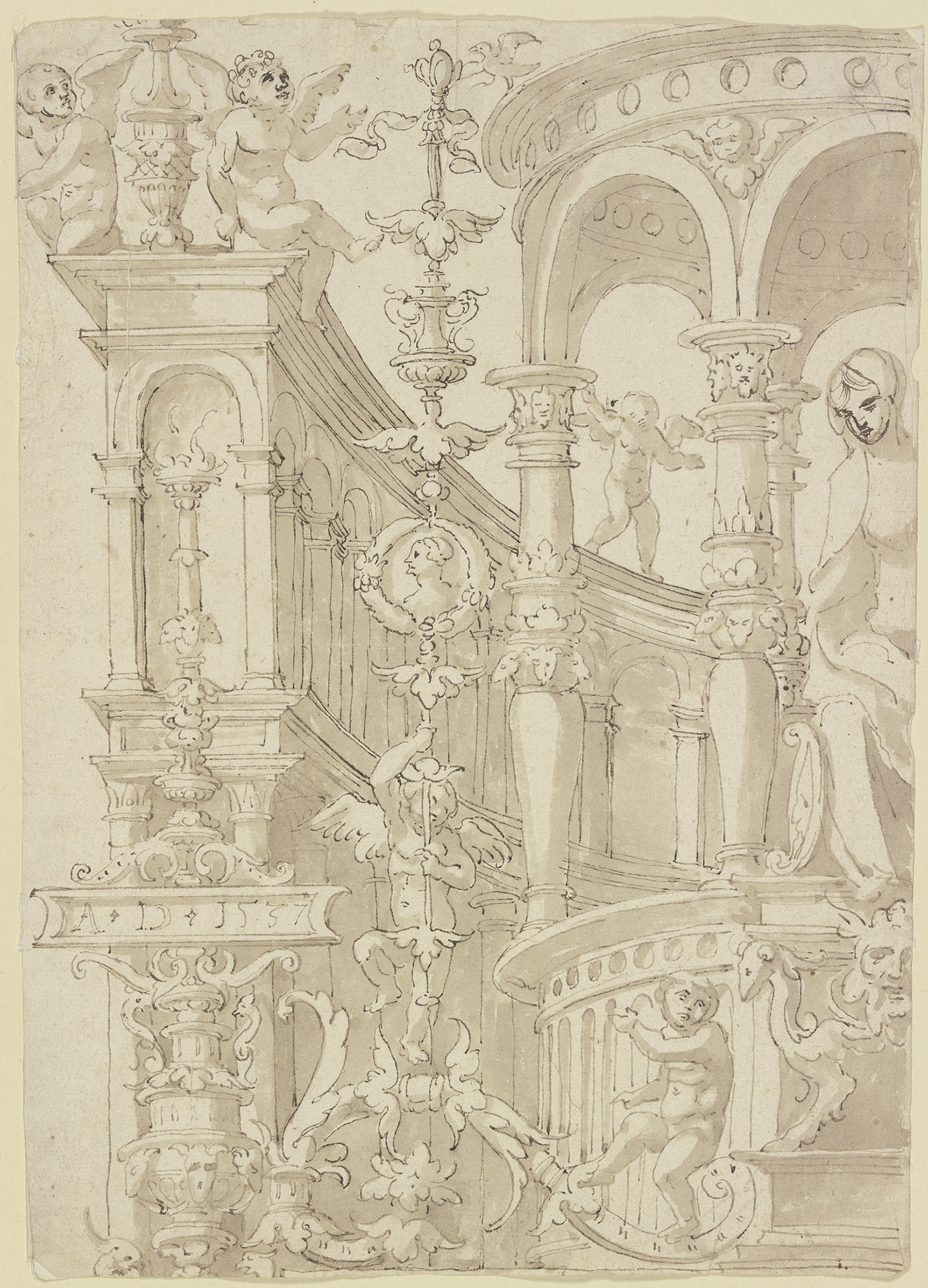
Anon., French school, detail of an altarpiece, 1537, ink, wash, 28.1 x 20.4 cm., Städel Museum, Frankfurt
 The Frame Blog