
France
17th century French drawings

Martin Fréminet (1567-1619), design for the high altar of the chapelle de la Trinité, château de Fontainebleau, 1611, pen-&-ink, wash, black chalk, white heightening, watercolour, 46.5 x 33.5 cm., Département des Arts graphiques, Musée du Louvre
‘This… bears the cyphers of Marie de’ Médici and Louis XIII. M. Szanto dates it precisely to 1611 (‘Martin Fréminet and the Trinity Chapel, two unpublished documents’ in Bulletin de la Société de l’Histoire de l’Art Français, 2003-04, pp. 33-38).’

Altar of the chapelle de la Trinité, château de Fontainebleau, as it is today
‘The design was apparently reconsidered, as the Darmstadt Landesmuseum has another drawing for the altarpiece (Inv. HZ 1743), less ambitious and closer to the final solution’.

Martin Fréminet (1567-1619), a king of Israel (Solomon?), design for a compartment of the vault of the chapelle de la Trinité, château de Fontainebleau, c.1603-08, pen-&-ink, wash, trace of black chalk or lead, 22.4 x 10 cm. (cut down on all four sides), Département des Arts graphiques, Musée du Louvre
‘This drawing is one of Martin Fréminet’s designs for the decoration of the vault in the Chapel of the Trinity, château de Fontainebleau, which was conceived by Henri IV in 1605 or even earlier, and undertaken by the painter in 1608. Fréminet worked on the decoration of this chapel until his death in 1619. If we include his studies for the high altar, only sixteen preparatory drawings for this very large ensemble are now known and the Louvre only preserves one, which is preparatory; not for the paintings or the stucco reliefs of the vault, but for the high altar itself. The payment of 2400 livres made to Fréminet in 1608 took into account his ‘designs for and direction of the new paintings and pictures’ that Henry IV had commissioned ‘in the vault of the great chapel of the said château’).’

Ceiling of the chapelle de la Trinité, château de Fontainebleau; the kings of Israel are in the long, sausage-shaped panels with outset corners on each side of the vault
This drawing shows one of the kings of Israel or Judah (Saul, David, Solomon, Rehoboam, Abijah, Asar, Jehoshaphat, and Jehoram) which were eventually painted in the compartments of the vault. This is probably Solomon holding the sceptre or hand of justice; he also has at his side the sword of justice. Solomon was not among the kings mentioned by Fréminet in a letter (undated) which he addressed to Henri IV concerning the iconography of the decoration of the Trinity Chapel (British Library, Harley Collection, MS 4543, folios 30 recto-31 verso, letter from Martin Fréminet to Henri IV, including the description of the iconographic programme imagined for the ceiling of the chapel (nd):
‘…In addition there will be twelve other paintings in the form of cameos which will bear the figures of six principal patriarchs, namely Abel, Noah, Abraham, Job, Moses, David, and six prophets mentioned, Samuel, Helias, Isaiah, Jeremiah, Daniel, and Jonah, each with the attributes proper to their persons’, Montaiglon, Archives de l’art français, 1862, pp. 350-366).
This subject was retained in the finished scheme, but was painted according to another drawing which is now in New York’.
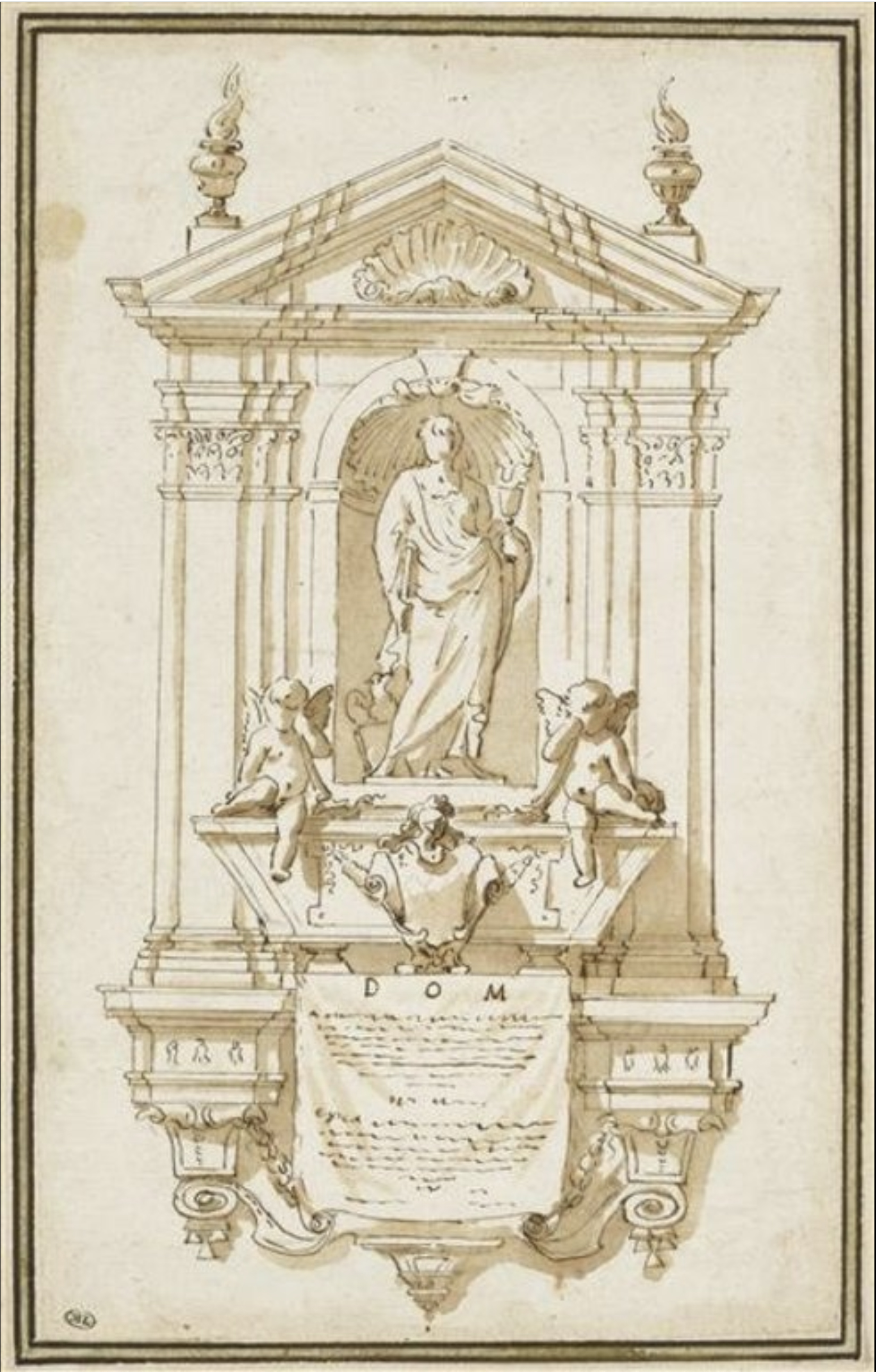
Charles Mellin (c.1597?-1649), design for an altarpiece with a statue of St John the Evangelist, pen-&-ink, wash, black chalk, 24.5 x 15.7 cm., Département des Arts graphiques, Musée du Louvre

Grégoire Huret (1606-70), design for the frontispiece of Viridarium sacrae ac profanae eruditionis, c.1632, red chalk, wash, 31.7 x 21.2 cm., J. Paul Getty Museum
‘This refined red chalk drawing is a preparatory design for the frontispiece of Viridarium sacrae ac profanae eruditionis [Garden of Sacred and Profane Knowledge], 1632, a posthumously-published collection of writings by the Jesuit Francisco de Mendoça (1580-1626). Epitomizing Grégoire Huret’s erudition and skill, the frontispiece is designed as a decorative frame (its centre left blank for the title) introducing the themes of Mendoça’s text. The top register shows a garden, referring to the ‘Garden of Knowledge’, guarded by an angel armed with a flaming sword. Huret, who was fascinated by the science of perspective, used strong diagonals and decreasing scale to suggest the remote reaches of the garden. Dampened red chalk deepens the illusion of space and volume, both in the landscape and in the details of the figures. The centre of the design is flanked by the personifications of Sacred and Profane Knowledge, who together raise a banderole. Profane Knowledge, at left, carries a cornucopia over her shoulder, while Sacred Knowledge wears a crown and holds a book. In the lowest section, set between two landscape cartouches, appears a portrait of Mendoça, his quill poised as if mid-sentence’.

Title-page to Mendoça’s Viridarium Sacrae ac Profanae eruditionis, Lyon, Jacques Cardon, 1632, engraving, 32 x 20.9 cm. (trimmed), © The Trustees of the British Museum
‘The drawing is incised for transfer, though the final print diverges from its design in various details – most notably in the addition of an architectural framework and a series of inscriptions that clarify the iconography. The more restrained arrangement of the engraving suppresses some of the drawing’s more charming details; gone are the cobweb above Profane Knowledge, the angel’s swooping pose, the playful interactions between figure and frame that make the drawing appear fresh and free. Such marked differences between drawing and print suggest that there may have been an intermediate design stage between the two. The drawing, hence, may represent a comparatively early phase of Huret’s process, but it nevertheless demonstrates the extraordinary care he took to work up every corner of the composition.’
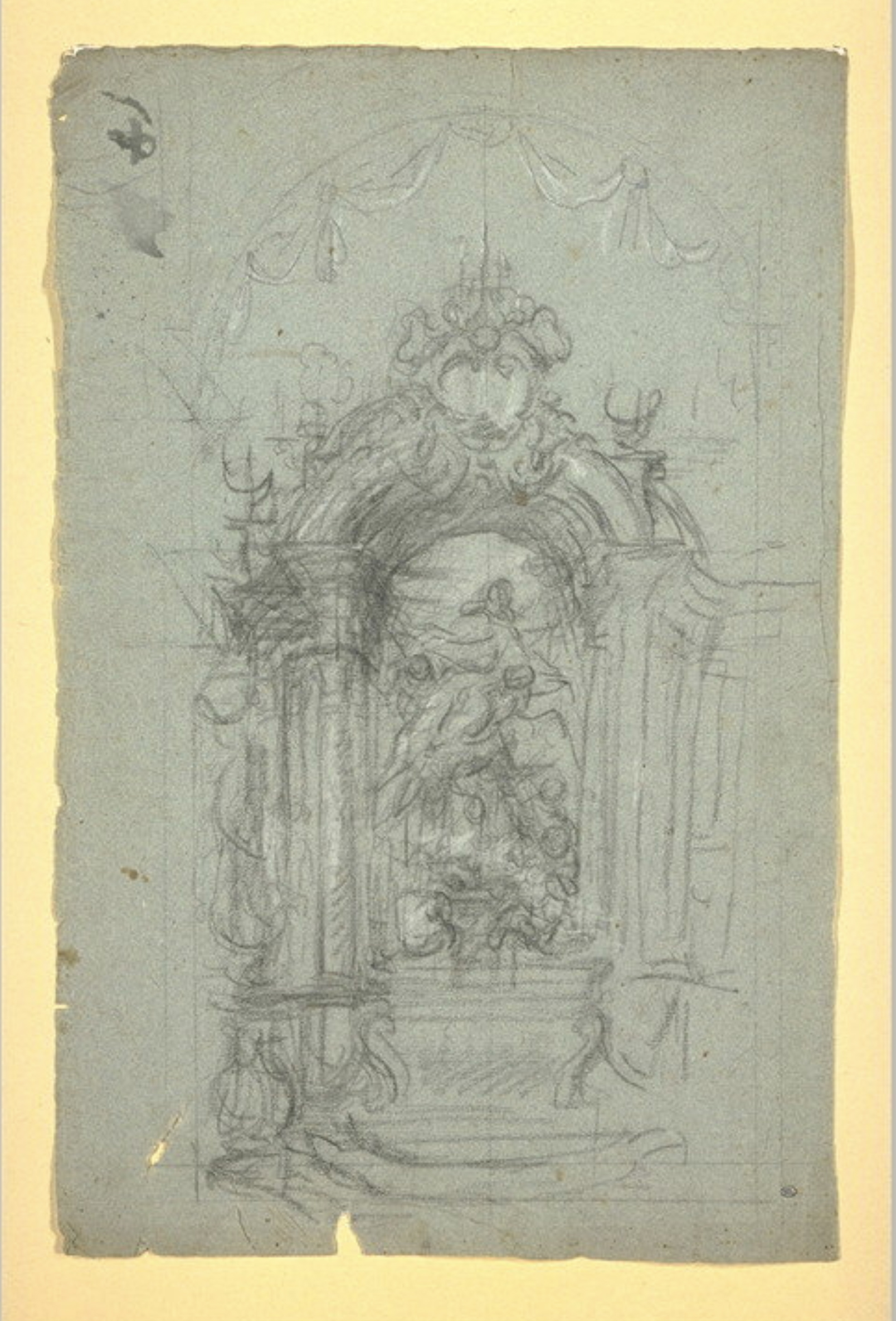
Nicolas Mignard (1606-68), design for an altarpiece with an Assumption of the Virgin, black chalk, white heightening, no dimensions given, Département des Arts graphiques, Musée du Louvre

Michel Dorigny (attrib.; 1617-65), design for a ceiling with three compartments, pencil, wash, watercolour, 24.4 x 51.4 cm., Département des Arts graphiques, Musée du Louvre
‘The presence of rams’ heads (ancient altar elements on the left) and fleurs-de-lys (border of the compartments) suggests that this is a project for a member of the Farnese family….
…The arrangement of the decorative figures and motifs offers points of comparison with the arrangement of the vault executed by Michel Dorigny around 1647-50 for the residence of Pierre Le Camus in Colombes (kept at the town hall of Port-Marly. An old copy representing a part of the ceiling is in the Canadian Centre for Architecture in Montreal). At the Hôtel de Lauzun, where Dorigny was responsible for the decoration of several rooms, around 1656-57, the variety of decorative motifs, the taste for medallions, the sense of trompe-l’oeil and the importance of the moving figures are comparable to [aspects of the present] drawing. The presence of shells and fleurs-de-lys certainly indicates a connection with a member of the royal family. Michel Dorigny was one of Cardinal Mazarin’s favourite painters. He executed several compositions for the Queen Mother’s apartment. This project could perhaps relate to Vincennes. (B. Brejon de Lavergnée in exhibition cat., Populating the skies. Parisian ceilings in the 17th century, Paris, Louvre Museum, 2014, no. 9)’.

Charles Le Brun (workshop or circle; 1619-90), design for an altarpiece, black chalk, pen-&-ink, wash, 41.7 x 55.4 cm., Département des Arts graphiques, Musée du Louvre
‘This sheet presents two elevations and a profile for an altar project. In the drawing on the left, the altarpiece is suggested rapidly in black chalk by Le Brun himself. Without too much difficulty, the painting of Christ in the Garden of Olives can be made out, with the angel holding the chalice at the right-hand side. This painting, now lost, was painted by Le Brun for Madame du Plessis-Bellière; it was then given to the Queen Mother, Anne of Austria, for her oratory, almost certainly at Versailles (see p. 381 of the L. Beauvais catalogue). Further to this, there is a high altar in one of the projects for the chapel of the north wing at Versailles (see Inv. 30239), the diagram of which is of the same type as that of the drawing on the right. These elements seem to confirm that this altarpiece design – which was probably not realized – was intended for Versailles.’

Charles Le Brun (1619-90), Mary Magdalene supported by two angels, black chalk, 32.6 x 19.5 cm., Département des Arts graphiques, Musée du Louvre
I’n his notebooks Morel d’Arleux states that this drawing was made ‘for a frontispiece’, [but]… according to the general form of the composition, this studio drawing should rather be seen as the design for an altar. The group of the Magdalene and the two angels was probably intended to be sculpted, above the painting of which the frame is sketched. J. Montagu offered an interesting interpretation of the subject (in December 1998): the drawing represents not the Magdalene but the soul of a deceased woman.’ (L. Beauvais, Musée du Louvre, Département des Arts graphiques, Inventaire général des dessins, ‘Ecole française, Charles Le Brun, 1619-1690′, tome II, Paris, RMN, 2000, n° 2502, p. 718)’.

Charles Le Brun (1619-90), frame for a looking-glass, c.1677, sanguine and black chalk, 38.1 x 23.6 cm., Département des Arts graphiques, Musée du Louvre
‘J. Montaigu (1963, n° 122) compared this project with a description in the Inventaire général du mobilier de la Couronne (pub. 1885, I, p. 277):
‘No 123 – A very large looking-glass, made by Debonnaire… in a silver frame carved with various ornaments, two large female caryatides at the sides, with drapery falling down behind them from its trompe l’oeil ‘suspension’ from the royal crown on the crest, above the arms of the King, which are supported by two figures of Fame… the said looking-glass is 10 pieds high by 6 pieds 4 pouces wide, weighing 1750m 4° 0g.’
No 124 is noted as another similar looking-glass. The Journal du Garde Meuble (AN O1 3305, fol. 40) states that these looking-glasses were delivered by Debonnaire on 16 August 1677, a few months before the death of the goldsmith and the full payment was made to his heirs in 1683.
According to A. Marie (II, 1972, p. 483,484), these glasses were to be placed on the piers between two windows, above consoles, in the Grands Appartements of Versailles, and more specifically in the salons of Mercury and Apollo (the throne room). Le Brun’s drawing, which is complete on the left side, was transferred to the right, and the artist excised some elements, since the two sides did not have to be exactly symmetrical…’ (L. Beauvais, Musée du Louvre).

Charles Le Brun (workshop or circle; 1619-90), ornament for a frame, c.1680, black chalk, 39.3 x 29.5 cm., Département des Arts graphiques, Musée du Louvre
‘Colbert asked Le Brun to create a tapestry with scenes from the life of Saint-Eustache for the church of that name. There is no record that it was made, but the Louvre has 6 drawings relating to this project… Also Le Brun’s posthumous inventory… mentions a cartoon (now vanished) for the banner of Saint-Eustache, drawn by Verdier [and retouched by Le Brun]…
The border [in the drawing above], where only the left side appears, is composed of volutes and leaves… at the bottom left, is a seated dog, symbol of Colbert’s loyalty, and in the top and bottom centres, two half-heads of deer whose antlers morph into the volutes. These two motifs [indicate] that this drawing is indeed one of the studies for the border of the banner of Saint Eustache.’ L. Beauvais, Musée du Louvre.

Charles Le Brun (workshop or circle; 1619-90), two designs for tapestry borders, black chalk, 39 x 57.4 cm., Département des Arts graphiques, Musée du Louvre
‘In these designs for tapestry, the destination of which is unknown, the tasselled border is reminiscent of a valance. The ornaments, acanthus scrolls, unicorn, vase, owl, are characteristic of the motifs used by Le Brun.’ L. Beauvais, Musée du Louvre.
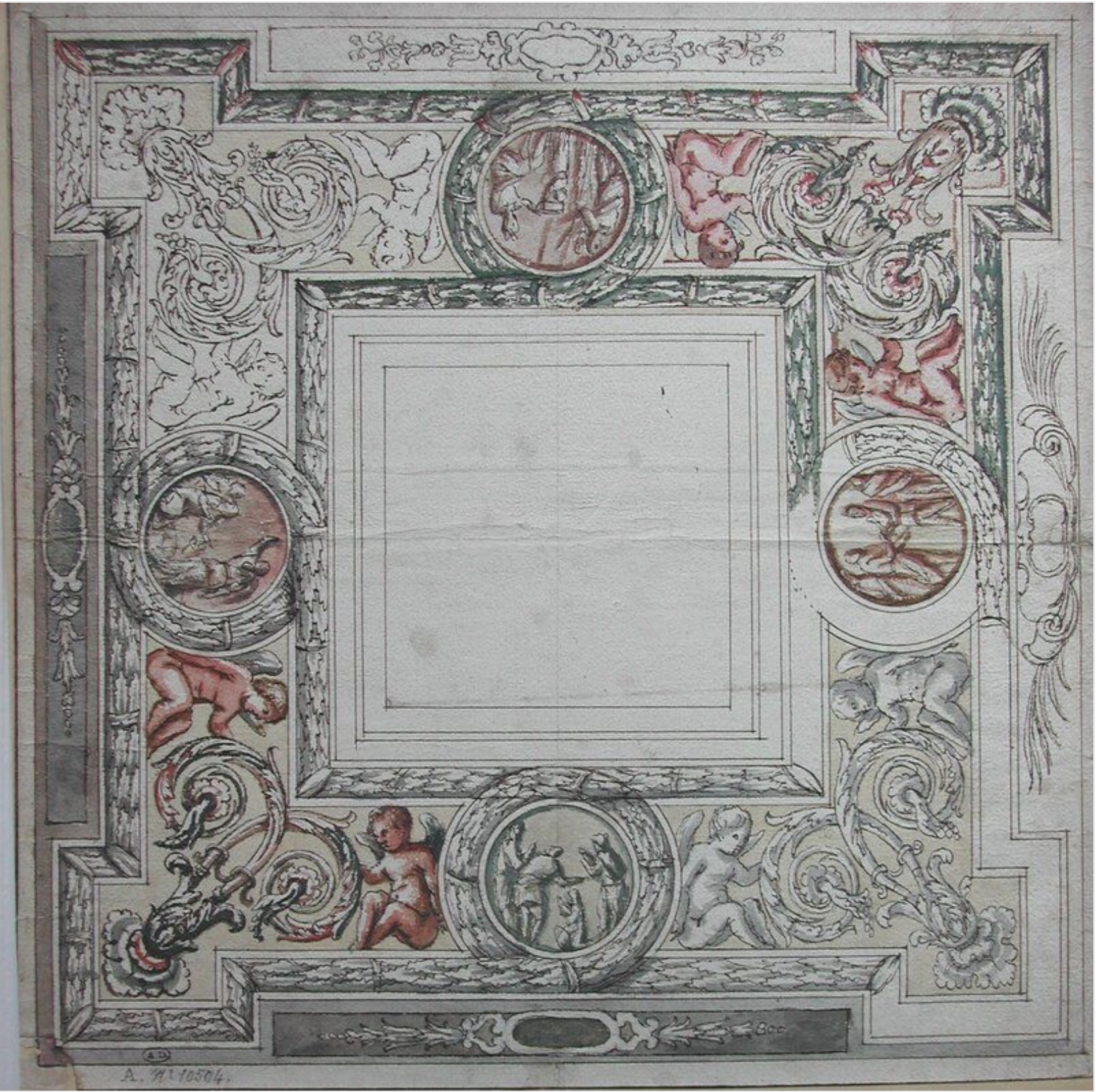
?Jean Le Pautre (1618-82; or other family member), design for a ceiling, 1633-80s, ink, wash, watercolour, 36 x 36.2 cm., Musée des Art décoratifs, Paris
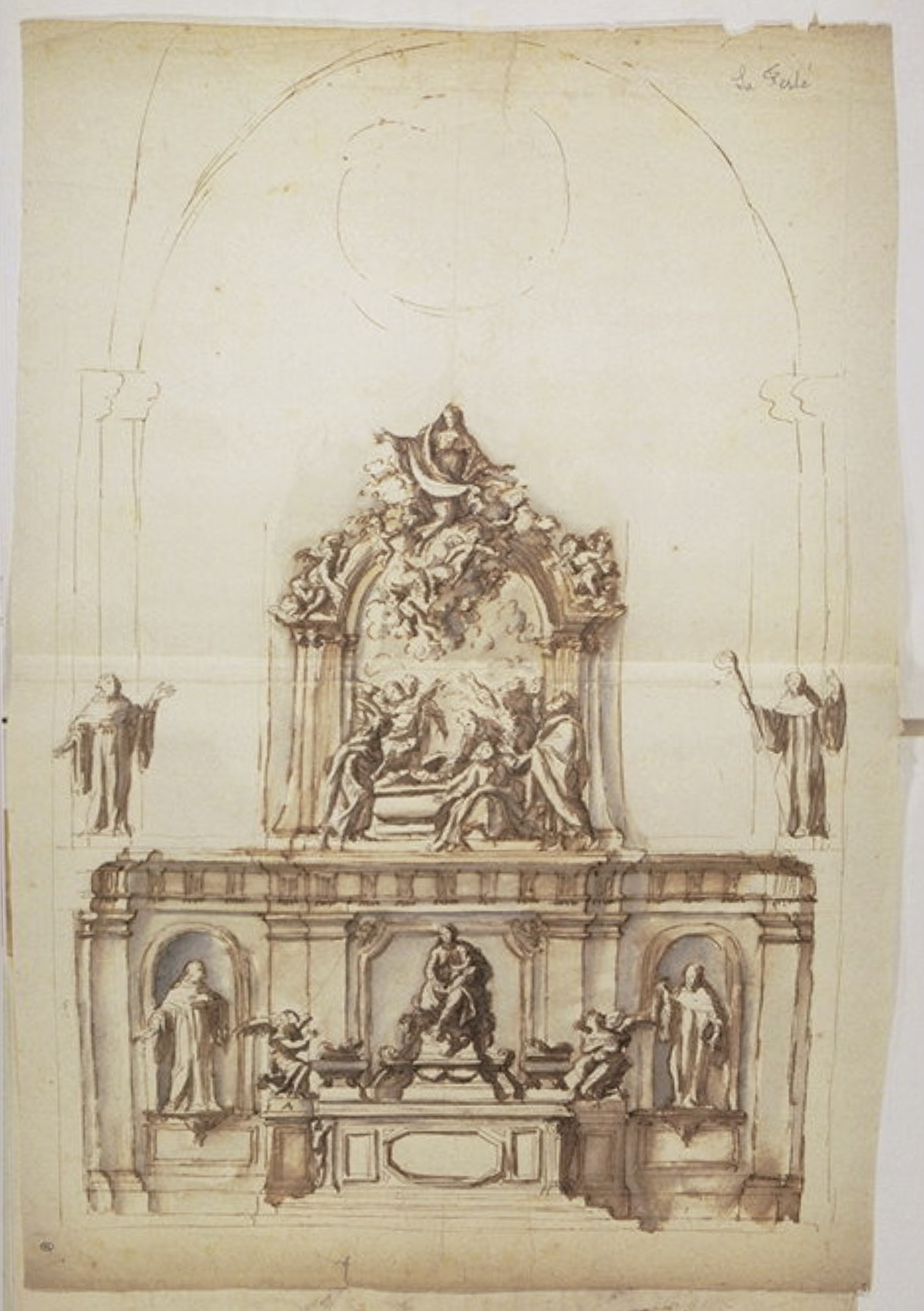
Jean Dubois (sculptor; 1625-94), design for a funerary monument with an Assumption of the Virgin above, pen-&-ink, wash, pencil, 53.8 x 36.7 cm., Département des Arts graphiques, Musée du Louvre
‘A cloister-like base in the Doric order, with an altarpiece and altar, for the choir of a Gothic church…
…[from] a hardback album covered in marbled paper, with a white spine and blue leather label bearing in gold letters: ‘J. Dubois/ Collection of original drawings’. It includes 2 engravings and 168 drawings, most of which are in pen washed with bistre or Indian ink. The first 135 are by Jean Dubois; the others by Guillaume. This album includes at the head of the volume 4 autograph documents followed by a handwritten study on Dubois by Chapuis (mayor of Messigny, near Dijon, who formed this collection)’.
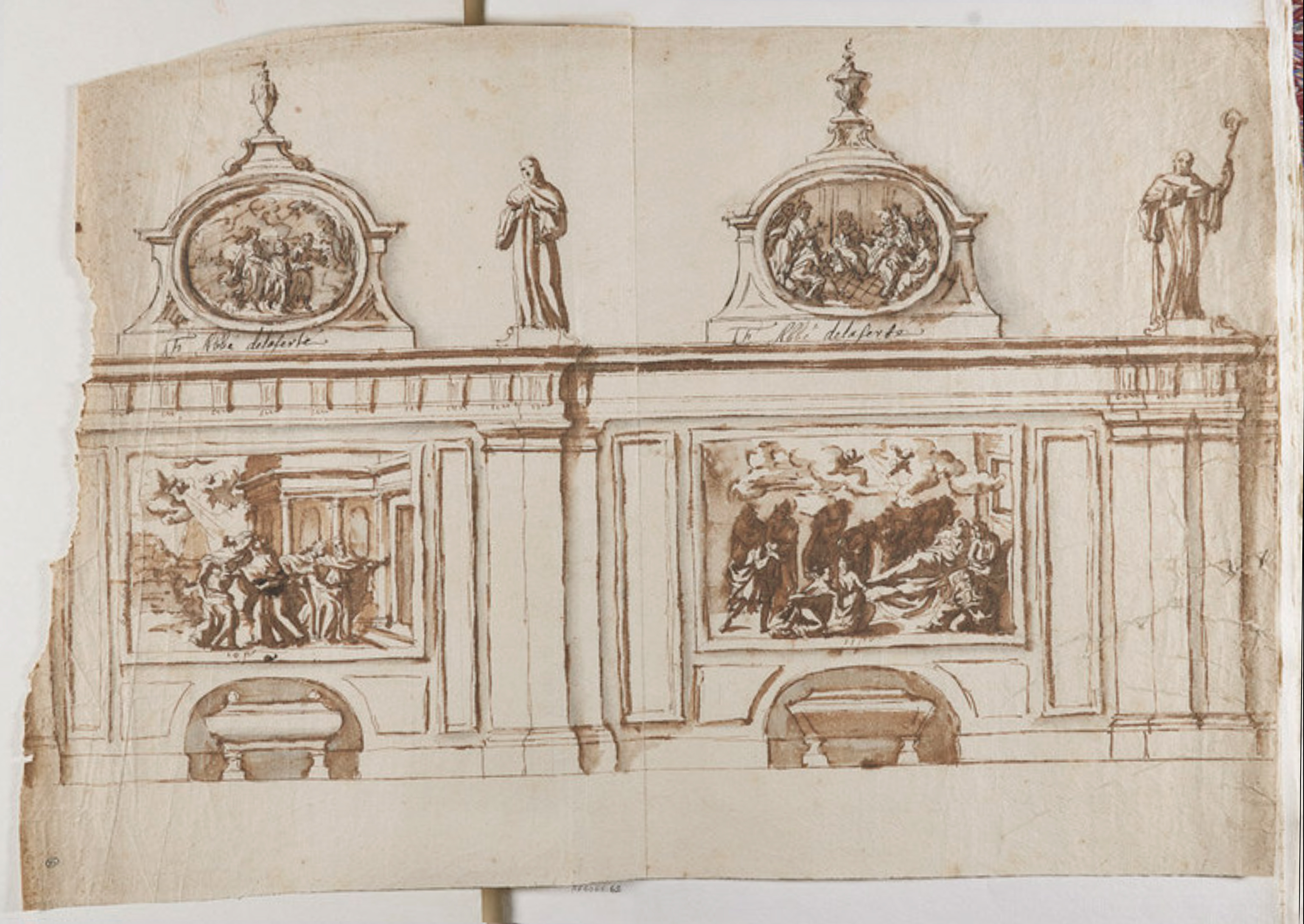
Jean Dubois (sculptor; 1625-94), design for a funerary monument with scenes from the life of the Virgin (The Visitation, Death of the Virgin, Christ amongst the doctors), pen-&-ink, wash, pencil, 53.8 x 36.7 cm., Département des Arts graphiques, Musée du Louvre
Comments as for the previous drawing by Dubois.
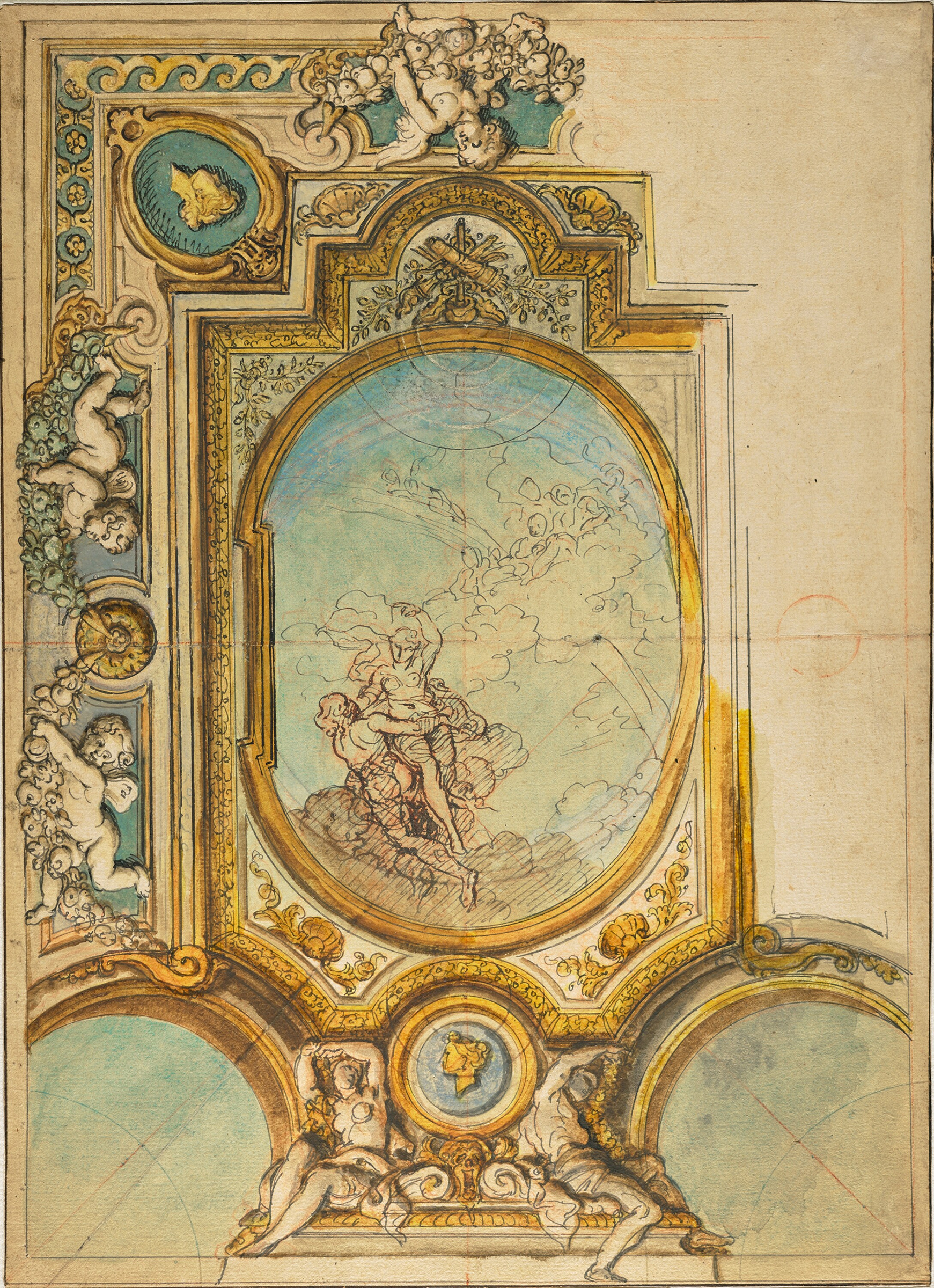
Charles de La Fosse (1636-1716), recto: studies for a ceiling decoration with the Apotheosis of Psyche, c.1680, pen-&-ink, watercolour, gouache, red chalk, 26 x 36.2 cm., J. Paul Getty Museum
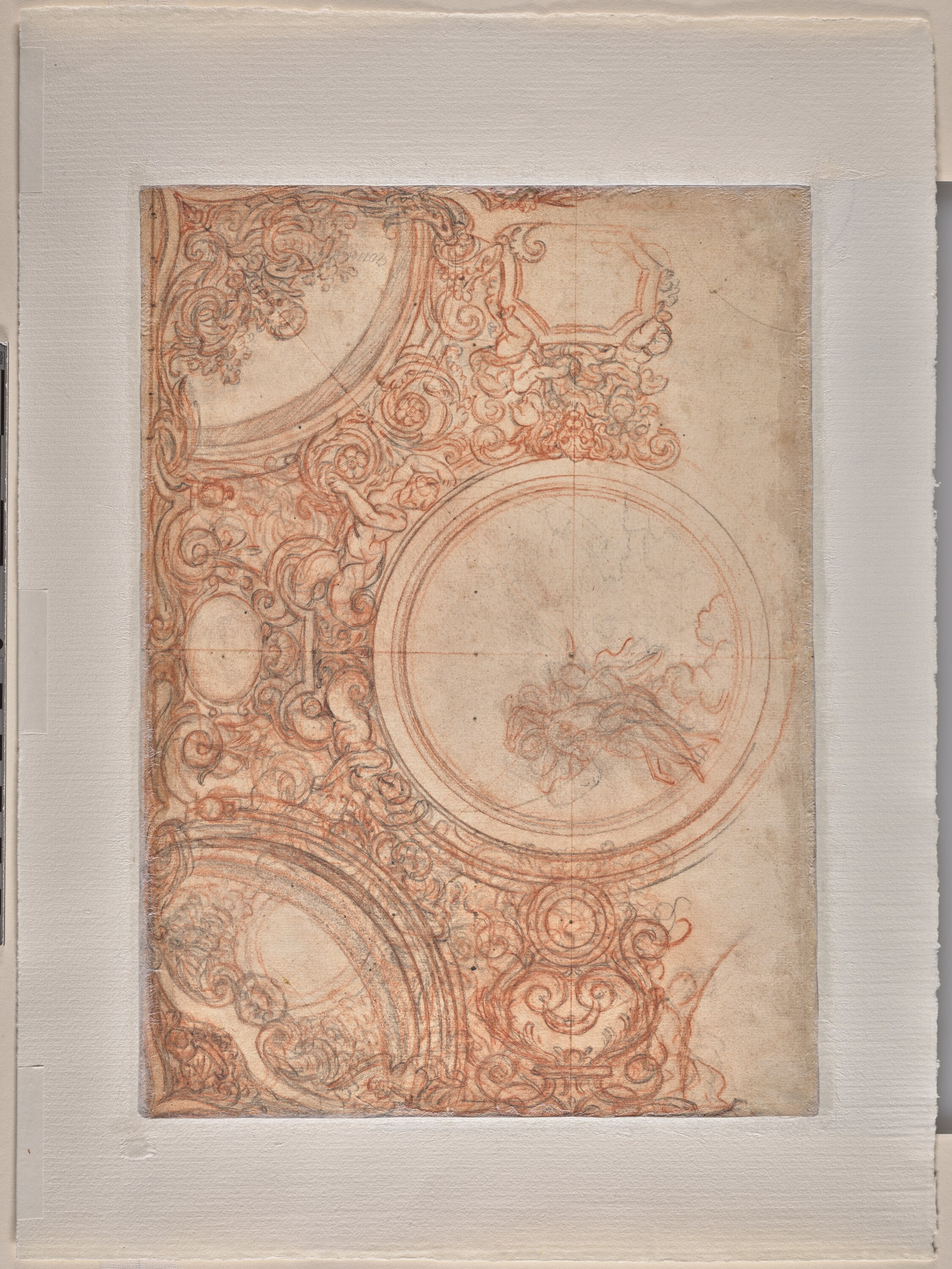
Charles de La Fosse (1636-1716), verso: studies for a ceiling decoration with the Apotheosis of Psyche, c.1680, black and red chalk, 26 x 36.2 cm., J. Paul Getty Museum
‘In the central oval of this elaborate design for a ceiling [upper image], a loosely sketched couple wrestles among the clouds while other figures watch above them. Charles de la Fosse quickly sketched the central mythological scene but focused most of his attention on the surrounding decoration. Along the border and frame, he showed various options for ornamental motifs which a patron could choose, such as putti holding garlands or draped female figures, portrait medallions or rosettes, and scrolling. The decoration, once the ceiling was built, would have been symmetrical; this drawing allowed the artist to help the patron understand his or her choices.
La Fosse used this drawing as a presentation piece for an unknown ceiling decoration project. Although the artist was one of the most fashionable decorative painters in Paris in the late 1600s, most of the private houses and palaces he decorated no longer survive, so scholars do not know whether this design was ever completed’.

Jean Berain (1640-1711), design for a ceiling, pen-&-ink, wash, 20.3 x 29.4 cm., Metropolitan Museum, New York
‘Design for the decoration of a ceiling, with a variation for the right side. Both sides of the design are in the style of the late Baroque and include decorative details such as putti, shells, palmettes, leaves, ribbons and garlands.’
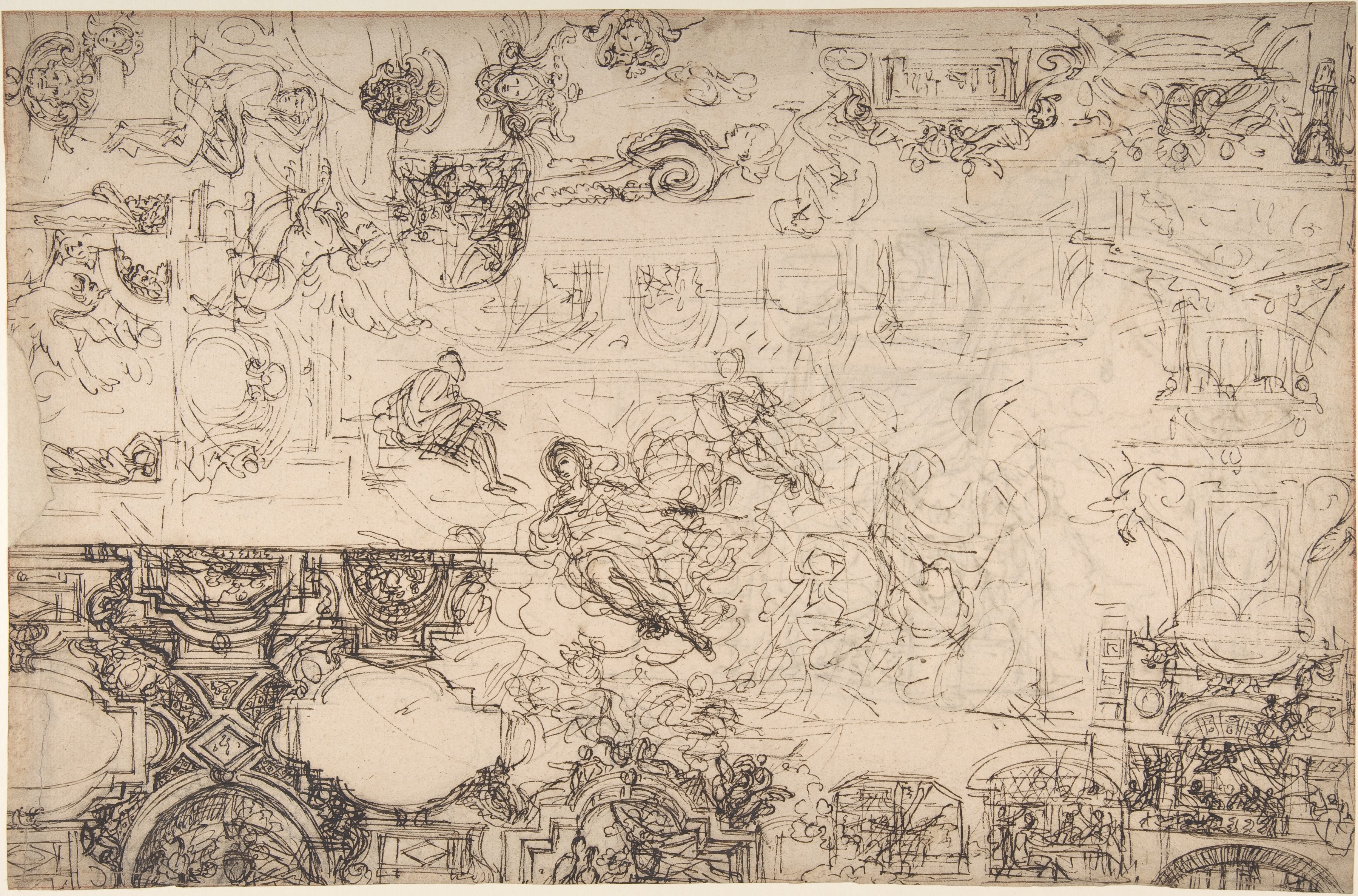

Michel Corneille II (1642-1708), Studies for a ceiling, recto & verso, 1660-80, pen-&-ink, pencil, 28.8 x 44.1 cm., Metropolitan Museum, New York
‘This sheet of energetic sketches has been attributed to the French 17th century painter Michel Corneille the Younger, a successful and prolific decorator of royal residences. The artist studied in Italy and trained under Pierre Mignard (1613-76) and Charles Le Brun (1619-90). Corneille II was also a practiced printmaker, who was employed by the German banker Everhard Jabach (1618-95) to engrave the best Italian drawings in his collection. The artist covered the sheet here with a large number of individual sketches, featuring ideas for figural groups, for ornament, and for the overall scheme of a compartmentalized ceiling. Although it is not certain for which building this ceiling design was intended, the ornamental motifs and the crisp style of draughtsmanship are thoroughly characteristic of Corneille’s work.’
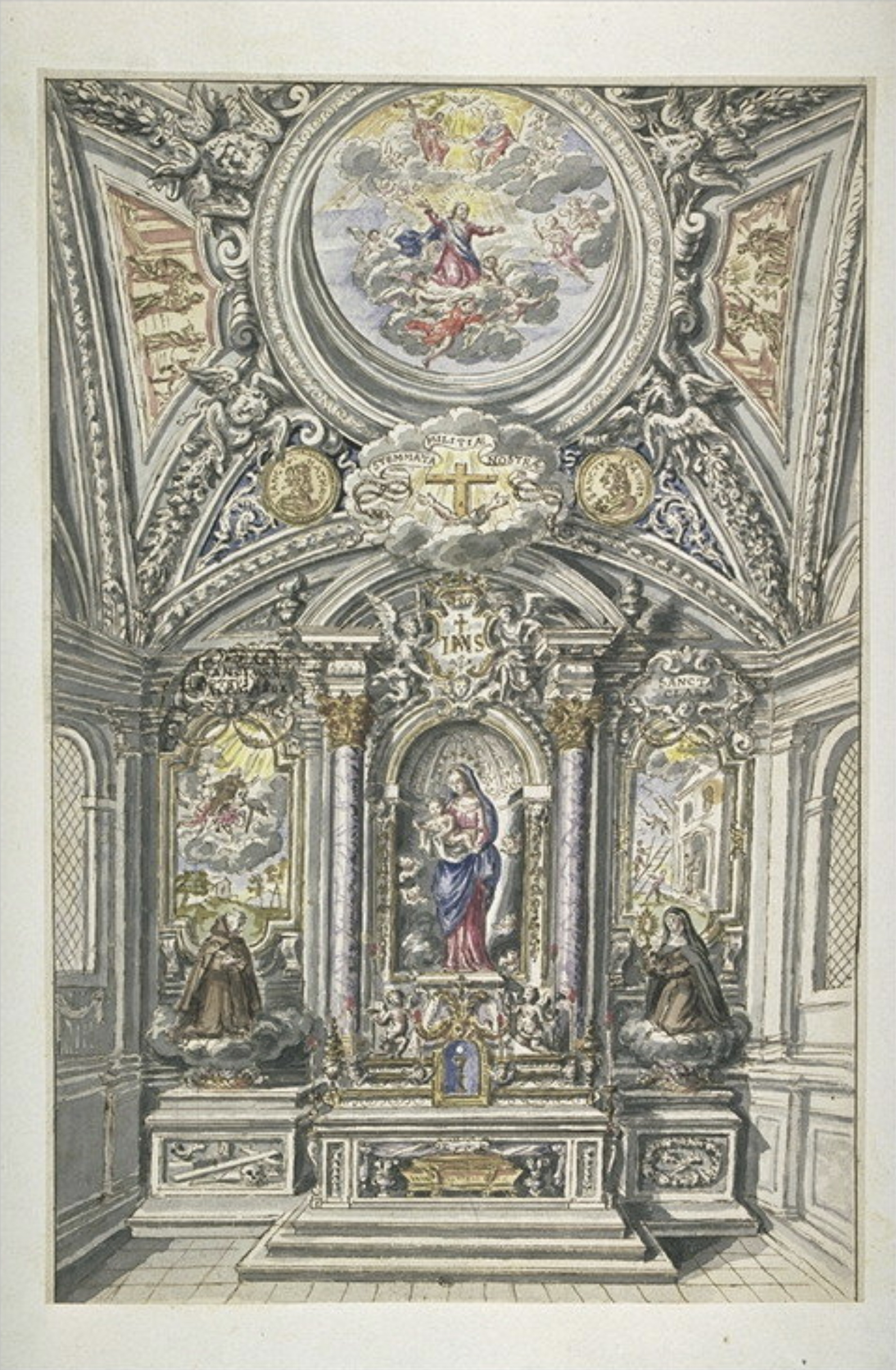
Pierre-Paul Sevin (1646-1710), design for an altar, 40 x 26.8 cm., pen-&-ink, wash, heightened with gold, watercolour, Département des Arts graphiques, Musée du Louvre

Pierre-Paul Sevin (1646-1710), design for an altar, 43.1 x 26.5 cm., pen-&-ink, wash, watercolour, heightened with gold, Département des Arts graphiques, Musée du Louvre
‘On either side of the altar are paintings of SS Vincent and Isidore’.
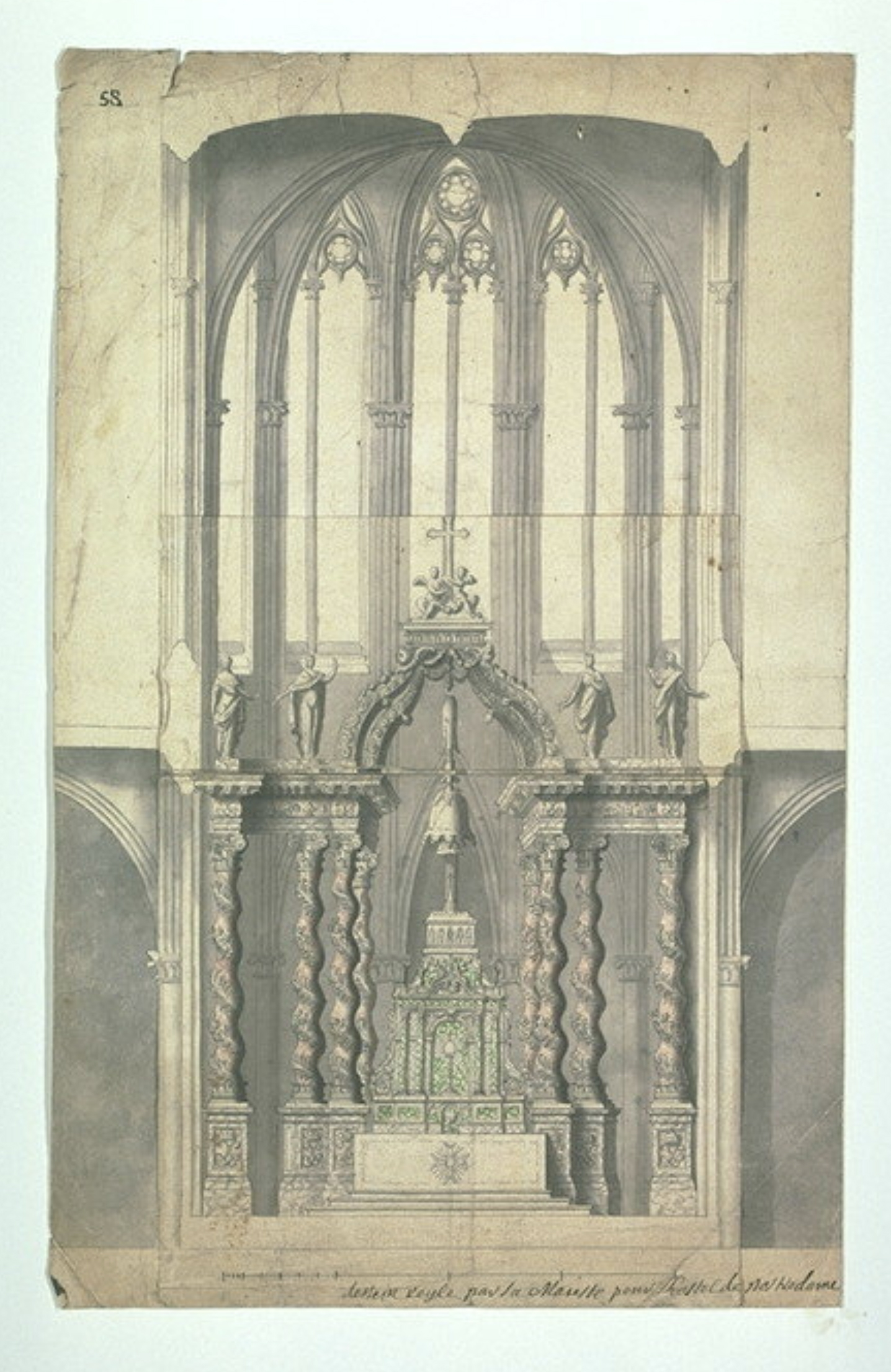
Anon., 17th century French school, design for an altar for Notre-Dame de Paris, pen-&-ink, wash, watercolour, 43.8 x 27.9 cm., additional sheets 88 x 20.5 and 18.7 x 20.5 cm., Département des Arts graphiques, Musée du Louvre
An ‘…altar framed by four columns with Corinthian capitals supporting an entablature on which are six draped figures. There are two additional sheets of paper with alternative arrangements with four Salomonic columns and six statues. An inscription at the bottom reads:
‘Dessein réglé par sa Majesté pour l’hostel de Nostre Dame’ (design decided upon by his Majesty for the cathedral of Notre-Dame)’.
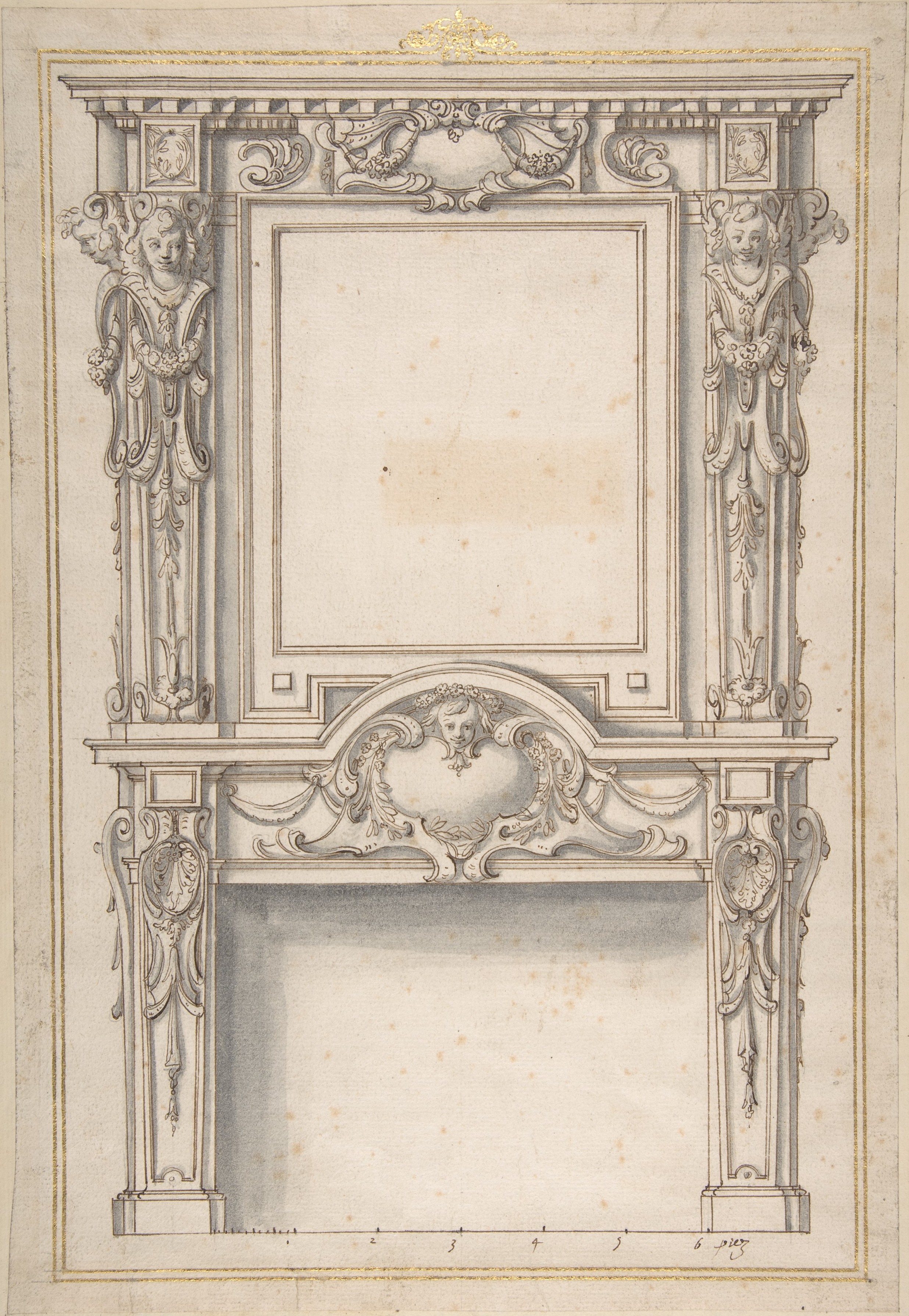
Anon., 17th century French school, design for a chimneypiece after Jean Barbet (1605-54), 1633 or later, pen-&-ink, wash, gold paint, 35.2 x 23.8 cm., Metropolitan Museum, New York
‘This drawing reproduces a chimneypiece published in a print series by Melchior II Tavernier (1595-1665) in 1633. Eight years earlier, Tavernier had hired a young artist called Jean Barbet to record some of the latest novelties in interior design from in and around Paris, which were then etched by Abraham Bosse (1602/04-1676). The rich and sculptural designs proved so popular that, shortly after their publication, copies were made in The Netherlands, Germany and England. In addition to printed copies, a luxurious set of drawn copies was also made in France, intended for the British architect Inigo Jones (1573-1652) and the so-called ‘Office of Works’ to present to Henrietta Maria, wife of Charles I. Jones was to interpret the designs in his own manner and execute them in several palaces belonging to the British royal family.’

Anon., 17th century French school (formerly attrib. Jean Le Pautre, 1618-82), elevation of a Royal bedroom, 1656-57 or later, pen-&-ink, wash, 18.8 x 30.9 cm., Metropolitan Museum, New York
‘Jean Lepautre was the elder brother of the architect Antoine Le Pautre. He is known mainly for his enormous production of prints, of which a large part contains designs for architecture, the interior and ornament, often based on his own designs. He devoted ten series, comprising a total of 71 prints, to designs for bedrooms, some of which contain narrative scenes while others are purely focused on the aspect of design. This drawing relates to the series ‘Alcoves à l’Italiene’ [sic] (Alcoves in the Italian manner) which was published by Pierre II Mariette around 1656-57. It shows an elegant canopy bed, supported by caryatids and crowned by a fleur-de-lys. This emblem of the French monarchy is used as a theme throughout the interior, returning in the crown surmounting the alcove, the woodwork of the balustrade, the wallpaper and the draperies.’
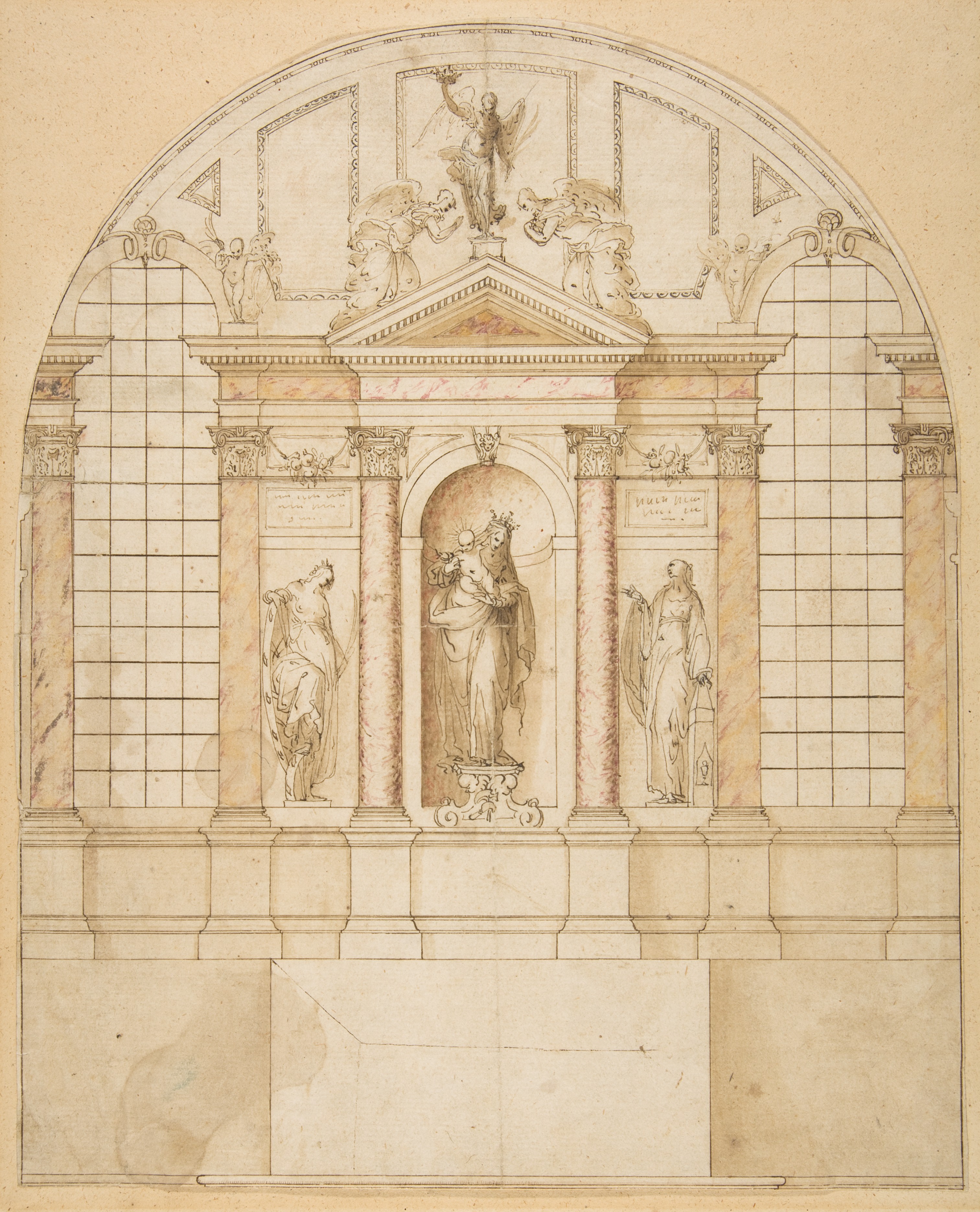
Anon., French school, design for an altarpiece, late 17th– early 18th century, pen-&-ink, wash, 30.4 x 24.6 cm., Metropolitan Museum, New York
 The Frame Blog