
Italy
17th century Italian drawings
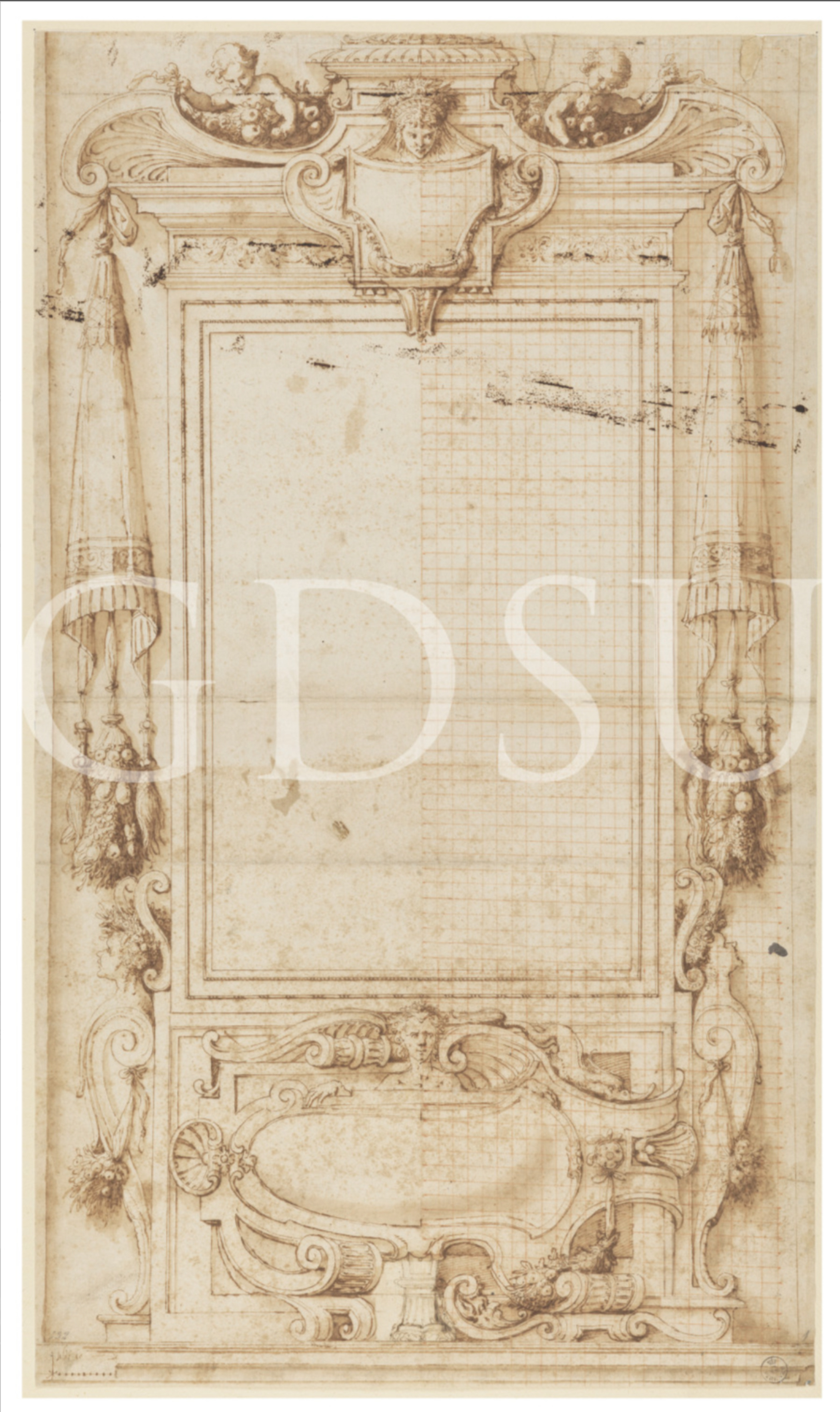
Jacopo Ligozzi (1547-1627), design for a Mannerist frame, pen-&-ink, wash, squared up with red chalk, 62.8 x 36 cm., Gallerie degli Uffizi
‘The circumstances of the execution of this drawing are unknown, but it was certainly intended for a decorative project of importance, in the dimensions alone (almost 3.5 m wide and 6 m high), which have been indicated by the artist. The elevation is that of an altar, without a table, and must have included a painting… In the lower section… is a large cartouche, elaborated in two alternatives, both with a markedly Mannerist imprint. The right option was preferred, as indicated by the grid…’
It is compared with other examples of Ligozzi’s work in 1608 and 1615, and is suggested as being intended for a trompe l’oeil painting, rather than a sculpture.

Giovanni Lanfranco (1582-1647), design for a wall decoration, 1616-17, pen-&-ink, wash, traces of red chalk, white heightening, 15.9 x 40.6 cm., Metropolitan Museum, New York
‘The artist made this fluid and graceful drawing in preparation for the fresco decoration of the Sala Regia in the papal Palazzo del Quirinale, a commission from Pope Paul V on which Lanfranco worked in 1616–17 along with Agostino Tassi, Carlo Saraceni, and others.
Erich Schleier (1970) related this drawing to the project for the decoration of a section of the frieze in the Sala Regia of the Quirinal Palace in Rome and identified it as the design for a section of a decorative frieze on the end wall of this important hall – a large room of the Swiss Guard in the Quirinal (also known as Sala de’ Svizzeri and Sala de’ Corazzieri). This end wall gives access to the Pauline Chapel, frescoed by Michelangelo around 1546…
…The rectangular frames, clearly designed for windows, appear on the Metropolitan Museum of Art’s drawing as they do in the Sala Regia, that is immediately below the upper cornice of the frieze. On the left, between two windows, is the scene of the ‘Sacrifice of Isaac.’ This scene, designed to be represented as on a tapestry, was intended as the actual centre of the finished design. The allegorical figures surrounding the Sacrifice of Isaac are probably Virtues. On the right is the narrative scene of the Flight into Egypt…’
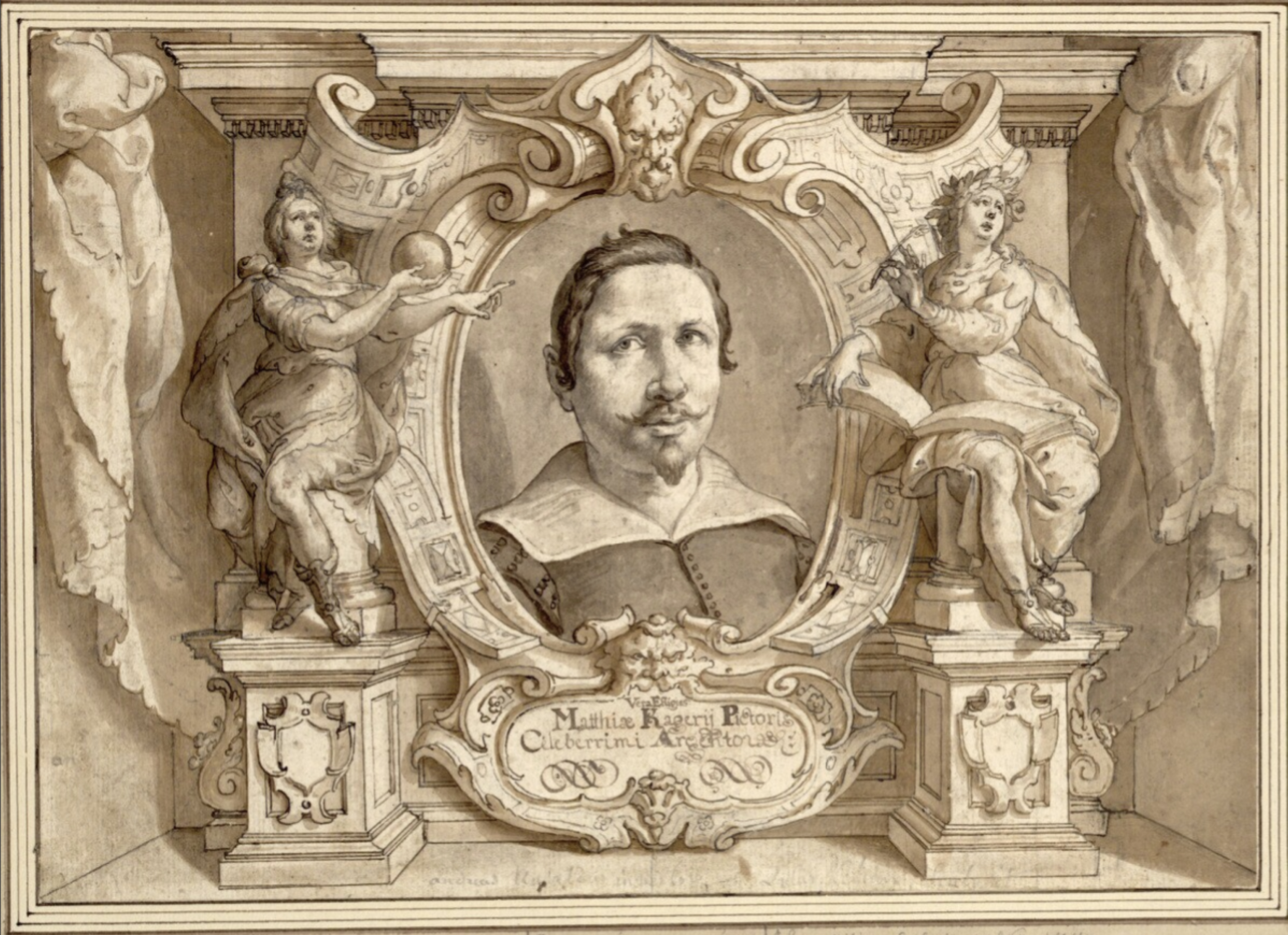
Andrea Ansaldo (1584-1638), design for a portrait bust of the artist Matthias Kager, to be carved by Lucas Kilian (Augsburg; 1579-1637), 1620, pen-&-ink, wash, stylus, 24 x 33.7 cm., Albertina, Vienna
Inscribed in the cartouche:
‘Vera Effigies / Matthiae Kagerij Pictoris / Céleberrimi Argentor’; beneath, in chalk, ‘andrea Ansaldi inven. 1620’ (?) and (rubbed off, but retained on the mount) ‘Lucas Kilian sculpsit’.
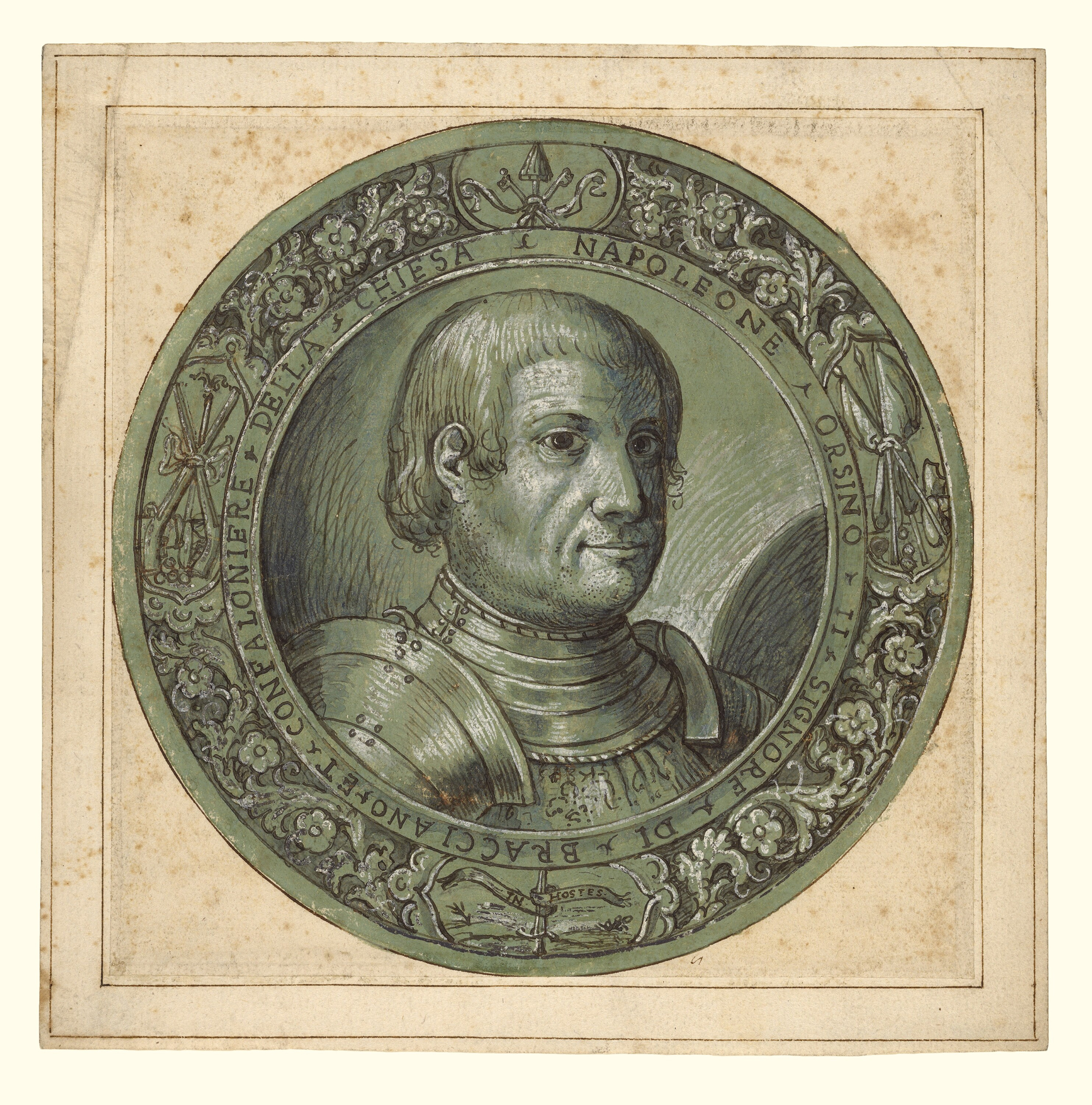
Giovanni Campagna (German?, fl.1616-33), Portrait of Napoleone Orsini II, c.1619, pen-&-ink, wash, white heightening, 17.1 x 17.8 cm., J. Paul Getty Museum
‘A portrait of a man dressed in armour fills the centre of this tondo… He is identified by an inscription as Napoleone Orsini II, Lord of Bracciano and standard-bearer of the Catholic Church. The border is embellished with floral motifs, military trophies, the papal regalia of the crossed keys and papal crown, and the sitter’s personal motto In hostes.
The portrait relates to a set of engravings which illustrates a manuscript entitled Elogii di cento e più personaggi illustri di casa Orsina (Archivio Storico Capitolano, Rome). Recounting the history of the Orsini family up to c.1460–70, the text and the accompanying prints were created by a little-known artist of German origin called Giovanni Campagna. It has been suggested that the Getty drawing was made as a presentation sheet to secure a patron’s support, which would have allowed Campagna to bring the manuscript up to date’.

Raffaello Vanni (1587-1673), Allegorical figure (?Ecclesia), with St Peter’s Basilica in a frame with emblems of St Peter, chalk heightened in white, 41.2 x 26.5 cm., Albertina, Vienna
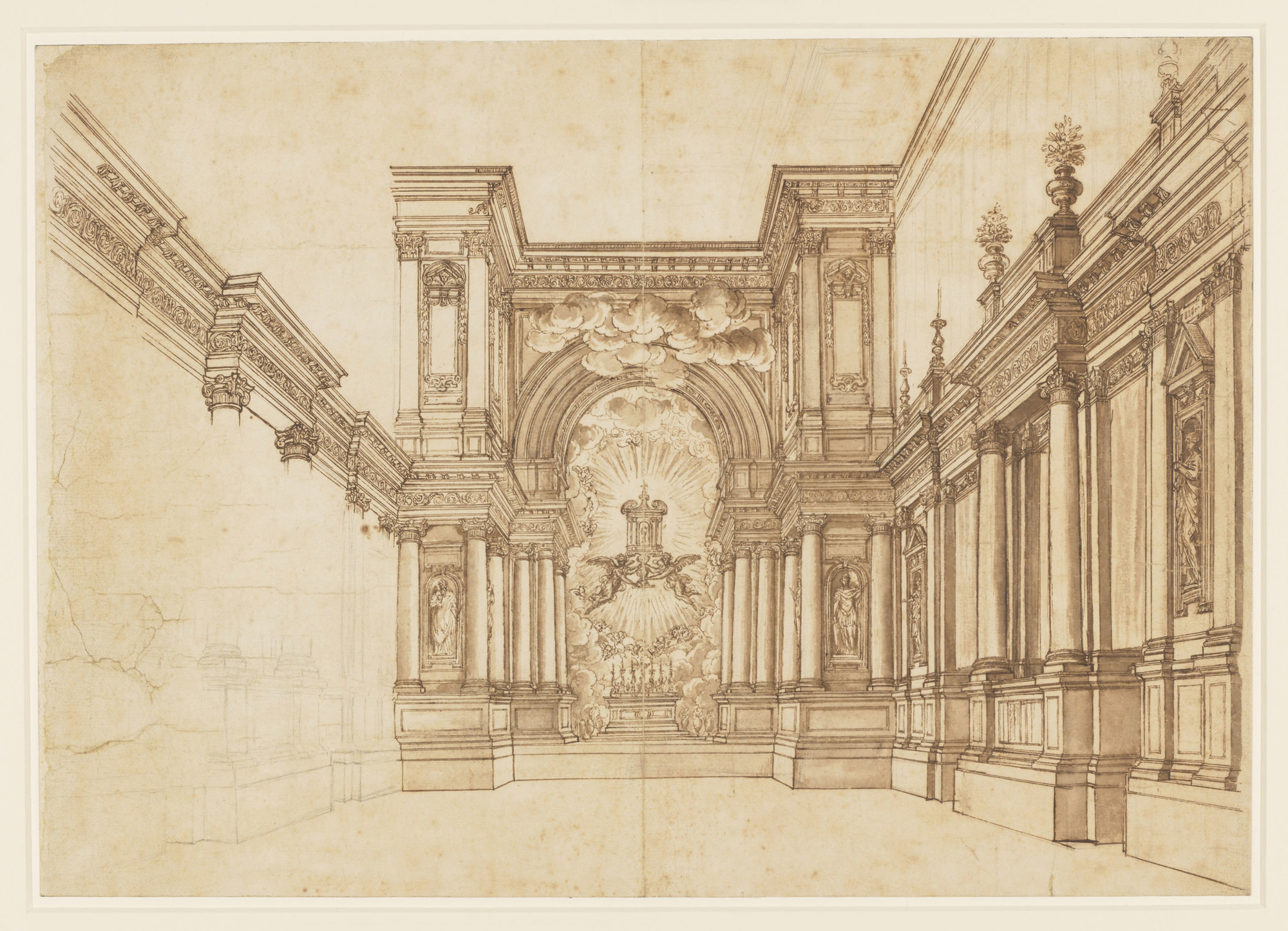
Pietro da Cortona (1596-1669), A design for a Quarantore (in San Lorenzo in Damaso, Rome), c.1632-33, pen-&-ink, wash, chalk, 39.8 x 56.8 cm., Royal Collection Trust. RCIN 904448
‘…The altar was surrounded by clustered columns supporting a triumphal arch, in front of which hung painted clouds. At the centre of the arch was the host itself, displayed in a monstrance supported by airborne angels, set against a backdrop of a sunburst with cherubs and clouds.’
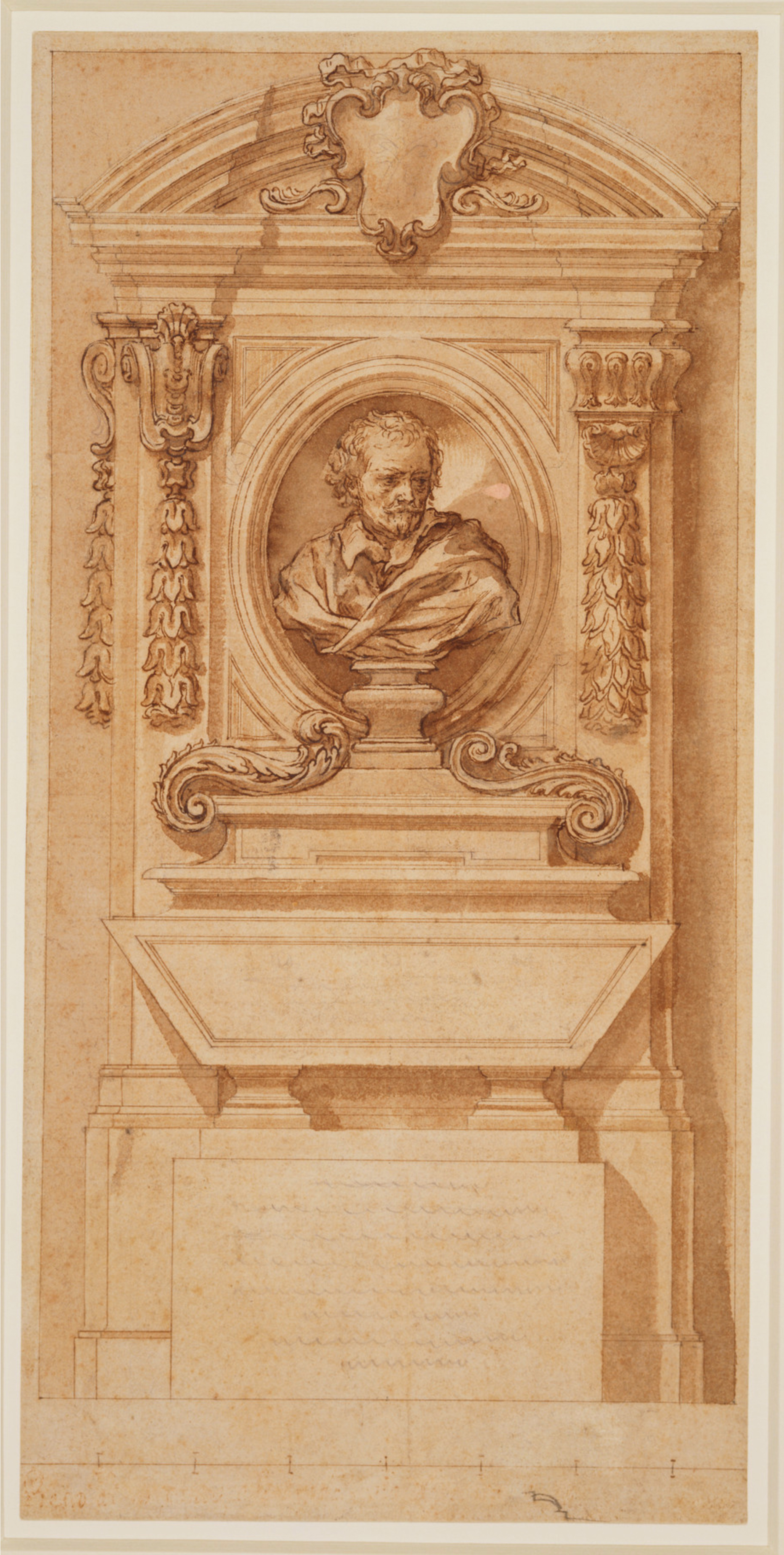
Pietro da Cortona (1596-1669), design for the artist’s tomb, c.1630-35, pen-&-ink, brown wash chalk traces, 34.5 x 16.9 cm., Royal Collection Trust. RCIN 904449

Pietro da Cortona (1596-1669), design for part of altarpiece frame, pen-&-ink, black chalk, brown wash, 18.7 x 12.3 cm., Royal Collection Trust. RCIN 904472
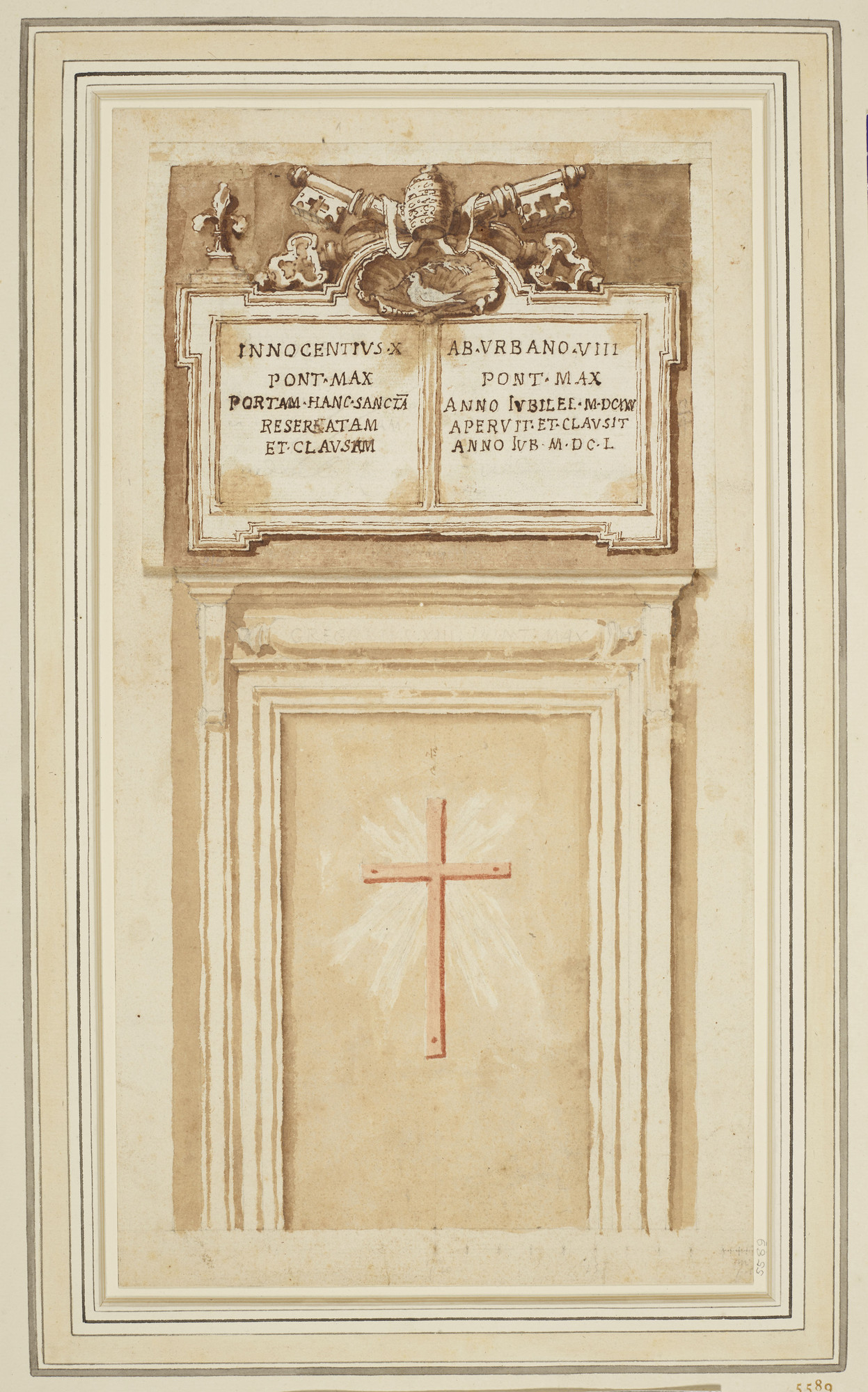
Bernini (1598-1680), design for the door of the Porta Santa, St Peter’s, Rome, c.1639-49, Royal Collection Trust. RCIN 905589

Bernini (1598-1680), design for the tomb of an ecclesiastic, c.1640-49, pen-&-ink, wash, 37.3 x 22.4 cm., Royal Collection Trust. RCIN 905605
‘A design of a memorial featuring a sculpted figure in ecclesiastical dress, seated in a sort of loge, turned presumably towards the altar; below a tablet with indications of an inscription and a winged skull, and above, a blank coat of arms. The design is related in general terms to the side groups in the Cappella Cornaro in Santa Maria della Vittoria, and the tombs in Cappella Raimondi in San Pietro in Montorio.’
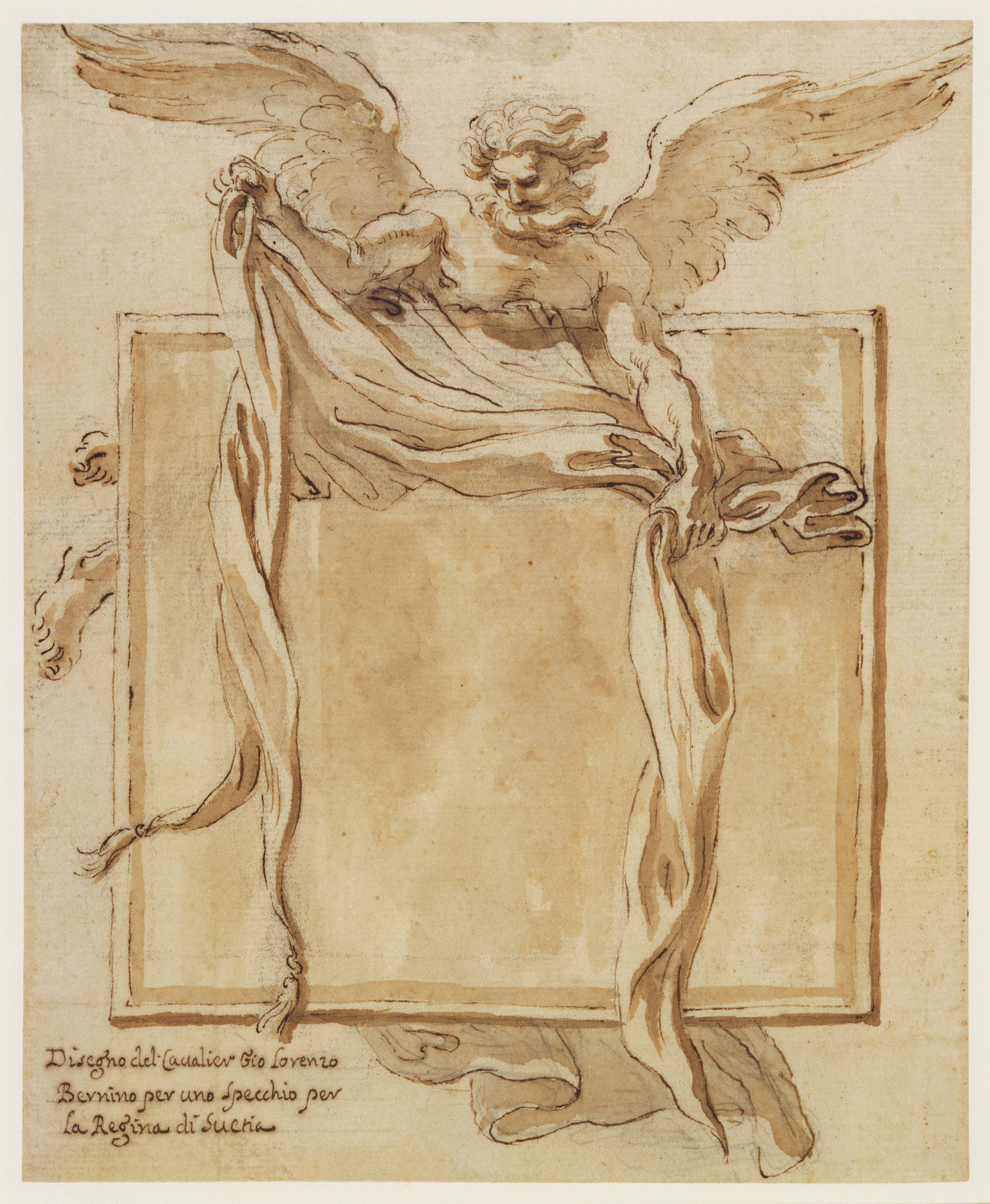
Bernini (1598-1680), design for a looking-glass for the Queen of Sweden, c.1656, pen-&-ink, wash, black chalk, 23 x 18.8 cm., Royal Collection Trust. RCIN 905586
‘A drawing of a square looking-glass with the winged figure of Chronos above, holding drapery which falls to form framing curtains within the square. Inscribed, lower left: Disegno del Cavalier Gio. Lorenzo Bernino per uno specchio per la Regina di Suetia.’
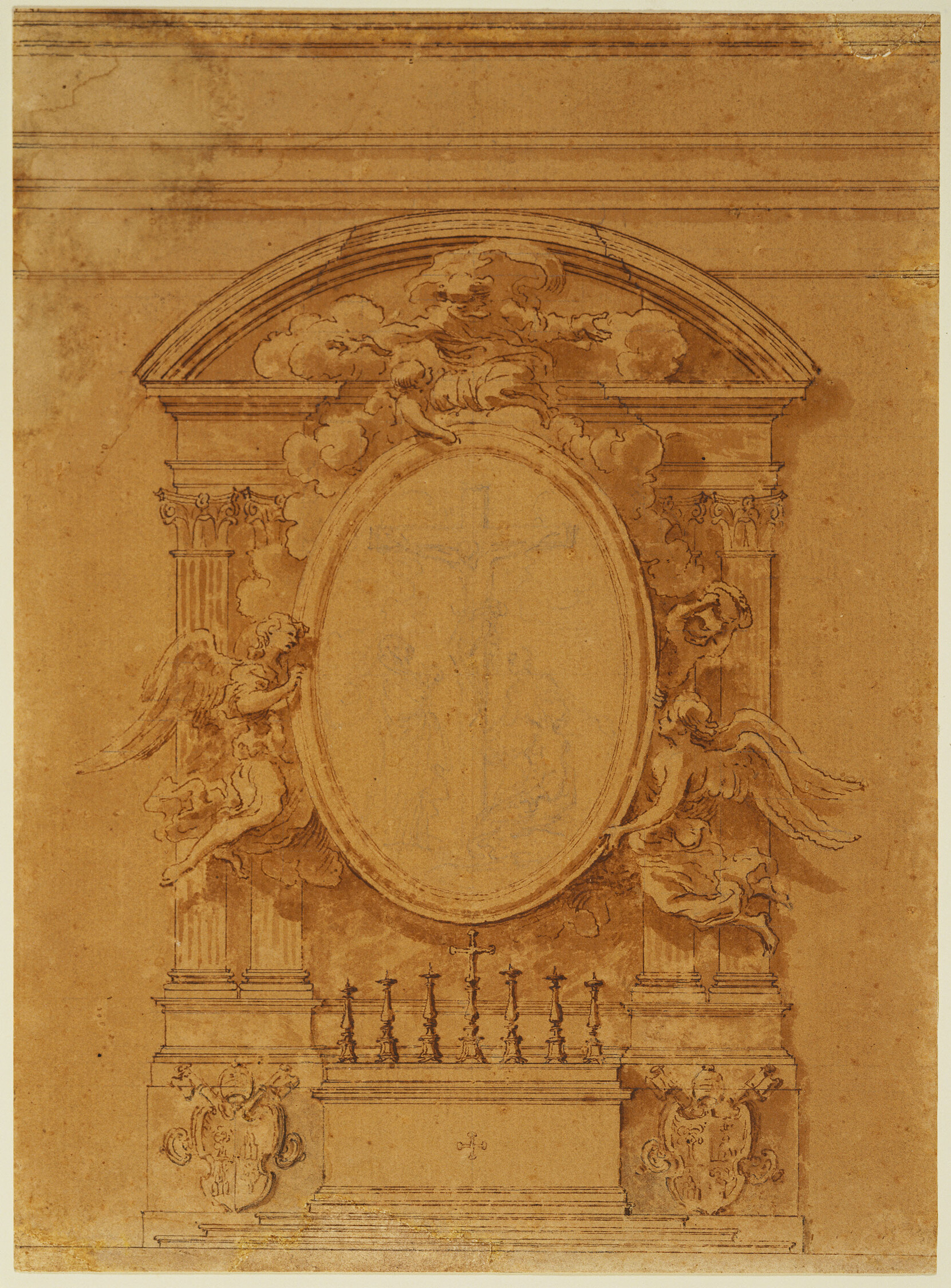
Bernini (studio; 1598-1680), drawing for the high altar, San Tommaso da Villanueva, Castel Gandolfo, c.1658-60, pen-&-ink, wash, black chalk, 24.5x 18.1 cm., Royal Collection Trust. RCIN 905615
‘… executed 1660-61, with stucco work by Antonio Raggi; paired Corinthian columns flank a large oval medallion, which is supported by angels on the left and right, and surmounted by God the Father kneeling under a segmental pediment. Within the medallion is a lightly indicated representation of the Crucifixion altarpiece. See also RCIN 905588‘.
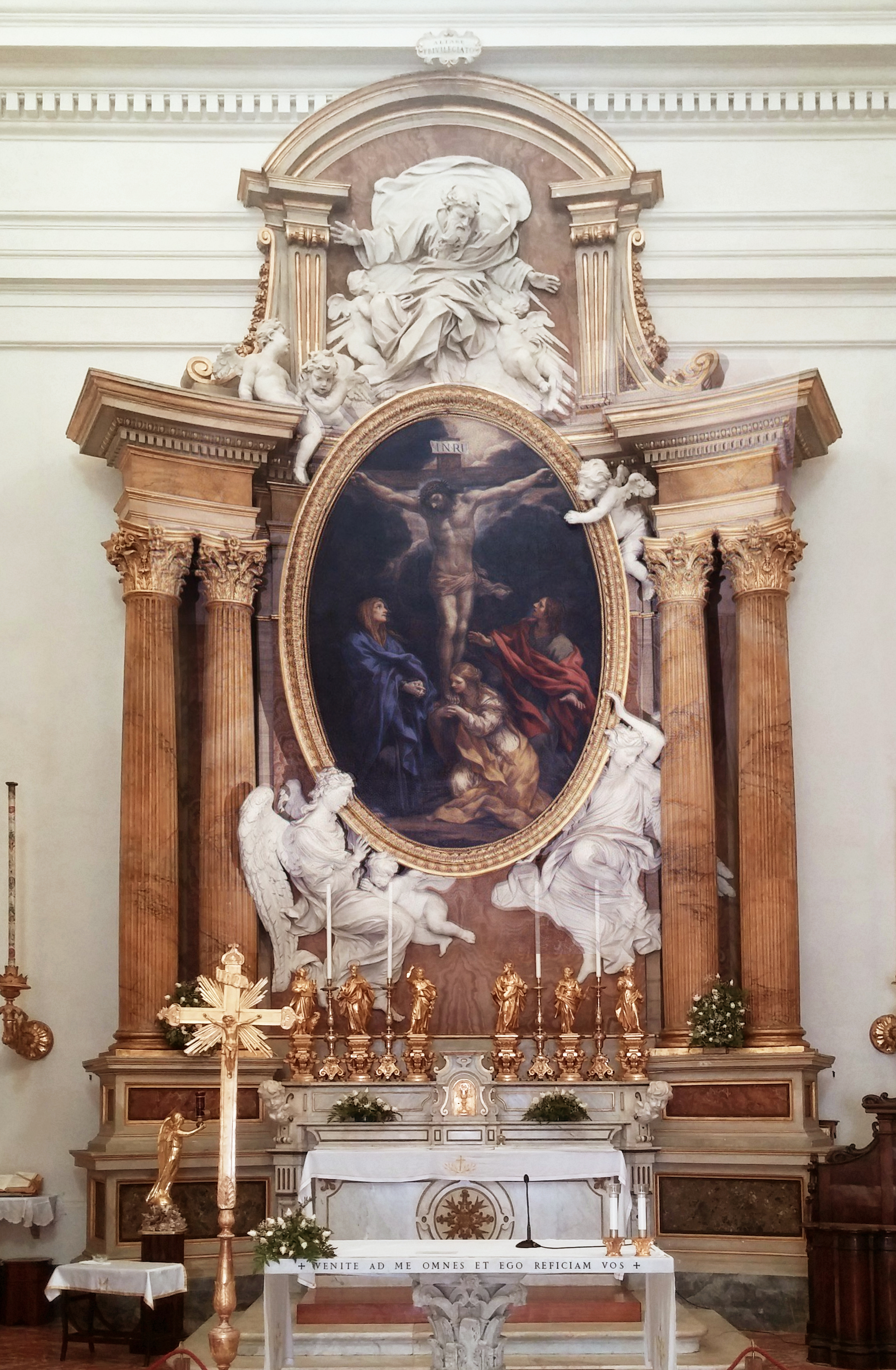
Bernini (1598-1680), interior and high altar, from 1658; Antonio Raggi (1624-85), stucco; Pietro da Cortona (1596-1669), Crucifixion, 1661, San Tommaso da Villanueva, Castel Gandolfo
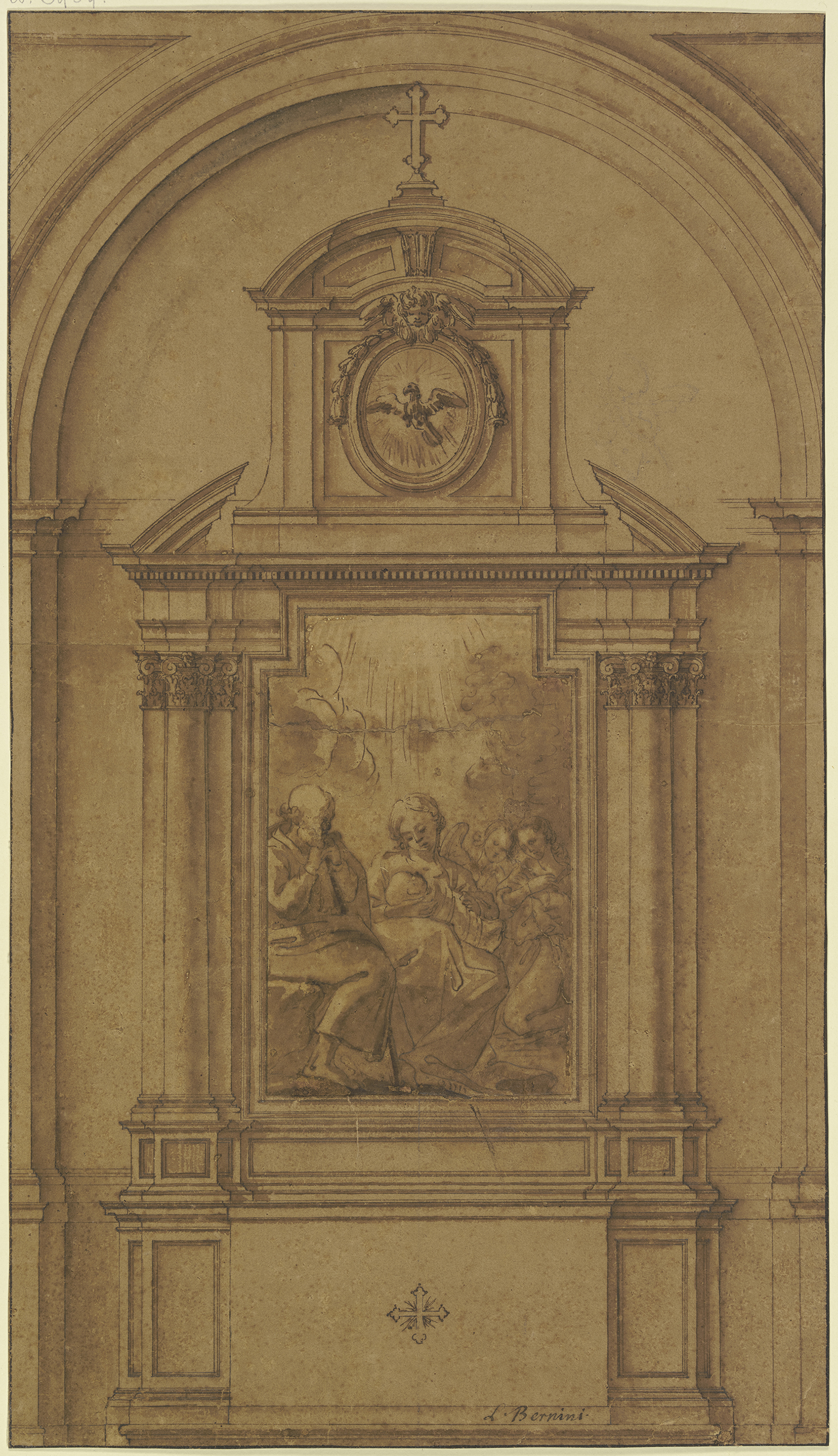
Bernini (1598-1680), design for altarpiece with the Holy Family, 17th century, pen-&-ink, wash, 40.3 x 23 cm., Städel Museum, Frankfurt

Bernini (workshop; 1598-1680), first design for the Cathedra Petri, St Peter’s, Rome, 1656-57, pen-&-ink, black chalk, 24.1 x 14.5 cm., Royal Collection Trust. RCIN 905614
‘A design for the model of the Cathedra Petri, St Peter’s, Rome: the gilded throne is supported by St Ambrose and St Augustine, and an angel hovers above with the papal tiara and keys. Inscribed below: Del Cavalier Gio: Lorenzo Bernino. The decision to create a worthy setting for the Chair of St Peter was made in 1656. In the next year a first model was produced. In the execution (1660-66) the project was greatly enlarged.’
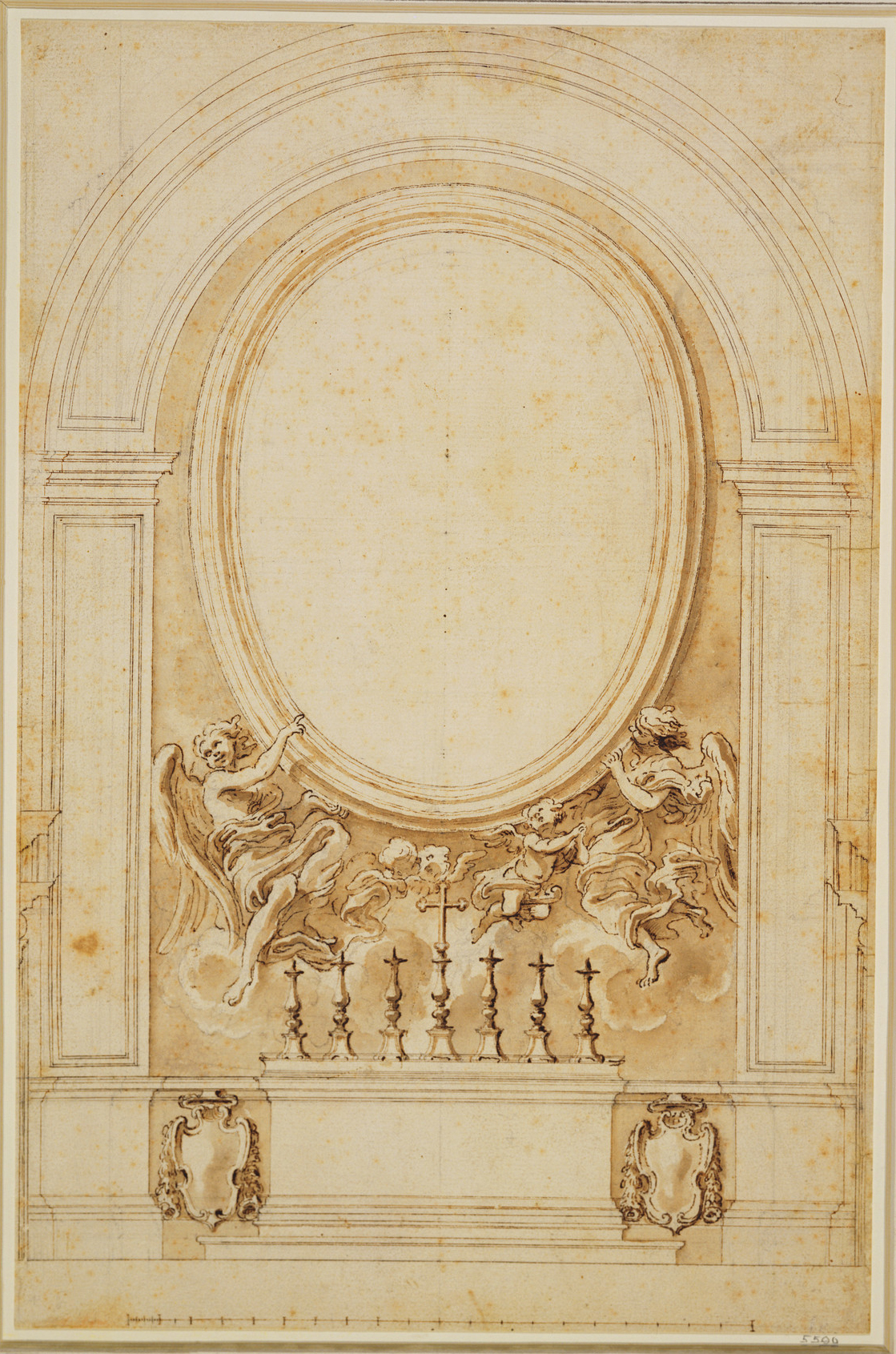
Bernini (workshop; 1598-1680), design for altar of Cappella Fonseca, S. Lorenzo in Lucina, Rome, c.1661-63, pen-&-ink, wash, black chalk, 39.9 x 26.5 cm., Royal Collection Trust. RCIN 905599

Bernini (1598-1680), Cappella Fonseca, S. Lorenzo in Lucina, Rome, with Giacinto Gimignani, Annunciation, 1664
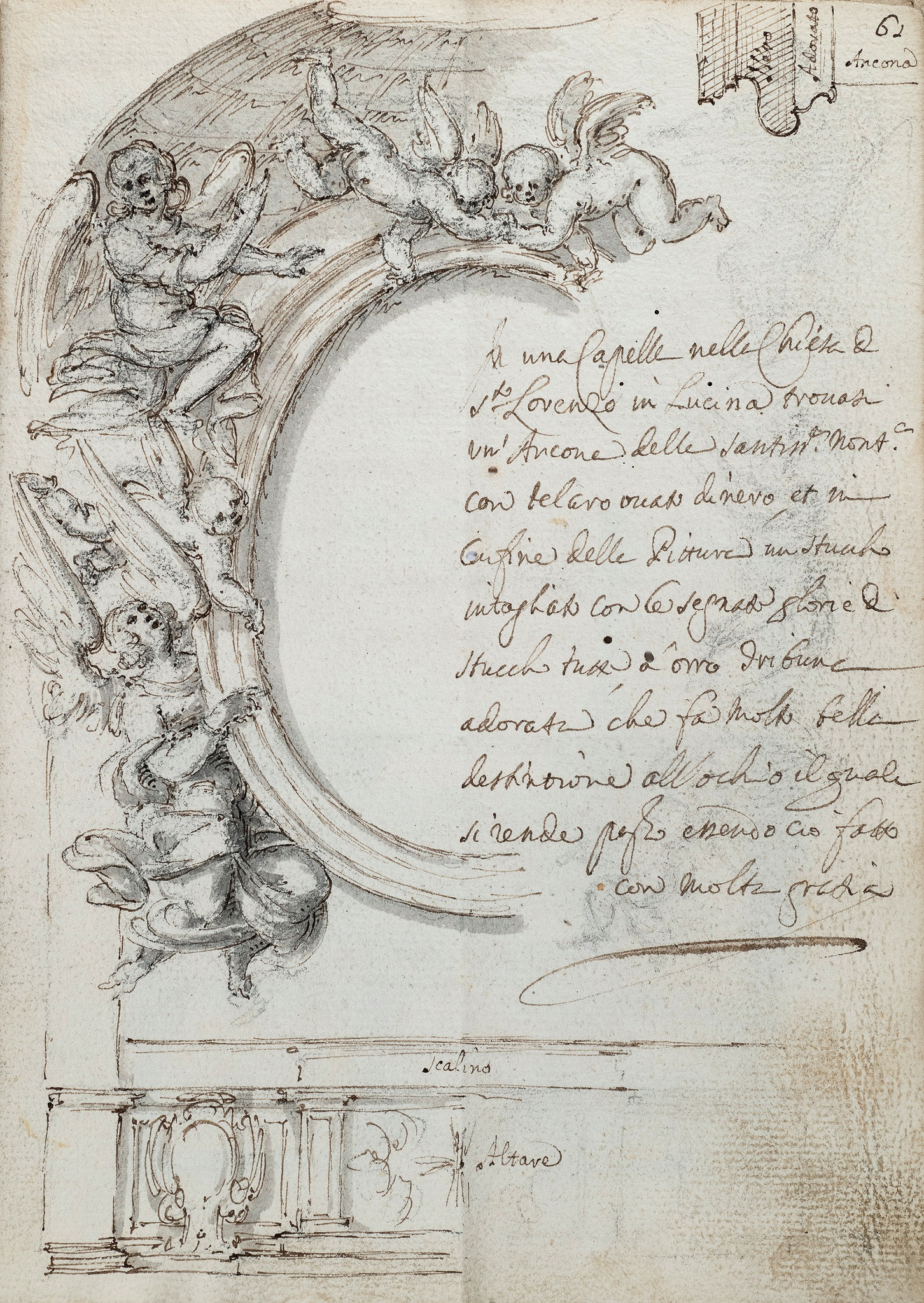
Bernini (1598-1680), design for the altar of Cappella Fonseca, S Lorenzo in Lucina, Rome, 1667, pen-&-ink, wash, 23.1 x 17.2 cm., Istituto Central per la Grafica, Rome
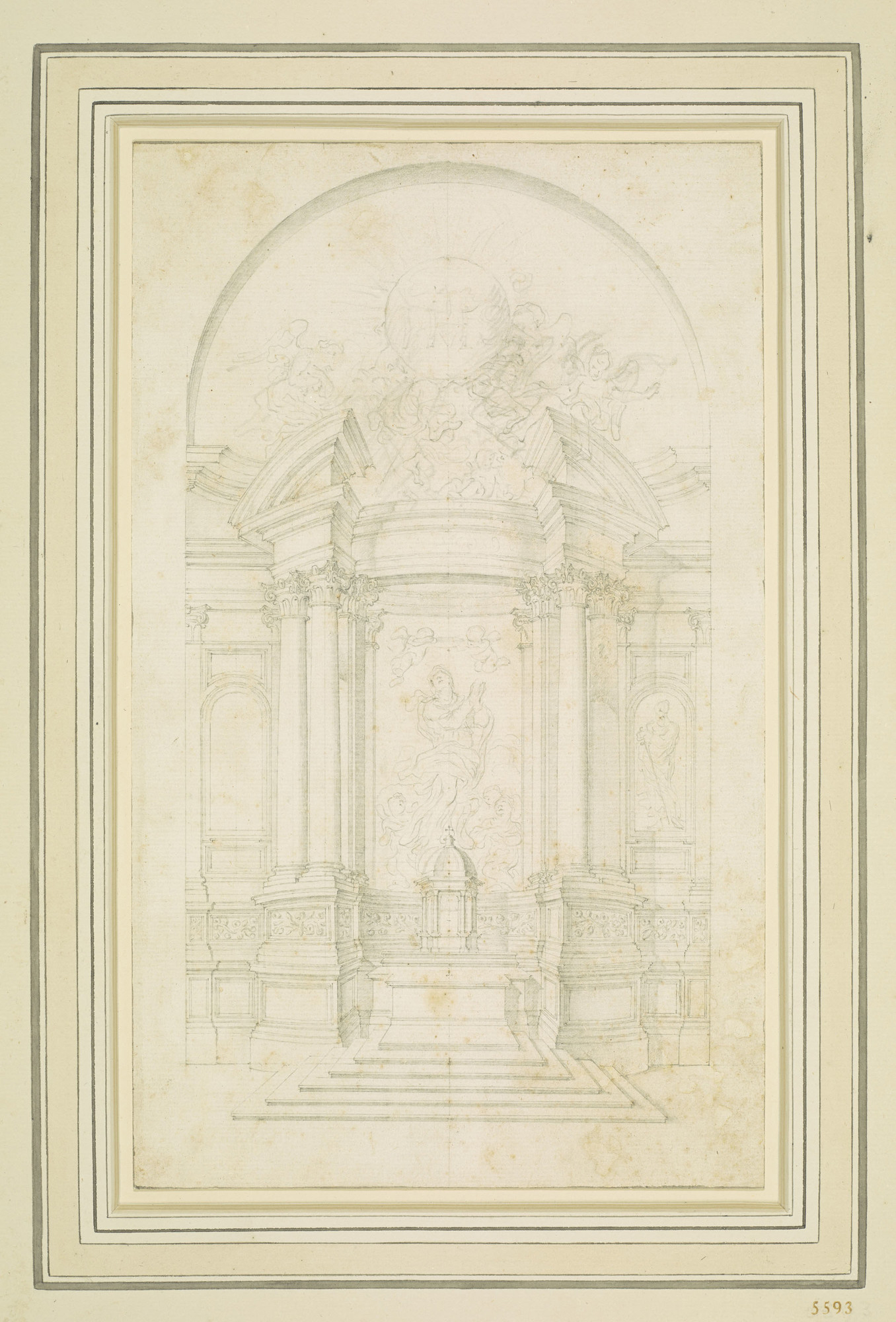
Bernini (workshop; 1598-1680), design for an altar, pencil, Royal Collection Trust. RCIN 905593

Bernini (workshop; 1598-1680), Death & a putto holding a frame with the portrait of a cardinal, pencil, pen-&-ink, wash, 22.8 x 16.7 cm., © The Trustees of the British Museum

Bernini (follower of; 1598-1680), study for an equestrian monument, c.1670-1700, pen-&-ink, wash, 48.2 x 32.3 cm., Royal Collection Trust. RCIN 905601
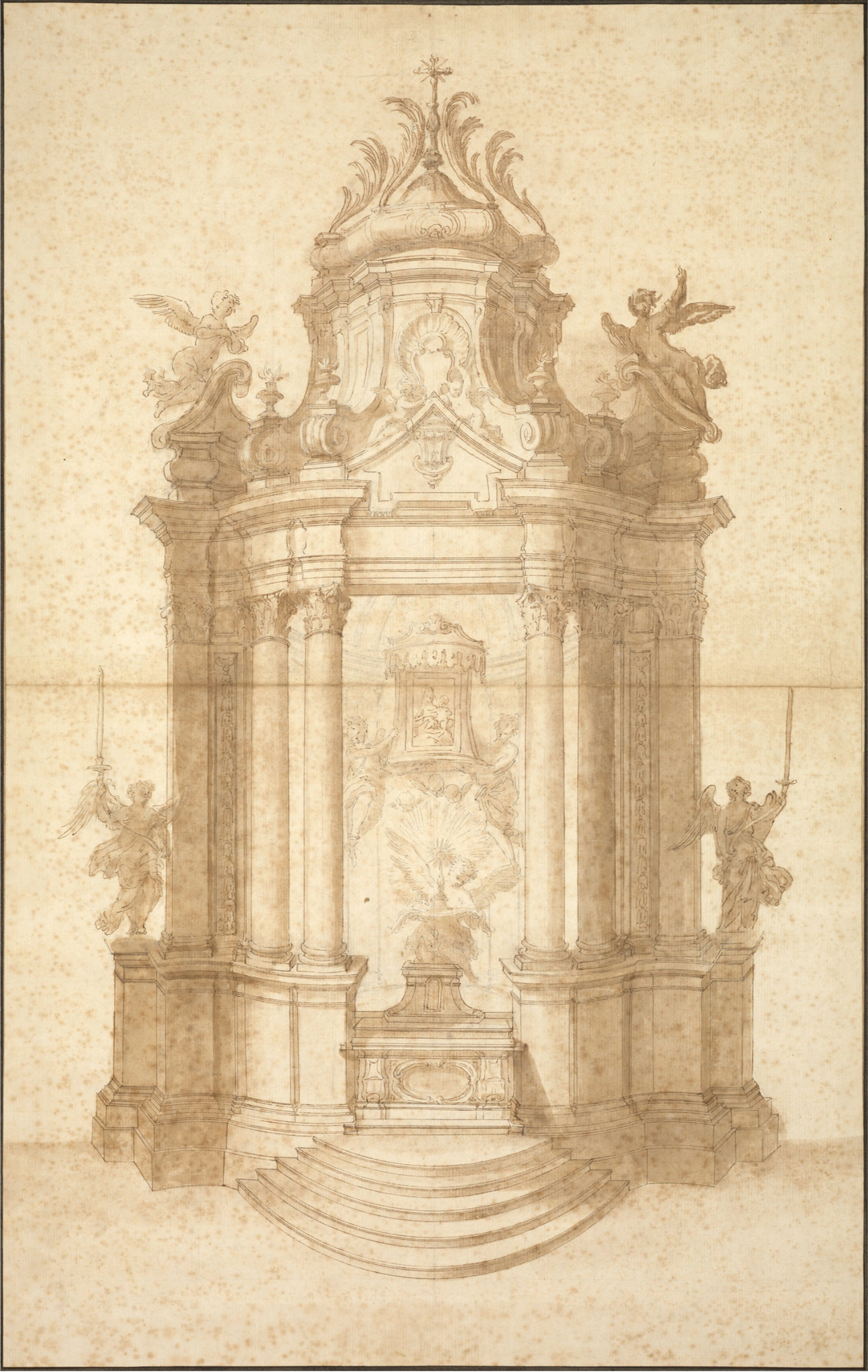
Bernini (follower of; 1598-1680), design for an altar, c.1650-1720, pen-&-ink, wash, black chalk, 74.1 x 46.9 cm., Royal Collection Trust. RCIN 911593
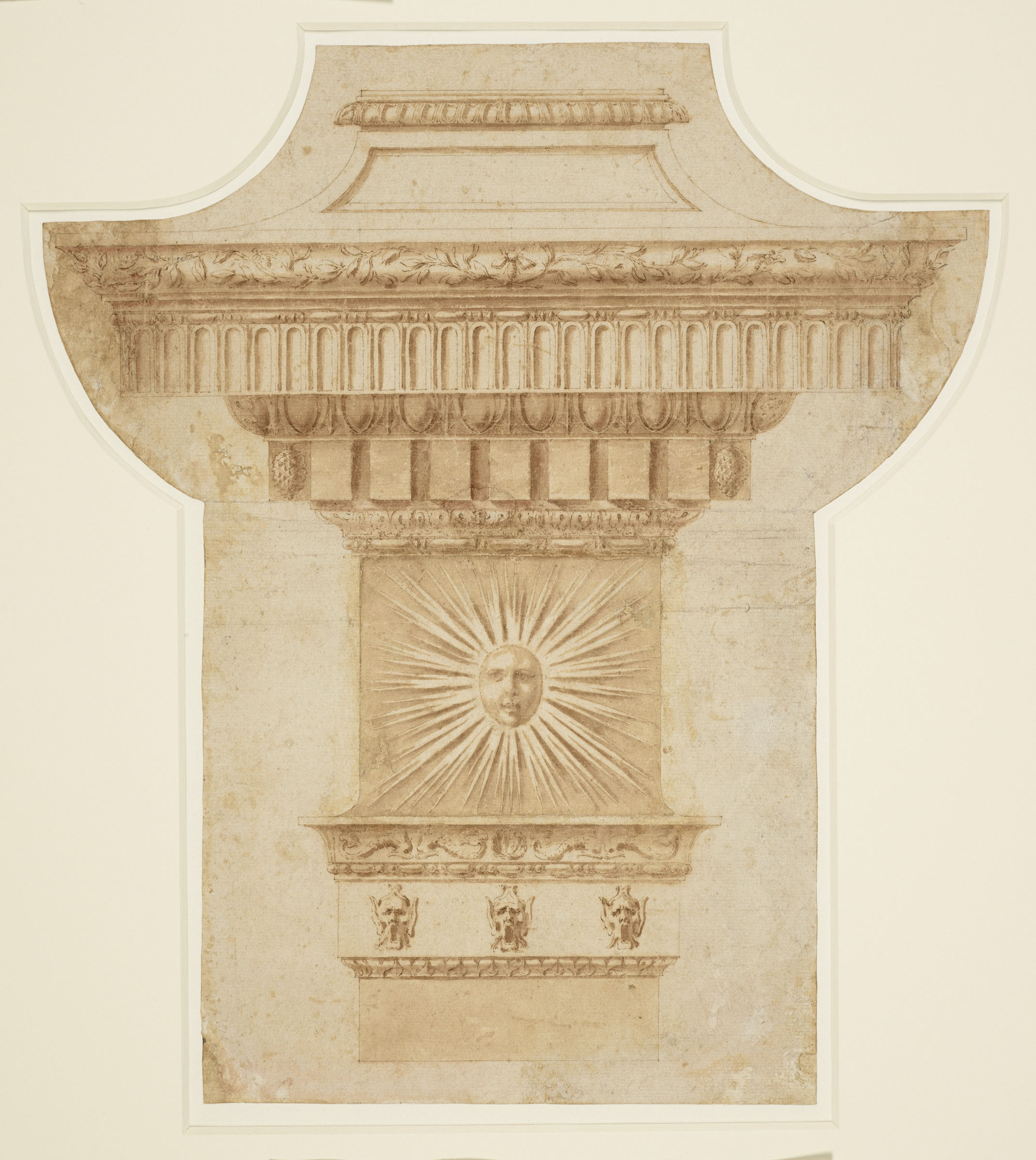
Francesco Borromini (attrib.; 1599-1667), design for the entablature of the baldacchino, St Peter’s, Rome, c.1625, pen-&-ink, wash, black chalk, 39.2 x 34.1 cm., Royal Collection Trust, RICIN 905636
‘…At the centre of the frieze is the Barberini symbol of the sun, on a separate piece of paper collaged on.’

Francesco Borromini (attrib., 1599-1667), design for the tomb of Urban VIII, St Peter’s, Rome, pen-&-ink, wash, black chalk, 53.4 x 31.9 cm., Royal Collection Trust. RICIN 905602
‘A drawing of the design for the tomb of Urban VIII in St Peter’s, showing the whole monument according to the first project: within a niche flanked by Corinthian columns, the statue of Urban VIII is set on an elaborate base with Charity on the left and Justice on the right of the sarcophagus. The tomb was planned in 1627, but was not completed until 1647.’

Il Volterrano (1611-90), study of three aedicular architectural frames, red chalk, pen-&-ink, 17 x 26 cm., Artcurial, 11 February 2021, lot 192
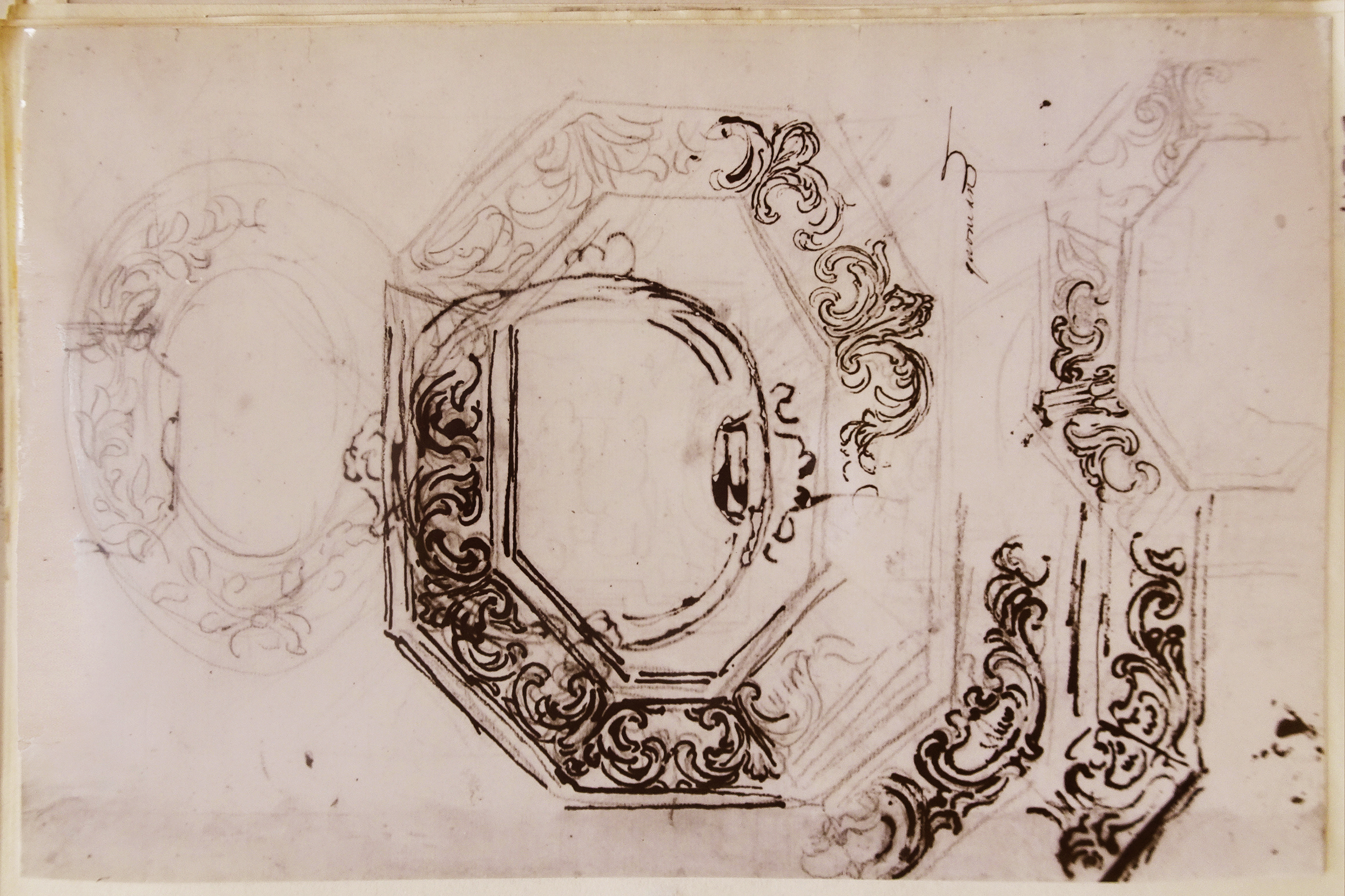
Il Volterrano (1611-90), designs for an octagonal and an oval frame, recto, red & black chalk, pen-&-ink, Sotheby’s, Thursday 3 July 1980, Lot 5
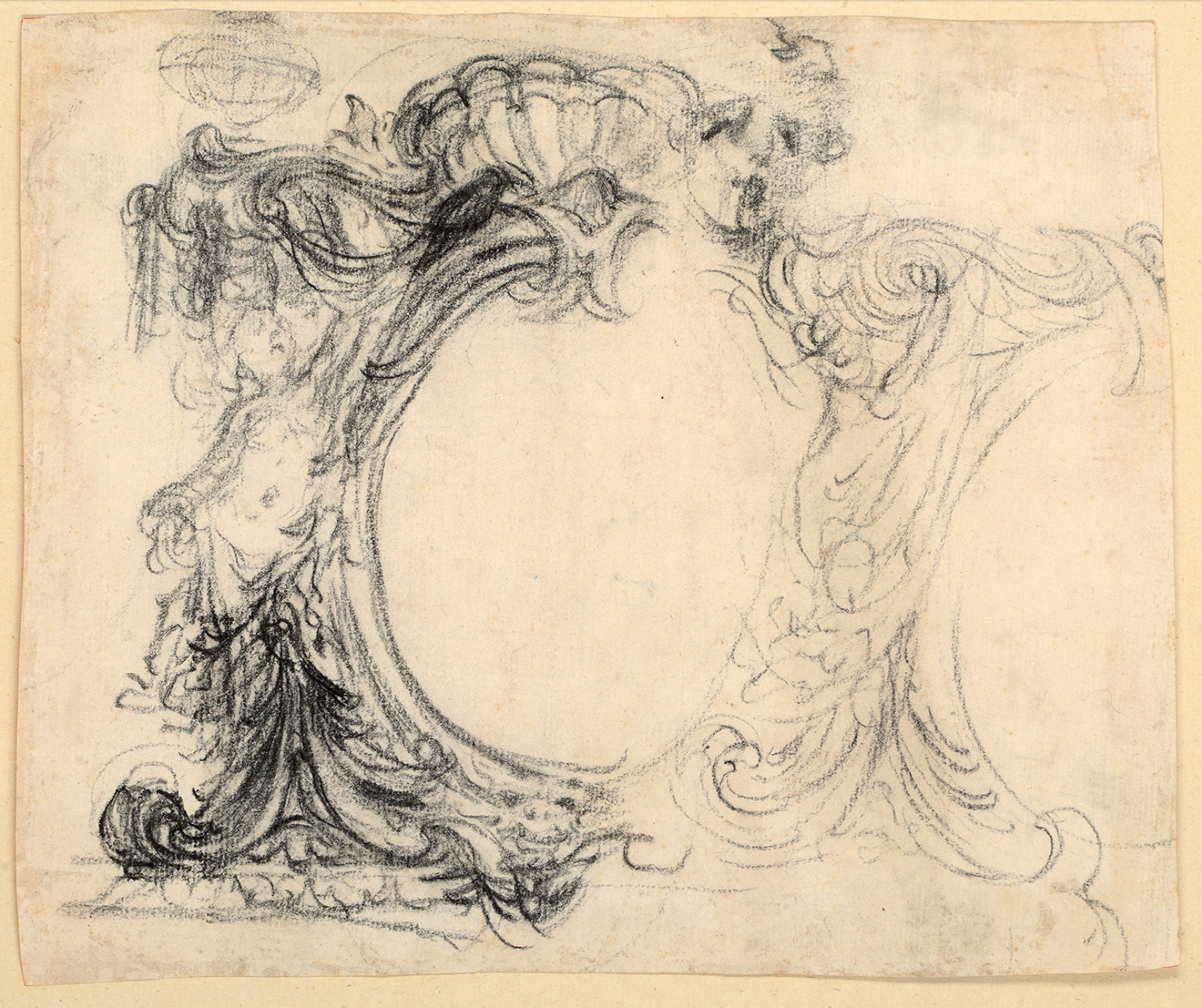
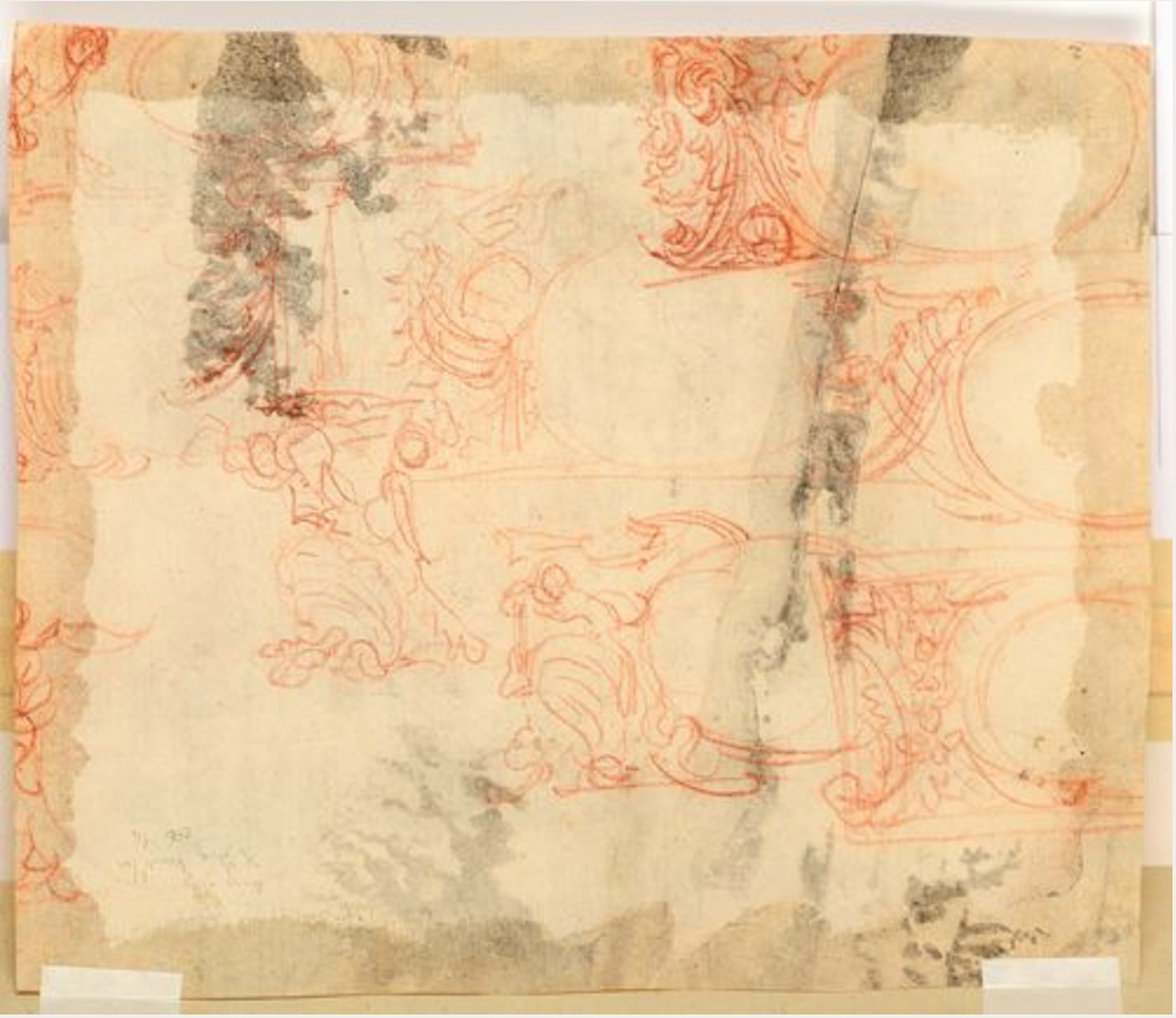
Il Volterrano (1611-90), two designs for frames or ceiling compartments, recto & verso, black & red chalk, 24.7 x 26 cm., Christie’s, 27 September 2016 (Brian Sewell’s sale), lot 23
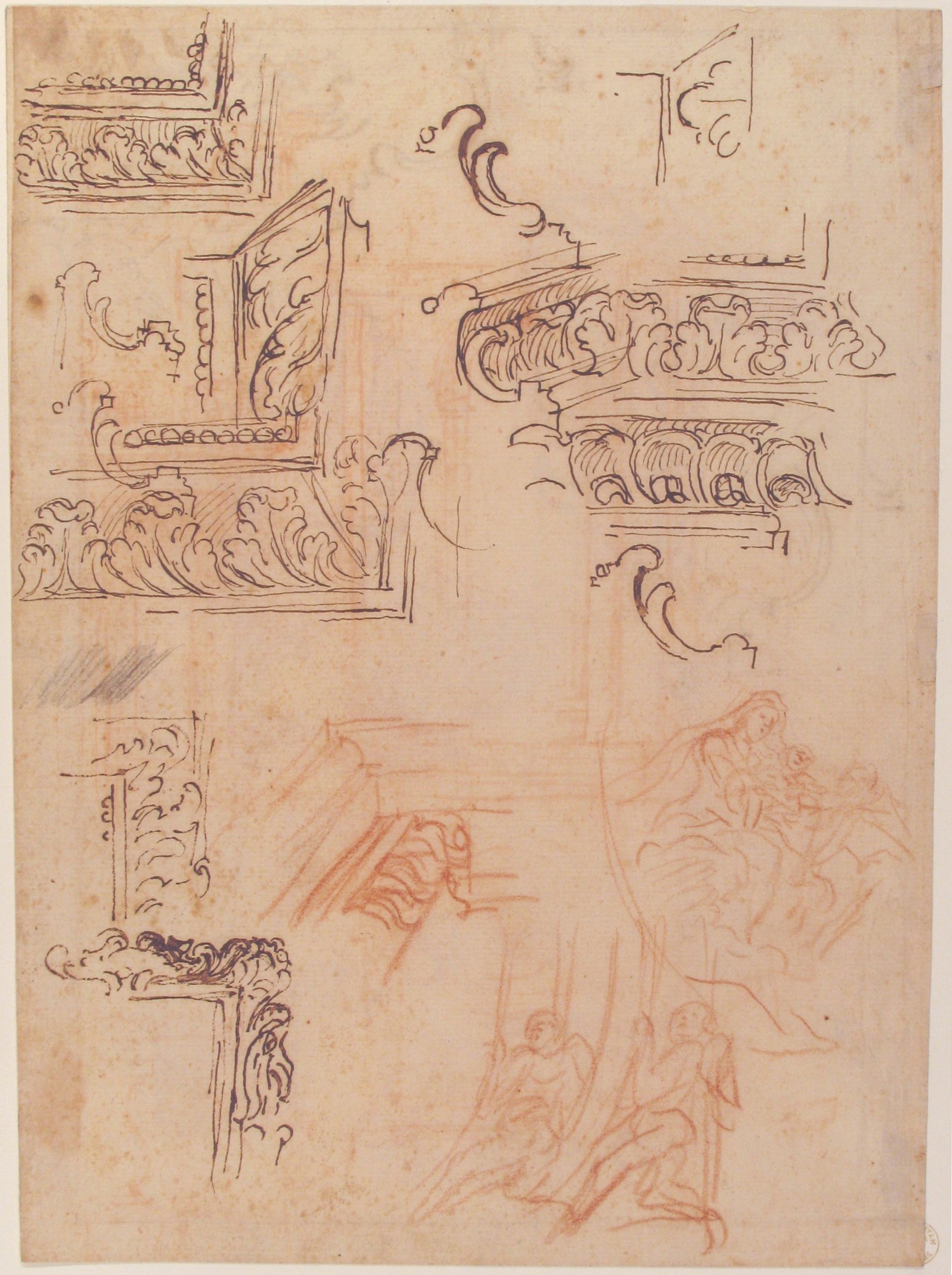
Il Volterrano (1611-90), studies of architectural mouldings, &c., red chalk, brown ink, recto, 28.5 x 20.7 cm., Metropolitan Museum, New York
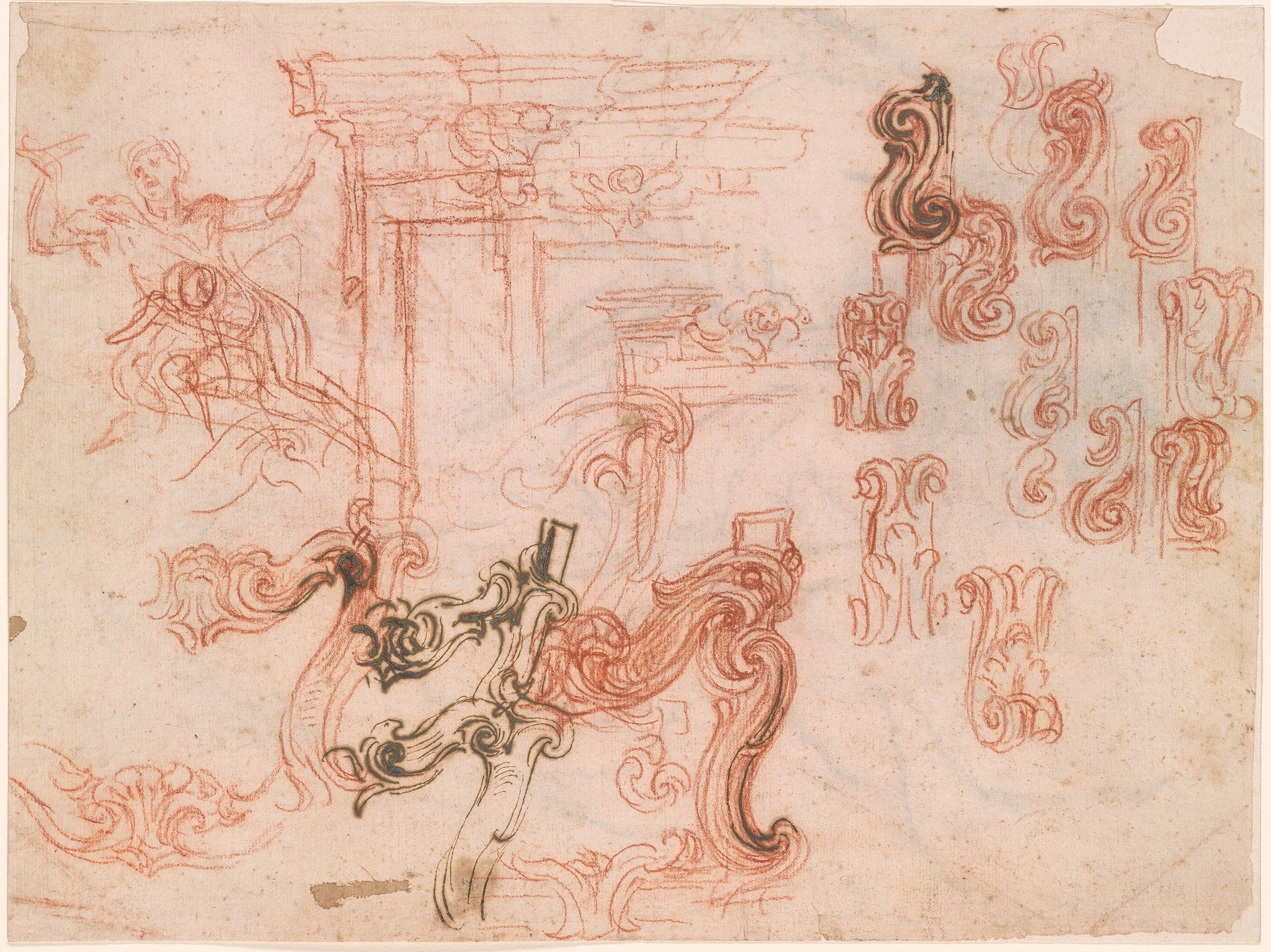
Il Volterrano (1611-90), studies of architectural ornament, red chalk, pen-&-ink, 10 ¾ x 14 3/8 ins (27.3 x 36.5 cm.), Pierpoint Morgan Library
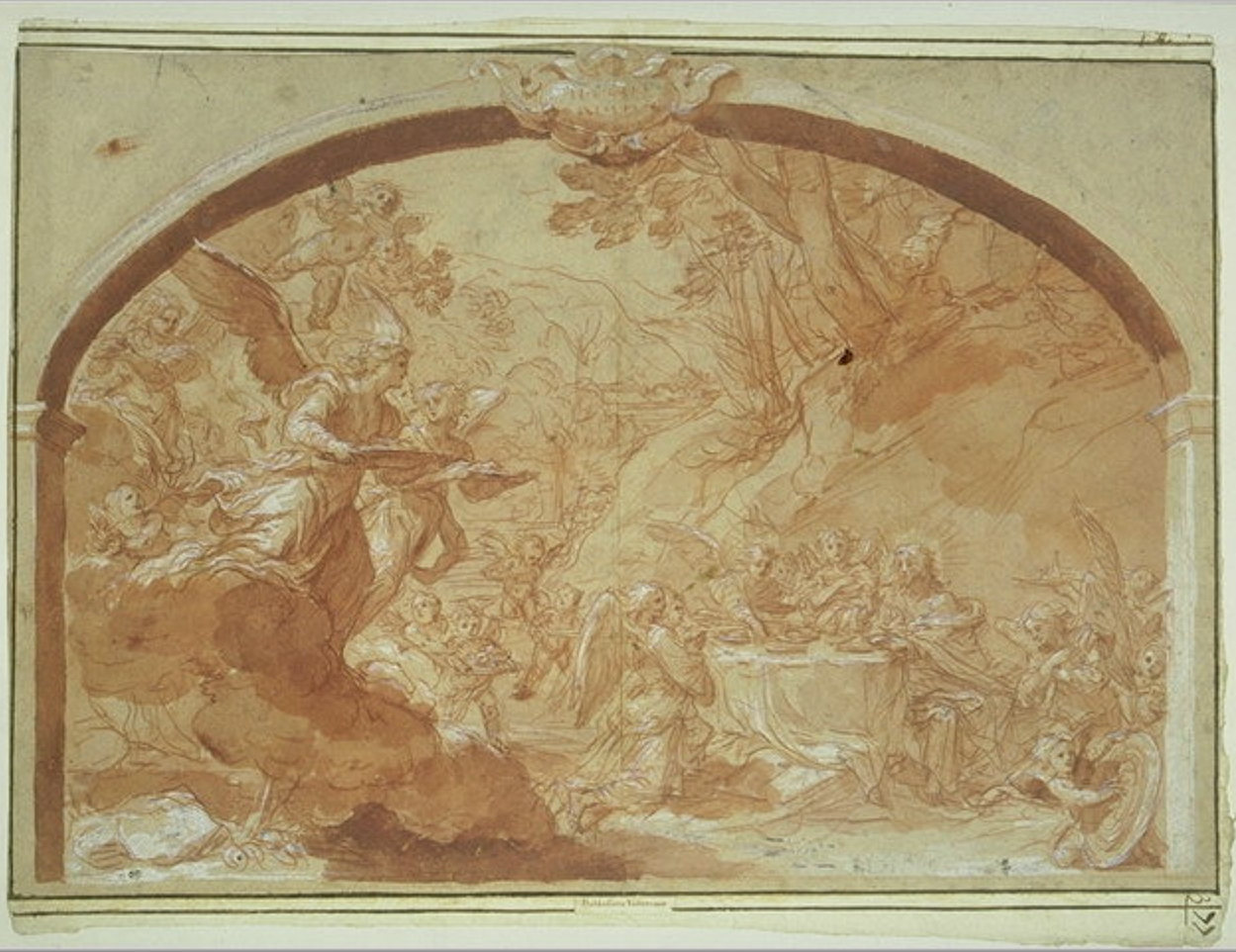
Il Volterrano (1611-90), Christ comforted by angels, 1650, red chalk, wash, white heightening, 34.3 x 48.8 cm., Inv 1169, Cabinet des dessins, Musée du Louvre

Il Volterrano (1611-90), Christ comforted by angels, 1650, Museo di pittura murale, San Domenico, Prato
Cartouches – which appear in so many of the borders of Volterrano’s frescos – must have been sketched and refined in innumerable drawings which have been lost, or are little publicized; however, one of them survives on the architectural setting in the study for Christ comforted by angels, which was painted in the refectory of the convent of Santa Teresa in 1650, and is now in the Museo di pittura murale, San Domenico, Prato.

Il Volterrano (1611-90), designs for an octagonal frame with angels, recto, red chalk, pen-&-ink, with annotations, 29 x 20 cm., private collection. Photo: Paul Mitchell
On the sheet above, the chosen frame (‘questo’, to which the sketch of the profile above it probably belongs) has been worked up in ink, and a note added across the middle indicating that the sight edge is to be walnut. There is an oval wreath of angels suggested within the picture, which would probably surround a Madonna and Child or an Ecce Homo, and this oval is set against the shaped octagonal mouldings and the dynamic outer framework of carved angels. The annotations in the bottom corner read:
‘A Pietra serena gilded with imitation marble [as the marble is imitation, the pietra serena may be, too]
B Cherubs of carved and gilded wood
C Walnut sight and gilded pine back
gilded and washed with lacquer as well
carved wooden crown of thorns
and back of red velvet
D The small frame is walnut and gilded’
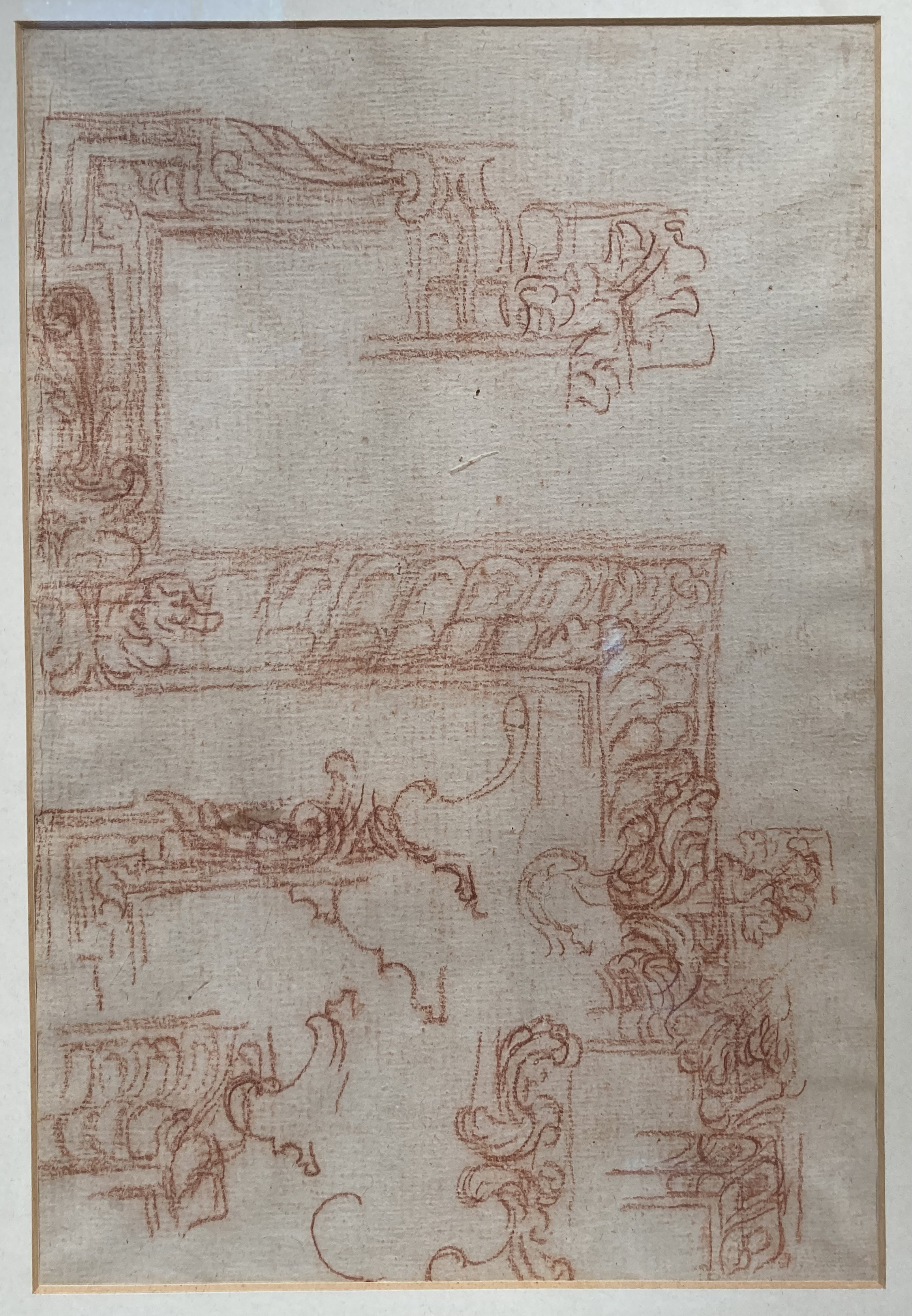
Il Volterrano (1611-90), designs for a fluted and an outset corner frame, recto, red chalk, 38 x 26 cm., private collection. Photo: Paul Mitchell
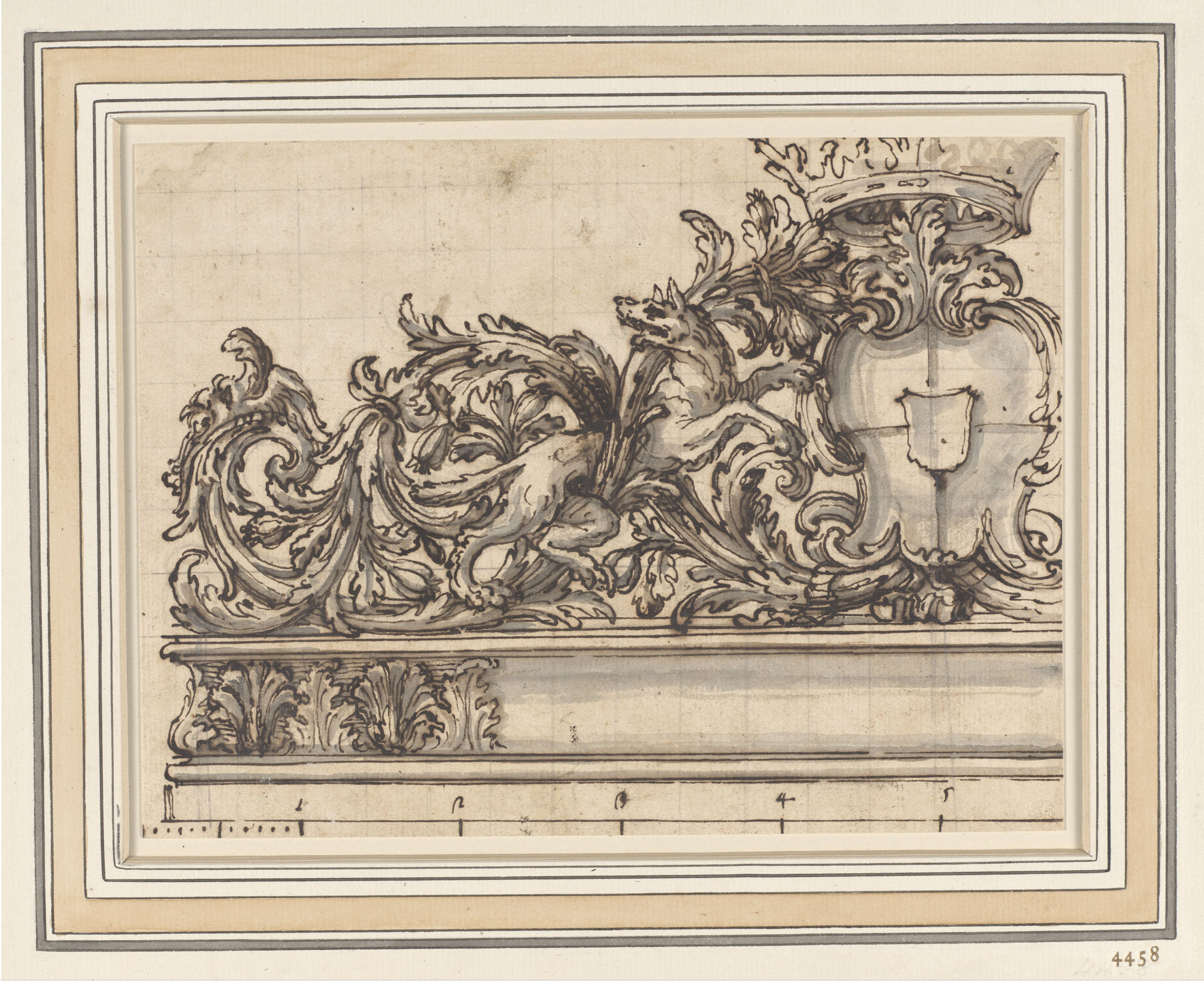
Johann Paul Schor (Giovanni Paolo Tedesco; 1615-74), design for the top of a frame, c.1650-74, pen-&-ink, black chalk, 17.3 x 23.1 cm., Royal Collection Trust. RCIN 904458
A design for the top of a frame, with a rampant dog, or wolf, entwined in acanthus leaves; with a coat of arms surmounted with a ducal coronet. Squared for enlargement; with a scale along the lower edge. See also RCIN 905578 (below).
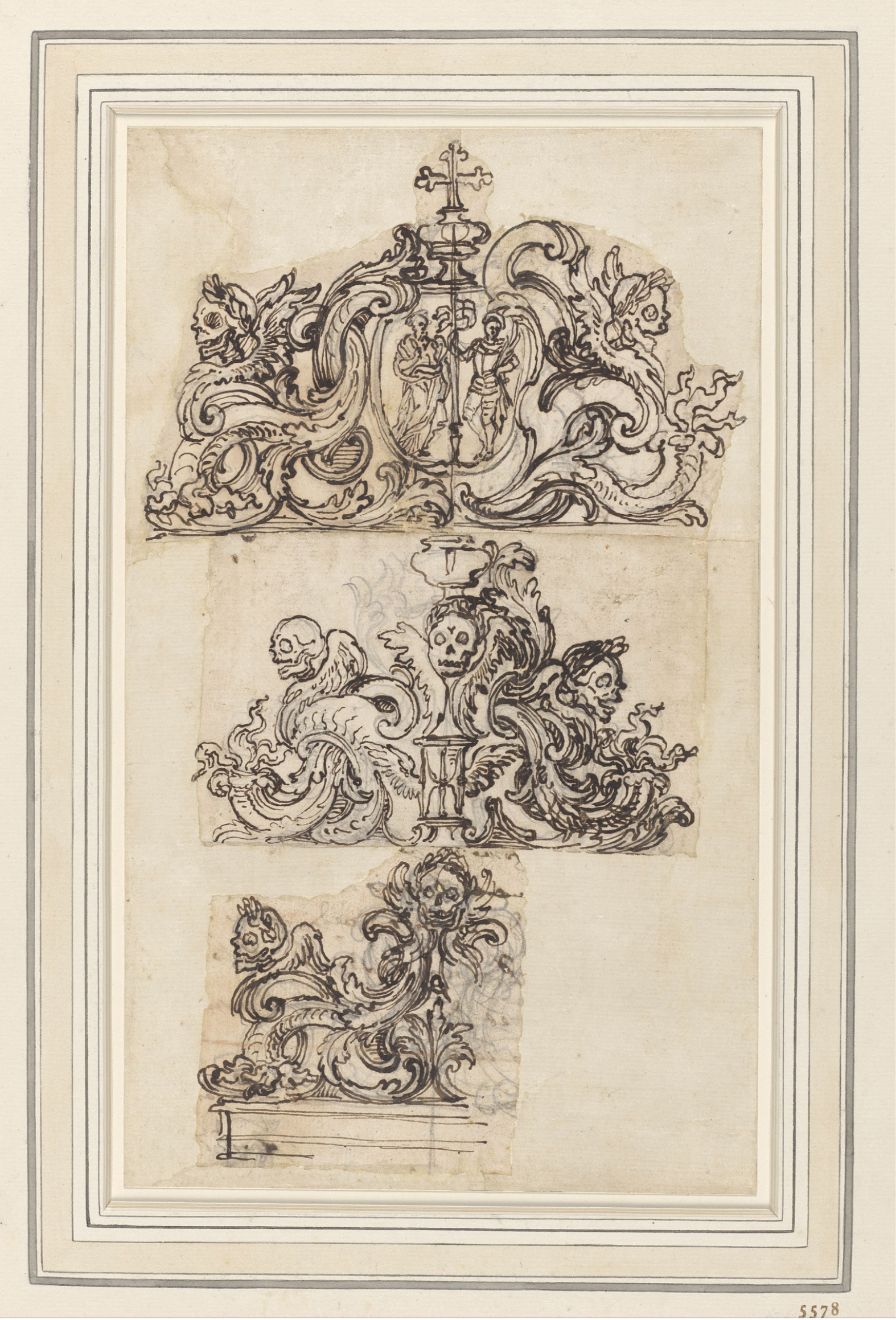
Johann Paul Schor (Giovanni Paolo Tedesco; 1615-74), three designs for the top of a frame, c.1650-74, pen-&-ink, black chalk, 31.5 x 18.7 cm., Royal Collection Trust. RCIN 905578
‘Three designs, all including skulls, some crowned with laurels. The upper design features two figures in the central space, surmounted by a cross. There is a winged hourglass in the middle of the central design. See also RCIN 904458 (above)’.
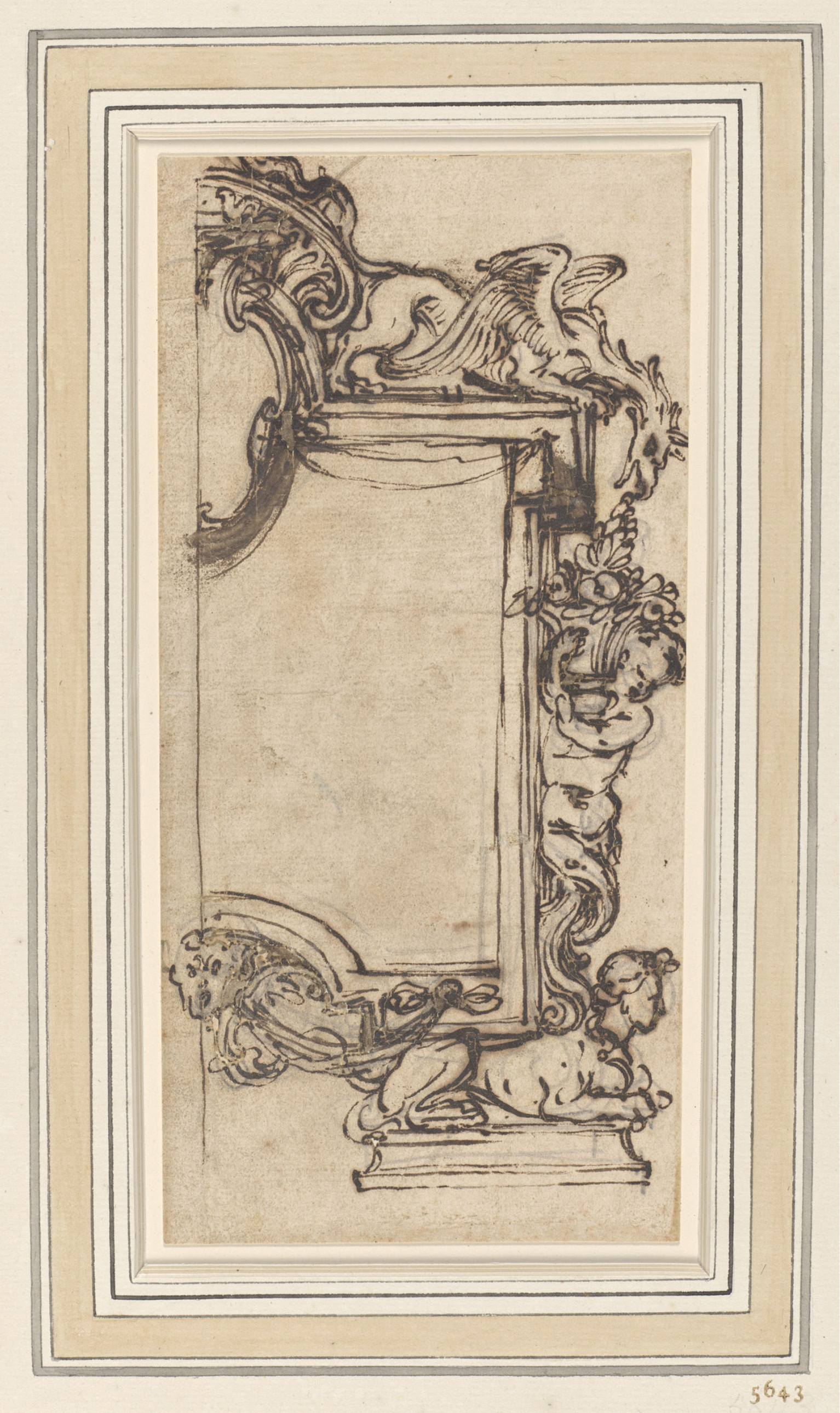
Johann Paul Schor (Giovanni Paolo Tedesco; 1615-74), a design for a frame, c.1650-74, pen-&-ink, wash, 24.2 x 11.5 cm., Royal Collection Trust. RCIN 905643
‘A design showing the right-hand side of a symmetrical frame, featuring a dragon at the top and a sphinx at the bottom. See also RCIN 905580 (below)’.
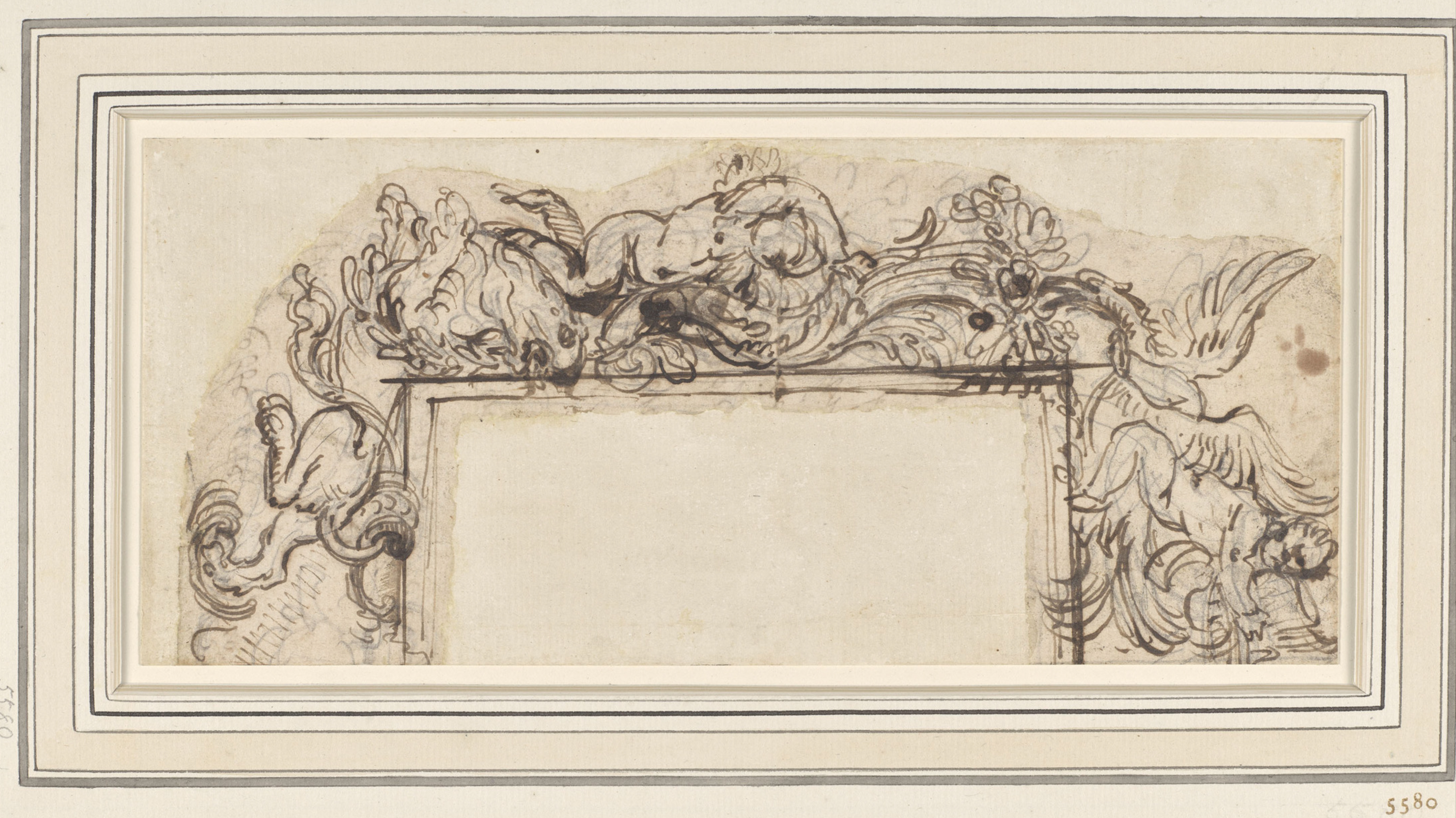
Johann Paul Schor (Giovanni Paolo Tedesco; 1615-74), a design for a frame, c.1650-74, pen-&-ink, black chalk, 27.7 x 12.2 cm., Royal Collection Trust. RCIN 905580
‘A design showing the left side of a symmetrical frame, featuring an eagle at the top, and a lion at the bottom. See also RCIN 905643 (above)’.

Follower of Johann Paul Schor (Giovanni Paolo Tedesco; 1615-74), design for a looking-glass, c.1660-90, pen-&-ink, wash, 15.5 x 7.6 cm., Royal Collection Trust. RCIN 905574 https://www.rct.uk/collection/search – /19/collection/905574/a-design-for-a-looking-glass
‘A design for an ornate frame for a looking-glass; with foliage and two putti, one of whom supports a ducal coronet’.

Filippo Lauri (1623-94), ceiling design for Palazzo Borghese, 1671, pen-&-ink, wash & watercolour, 25.5 x 73.5 cm., Royal Collection Trust. RCIN 906833
‘The rectangular frames in the curves of the vault were to be filled with landscapes by Gaspard Dughet…
Here Lauri displaced the central frame a little to the left, probably to enhance the illusion, when entering the room, that the frames stood proud of the curve of the ceiling and that the pediments projected in front of them. The frame as painted was stripped of its winged bucranium, and the mask in a shell above was flanked only by garlands; the putti were used instead for the frames of the landscapes on the short walls of the ceiling, where they support the dragon and eagle of the Borghese arms’.

Carlo Maratti (1625-1713), Madonna & Child in an oval frame, 1640-1713, pen-&-ink, wash, black chalk, 23.1 x 18.8 cm., © The Trustees of the British Museum
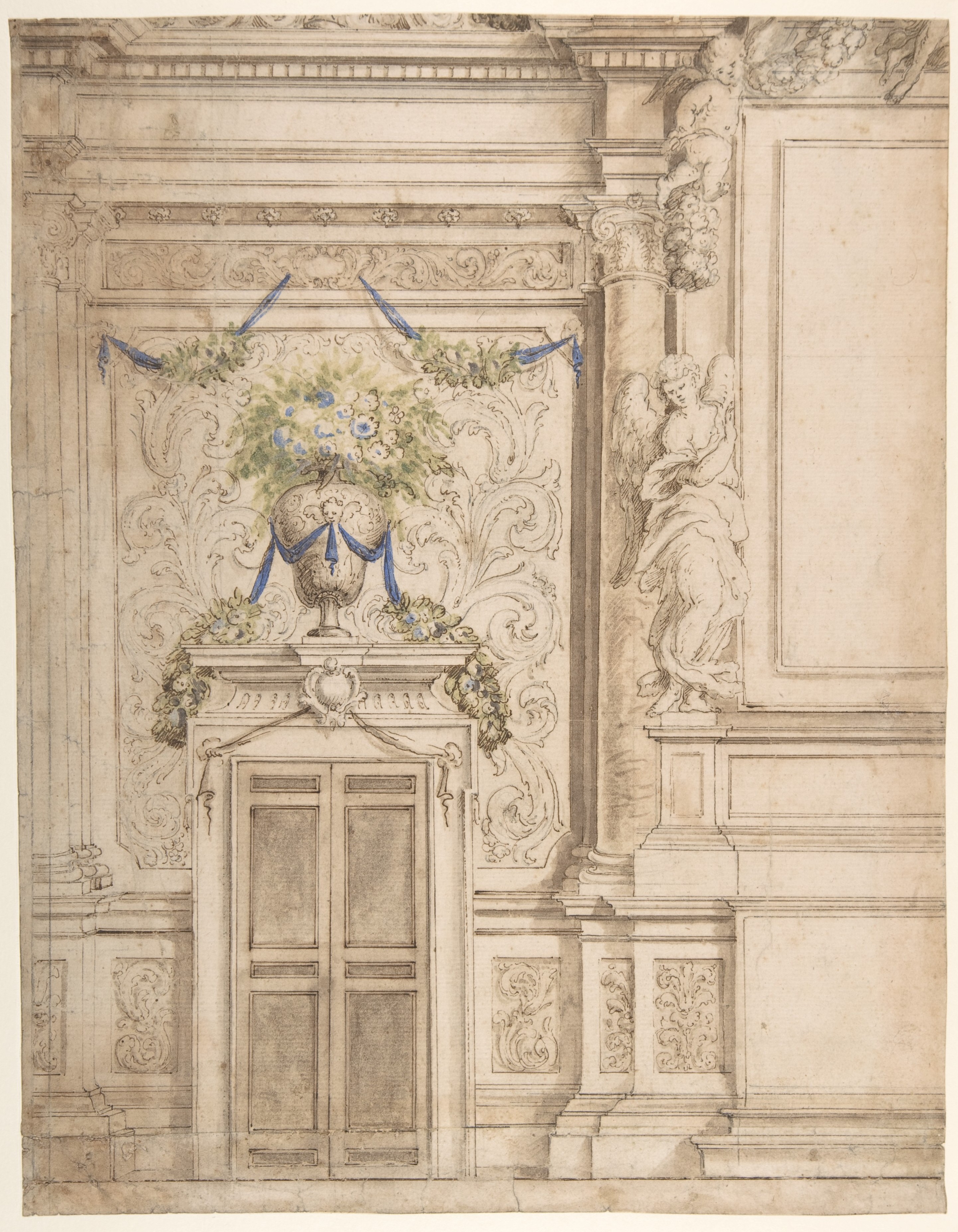
Francesco Ferrari (1634-1708), design for the decoration of a chapel wall (left half), c.1690, pen-&-ink, wash, watercolour, black chalk, 35.2 x 27.6 cm., Metropolitan Museum, New York
‘This drawing contains the design for the decoration scheme for the wall of a chapel or church with an altar at the centre. A similar sheet showing the right half of the scheme was formerly in the collection of Lodewijk Houthakker; that sheet contains the signature of the artist, Francesco Ferrari. The two halves were undoubtedly once part of the same large presentation drawing which was later cut, and together they show that the wall was symmetrically arranged, with a door on either side of the central altar. The Houthakker sheet further shows an arched pediment above the altar. Each sheet has a later inscription which appears to identify the location for which the design was intended: the inscription on the Houthakker sheet is in English and refers to a Capella Tolomei in Ferrara, whilst the inscription on the Met’s drawing is in Italian and reads Capella di collegio Tolomei. Based on the link to Ferrara, Peter Fuhring has suggested that the scheme was designed for a chapel dedicated to St Tolomei in the church of San Giorgio in Ferrara. The use of the word collegio could, alternatively, imply that the design was intended for the main chapel in the Collegio Tolomei, founded in Siena in 1676, based on the stipulations of Celso Tolomei (1572-1634).’

Gregorio de’ Ferrari (1647-1726), design for an overdoor, c.1670-90, pen-&-ink, wash, traces of black chalk, 28.8 x 20.4 cm., Metropolitan Museum, New York
‘This sheet contains two ideas for the decoration of a frame in which a satyr takes centre stage. In the design on top a satyr mask is being crowned with a bay-leaf wreath by two cherubs, while in the lower design a vase decorated with satyr masks is placed centrally on top of the frame and is flanked by the figures of two young satyrs. Because only a small part of the frame below is shown, it is hard to tell what kind of frame this was meant to be, although the heavy ornament on top suggests that it is most likely an architectural frame for a door or a window. The artist, Gregorio de’ Ferrari, is known to have made designs for the interior, most notably in the Palazzo Rosso along the prestigious Strada Nova in Genoa. He worked there together with Domenico Piola, for whose family workshop De’ Ferrari also designed tombs, altars, textiles, silver, ship decorations and frontispieces.’
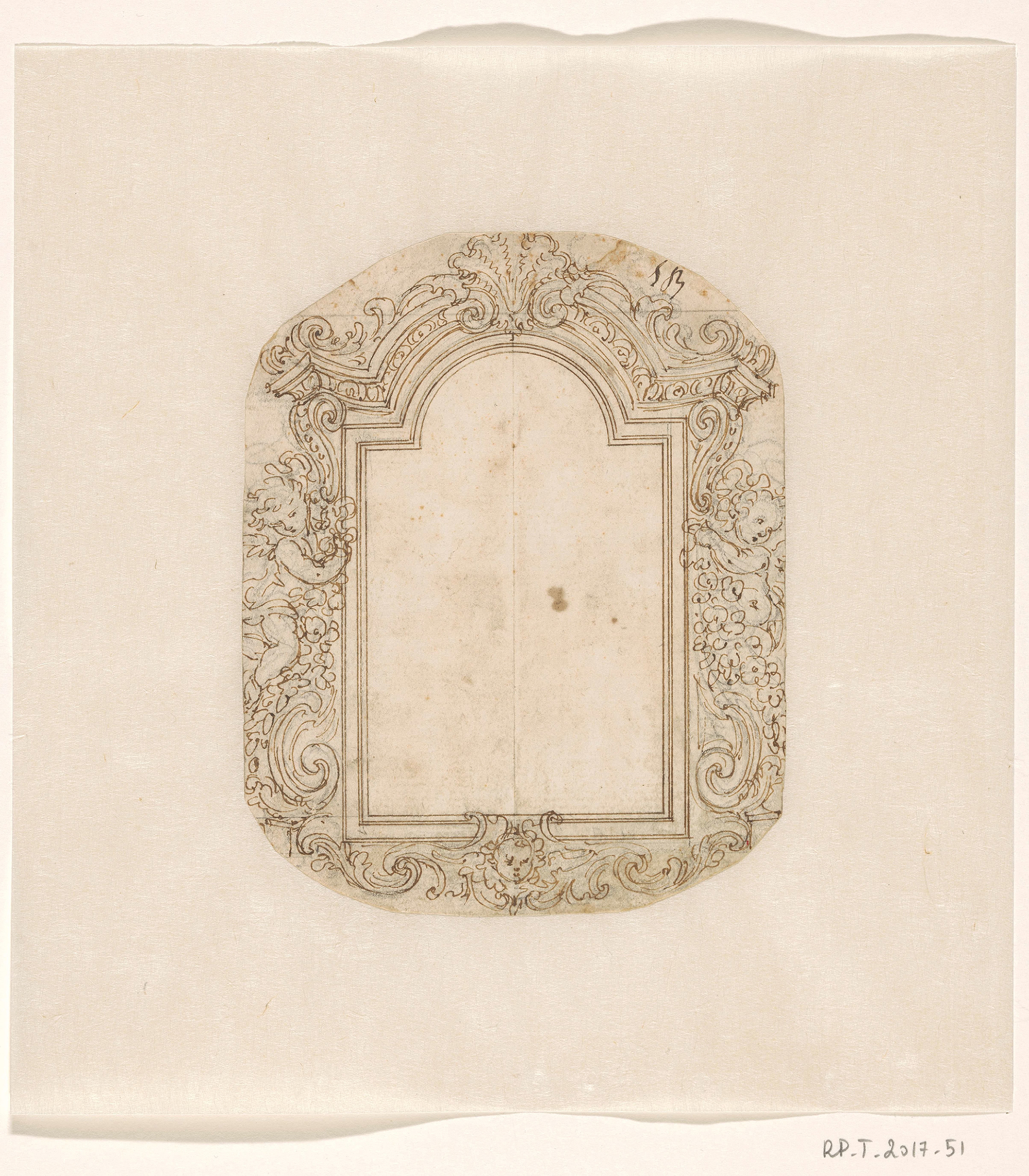
Giovanni Battista Foggini (1652-1725), design for a frame with two putti, c.1680s-1710s, pencil, pen-&-ink, 14.7 x 117 cm., Rijksmuseum

Giovanni Battista Foggini (1652-1725), design for an altarpiece with The adoration of the shepherds and God the Father, c.1680s-1710s, pen-&-ink, wash, pencil, 24.7 x 15 cm., Metropolitan Museum, New York

Giovanni Battista Foggini (1652-1725), design for a fountain in a niche, c.1670s-1710s, pen-&-ink, wash, traces of black chalk, 26.8 x 16.5 cm., Metropolitan Museum, New York

Carlo Fontana (1638-1714), design for the apse of Naples Cathedral, 1691-96, Royal Collection Trust. RCIN 909361
‘Recessed bays to either side contain the Gesualdo (left) & Carafa monuments (right). The bust over the altarpiece probably represents St Gennaro & the sarcophagus above the altar is to contain his relics’.

Giacomo del Pò (1652-1726), Education of the Virgin in an oval frame supported by angels, in an architectural niche, chalk, pen-&-ink, wash, 39.3 x 30 cm., Albertina, Vienna
The angels sit on ornamented modillions, and the base of the oval frame rests on a sculptural cartouche; at the top it is decorated with festoons of bunched leaves, flowers and swags of drapery.
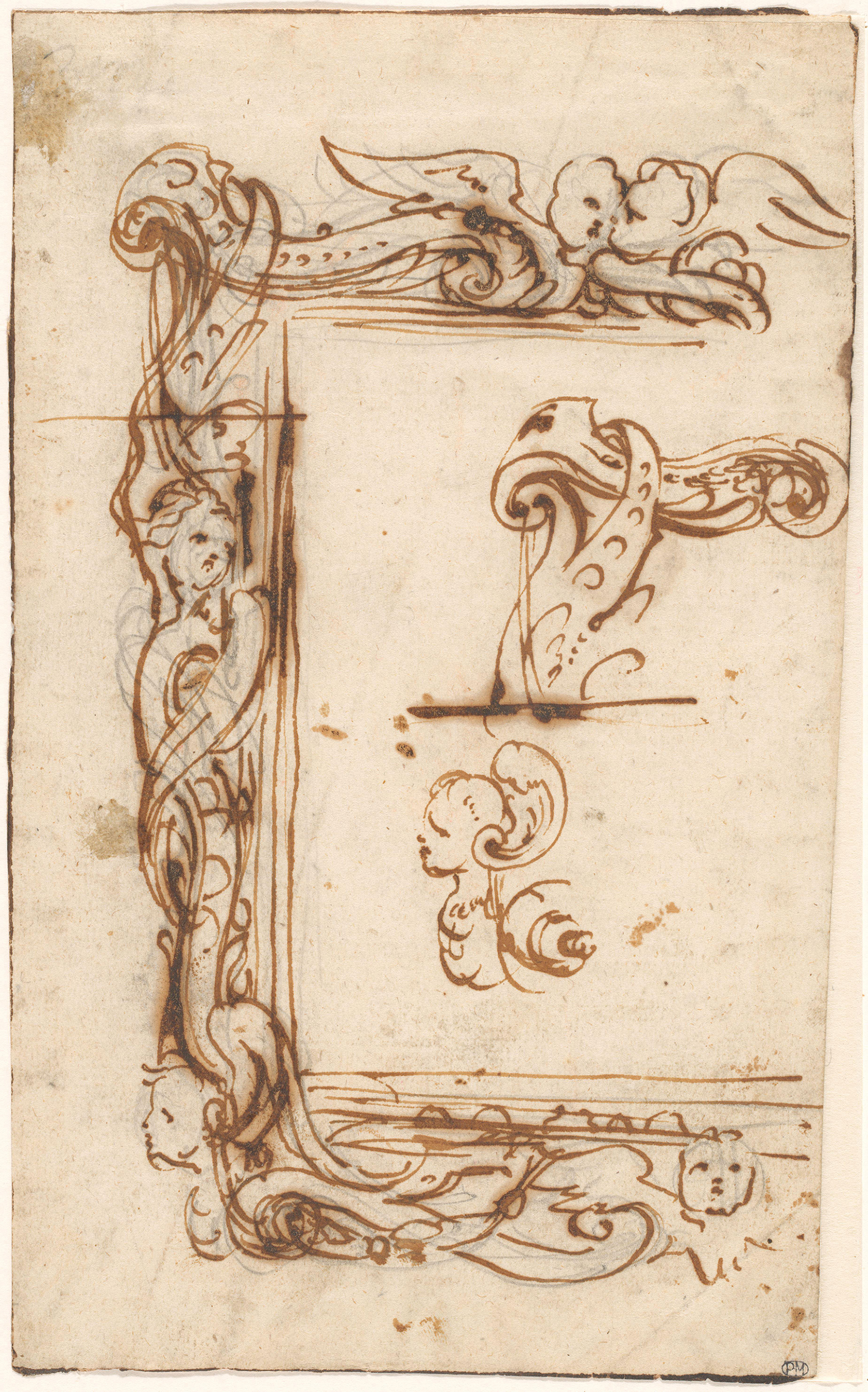
Anon., Italian school (possibly Florentine), design for a frame, with details, c.1610-25, pen-&-ink, 20.7 x 12.7 cm., Rijksmuseum

Anon., Roman school, 17th century, design for a frame for a portrait, c.1700, black chalk, 25.9 x 8.5 cm., Royal Collection Trust. RCIN 904422
‘A design for a frame for a portrait: two putti hold a wreath at the top of a gadrooned oval frame, evidently intended for a portrait. Below, a bundle of brushes and a mahlstick are placed above a cartouche which is marked as if with an inscription. This is probably a preparatory drawing for an engraving’
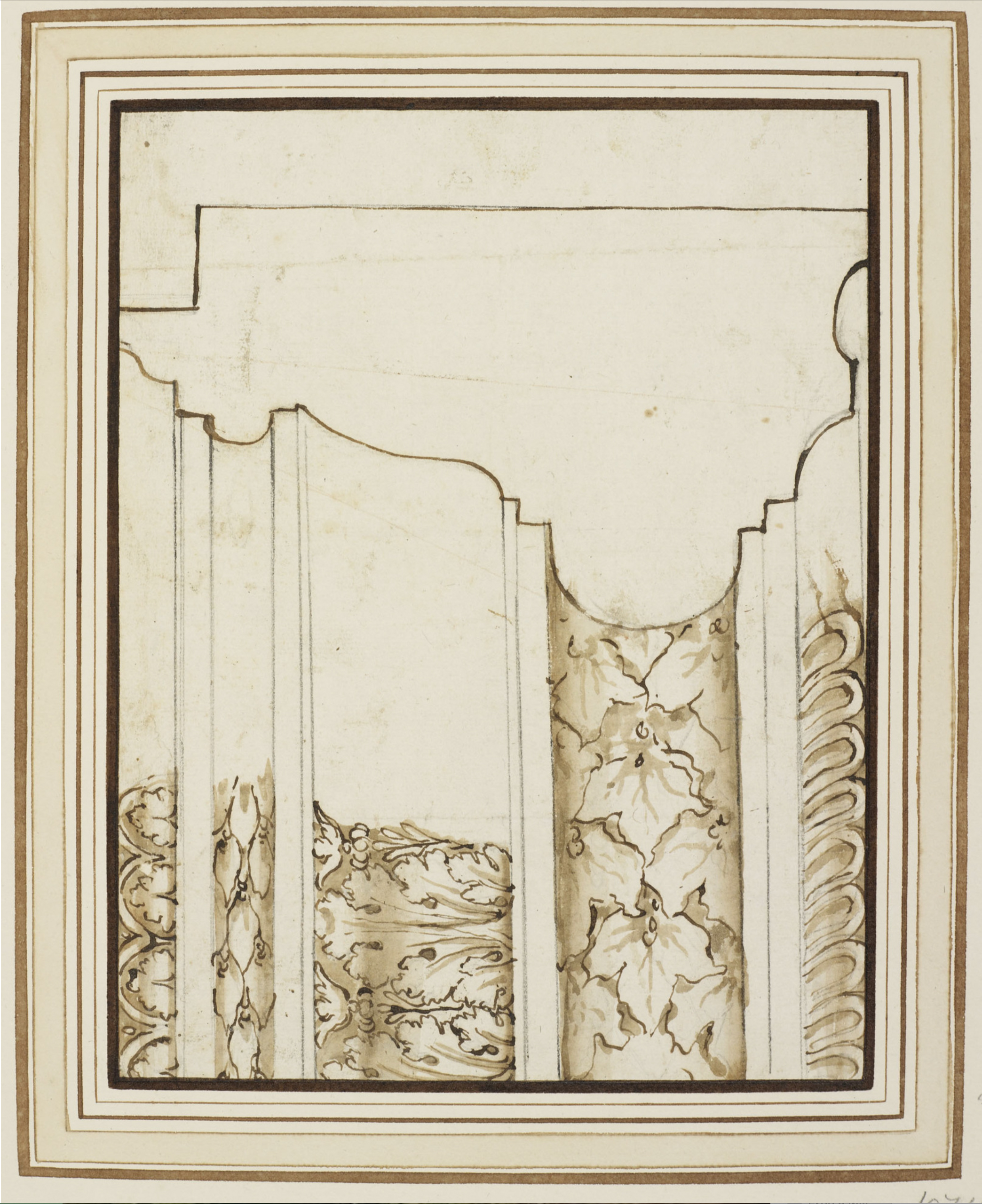
Anon., Roman school, 17th century, design for a moulding [it appears to be for a frame], Royal Collection Trust. RCIN 910749
This is a Baroque moulding, with concave and ogee mouldings stepped between a large and a small torus, with five orders of ornament, the main torus being carved with grapes and vine leaves – possibly because it was made for a painting where this symbol of the Eucharist was appropriate, or possibly for a mythological subject involving Dionysos.

Anon., Italian school, design for a ceiling with The allegory of Dawn in oval frame, and alternate choices for latter, c.1640-1700, pen-&-ink, wash, pencil, 24 x 19 cm., Metropolitan Museum, New York
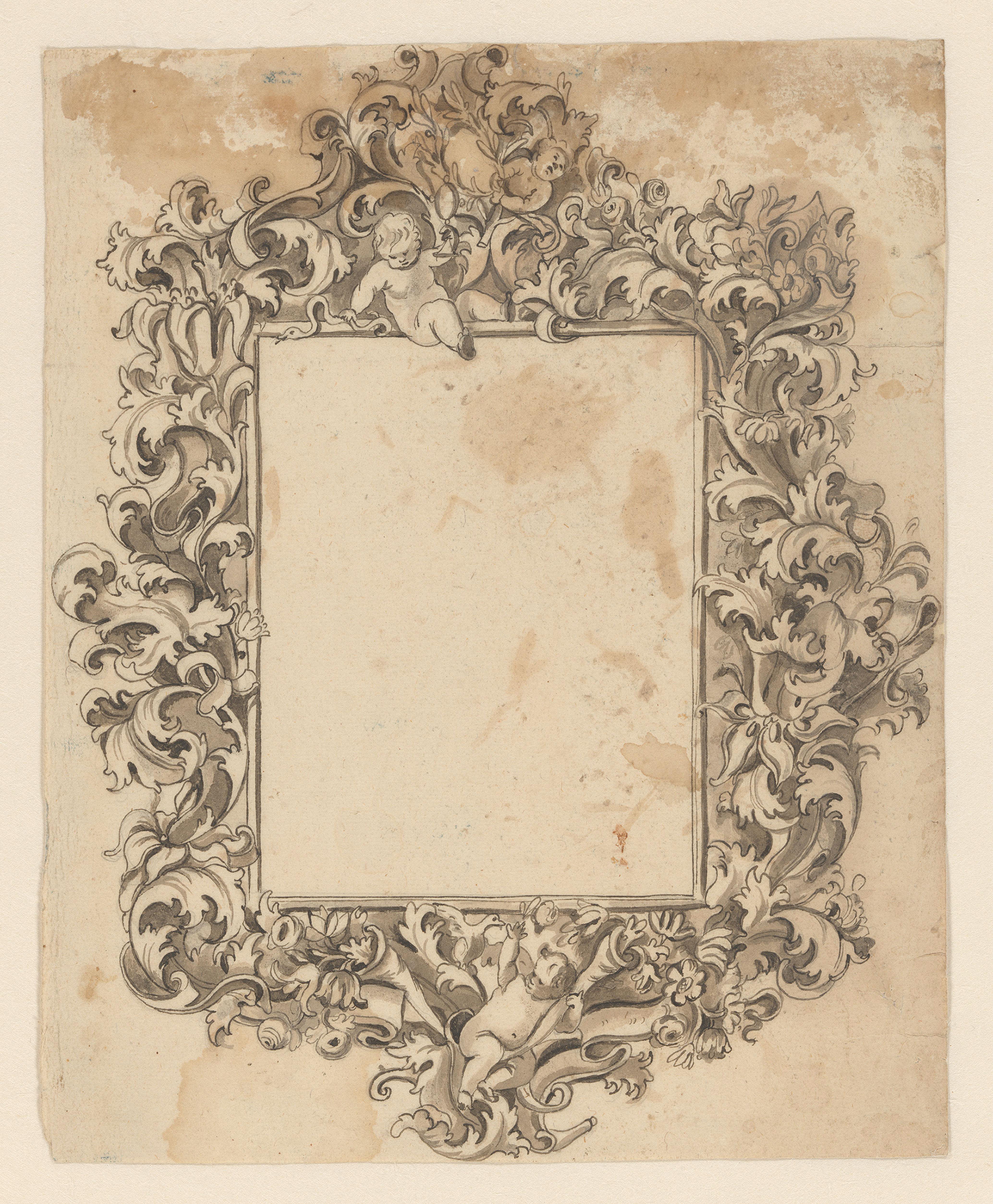
Anon., North Italian school, design for a leaf frame with figures of Prudence & Victory, above, and boy with cornucopia, below; different options on right and left, c.1680-1700, pen-&-ink, wash, black chalk, 25.3 x 20.6 cm., Rijksmuseum
‘The drawing is related to drawings of designs from the workshop of the sculptor Andrea Fantoni (1659-1734) in Rovetta near Bergamo, but there is insufficient reason to attribute it to him.’
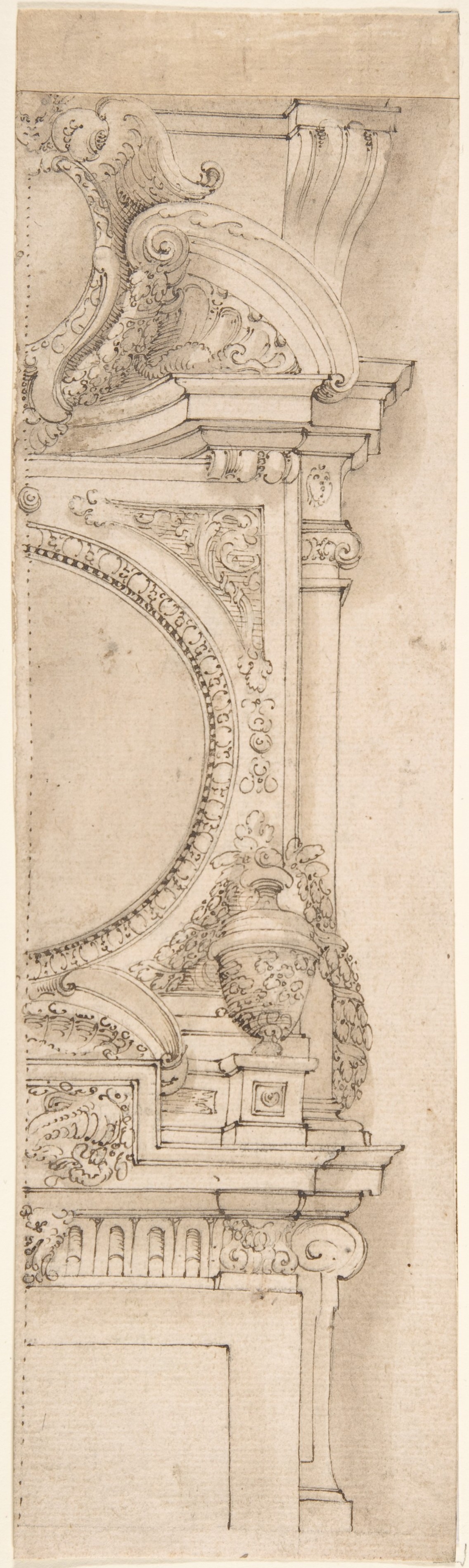
Anon., Italian school, 17th century, design for right half of a chimneypiece, pen-&-ink, wash, pencil, 29 x 8.4 cm., Metropolitan Museum, New York

Anon., Italian school, 17th century, design for left half of a chimneypiece, pen-&-ink, wash, pencil, 29 x 9.8 cm., Metropolitan Museum, New York
‘By the 17th century, chimneypieces had become an important object of design within the interior. Examples in late Renaissance and early Baroque styles were often highly sculptural, heavily ornate and very colourful feats of bravura design. The love for the theatrical, which characterized the Baroque period, meant that a certain level of monumentality was pursued. In that respect, these two drawings show designs of a relatively modest nature, although coloured marbled and gilding could transform their final look dramatically.’
 The Frame Blog