
Low Countries
16th century Low Countries
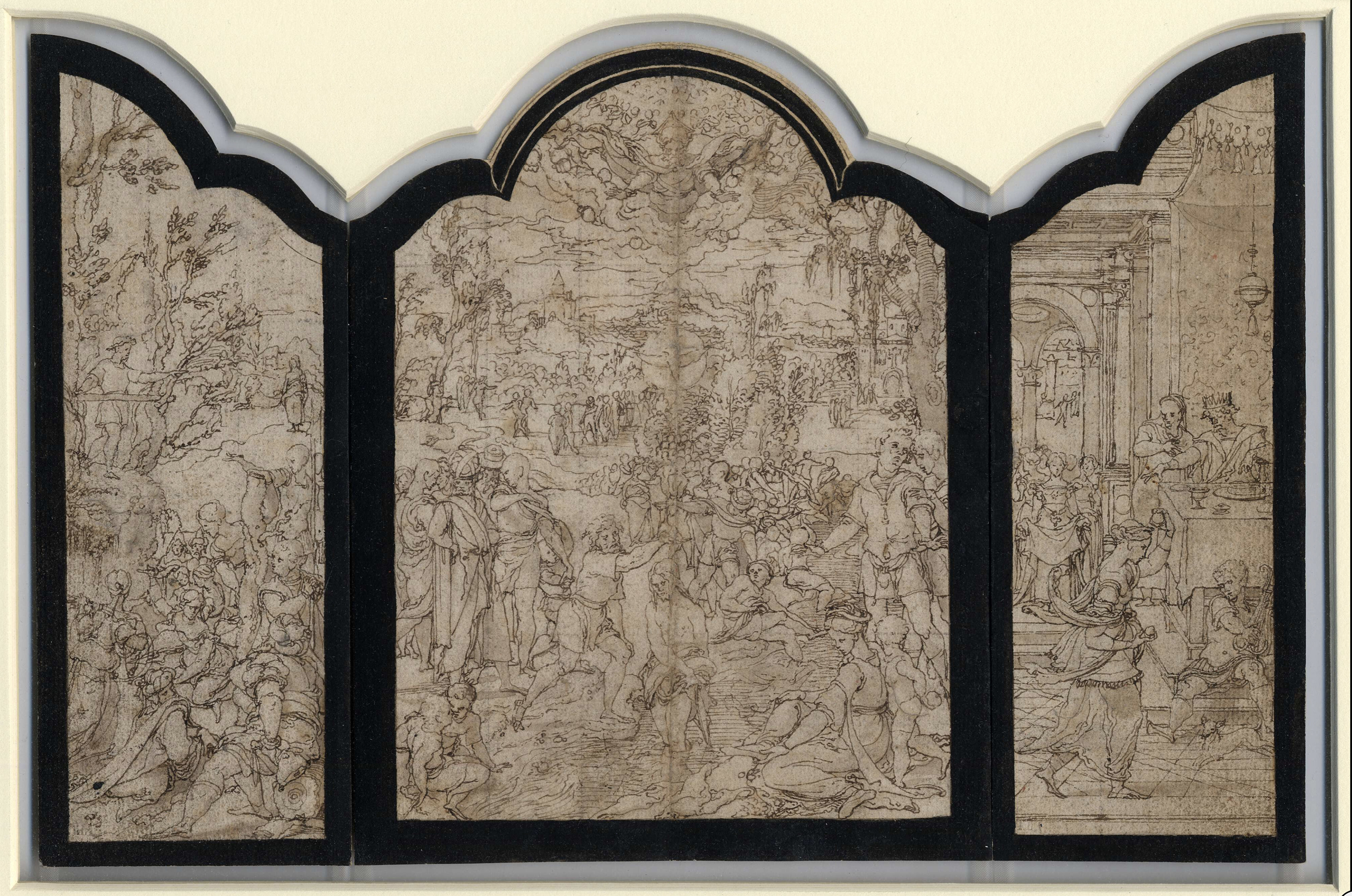
Pieter Coecke van Aelst I (1502-50), Triptych with scenes from The life of John the Baptist, c.1535-36, 21.1 x 31.9 cm., © The Trustees of the British Museum
‘Stylistically close to a drawing in Fondation Custodia, inv.no.5928. This is a design for a triptych… possibly a recording of a now lost work or a vidimus to show the commissioner before the execution of the painting. One of few Netherlandish examples from before the second half of the 16th century which includes a design for a frame. Stijn Alsteens observed that this drawing seems to have been altered at a later date: ‘originally, the drawn frame probably consisted only of two pairs of thin double framing lines, and not of the broad black strip now surrounding the five scenes and throwing Coecke’s delicate work somewhat out of balance’, in E. Cleland, ed., Grand Design: Pieter Coecke van Aelst and Renaissance Tapestry, New York and New Haven, 2014, cat 18, p. 90-93. Alsteens includes the present sheet in Group A (drawings by and attributed to Coecke) in his subsequent catalogue of Coecke’s drawings in Master Drawings’.
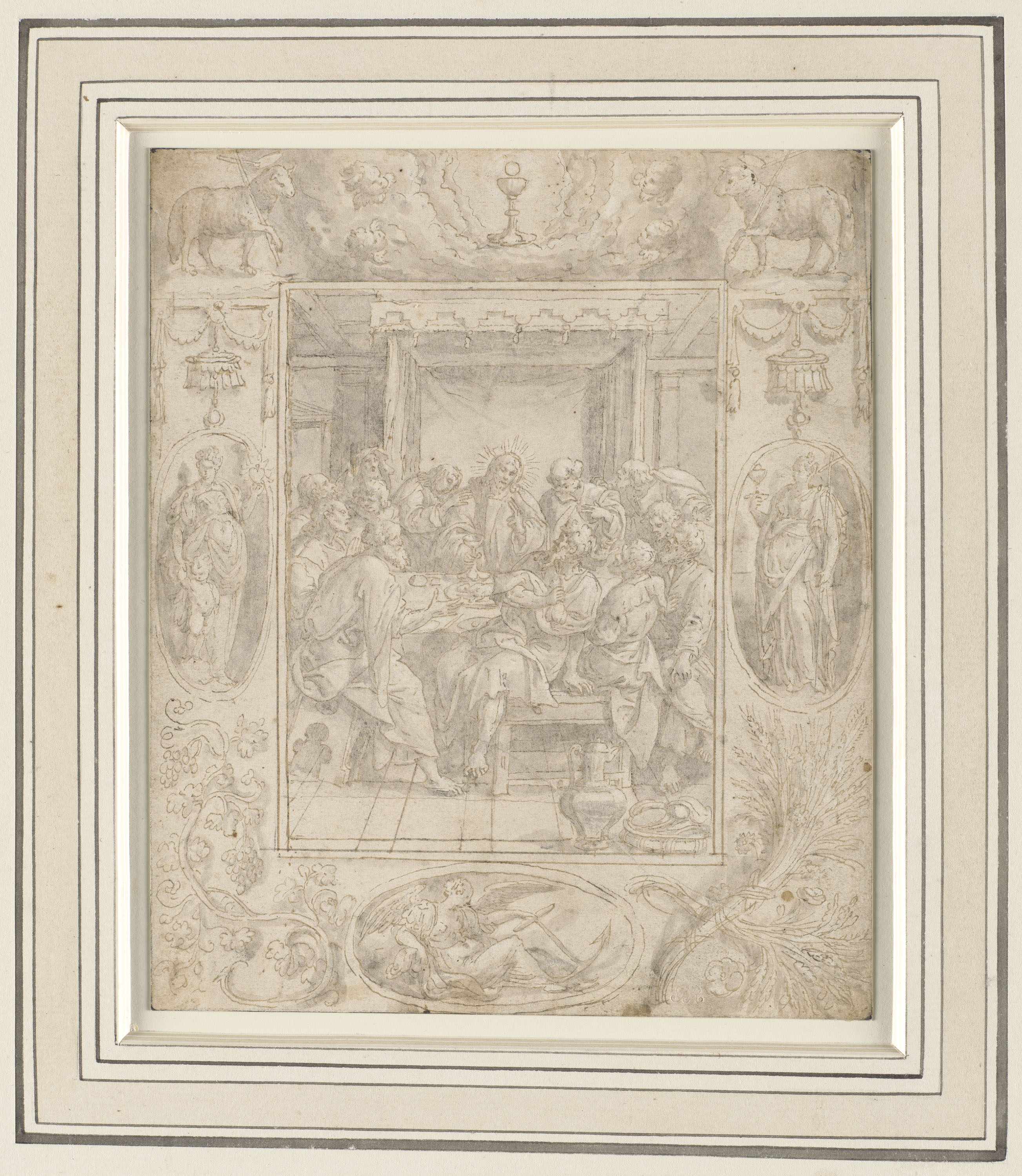
Maarten de Vos (1532-1603), The Last Supper, pen-&-ink and wash, 19 x 15.8 cm., Royal Collection Trust. RCIN 906319
This is the preparatory drawing for the engraving in reverse by Anthoine Wierix, which is part of a series of the Passion of Christ, but see also Dorien Tamis, ‘Figurative frames in the Low Countries‘.
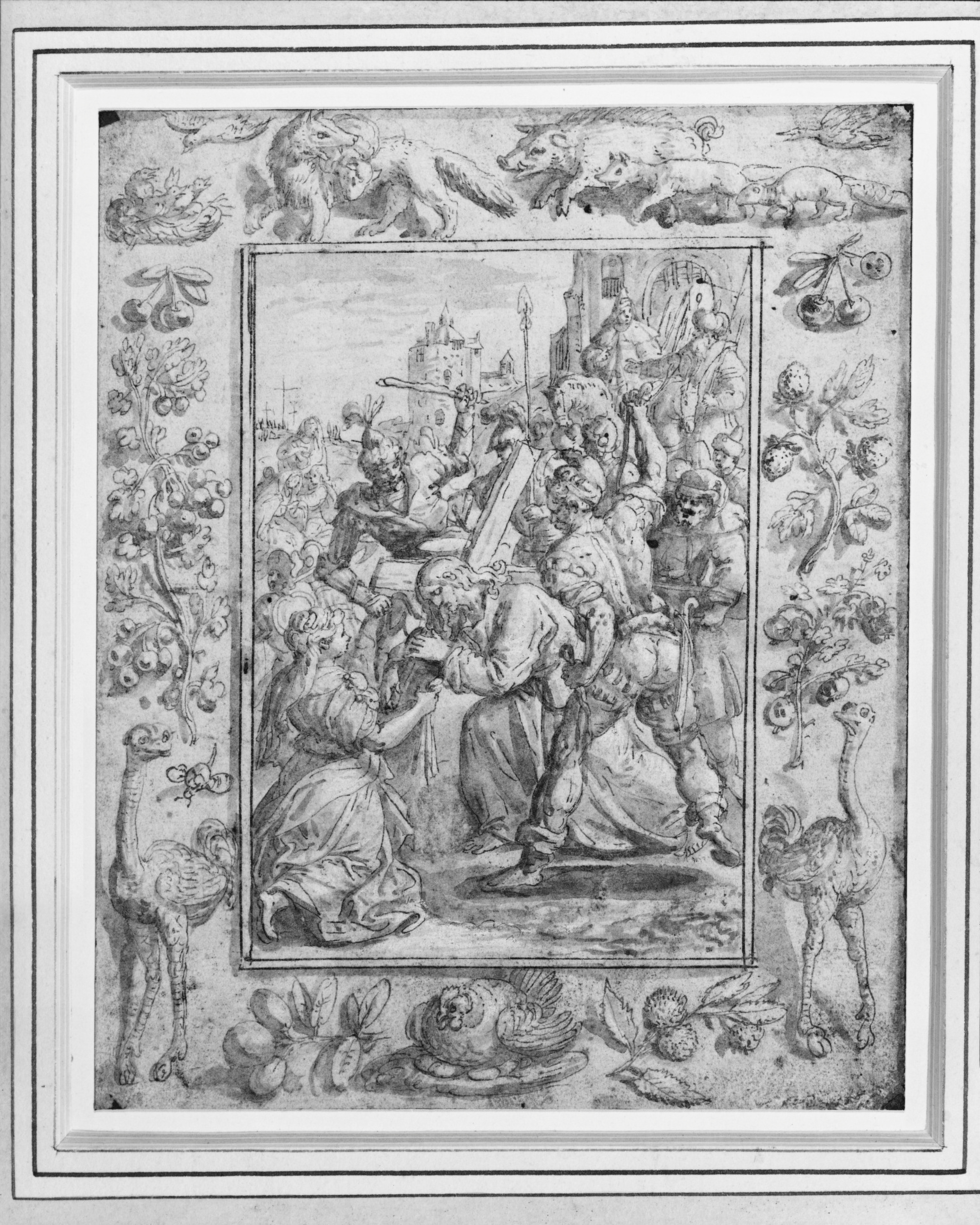
Maarten de Vos (1532-1603), Christ carrying the Cross, pen-&-ink and wash, 27.6 x 19.6 cm., Royal Collection Trust. RCIN 906320
This is also a preparatory drawing for the engraving in reverse by Anthonie Wierix, and see (as above) Dorien Tamis.
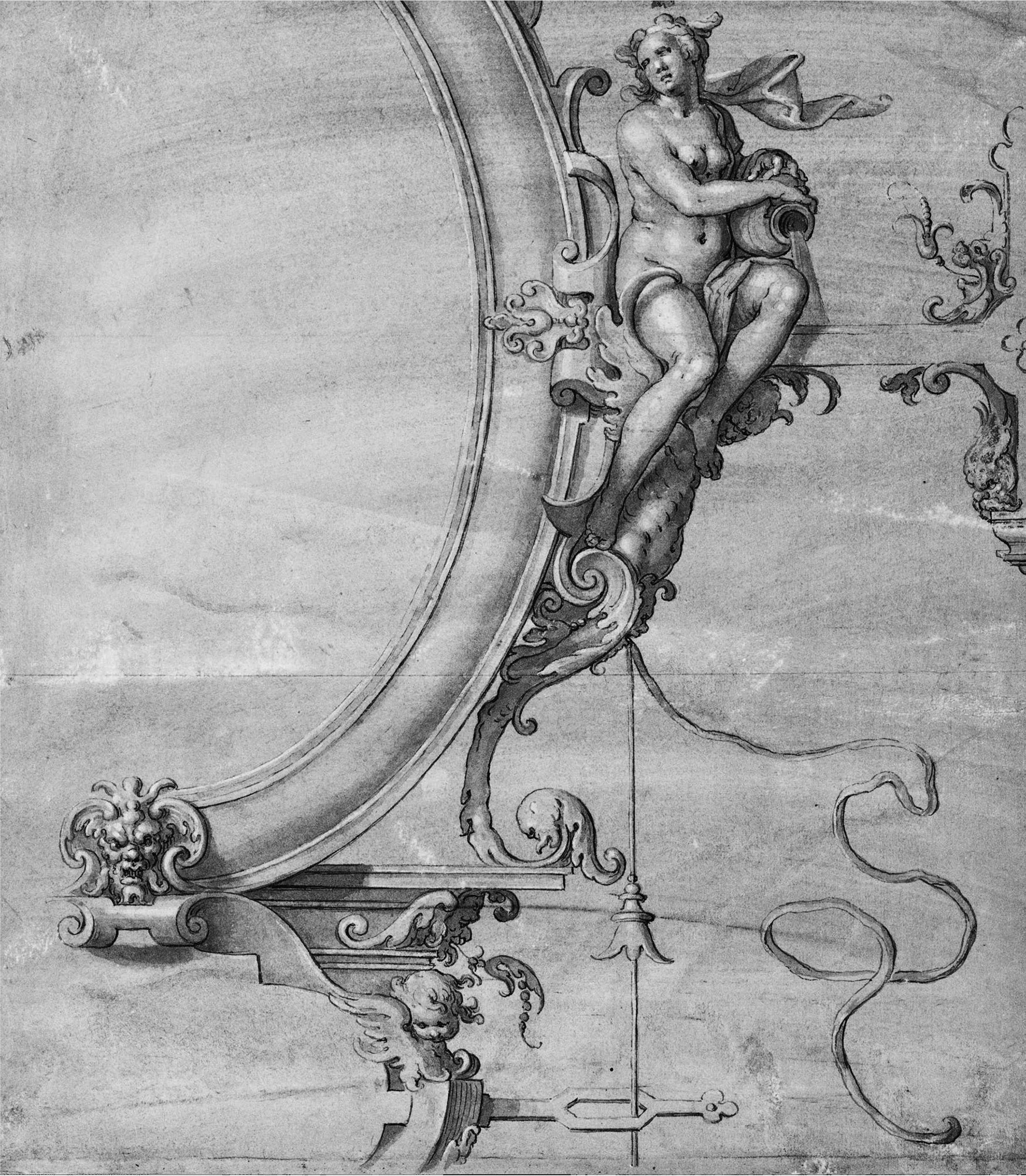
Netherlandish School, c.1575-1600, design for decoration for part of an oval frame with nude female and strapwork, pen-&-ink, wash, heightening, 30.1 x 26.4 cm., Royal Collection Trust. RCIN 910940
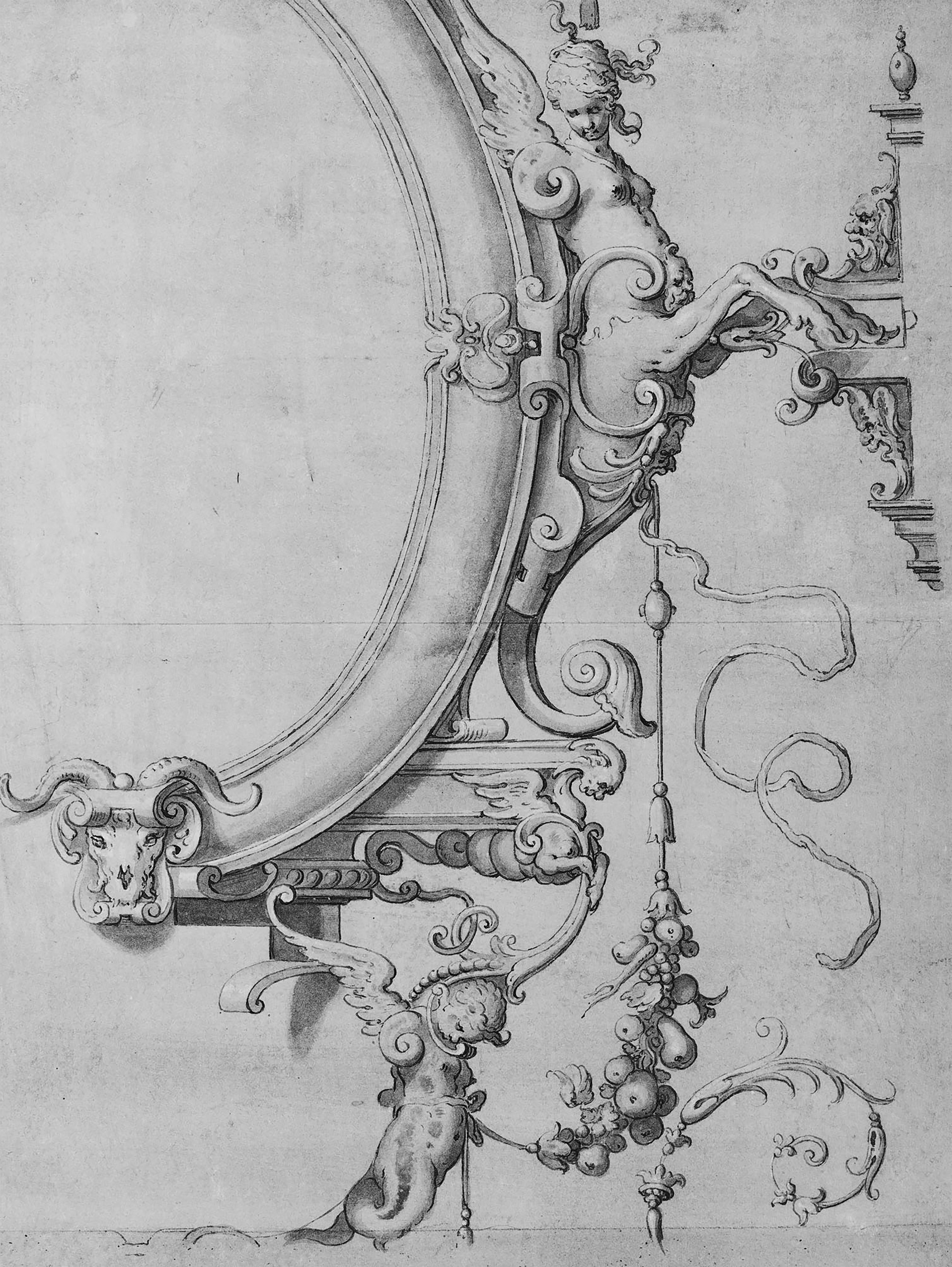
Netherlandish School, c.1575-1600, design for decoration for part of an oval frame with grotesque figures, swags, strapwork, &c., pen-&-ink, wash, heightening, 35 x 26.5 cm.; Royal Collection Trust. RCIN 910941
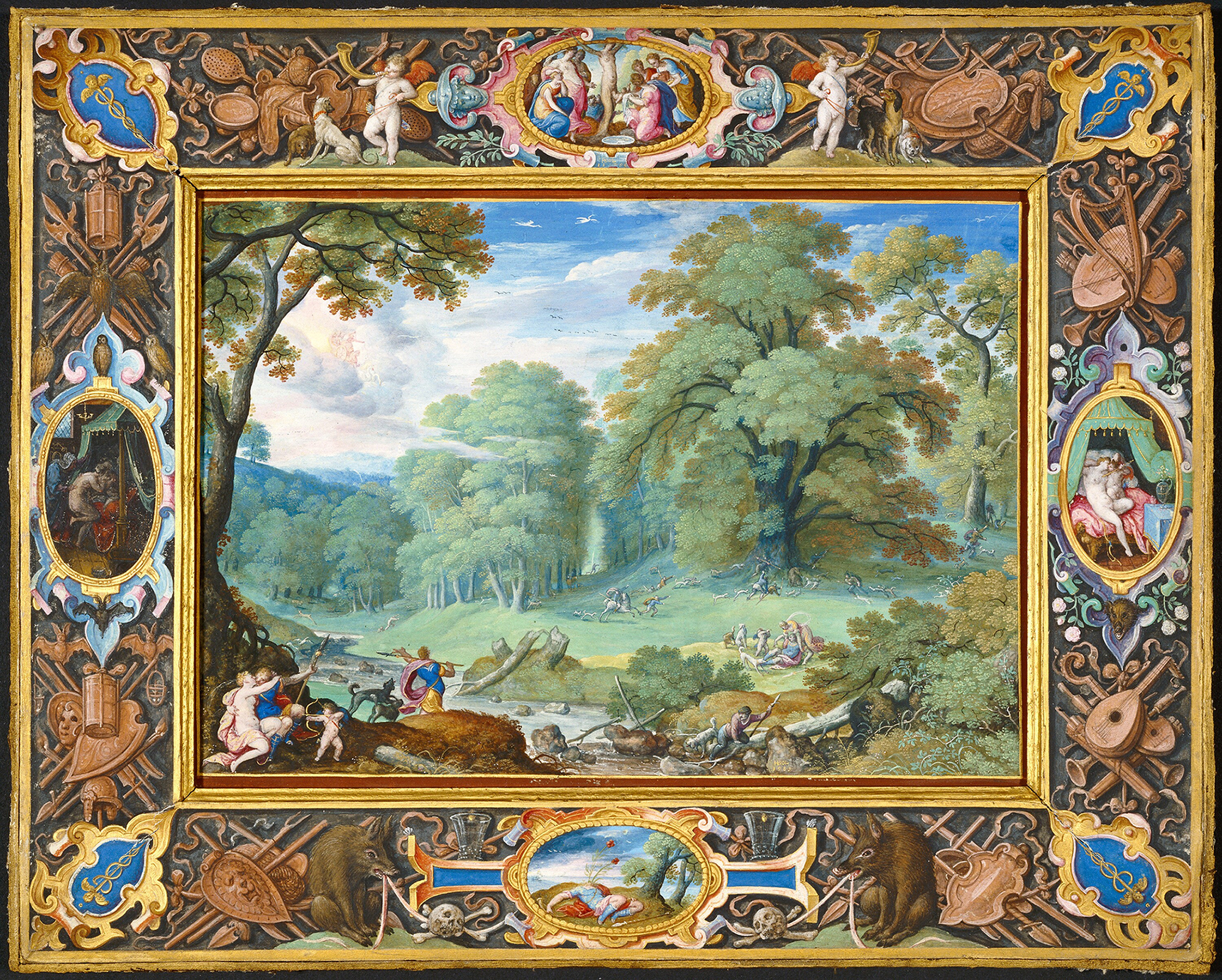
Hans Bol (1534-93), Landscape with the story of Venus & Adonis, 1589, miniature on vellum, gouache, gold, 20.6 x 25.7 cm. unframed, J. Paul Getty Museum
‘Hans Bol painted this unusual miniature in two parts: the central landscape, painted on parchment mounted on wood, and the framing design, painted directly on wood. Both parts tell the story of the beautiful youth Adonis from Ovid’s Metamorphoses. In the main panel, Venus and Adonis embrace before he leaves on the hunt shown in the distance, in which he is killed by a boar. Clockwise from left, the oval [cartouches on the frame] show subsidiary incidents: Adonis’s mother Myrrha commits incest with her father; turned into the myrrh tree as punishment, Myrrha bears their son, Adonis; Venus is struck with love for Adonis; blood springing from the dead Adonis turns into the anemone flower.
In the frame, Bol combined the cartouches and trophies of a three-dimensional picture frame with illusionistic borders reminiscent of manuscript illumination. His materials – opaque colour and gold paint on parchment – also follow the tradition of manuscript illumination’.
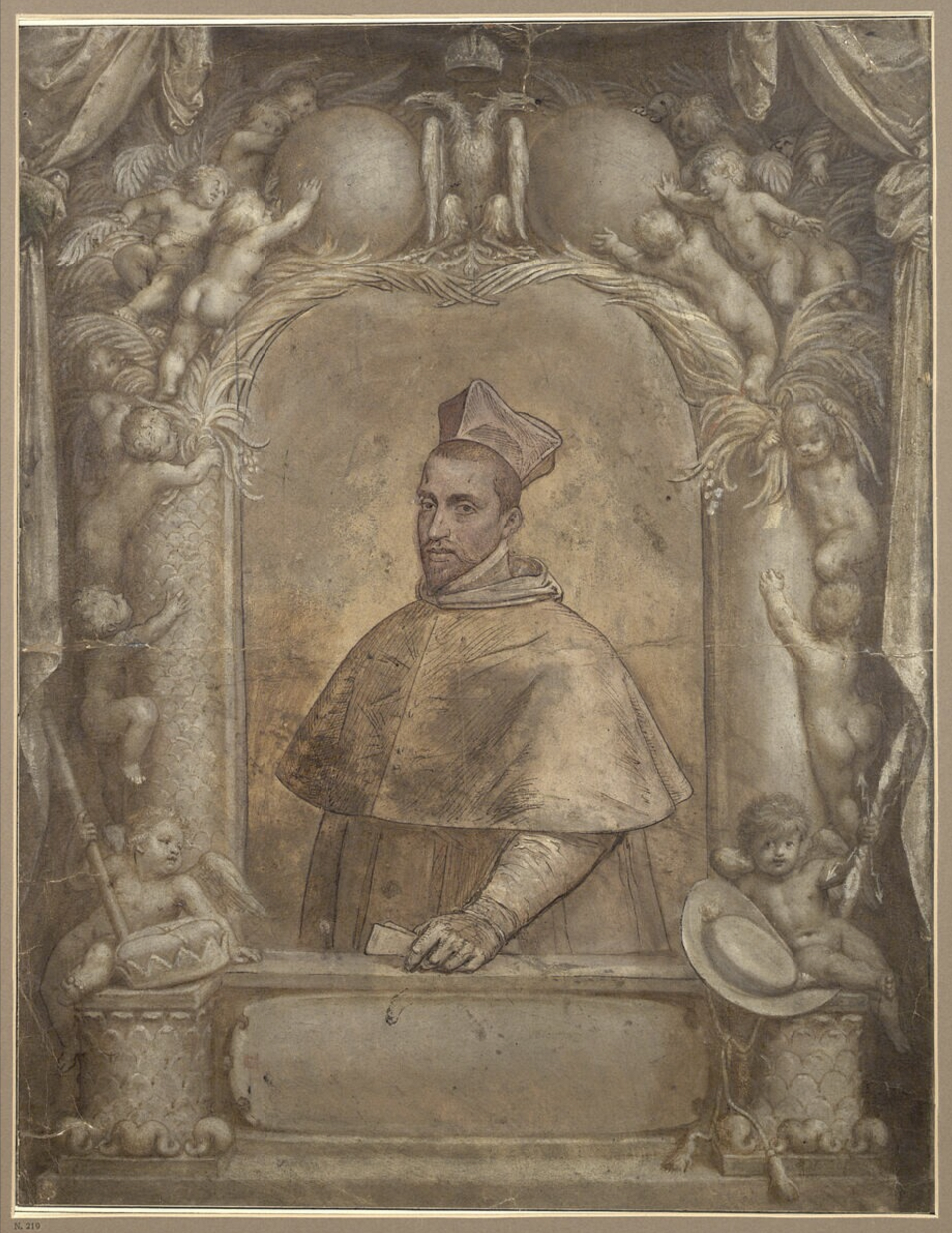
Otho van Veen (1556-1629) & Rubens (1577-1640), Archduke Albrecht of Austria as a cardinal, c.1597, pen, oil paint, 46.2 x 36 cm., Albertina, Vienna
‘This is the model for an engraver: the corresponding engraving is dated 1597 and names Otho van Veen as the creator and Georg van de Velden as the engraver. According to E. Mitsch, AK Albertina 1977, pp. 1-3, no. 1, Rubens largely prepared this model. Otho van Veen clearly highlighted the portrait of the Archduke as the centrepiece of the depiction and accentuated the frame, attributed to Rubens (by Norris 1940), with pen-&-ink. This is the earliest known example of an oil sketch on paper by Rubens.
Julius Held (Held 1980, p. 527, note 7) and Anne-Marie Logan (AK Rubens Albertina 2004, p. 79, note 96), however, attribute the entire sheet to Otto van Veen.’
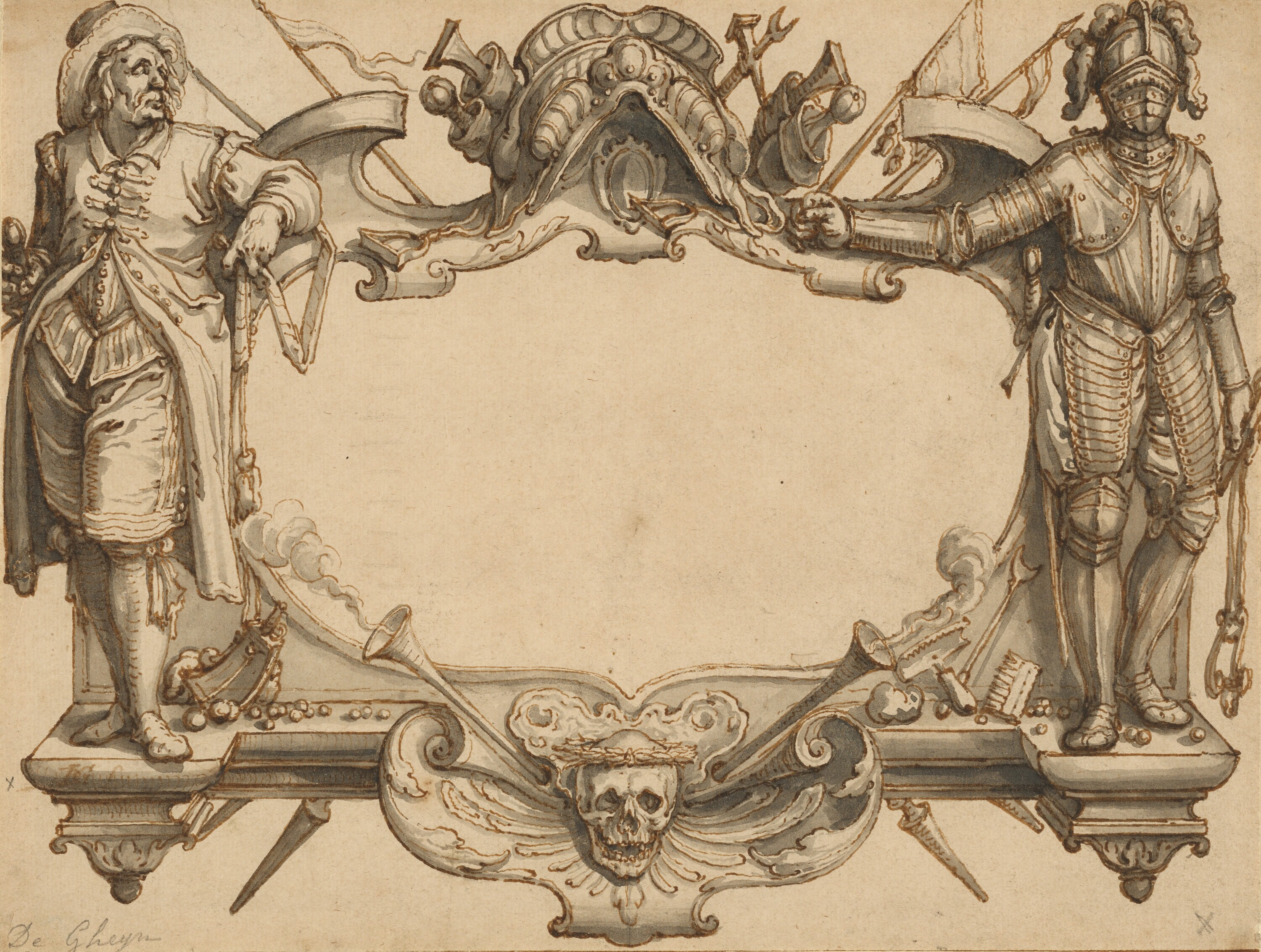
Jacques de Gheyn II (1565-1629), design for the title page of The exercise of cavalry, 1598-99, pen-&-ink, wash, incised, 15.6 x 20.6 cm., J. Paul Getty Museum
‘An armoured and an unarmoured cavalryman lean against the frame of an empty cartouche which melts pliantly into grotesque strapwork. A witty arrangement of equestrian accoutrements decorates the top and bottom, including a saddle laden with weapons, flags, stirrups, a curry comb, and other brushes. A laurel-crowned skull and smoking trumpets below symbolize death and fame. The guns and blades which extend up and down from the cartouche evoke the battle charge and give a three-dimensional depth to the scene.
Jacques de Gheyn drew this elaborate frame as a model in reverse for the title page of The Exercise of Arms, published in 1607. Conceived as a military handbook for the cavalry regiments of the Dutch army, The Exercise of Arms contained twenty-two designs. Count Johann II of Nassau-Siegen commissioned the text to give the Dutch horse guards a set of clear and systematic military procedures for training soldiers’.
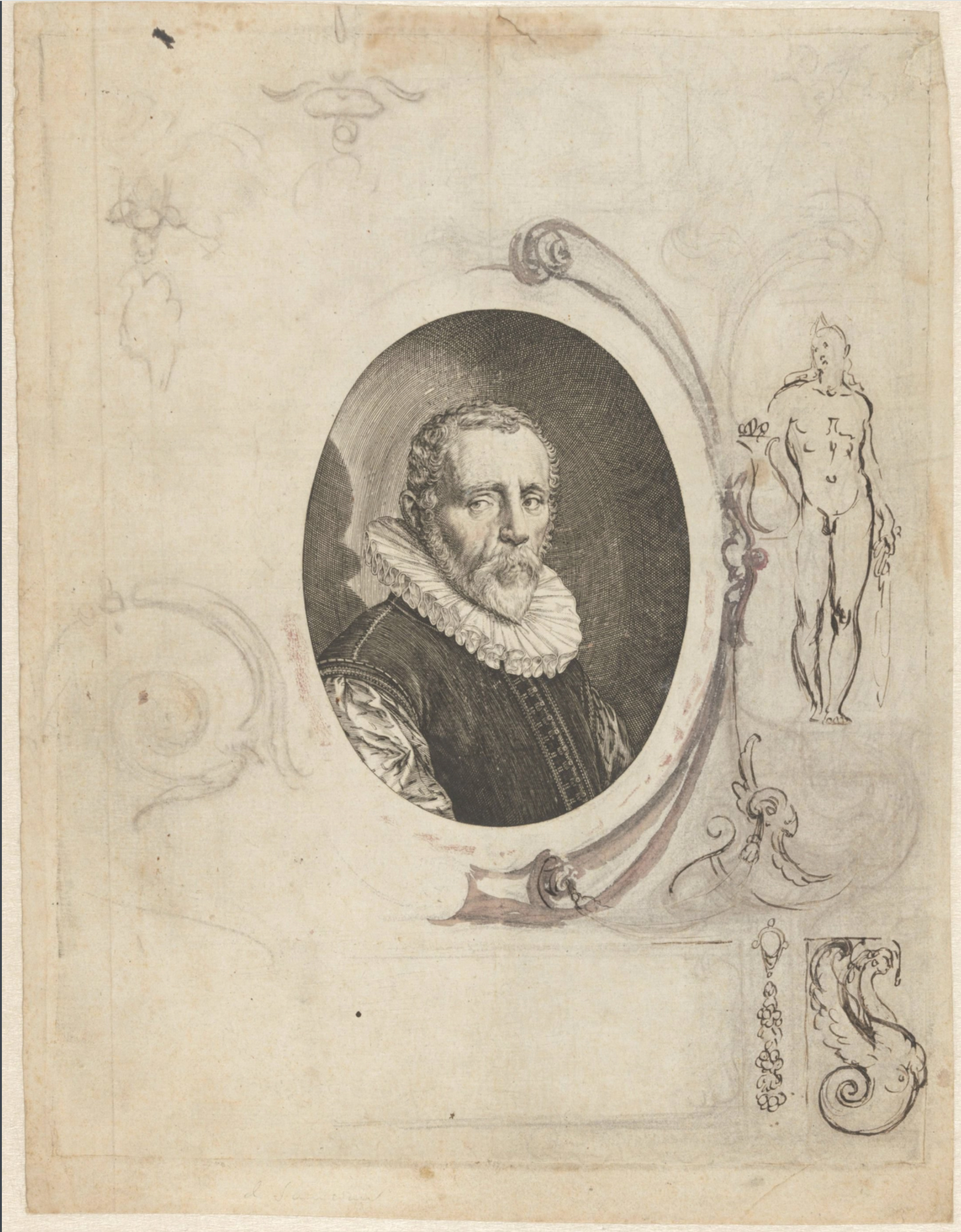
Karel van Mander I (1548-1606), print of the Portrait of Pieter Hogerbeets with sketches for frame, 1599, pen-&-ink, brush, black chalk, incised marks, on proof of an engraving, 29.6 x 22.8 cm, Rijksmuseum
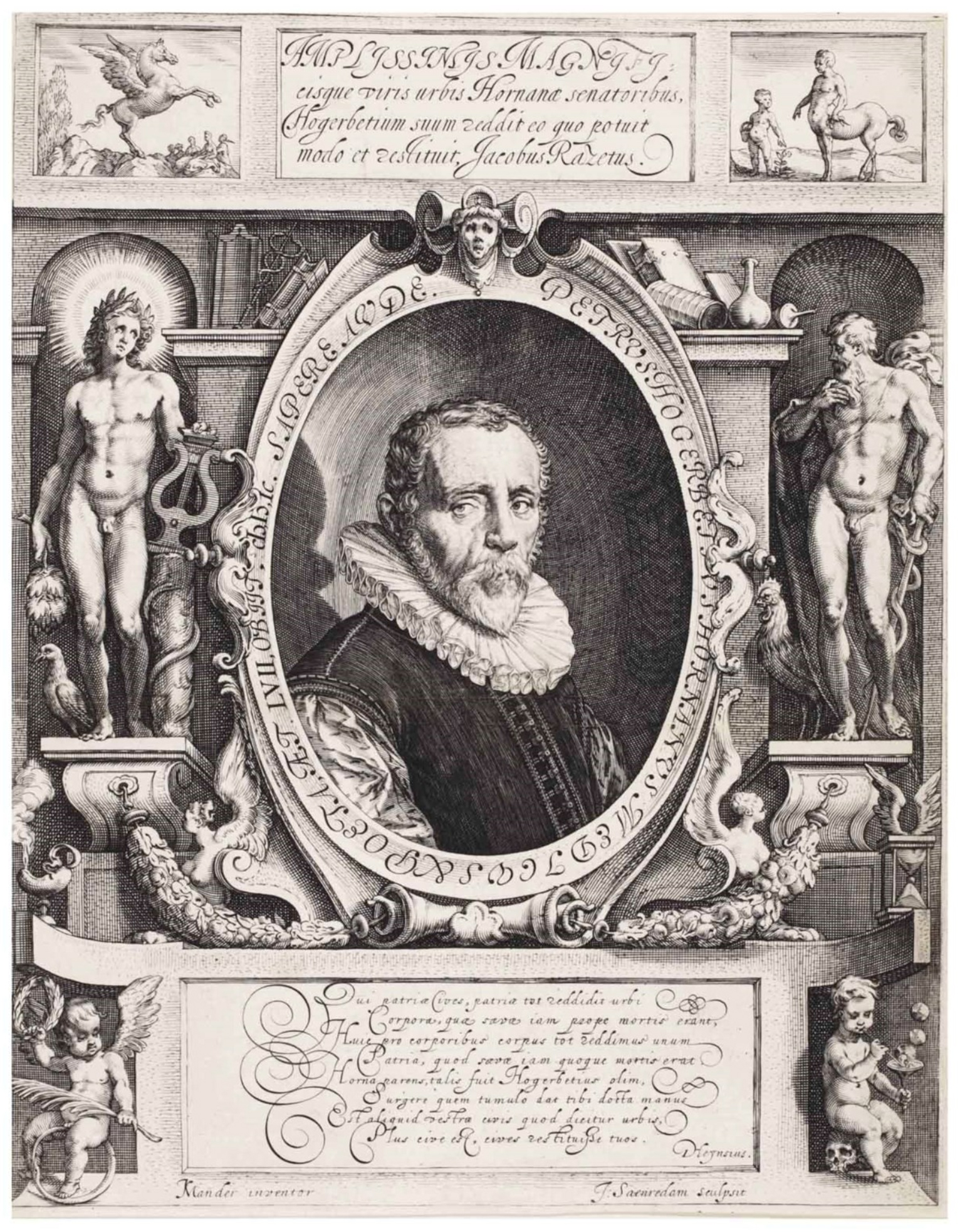
Karel van Mander I (artist; 1548-1606) & Jan Saenredam (engraver; 1565-1607), Portrait of Pieter Hogerbeets, finished state of print, Christie’s, 10 December 2014, Lot 115
[Upper image:] ‘This is a drawn design for the surround of a portrait engraving. The draughtsman Karel van Mander was here trying out suitable ornamentation for the portrait of the learned physician Hoogerbeets. The engraver’s final design [lower image] turned out to be very different.’
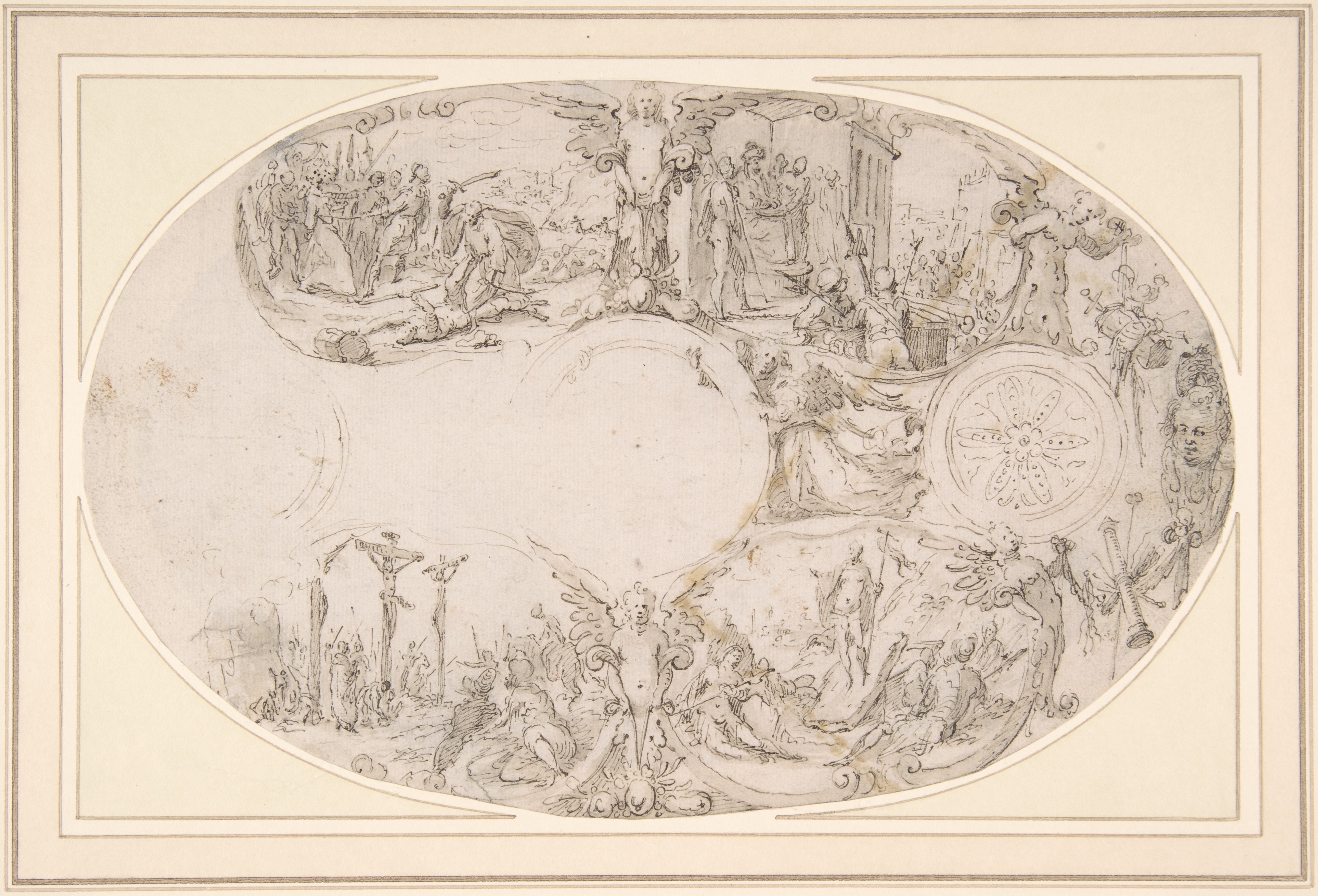
Paulus Willemsz. van Vianen (1570-c.1613/14), design for a silver dish with Scenes from Christ’s Passion, c.1600, black chalk, pen-&-ink, wash, 14.1 x 21.7 cm., Metropolitan Museum, New York
The individual scenes have framing elements consisting of winged caryatides morphing from leaves, with fruit and flowers at the base of the central frontal figures, and joined by scrolls, with the instruments of Christ’s Passion and a cherub’s head in the completed right-hand lateral spandrel. The central roundel is supported by angels.
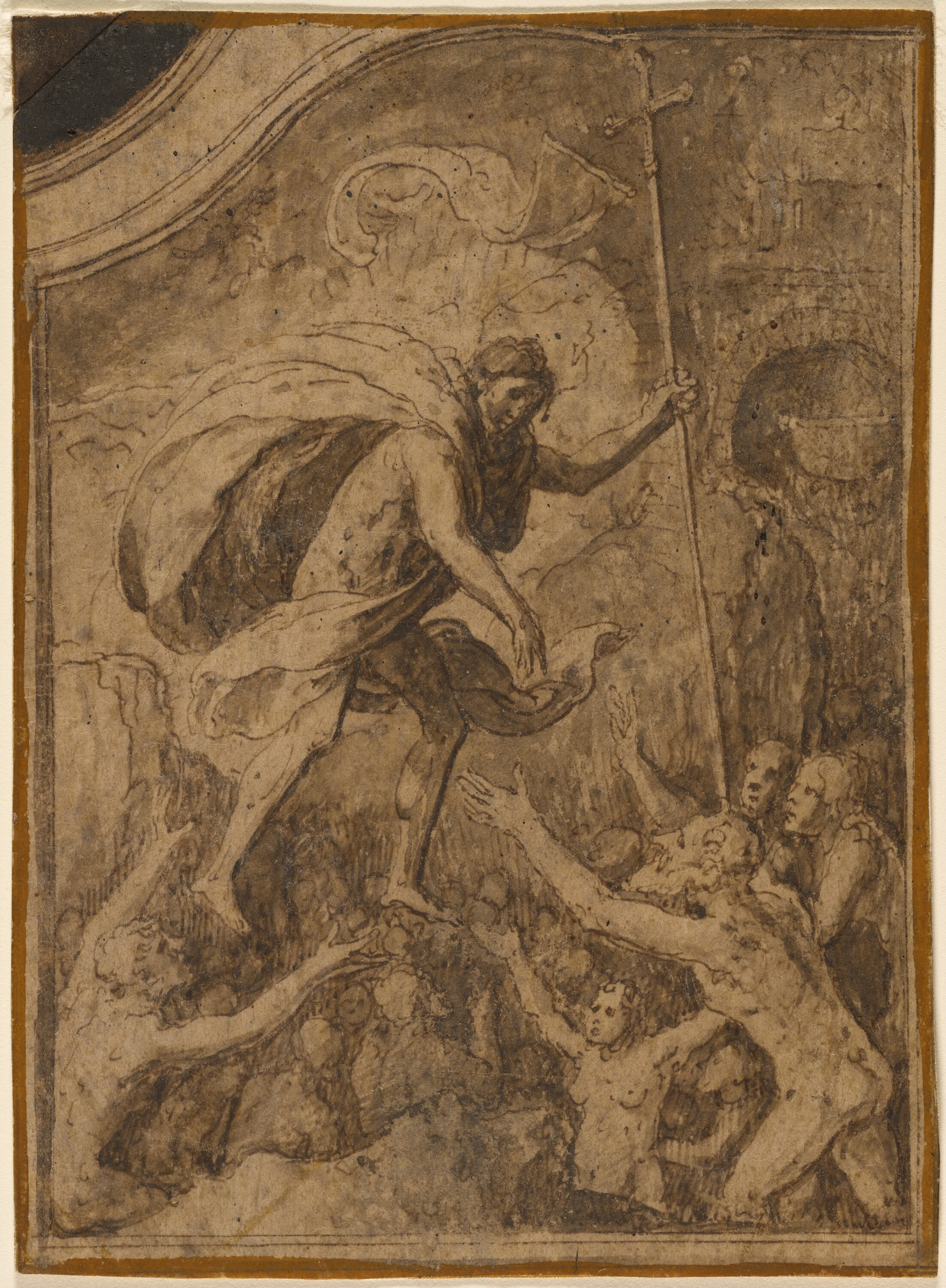
Anon., Flemish school, Christ in Limbo, 1520-40, pen-&-ink, wash, 16.7 x 12.2 cm., J. Paul Getty Museum
It is thought that ‘… this drawing was made as a design for the wing of an altarpiece, as the curved frame along the upper left side is similar to [those of] other altarpieces’.
 The Frame Blog