
Spain
17th century Spanish drawings

Francisco Rizi (1614-85), The expectant Virgin appearing to St Simón de Rojas, c.1650, pen-&-ink, wash, black chalk, partly incised, 19.6 x 12.5 cm., © The Trustees of the British Museum
‘The architectural frame enclosing the figures comprises a plinth, an elaborate arched moulding and putti which seem to leap off the ledge toward the figures below. Rizi employed the illusionistic proscenium arch to indicate deep perspective in his painting of The Virgin and Child Adored by Saints Philip and Francis in the Capuchin Church of El Pardo painted in 1650. Two drawings for this painting survive, the first a partly finished study laying out the main elements of the composition (Uffizi, Florence), and the second a much more refined study which is very similar to the present work (Instituto Valencia de Don Juan, Madrid). Rizi evidently planned his drawings in several stages and the finished sheets might have been intended to present to the patron, or as a record of his work.
Llamas Delgado has identified this drawing and another two in the Biblioteca Nacional in Madrid as part of a design for an altar in the chapel of the Shod Trinitarian in Madrid. The pronounced three-dimensional elements in this drawing suggests it to be a study of a niche with sculpted figures set on a pedestal. Rizi’s activity as a theatre designer is important for understanding this drawing, in particular the plasticity of its forms. He was Director of stage design for the Coliseo Theatre of the Buen Retiro in Madrid in the 1640s and responsible for the street decorations and temporary architectural structures for the entry of Mariana of Austria in Madrid in 1649. Rizi’s theatre work provided a model for the scenographic altarpiece that became so important in Madrid during the second half of the 17th century.’
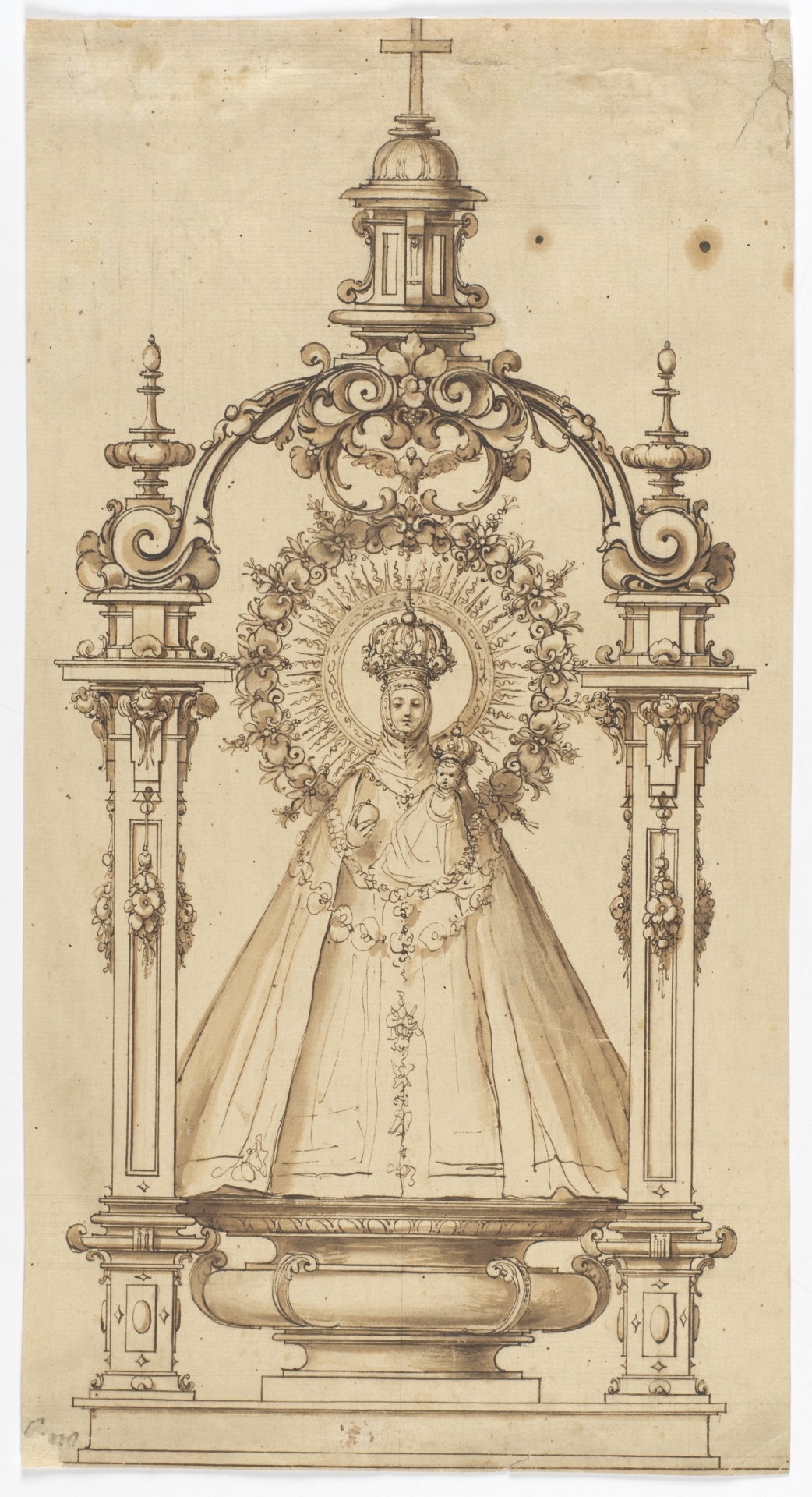
Sebastián de Herrera Barnuevo (1619-71), The Virgin of Atocha, 1654, pencil, wash, 39.2 x 20.6 cm., Museo del Prado
‘The image of the Virgin, wearing a very large crown attached to an outer halo, stands on a base with concave and convex mouldings. Two pierced pilasters, decorated with plaques and garlands, flank her. Above these is an arch with scrolling foliage and flowers, and above these a cross.
As Wethey pointed out, it is a very beautiful work, characteristic of Herrera Barnuevo and undoubtedly the project he presented in 1654 to the Cathedral of Toledo. It was intended to be made in silver, but was never realized; although he was paid for the drawing on 15 February of that year, the piece was ultimately made by the goldsmith Virgilio Fanelli, to a design by Pedro de la Torre.
Nevertheless, the drawing was exhibited in Pontevedra in 1959, when it was attributed to Cano, an attribution which was untenable from a stylistic point of view.’
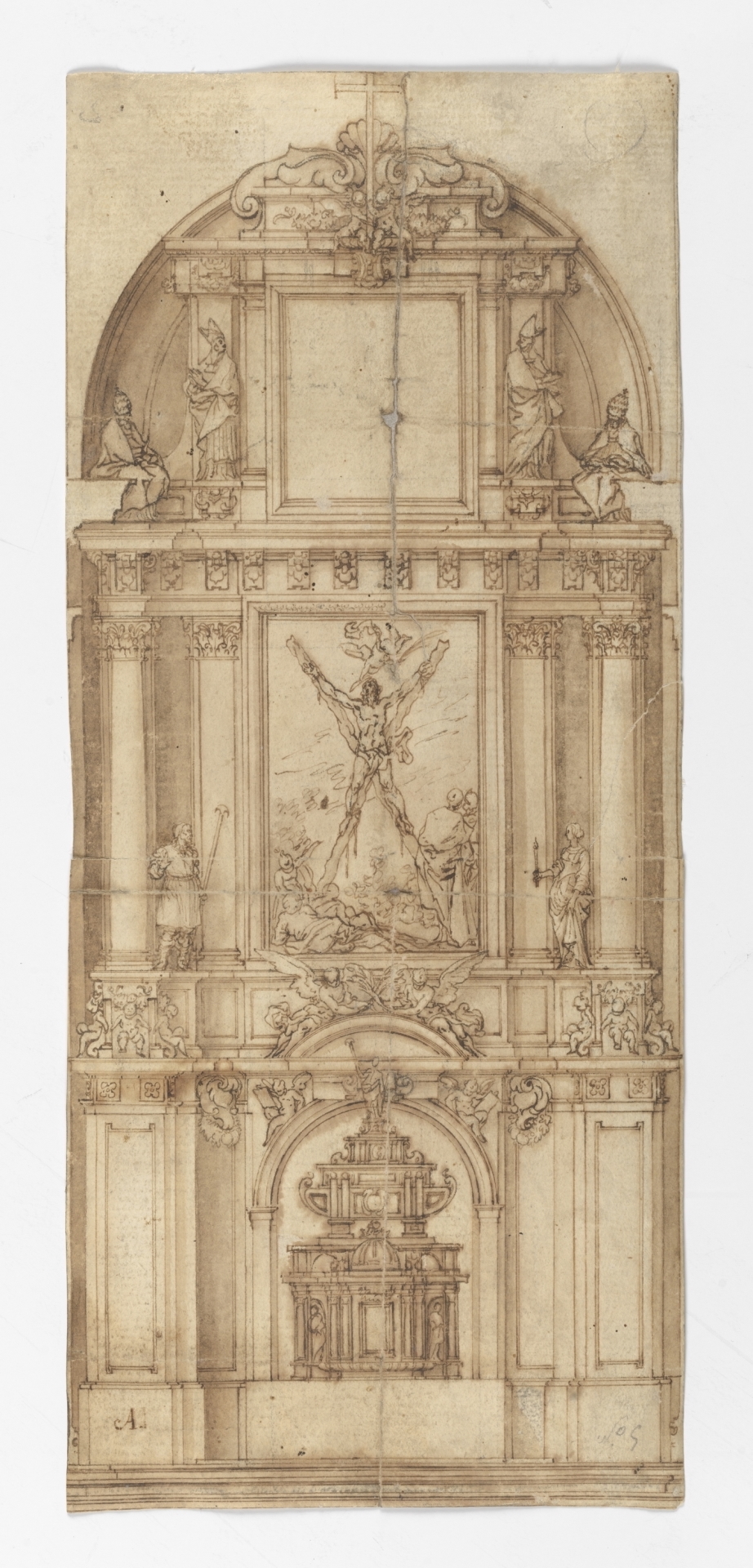
Alonso Cano (1601-67), design for an Altarpiece to St Andrew, from Madrid, c.1643, pencil, wash, 28.6 x 12.4 cm., Museo del Prado

Alonso Cano (1601-67), Altarpiece of St John of God, 1653-57, pencil, wash, 23.2 x 16.2 cm., Museo del Prado

Anon., 17th century Spanish school, design for left half of an altar, c.1600-50, pen-&-ink, wash, traces of black chalk, 24.6 x 9.8 cm., Metropolitan Museum, New York
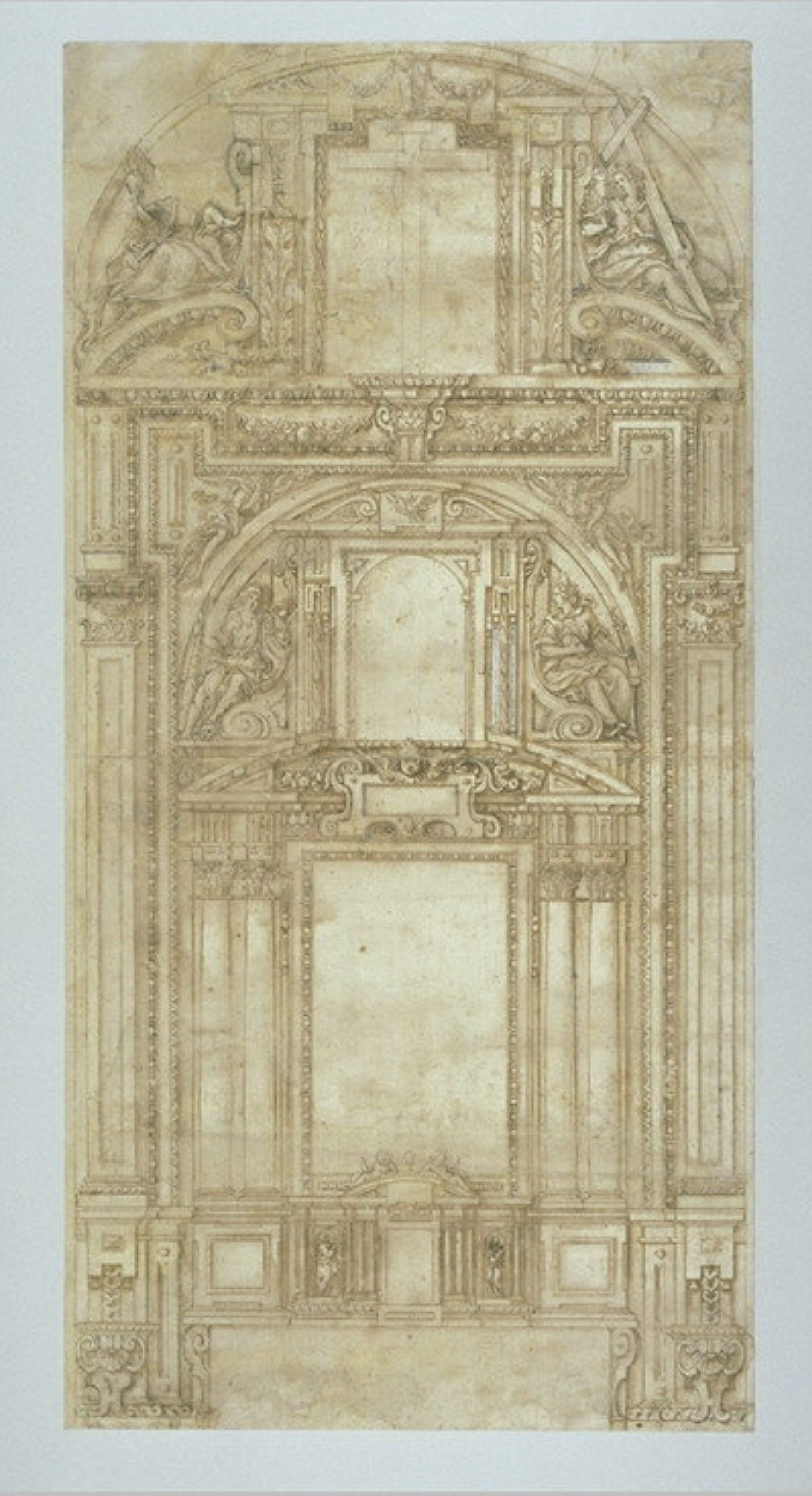
Anon., 17th century Spanish school: Seville, design for an altarpiece, first two-thirds 17th century, pen-&-ink, wash, white gouache heightening, traces of black chalk, 65 x 30.1 cm., Département des Arts graphiques, Musée du Louvre
‘Attributed to Alonso Cano in the Standish sale catalogue, this altarpiece project was rightly rejected from the artist’s corpus by Wethey. But the architectural elements and ornamental motifs do place this important altarpiece in the circle of the master, in Seville or Granada, at the turn of the century (around 1660 at the latest). The allegorical figures, probably intended to be modelled in stucco, represent Faith and Charity seated on the volutes of the open pediment, with Fortitude and Temperance (?) under the central archivolt, and are similar to Cano’s drawings. Temperance (?) offers a technique and physiognomy comparable to the figure in the St Catherine Altarpiece in the Kunsthalle, Hamburg, a significant example of Cano’s decorative conception. The niches housing SS Peter and Paul on either side of the small tabernacle at the base are composed in the same spirit as the lower compartment of the Altarpiece of St John the Evangelist (1635-37) in the church of Santa Paula in Seville.’ (L. Boubli and A.E. Perez Sanchez, in cat. exp. Spanish Drawings: Masters of the 16th and 17th Centuries, Paris, Musée du Louvre, 1991, no. 121). ‘(…) The allegories of Faith and Charity are arranged like those in the design for the high altar of the church of Our Lady of Guadalupe, attributed to Francisco de Mora (Madrid, Biblioteca Nacional, inv. 365)’.
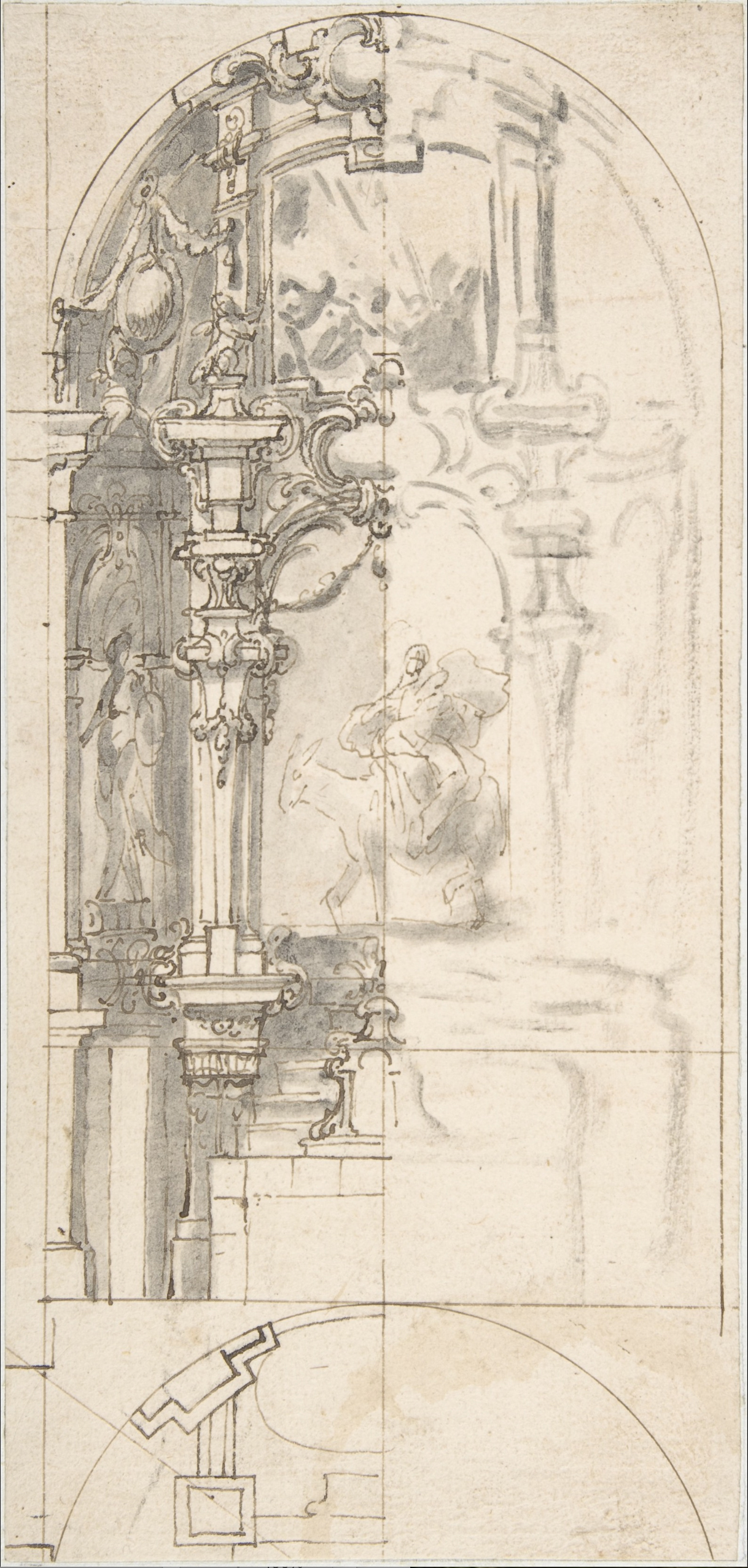
Anon., 17th century Spanish school, design for a chapel with an altarpiece of the Flight into Egypt, plan and elevation, pen-&-ink, wash, 24.4 x 11.6 cm., Metropolitan Museum, New York

Anon., 17th century Spanish school, design for an altarpiece with The Immaculate Conception, pen-&-ink, wash, traces of black chalk, 24.9 x 17.1 cm., Metropolitan Museum, New York

Anon., 17th century Spanish school, decoration for a spandrel, pencil, wash, 22.3 x 17.4 cm., Museo del Prado
‘A female figure leans against the curve of the arch of a semi-circular doorway, with a grille with converging radii, typical of the Madrid style. This drawing has a mock architectural background and a large vase with flowers. A cartouche is depicted on the axis of the door.
It appears to be a copy of another identical drawing, but of superior quality; the other drawing is preserved in Florence as the work of an anonymous Tuscan artist. Nevertheless, it is undoubtedly a work from Madrid, made at the end of the 17th century, and can be associated with Coello, Donoso and Palomino. The grille – so characteristic of the Madrid style – and the influence of Mitelli and Colonna, evident in the mock architecture and the vases, leave no doubt as to its Spanish provenance.’
 The Frame Blog