
Framing the European paintings at The Metropolitan Museum: Part 4

by Keith Christiansen
FRAMING IN THE 15th & 16th CENTURY: The Low Countries
Part 3 of this series by Keith Christiansen on the frames of The Met looked at those of the 14th-16th century, mainly from Italy; Part 4 carries on from where the latter ended, and focuses on Northern frames.
An early altarpiece framing
The same dynamic between painters and framemakers which operated in Italy did so too in the Netherlands. As noted at the beginning of the previous installment of these essays, what differed was the northern tradition of altarpieces with folding wings, most famously represented by Jan van Eyck’s Ghent Altarpiece , completed in 1432, but equally characteristic of more modest-scaled works, such as The Merode Altarpiece, the frame of which is modern but based on period examples. Among the early Netherlandish paintings in The Met’s collection which have retained their original frames, pride of place belongs to Van Eyck’s extraordinary Crucifixion and Last Judgment.

Jan van Eyck (c.1390-1441), Crucifixion & Last Judgement, c.1436-38, o/c from panel, each wing 56.5 x 19.7 cm., Metropolitan Museum, New York
It is displayed in the museum as a diptych, but it now seems that the two scenes may have functioned as the folding wings of a triptych, or the shutters of a reliquary. What must immediately strike any viewer is the contrast between the meticulously detailed and expansive panoramas of the pictures and the simple profile of the frames, which function as a surround but inevitably also suggest a of window – an idea famously articulated by Leon Battista Alberti in his treatise on painting of 1434 (I,19) but already fully explored independently by painters north of the Alps.
The Crucifixion is a landmark of the new naturalism of the Renaissance and a testament to the analytic mind by which Van Eyck redefined the potential of art. The milling crowds at the foot of the cross; the vast sweep of the landscape setting, with the detailed rendering of a distant city; the meandering river which leads to a range of snow-capped mountains; the cratered moon and clouds hanging in the sky; all transform the biblical event into a lived-in present. The companion picture evokes, instead, a visionary apocalyptic battle bringing the temporal world to an end. The scale of the figures is determined by a sacred hierarchy which is further asserted by the symmetry of heaven and the frightening chaos of Hell, while in the distance resurrected figures rise from the barren earth and churning sea.
The frames for these extraordinary paintings were detached when the paint surface was transferred in Russia from their original panel support to canvas (the pictures were sold by the Russian state n 1933). They were then gilded. Their simple profile perfectly sets off the detailed scenes. What sets the frames apart is the manner in which the surface has provided space for a multi-lingual textual commentary which enhances the viewer’s comprehension of the events depicted.

Van Eyck, detail of restored frame on the Last Judgement, bottom left-hand corner
In addition to the raised letters on the cavetto, or hollow, inner portion of the moulding, technical examination undertaken in 2018 indicated that beneath a later gilding of the flat frieze of the frames were remnants of the original reddish pigment, as well as a fragmentary inscription painted in white and black gothic letters. The decision was made to recover what remained and then to integrate it so as to convey the original appearance. The gothic script proved to be in Middle Dutch while the raised, uncial lettering is in Latin. The texts are taken from Isaiah (53:6-9, 12), Revelation (20:13 and 21:3-4), and Deuteronomy (32:23-24), and relate to the themes depicted. These inscriptions can be understood as addressed to both elite viewers trained in Latin, such as ecclesiastics and scholars, as well as to literate laymen. In this way the frames function not only as a window onto two complementary worlds – one evoking the historical/biblical past, the other a visionary, apocalyptic future – but as a transmitter of the ideas which the narrative of both paintings was intended to convey.
Portrait frames, windows and portals
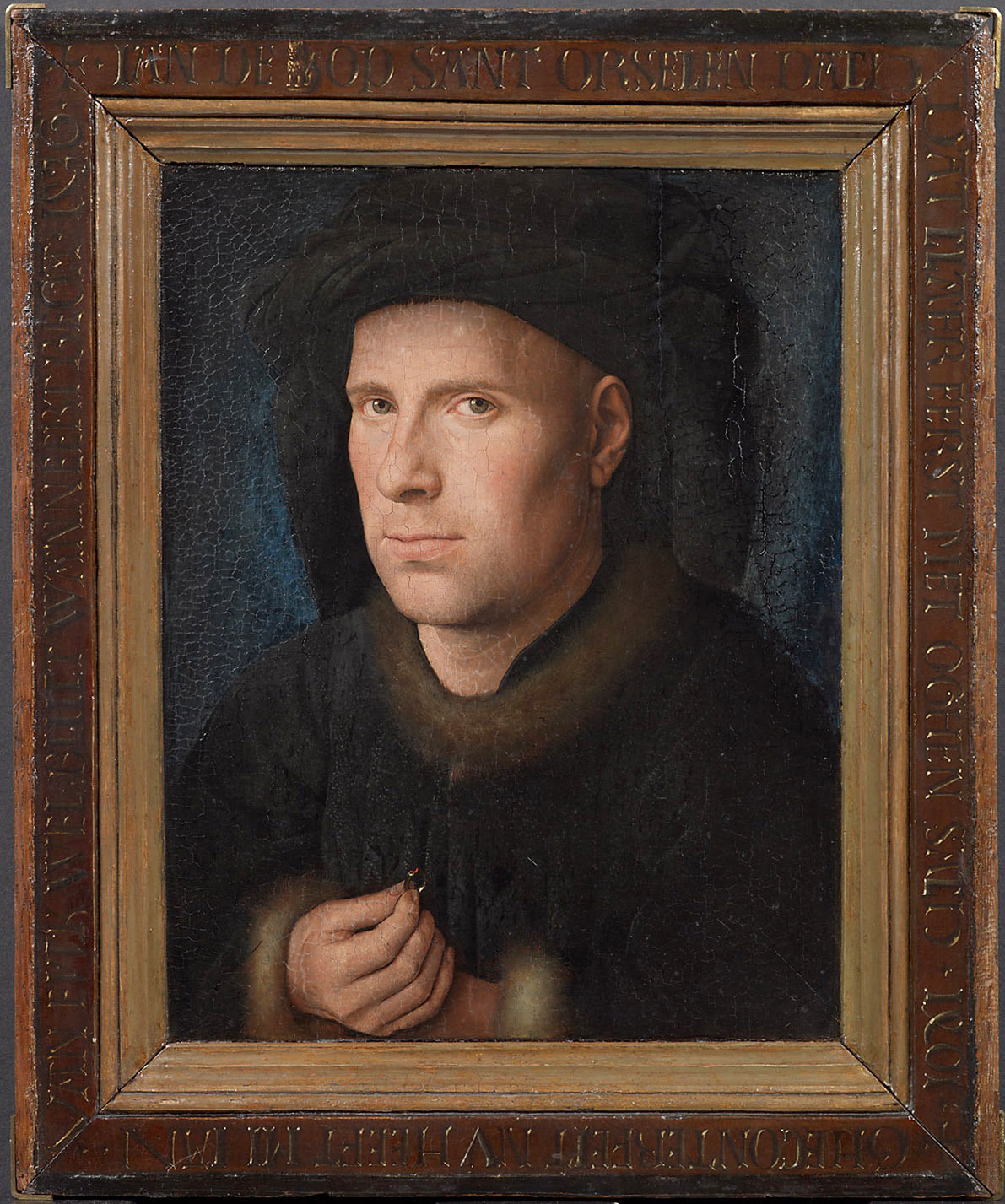
Van Eyck (c.1390-1441), Jan de Leeuw, 1436, o/panel, panel: 33 x 27.5 cm., image: 24.6 x 19.2 cm., frame: 37 x 31.5 x 3.5 cm., Kunsthistorisches Museum, Vienna
Van Eyck’s conceptualization of the frame as both container and vehicle for meaning was no less innovative in the portraits he painted. Take, for example, his astonishing portrait of the goldsmith Jan de Leeuw in Vienna, where the frame functions both as a surround and conceptually as a window through which we make eye contact with the sitter, who displays to the viewer a ring as an indication of his profession. Like the frames on the two wings discussed above, it contains an inscription in Flemish – rendered as though chiselled into the frieze – by which De Leeuw addresses the viewer and claims the painting as a record of his appearance at a specific moment in his life. It reads:
‘Jan De [image of a lion = Leeuw], who first opened his eyes on the feast of St Ursula, 1401. Now Jan Van Eyck has painted me; you can see when he began it. 1436 +’

Catherina van Hemessen (1528-1567), Self-portrait at the easel, 1548, o/ panel, 32.2 x 25.2 cm., Kunstmuseum, Basel
Variations on this type of frame became standard in Netherlandish and, indeed, European, painting. In 1548, Catherina van Hemessen depicted herself painting her self-portrait on a panel with a more deeply canted profile and not yet coloured, but having much the same proportional relationship.
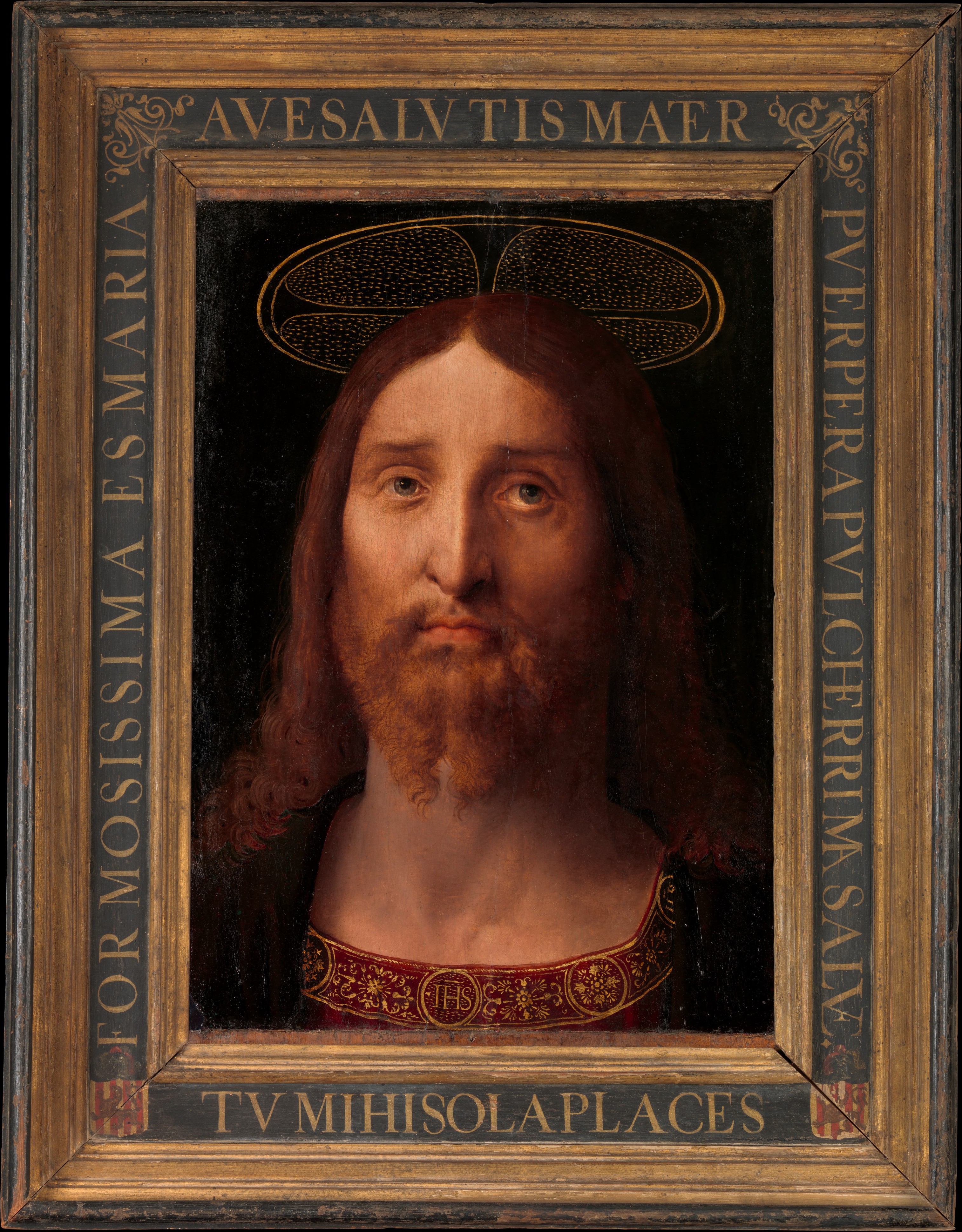
Fernando Yáñez de la Almedina (c.1475?-1536), Head of Christ, c.1506, o/panel, 41.9 x 30.5 cm., Metropolitan Museum, New York
The late 16th century Spanish frame on Fernando Yáñez de la Almedina’s Head of Christ is inscribed in immaculate humanist lettering with four salutations to the Virgin (the frame happened to fit the image of Christ and so was applied to it in 2014, despite the fact that it was clearly was intended for a depiction of the Virgin Mary):
‘Formosissima es Maria/ Ave salutis Mater/ Puerpera pulcherrima salve/ tu mihi sola places’
Thou, Mary, art the most beautiful/ Hail, Mother of salvation/ Hail, most beautiful child/ You alone please me
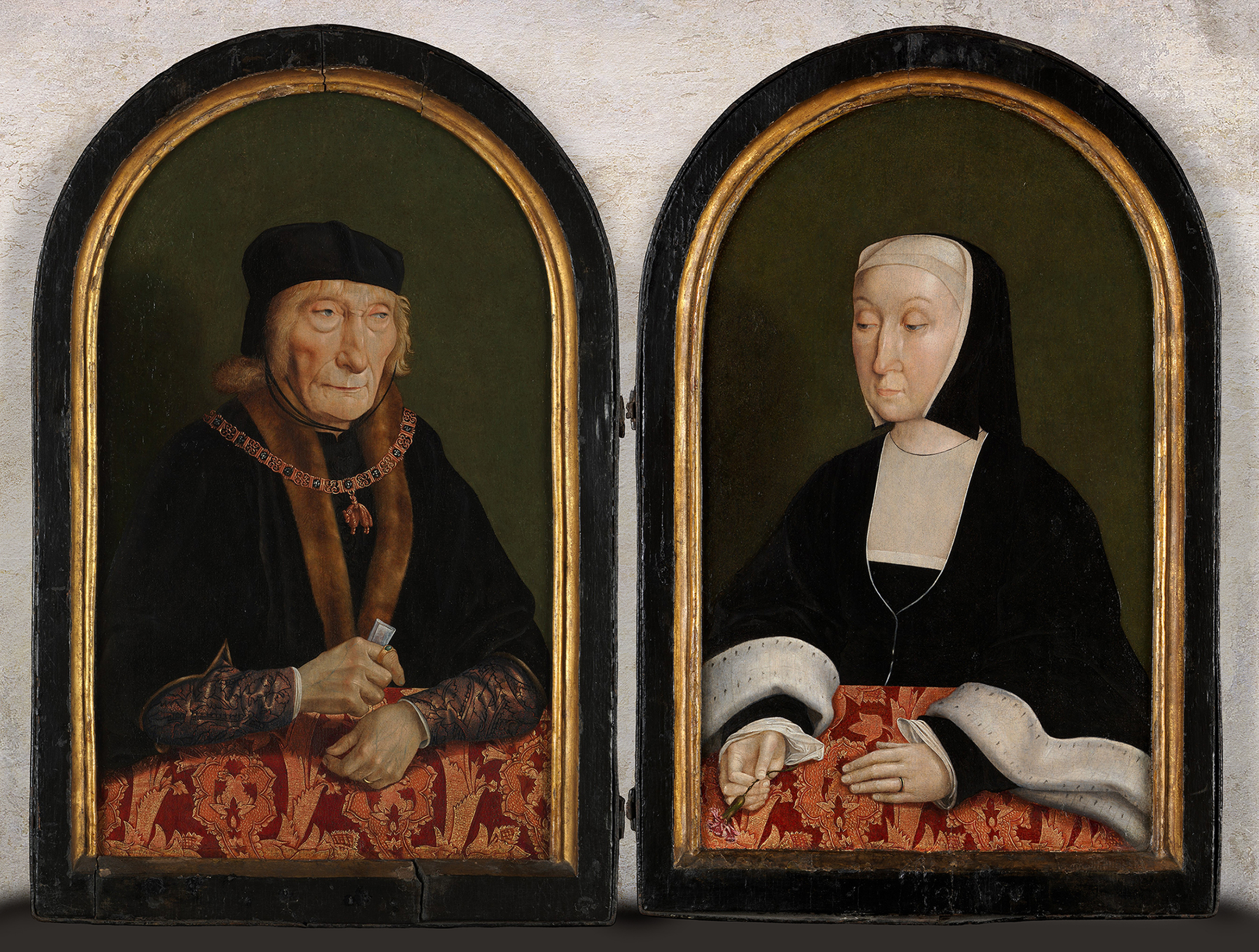
North Netherlandish painter, Jan, 1st Count of Egmond, 42.5 x 26 cm., and Magdalena, Countess of Egmond, 48.9 x 31.8 cm. (with frame), c.1516-20, o/canvas from panel, Metropolitan Museum, New York
Unfortunately, only a few of the Met’s Netherlandish portraits possess their original frames, and they are not the most noteworthy, as with the two works above. All too often, the prestige among later collectors of possessing a work by one of the great Netherlandish masters led to substituting their modest-seeming mouldings for something more flashy.

Hans Memling (fl. 1465-d.1494), Portrait of a young man, c.1472-75, o/ panel, 38.3 x 27.3 cm., Metropolitan Museum, New York
This is the case with Memling’s Portrait of a young man, in which the sitter – probably a member of the prosperous Florentine commercial community in Bruges – is depicted before an open loggia, gazing vaguely into the distance, his hands shown as though resting on a window sill or balcony ledge. A raised barbe of paint around the edges demonstrates that originally the portrait had an engaged frame, the removal of which trimmed the tips of several of his fingers.

Hans Memling (fl. 1465-d.1494), Portrait of a young woman, 1480, 38 x 26.5 cm., Stedelijke Musea, Bruges
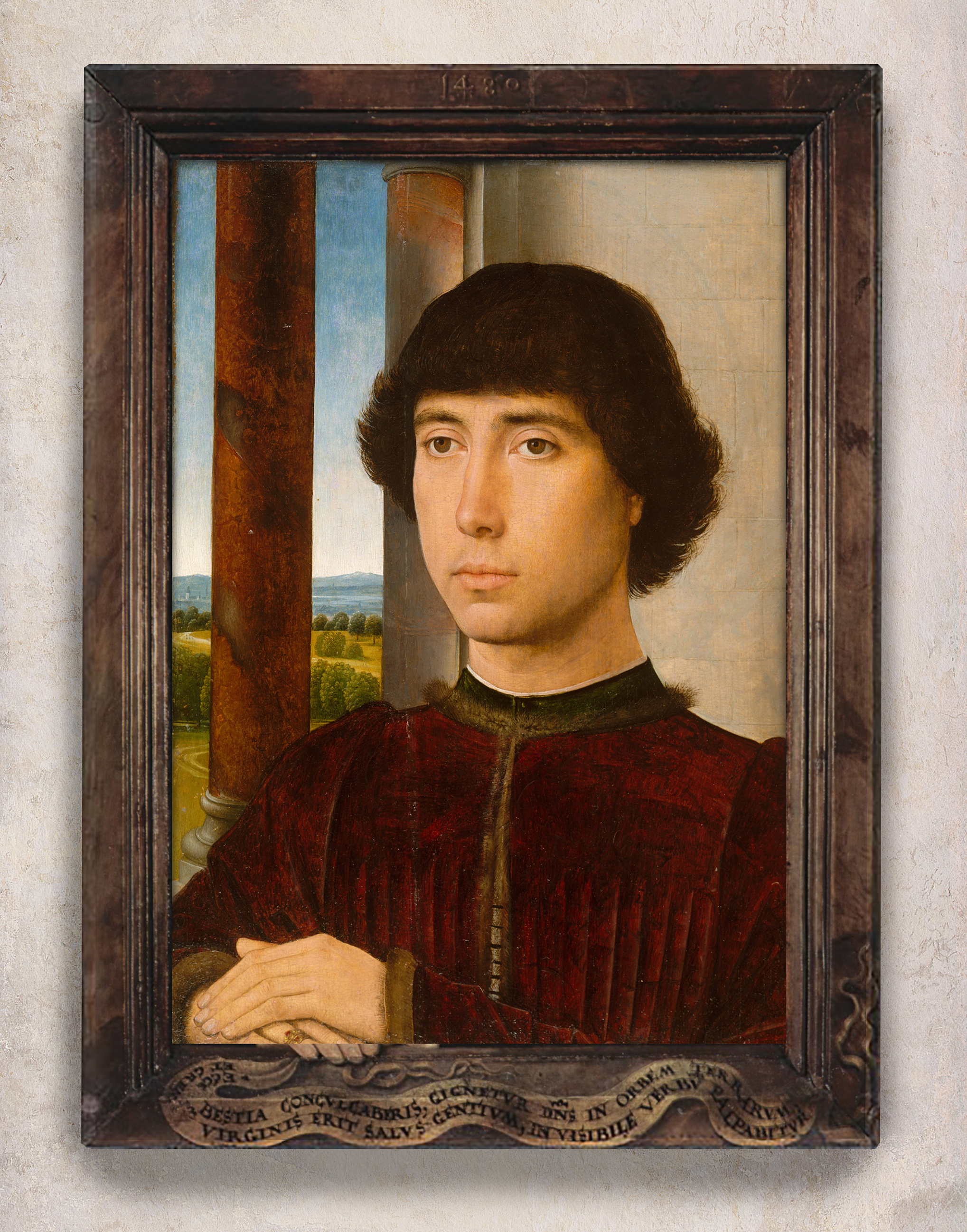
Hans Memling, Portrait of a young man, montaged into the frame of the Bruges Portrait of a young woman
A comparison with Memling’s Portrait of a young woman in the Stedelijke Musea, Bruges, which preserves its original, marbled frame (excluding the banderole – added in the 16th century – which unfurls across the bottom moulding), makes clear what has been lost in the later reframing of The Met’s portrait – both aesthetically and conceptually. In the portrait of the young woman, Memling emphasizes the window-like qualities of the frame by employing a uniform moulding on three sides and a canted horizontal rail – a rainsill – at the bottom, on which the sitter places her hand.

Hugo van der Goes (c.1440-82/83), Adoration of the Magi (The Monforte Altar), c. 1470-75, o/panel, 147.2 x 241.4 cm., Gemäldegalerie, Berlin
It is an alternative design to the frame on Van Eyck’s portrait of Jan de Leeuw, and pervades Netherlandish practice – whether for modestly-scaled works such as portraits or full-sized altarpieces, such as Hugo van der Goes’s magnificent Adoration of the Magi in Berlin, where it is augmented by a thin Gothic colonet.
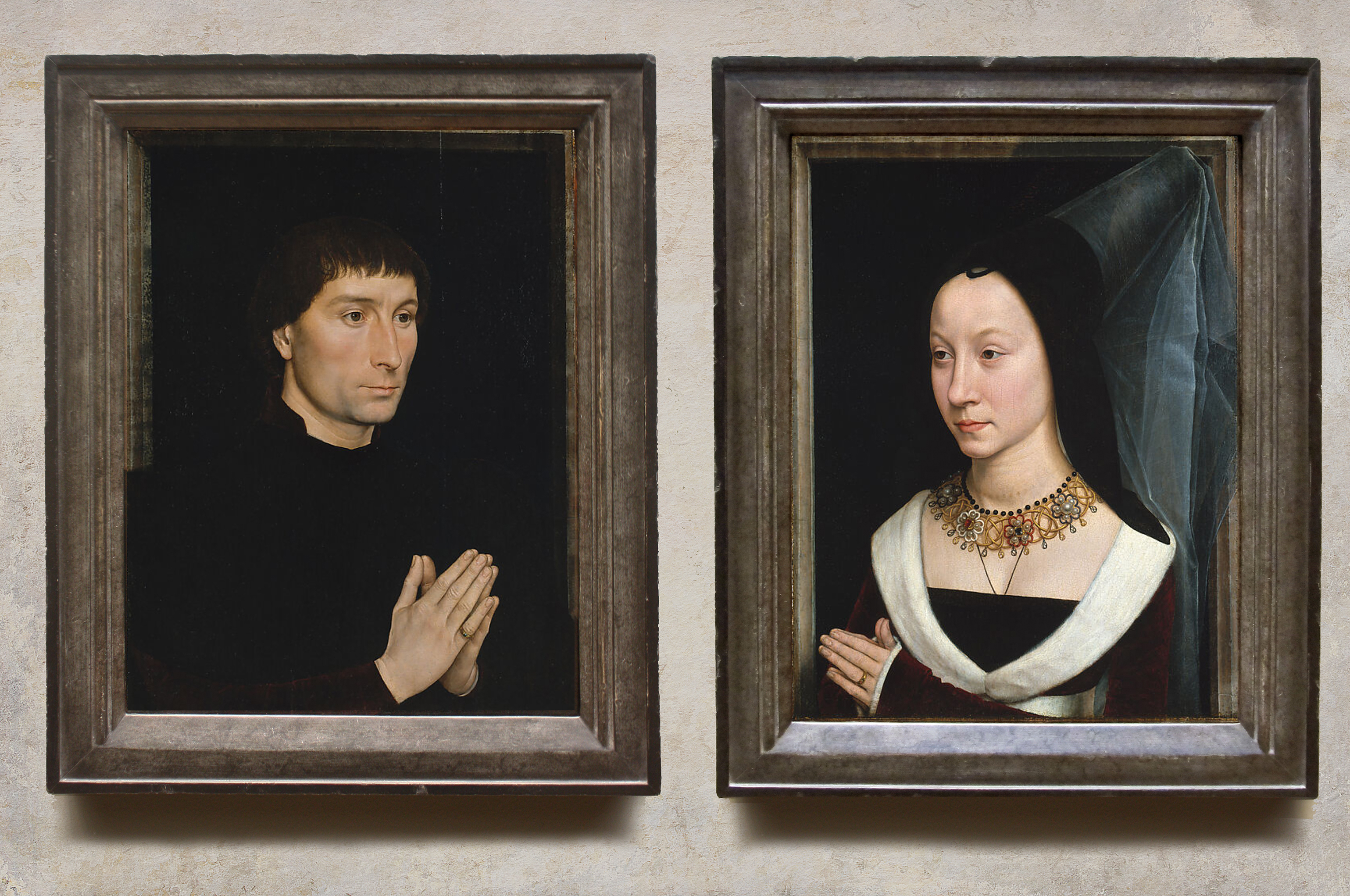
Memling (fl. 1465-d.1494), portraits of Tommaso di Folco Portinari and Maria Portinari, c.1470, o/panel, 42.2 x 31.8 cm., and 42.2 x 32.1 cm., formerly wings of a triptych on either side of an image of the Virgin; Metropolitan Museum, New York
Over the past four decades a concerted effort has been made to reframe some of the most important 15th century Netherlandish paintings in The Met’s collection with copies of period frames. Prime examples are those on Memling’s superb paired portraits of Tommaso Portinari, who headed a branch of the Medici bank in Bruges, and his wife Maria (née Baroncelli). In this case the model followed was the original frame on Memling’s Christ giving His Blessing of 1481 in the Boston Museum of Fine Arts . In these paired portraits Memling enriched the implication of the frame-as-window by painting an inner moulding in front of which the sitters are posed, their hands clasped in prayer, their gazes directed towards the missing centre panel, which almost certainly showed the Madonna and Child, which has plausibly been identified with a work in the National Gallery, London. The colour of the modern frames was chosen to relate to that of the painted mouldings within the pictures.
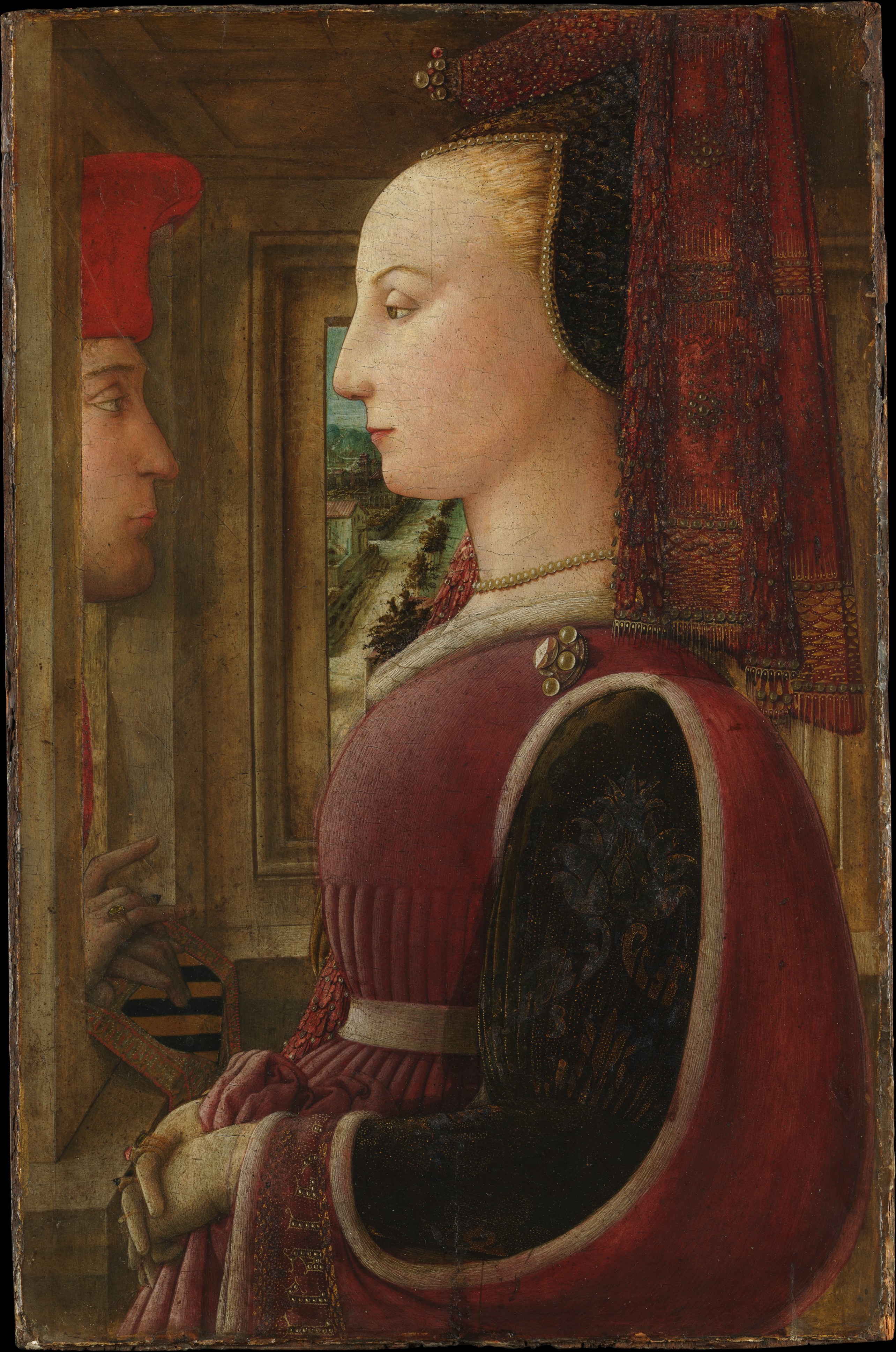
Filippo Lippi (c.1406-69), Portrait of a woman with a man at a casement, 1440, tempera/panel, 64.1 x 41.9 cm, Metropolitan Museum, New York
The impact of the Netherlandish approach to portraiture, with its presentation of the sitter positioned on the other side of a window, as a living likeness – someone who, to employ a phrase from contemporary humanist criticism, ‘lacked only a voice’ – was immense. It had an especially deep influence on Italian painting, where the detached profile view had been dominant, as in Filippo Lippi’s innovative Portrait of a woman with a man at a casement.

Cosimo Rosselli (1440-1507), Portrait of a man, c.1481-82, tempera/panel, 51.8 x 33 cm., Metropolitan Museum, New York
Cosimo Rosselli’s Portrait of a man, in which the sitter is posed at an angle and his hand is shown as though resting on a sill, is clearly inspired by the example of Memling, examples of which were readily available in Florence. Its ornately decorated aedicular frame might seem to indicate a significant Italian departure from the more modest Netherlandish patterns, but the frame is, in fact, a replacement from the 20th century and was probably made by the Sienese framemaker Ferruccio Vannoni in response to market demand (virtually all of the 15th century Italian portraits in Benjamin Altman’s collection had aedicular frames).

Cosimo Rosselli, Portrait of a man without the frame
The taste for such settings has significantly distorted our idea of Italian portraiture, since the original frame of Rosselli’s portrait (which the raised barbe around the edges of the paint surface and the extension of bare wood indicates was engaged) was unquestionably more modest.
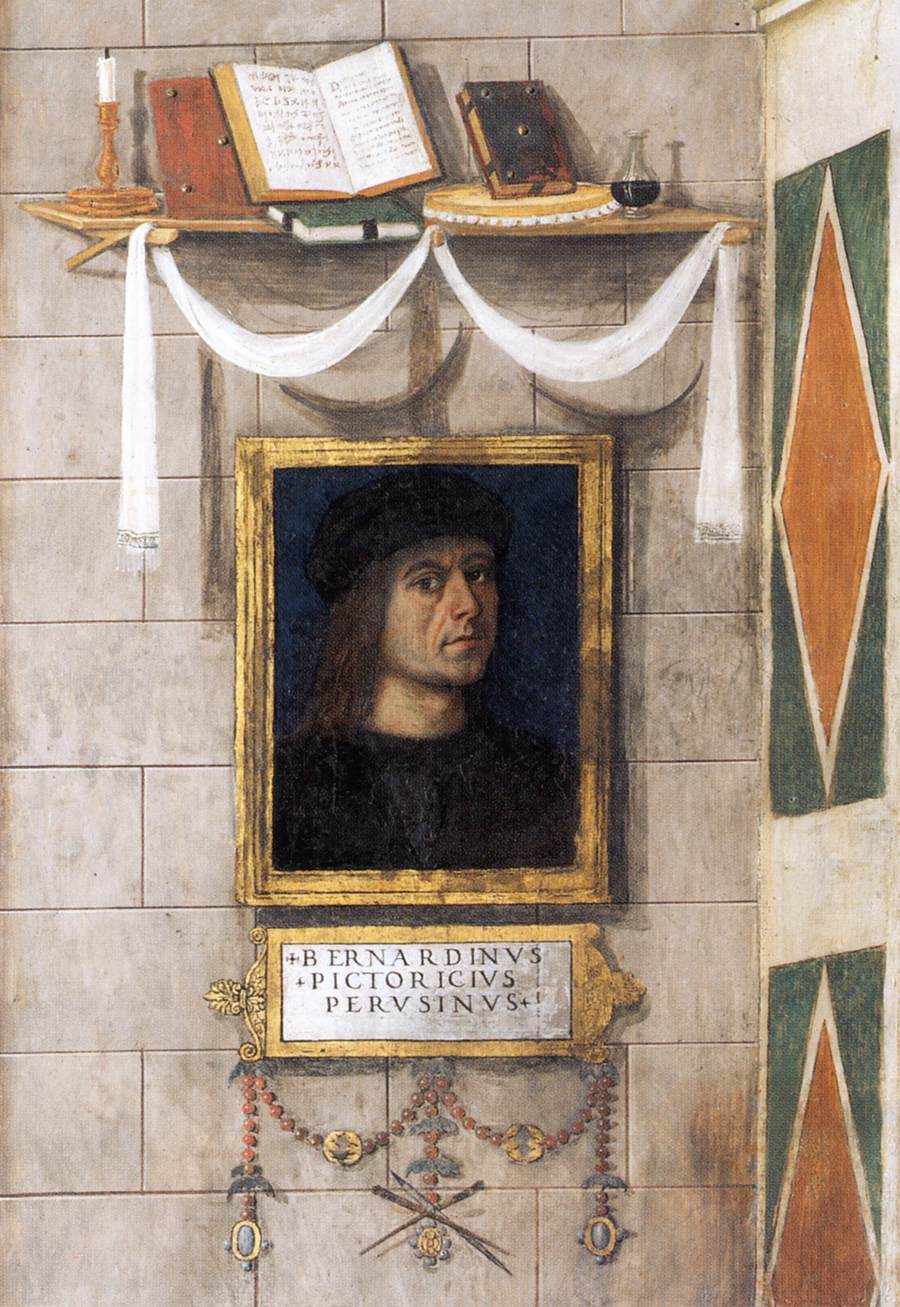
Pinturicchio (c.1454-d.1513), Self-portrait, detail of The Annunciation, 1501, fresco, Collegiata di Santa Maria Maggiore, Spello. Photo: Web Gallery of Art
An example of what was typical of the period can be seen in Pinturicchio’s own self-portrait in trompe l’oeil, hanging on the back wall of the Virgin’s bedroom in his fresco cycle in the collegiate church at Spello. Almost identically-framed portraits are depicted by Pietro Perugino in his cycle of frescos in the Cambio in Perugia, and by Macrino d’Alba in a painting of St Francis receiving the stigmata in the Galleria Sabauda in Turin.
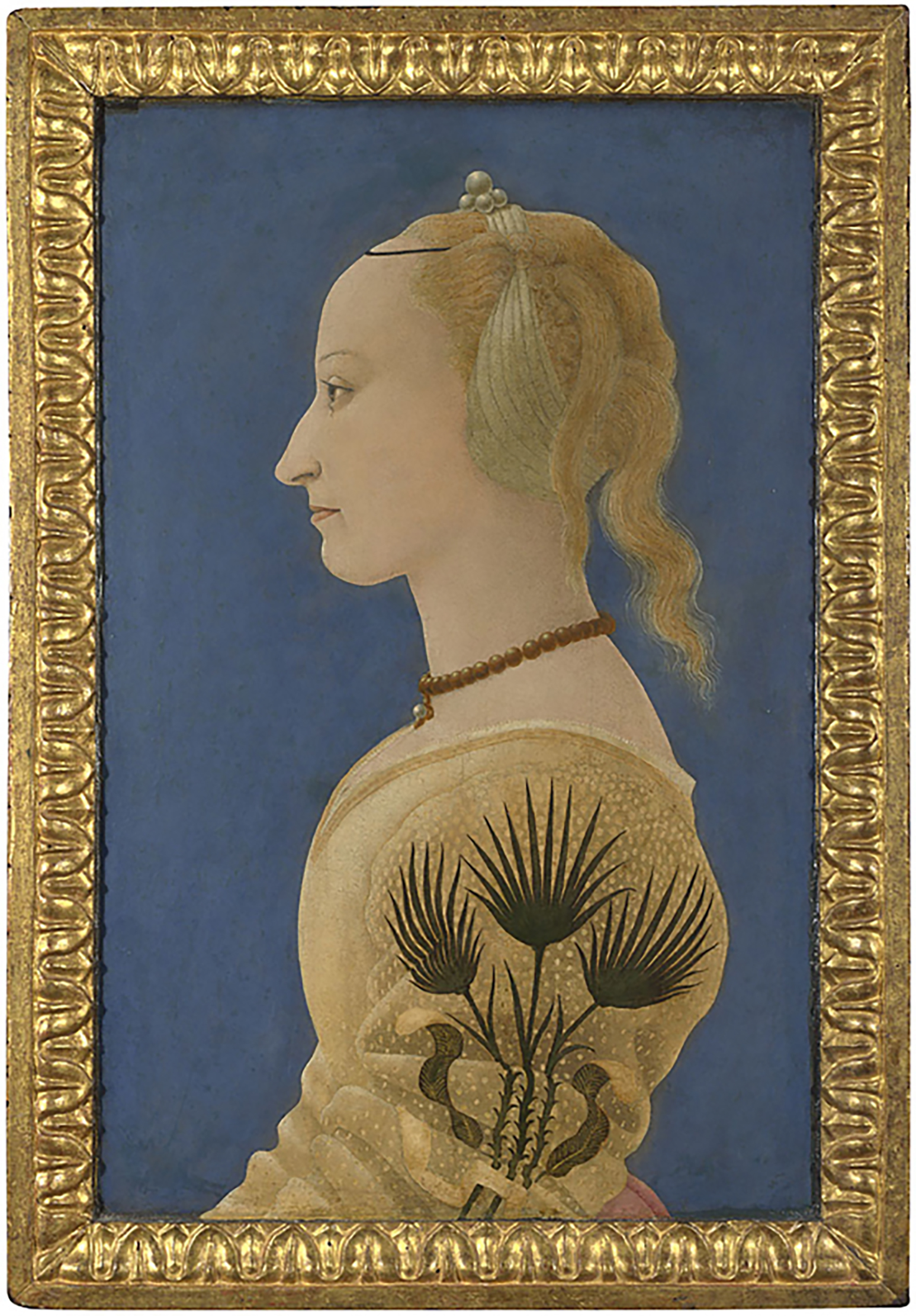
Baldovinetti (c.1426-99), Portrait of a woman, c.1465, tempera & oil/panel, 62.09 x 40.6 cm., National Gallery
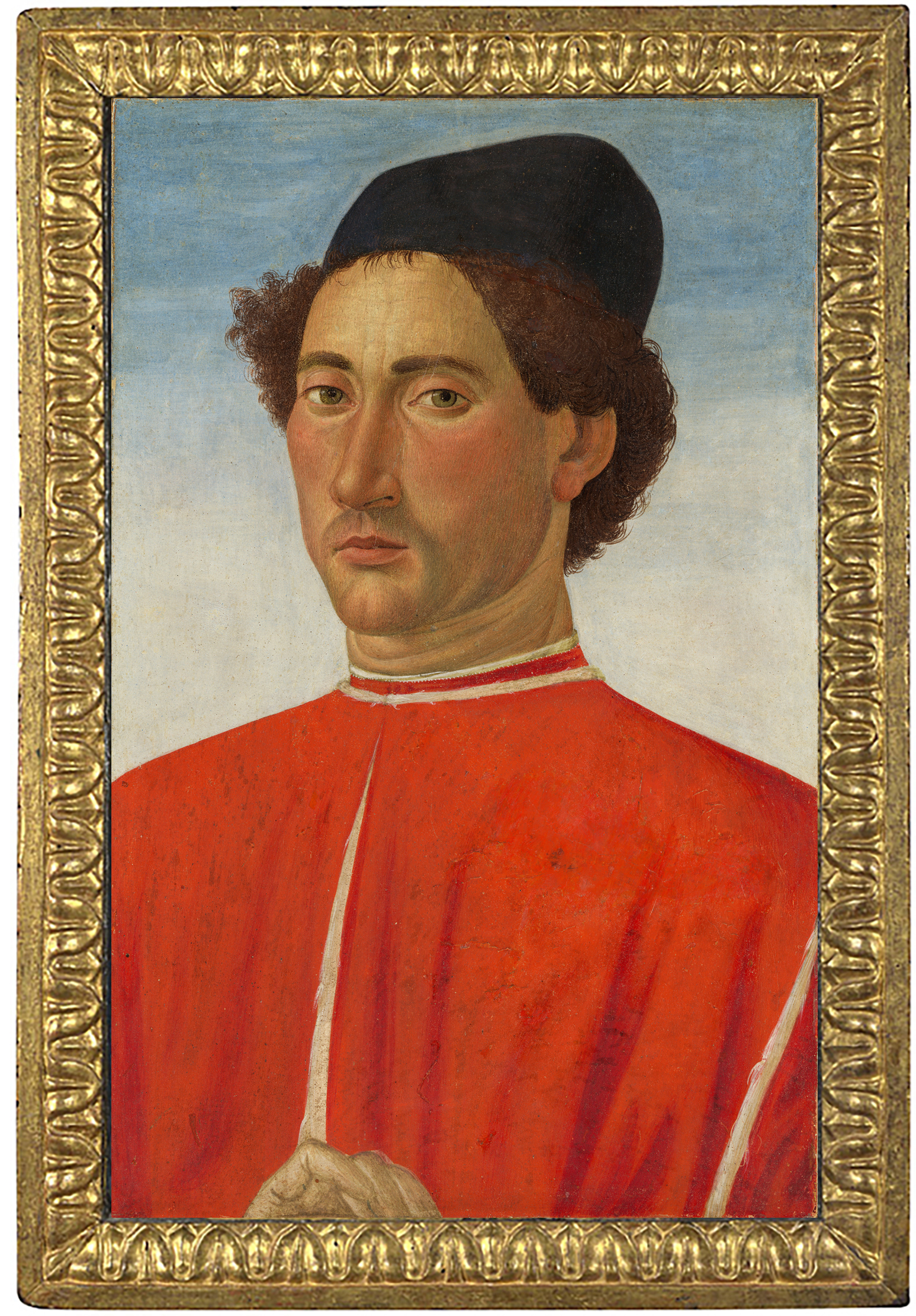
Cosimo Rosselli, Portrait of a man montaged into the frame of Baldovinetti’s Portrait of a woman
Baldovinetti’s Portrait of a woman in the National Gallery, London, and Botticelli’s Portrait of a man with a medal in the Gallerie degli Uffizi are amongst the rare Florentine portraits which retain their original engaged frames, the moulding beneath the top edge decorated with a leaf-&-dart, providing an alternative model to later, more unwarrantedly complex borders. It was this design which may have been the original frame for Cosimo Rosselli’s portrait.
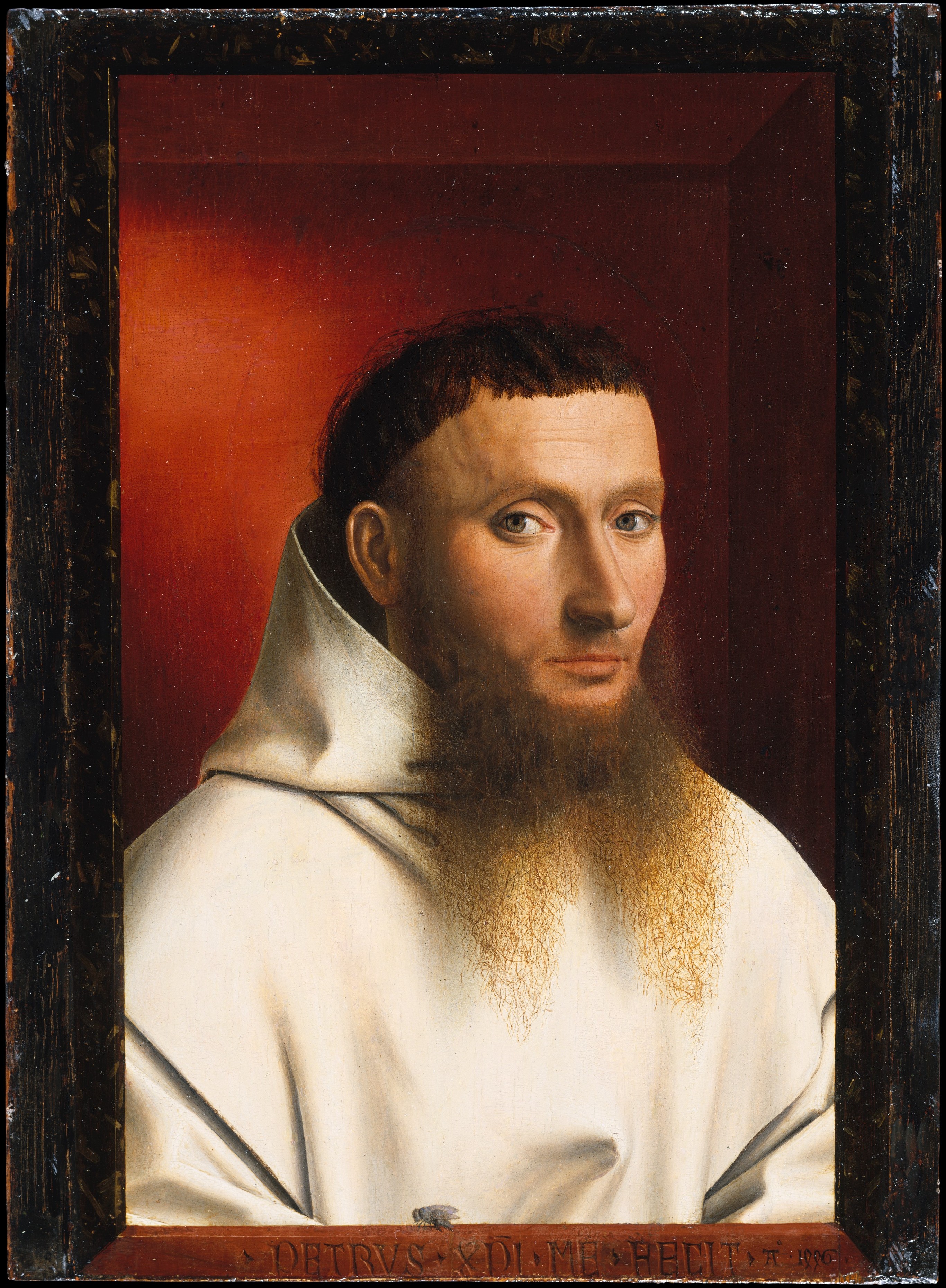

Petrus Christus (fl.1444-d.1475/76), Portrait of a Carthusian, 1446, o/panel, 29.2 x x21.6 cm., Metropolitan Museum, New York, without and with modern frame
Petrus Christus’s vivid portrait of a Carthusian monk – another bequest to The Met from the remarkable collection of Jules Bache – enhanced the window motif explored by Van Eyck by depicting a trompe l’oeil casement of costly red jasper and green porphyry, from which the sitter peers out. A fly seems to have landed momentarily on the sill, further conferring on the picture the quality of a moment fixed in time; perhaps also reminding the viewer of the transience of life itself. Whether and in what fashion the actual frame may have enriched these ideas – perhaps through an inscription – is impossible to say; the present frame is modern, although inspired by historical prototypes.
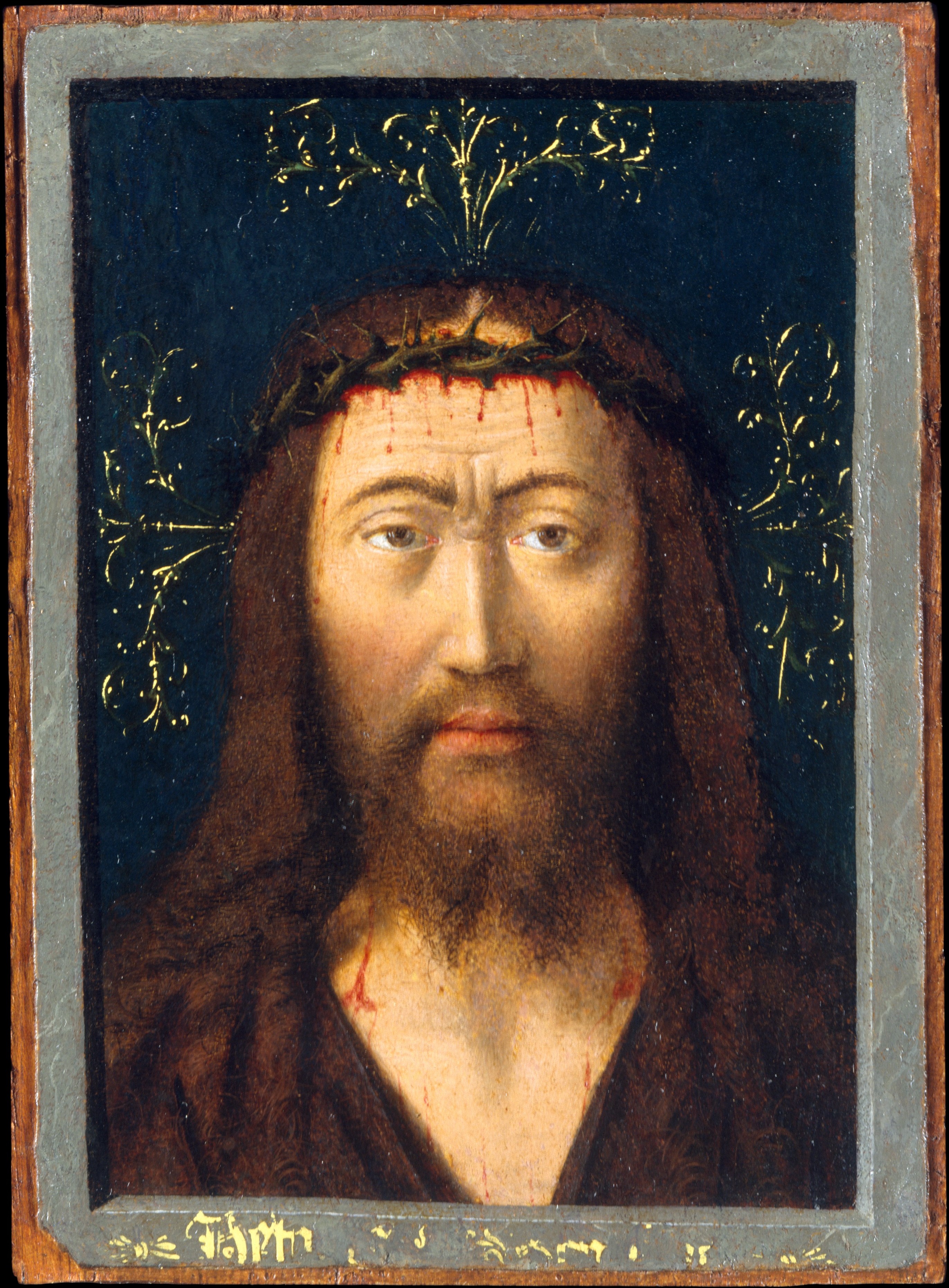
Petrus Christus (fl.1444-d.1475/76), Head of Christ, c.1445, o/parchment/panel, 14.6 x 10.5 cm., Metropolitan Museum, New York
Christus used the same motif in his miniature Head of Christ, depicting the sacred figure as though physically present on the other side of the grey window casement. By this device the traditional, hieratic image of Christ’s face familiar from Byzantine and mediaeval paintings acquired a new immediacy: Christ is both hieratically distant, His frontally-viewed face set off by a cruciform halo of gilded rinceaux, and yet empathetically human, with rivulets of blood around His neck. Like the frames of portraits, there is an inscription here, too – unfortunately only fragmentary – in florid Gothic letters which identify Christus as the painter. As with the Portrait of a Carthusian, the frame is modern, whereas that on Gerard David’s Christ Blessing, dated about a half century later, is integral with the walnut panel.
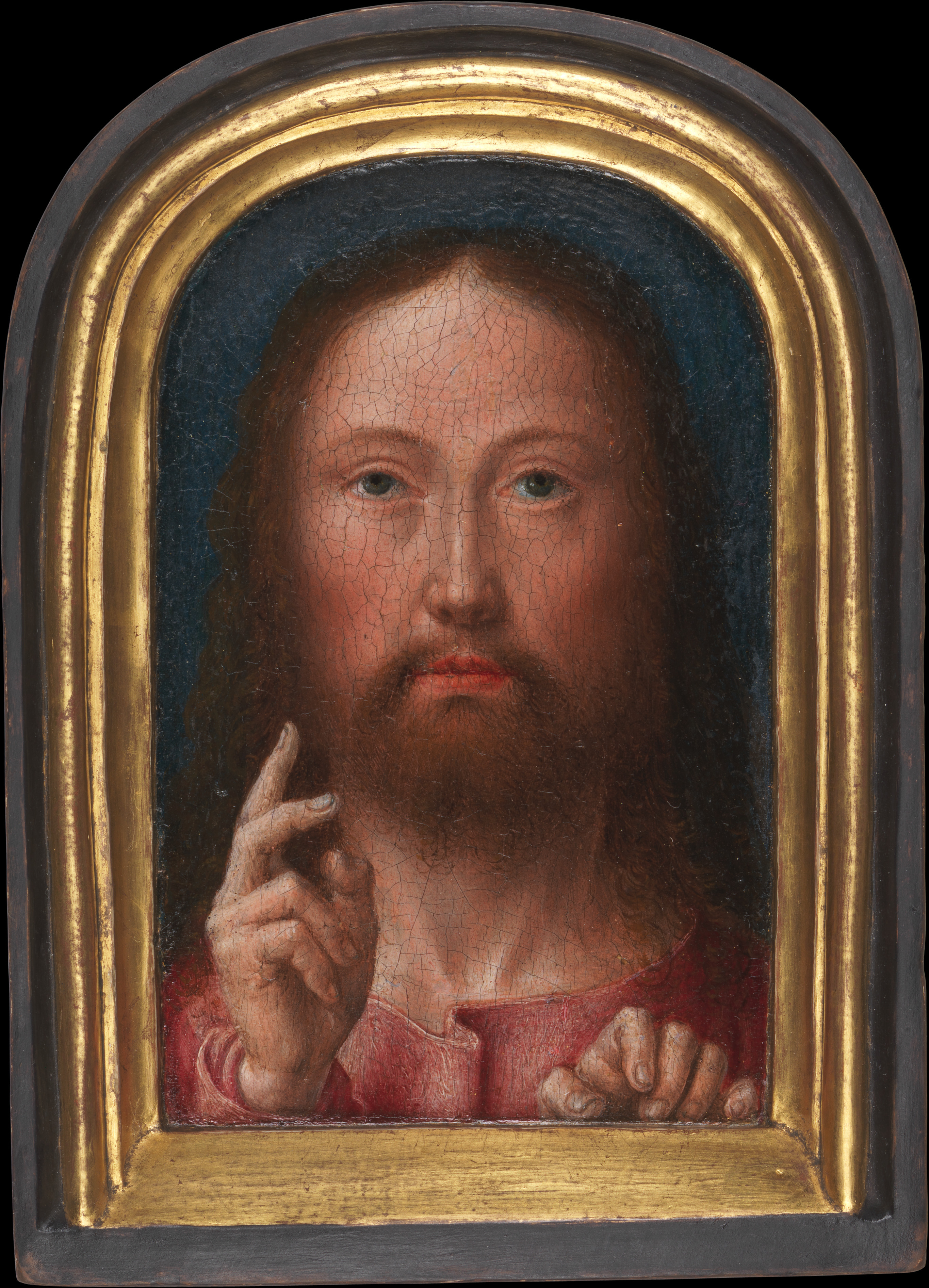
Gerard David (c.1455-1523), Christ Blessing, c.1500-05, o/panel, 9.2 x 6 cm., or 12.1 x 8.9 cm. overall, Metropolitan Museum, New York
The image here has been executed on the lowered surface obtained by scraping out the central area of the panel, leaving the framing mouldings standing proud of it. Christ’s right hand is raised in blessing and His left is placed directly on the edge of the frame, bringing the sacred figure into intimate colloquy with the worshipper. The overlap with portraiture is both obvious and intentional.
It may seem paradoxical that amongst the artists who built most fruitfully on the traditions of Netherlandish portraiture was an artist born in distant Sicily, Antonello da Messina. However, paintings from the Low Countries enjoyed great prestige throughout Europe, and Antonello was able to study the works of Van Eyck first hand at the Neapolitan court of Alfonso I – a passionate admirer and avid collector of Netherlandish paintings.

Antonello da Messina (c.1430-79), Portrait of a young man, c.1470-72, o/panel, 27 x 20.6 cm., Metropolitan Museum, New York
Antonello’s Portrait of a young man provides a key example of the way he built on Van Eyck’s legacy. Unfortunately, the panel support has been trimmed and, like other portraits by the artist, the work has lost its original frame, but the innovation is no less clear. The sitter not only engages the viewer with his gaze, but he responds to him or her with the hint of a smile, suggesting not only a physical but a psychological presence, and thereby setting the stage for what Leonardo da Vinci sought to achieve in his portrait of Lisa del Giocondo – the Mona Lisa.
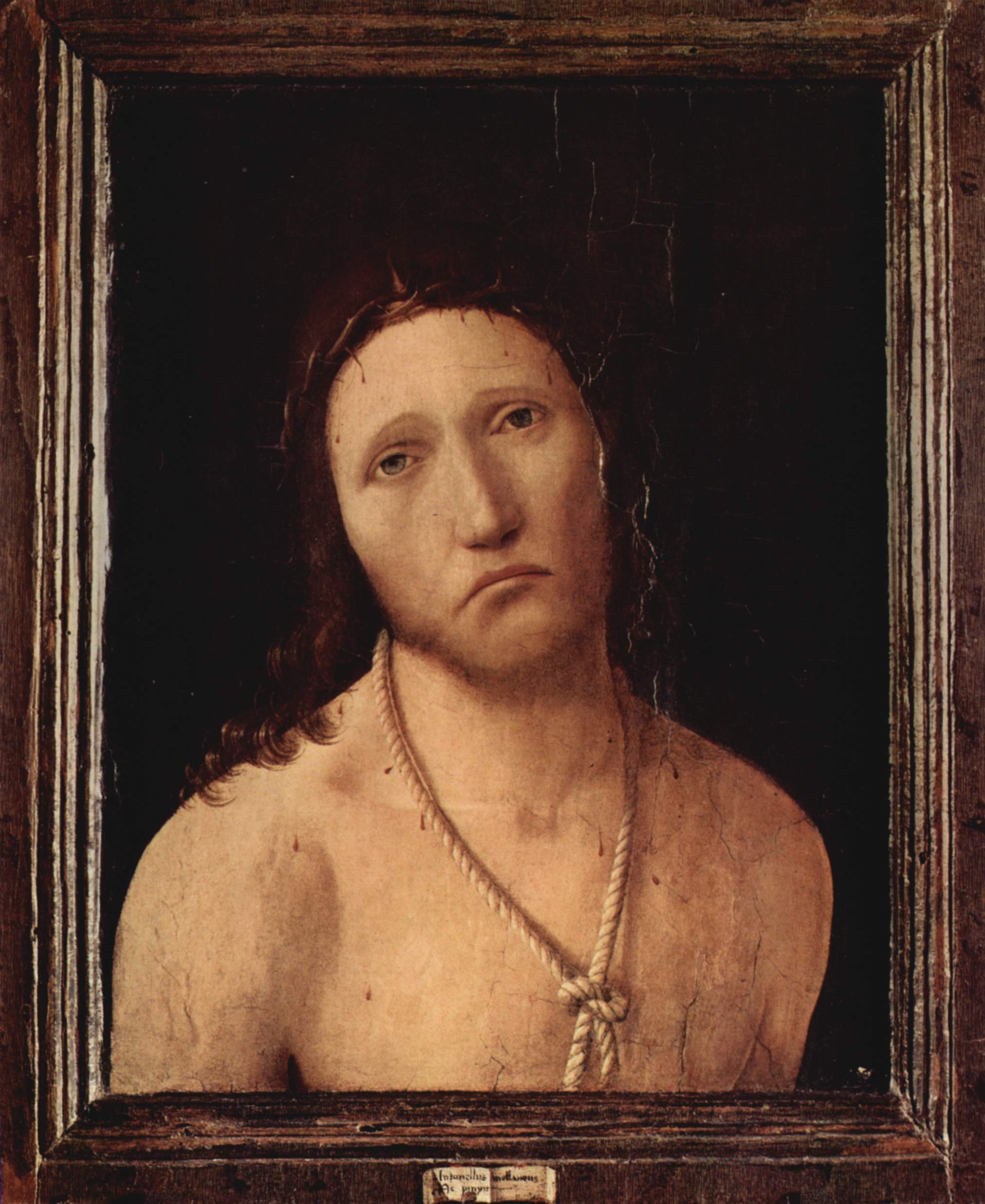
Antonello da Messina (c.1430-79), Christ as the Man of Sorrows, 1474, o/panel, 39.7 x 32.7 cm., Palazzo Spinola, Genoa

Antonello da Messina, Portrait of a young man montaged into the frame of Christ as the Man of Sorrows
Antonello’s portrait is currently in a Renaissance-style frame made of old elements, and – to get an idea of the original effect of the portrait, as well as the way it built on the example of Netherlandish painting – we need to imagine it in an engaged moulding, much like the one on Antonello’s Christ as the Man of Sorrows, which retains its original frame, together with a trompe l’oeil inscribed cartellino which also derives from Van Eyck’s practice [1]. Just as the sitter of Antonello’s portrait turns his head and engages the viewer with a sidelong gaze and a smile, so the dolorous expression on Christ’s face demands an empathetic response: the picture is conceived with the viewer confronting Christ as he pauses on his way to Calvary, the rope by which He is being led hanging from His neck.
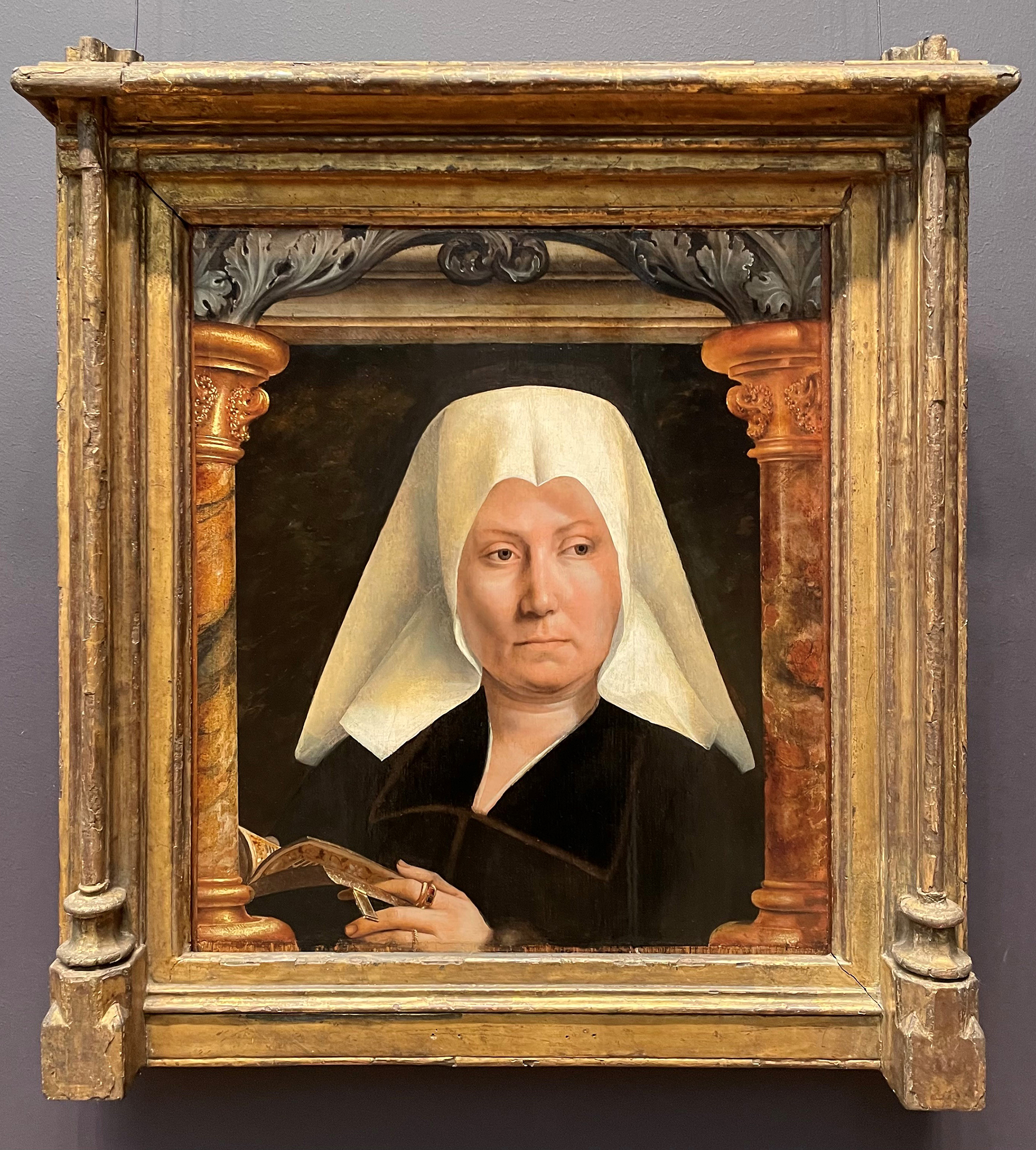
Quentin Massys (1466-1530), Portrait of a woman, c.1520, o/panel, 48.3 x 43.2 cm., Metropolitan Museum, New York
Quentin Massys subsequently took the idea of the marble casement within the frame, and the sitter as though interrupted, to yet another level in his Portrait of a woman. The picture has a pendant in a private collection depicting the sitter’s spouse in the same architectural setting. Unlike the Portinari panels, these could not have formed a triptych, where the eyes of the couple are directed toward the centre panel, and it has been suggested that the pictures may possibly have hung in a chapel where their attention was focused on the altar.
However this may be, Massys was consistently interested in the psychology of his sitters, and in creating the appearance of an arrested moment. His somewhat dour female sitter occupies a space located between two veined marble columns and a stone lintel on the back wall. These features are very much of the moment and have been conceived in what might be thought of as a classicizing late Gothic style, which is also found in contemporary architecture. Interrupted in her reading, the sitter turns her head and casts a sidelong glance – as though her attention has been diverted by something in the viewer’s space – whilst she marks a place in the open book of hours she holds with the index finger of her left hand; the borders of the illuminated pages are as carefully described as the sitter’s character. The picture reacts to the presence and engagement of the assumed viewer.
Massys clearly intended that the bases of the columns he painted, which trimming of the panel has cropped at the bottom, would appear to sit just inside the opening of the frame. The elaborate and very architectural frame on the picture today must have been conceived so as to extend the conceit of the portrait into the third dimension, but it is not original. It is constructed from elements of an antique frame, and was unquestionably designed for the dealer who sold the picture to Michael Friedsam, whom we have already encountered as the owner of Giovanni di Paolo’s altarpiece (see Part 3 of this series of articles). Friedsam was also the friend and business associate of Benjamin Altman, and emulated his taste. It is interesting, therefore, that the same type of frame, albeit in a more pronounced Gothic style, was created for a number of Netherlandish pictures in Altman’s collection, including for Memling’s portraits of the Portinari.

Hans Memling (fl.1465-d.1494), Madonna & Child with SS Catherine of Alexandria and Barbara, early 1480s, o/panel, 67 x 72.1 cm., Metropolitan Museum, New York
As we have seen, those frames have since been discarded and replaced by modern settings in period style, whereas a Gothicizing frame constructed from the same cache of fragments on Memling’s Madonna & Child with saints is still in place on the painting. It is hardly a coincidence that Memling’s three pictures, like Massys’s portrait, were all handled by the same two dealers, Léopold Goldschmidt in Paris and Kleinberger Galleries in Paris and New York. The frames were probably constructed in Paris as part of a marketing strategy to accommodate the taste of a respected collector.
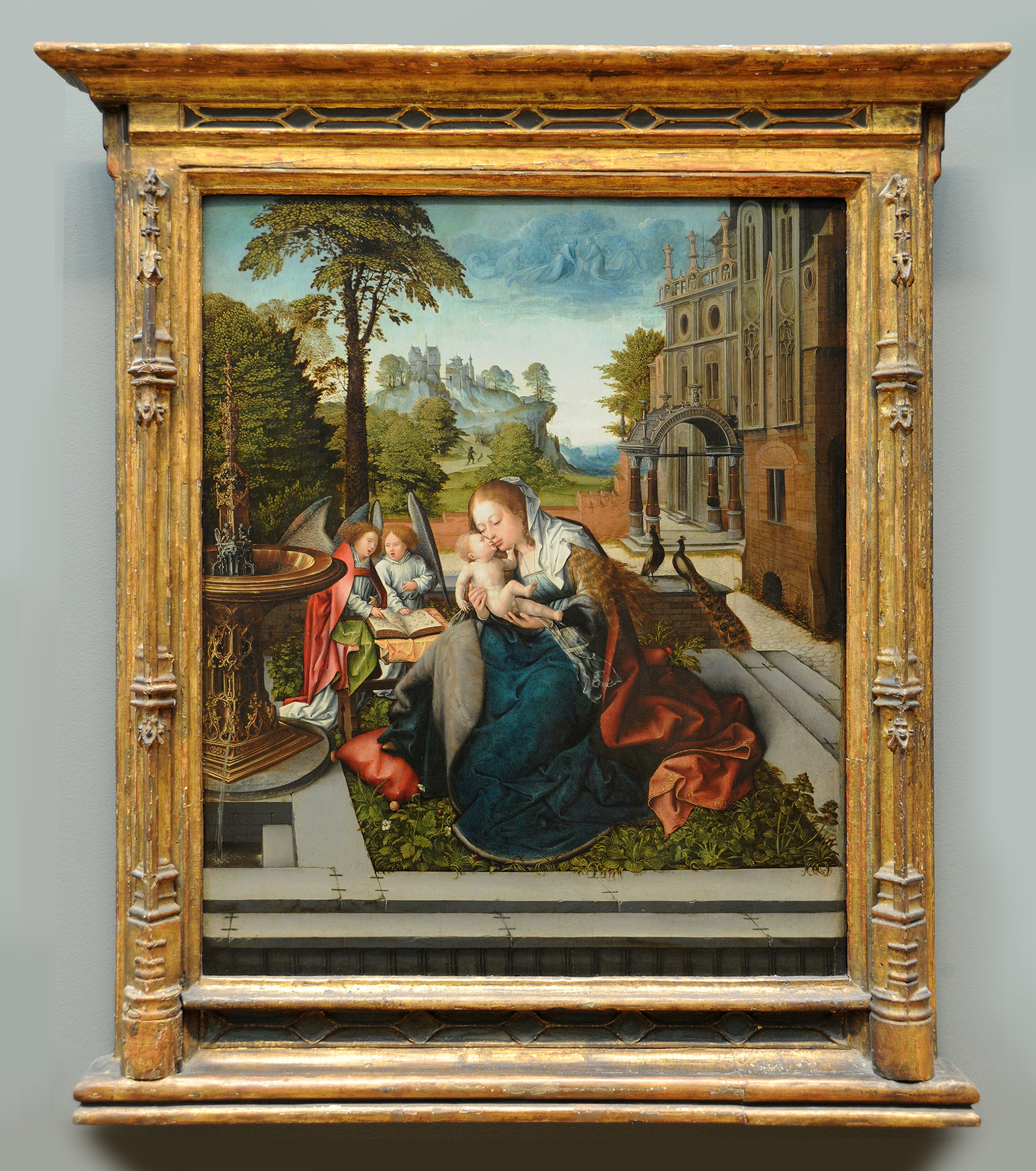
Bernard van Orley (c.1492-1541/42), Madonna & Child with angels, c.1518, o/panel, 85.4 x 69.9 cm., Metropolitan Museum, New York
Just as the 17th century paintings in Altman’s collection were all shown in richly carved Régence frames, so virtually all of the Netherlandish pictures were displayed as masterpieces of Gothic painting in what was clearly conceived as a Northern counterpart to the Italian Renaissance-style aedicular frames. Not surprisingly, when in 1910 Benjamin Altman acquired Bernard van Orley’s Madonna & Child with angels, it too was put in a NeoGothic frame.
So what did the original frame of Massy’s Portrait of a woman look like? This is not an easy question to answer precisely because of the prominence accorded to the architectural window within the painting. Unfortunately, the work which is most comparable – a painting in the Louvre depicting Mary Magdalene behind a ledge framed by two marble columns – has lost its original frame and is displayed in a later, gilded cassetta (as is The Met’s Adoration of the Magi by Massys).
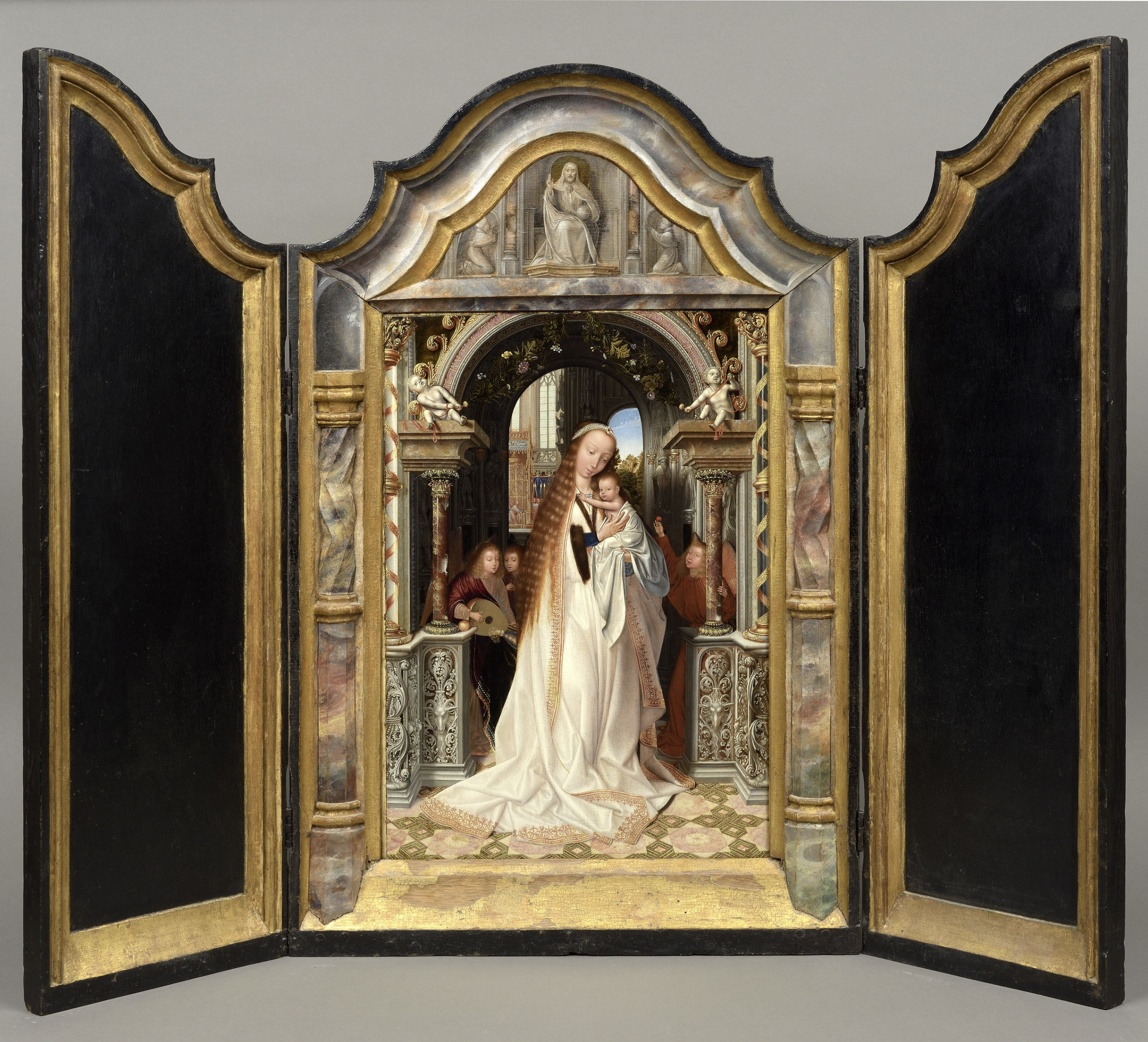
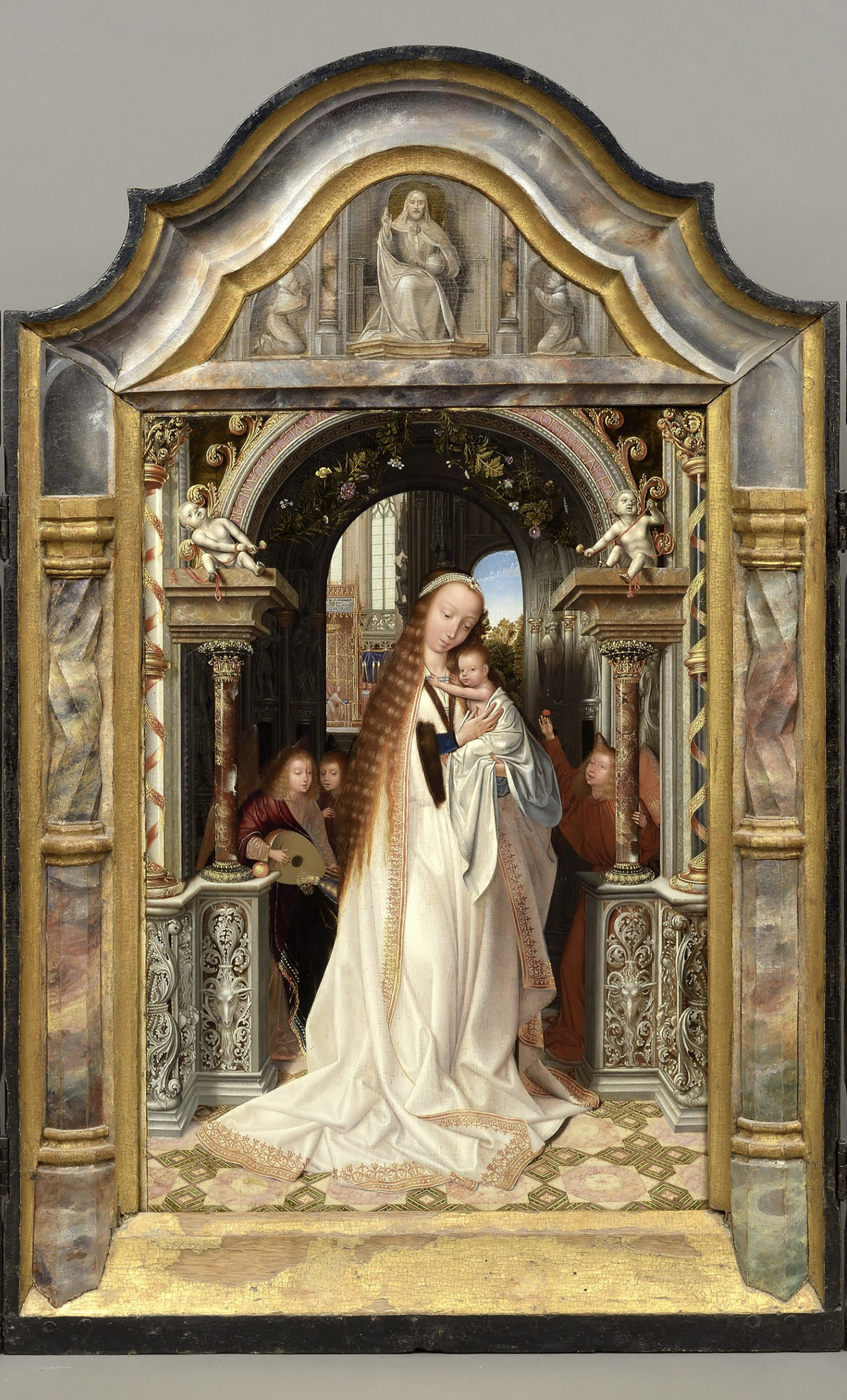
Quentin Massys (fl.1465-d.1494 or 1530), Madonna & Child surrounded by angels, c.1509, 54.5 x 37.5 cm., and detail of centre panel, Musée des Beaux-Arts de Lyon
However, in Massys’s triptych in the Musée des Beaux-Arts in Lyon, the contemporary Netherlandish altarpiece frame with ogee-arched top is imagined as a Romanesque portal opening into the Gothic/Renaissance church interior where the Virgin stands: the frame becomes part of the sacred image, and symbolizes the passage from the Old to the New Dispensation [2].
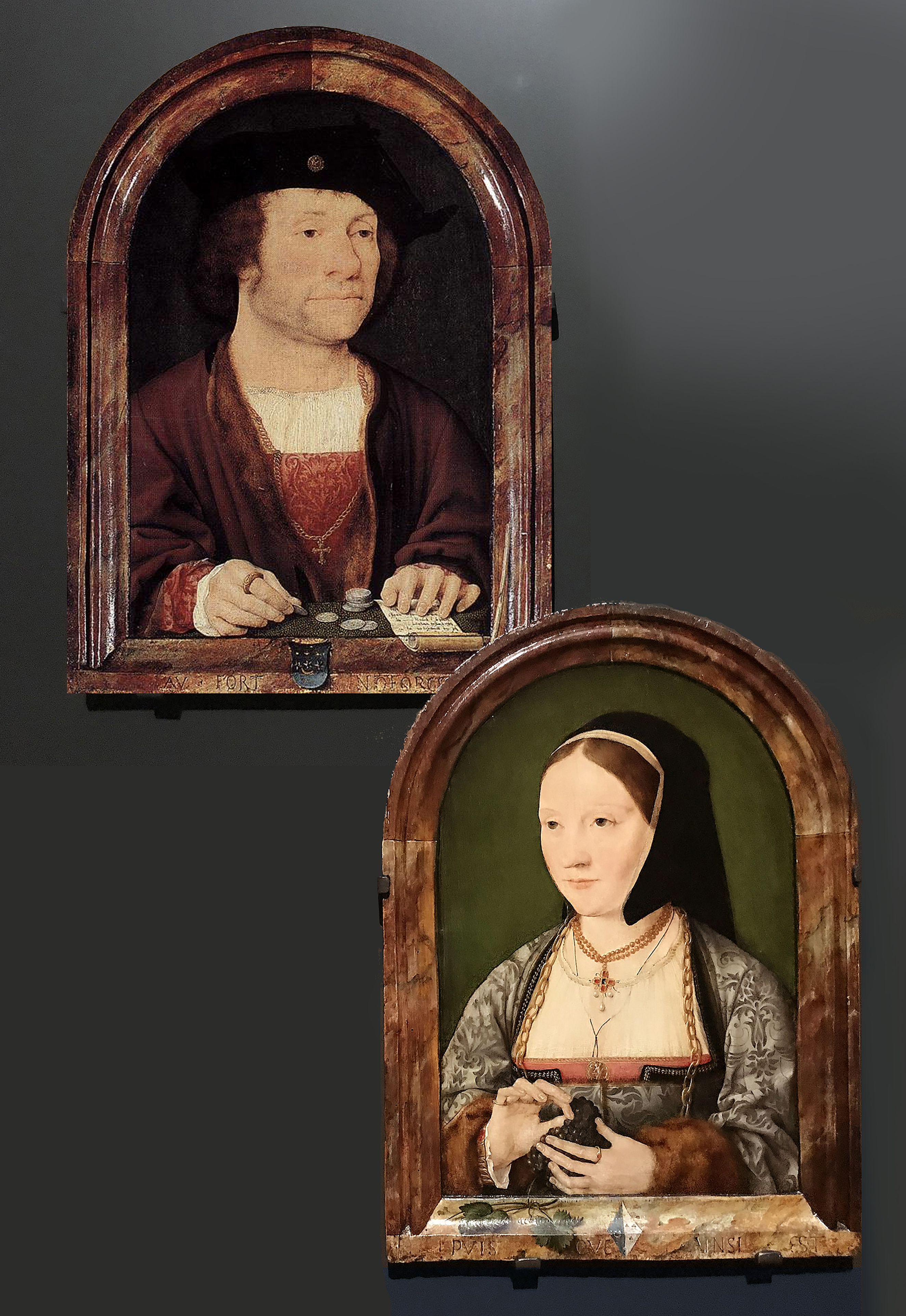
Joos van Cleve (c. 1485/90-1540/41), Portrait of ?Anthonis van Hilten, and Portrait of ? Agniete van den Rijne, each c. 1515, 40 x 28 cm., Rijksmuseum Twenthe
Joos van Cleve employed faux-marbre frames of traditional Netherlandish form in his paired portraits of ?Anthonis van Hilten and ?his wife Agniete van den Rijne. Might the frames on Massys’s paired portraits have resembled these? These are the uncertainties confronting any attempt to imagine the frame of such an individual work… and the inevitable compromises made in any reframing project.
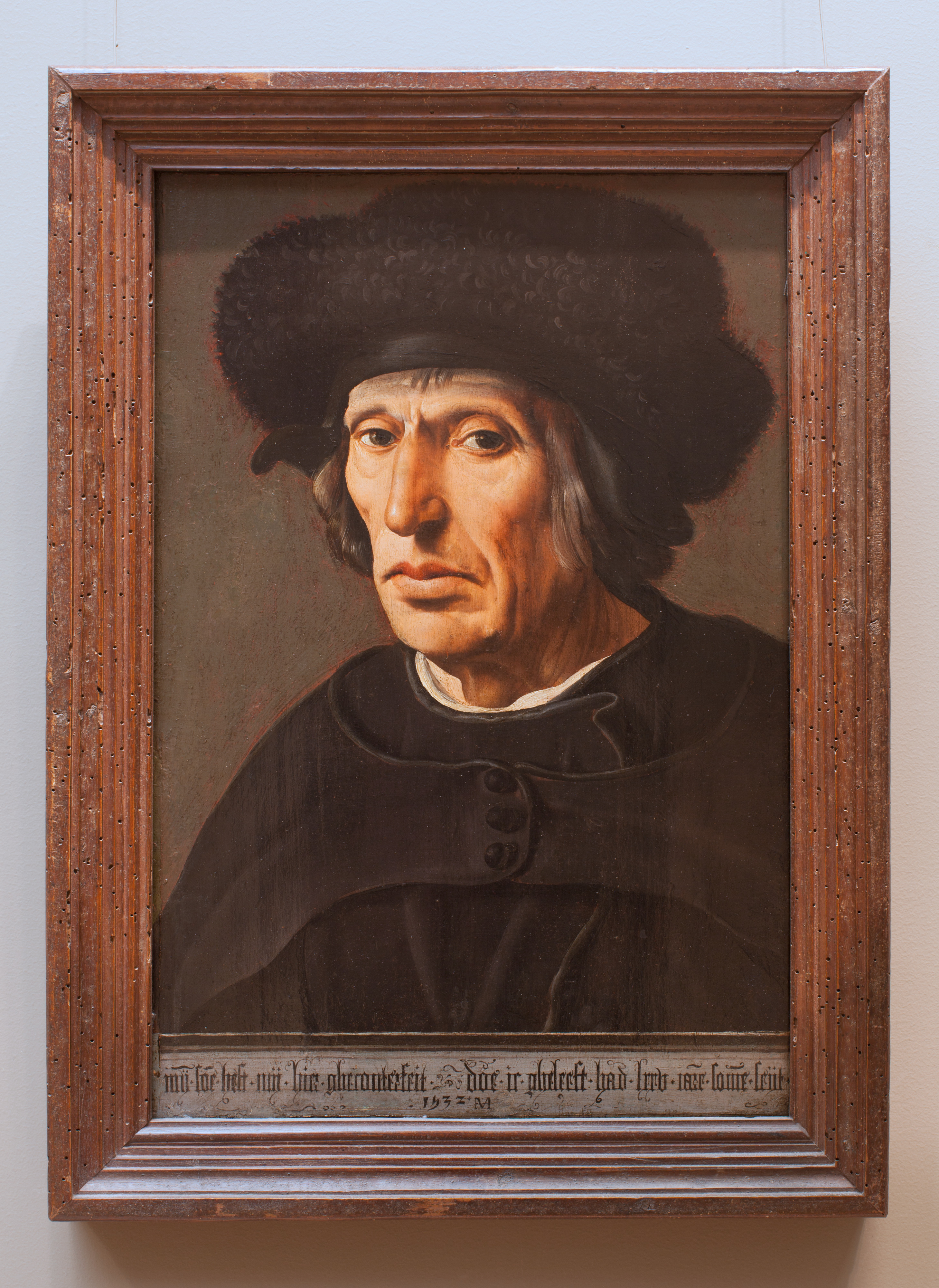
Maarten van Heemskerck (1498-1574), Jacob Willemsz van Veen, the artist’s father, 1532, o/panel, 52.1 x 34.9 cm., Metropolitan Museum, New York
When, some years ago, a period-appropriate frame was sought for Maarten van Heemskerck’s disarmingly frank portrayal of his father, the choice fell on an elegant but simple plain wood setting from The Met’s stock of frames. Although it may be chronologically appropriate- it dates from perhaps as early as c.1490 [3] – the frame is Italian rather than Netherlandish. How the original frame may or may not have related to the feigned stone ledge in the picture remains an open question. The ledge bears an inscription rendered in Gothic letters which, quite literally, puts words into the mouth of the glum-faced sitter. Evidently unsure of his own age, Heemskerck’s father declares in his native Dutch:
‘My son portrayed me here when I had lived seventy-five years, so they say / ·1532·MVH’
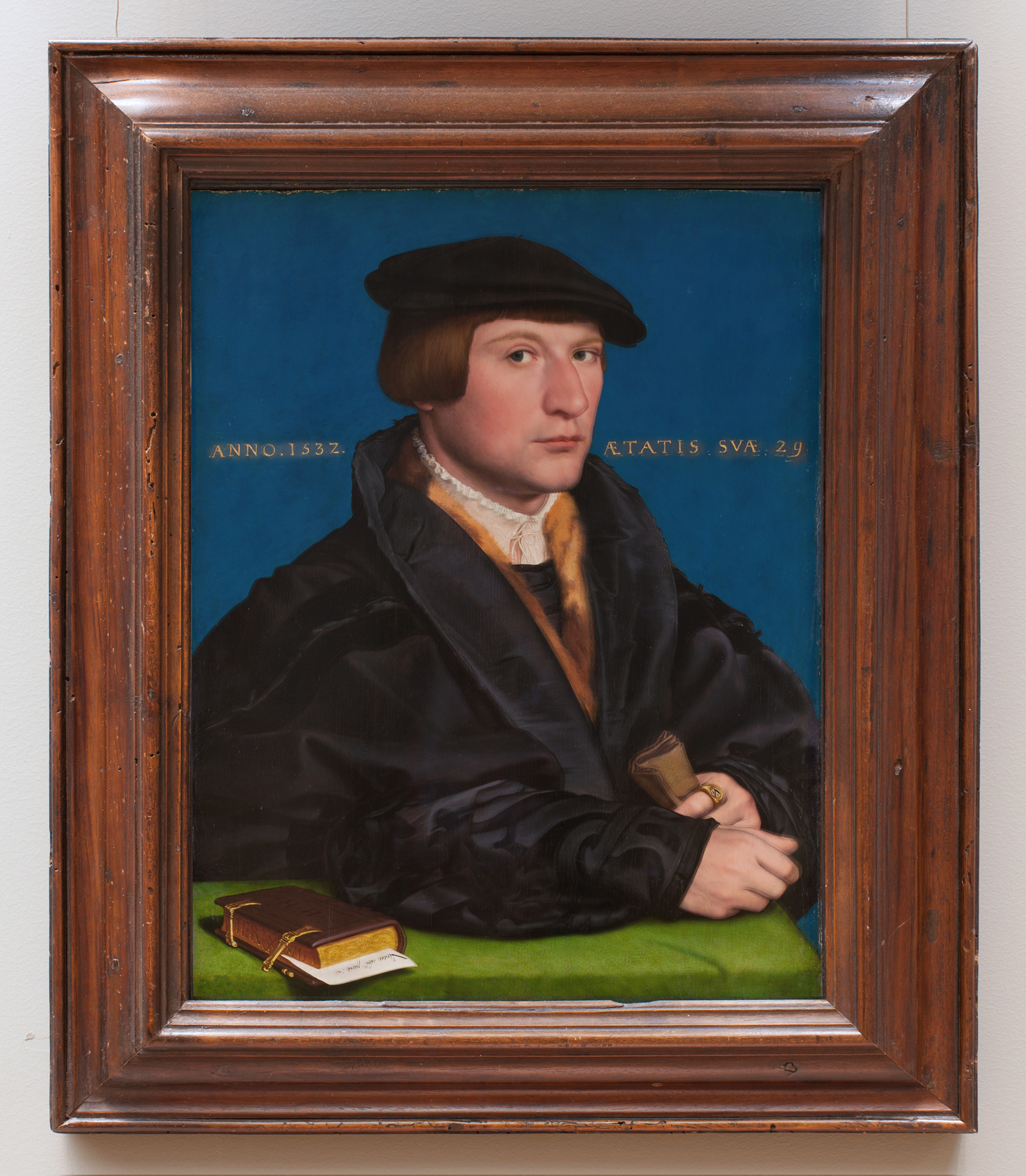
Hans Holbein the younger (1497/98-1543), Hermann von Wedigh, 1532, o/panel, 42.2 x 32.4 cm., Metropolitan Museum, New York
Similarly, a handsome late 16th century Florentine frame with a reverse profile veneered in walnut was given to Holbein’s 1532 portrait of Hermann von Wedigh III, a member of the German merchants resident in London. In contrast, the frame on Cranach’s Portrait of a man with a rosary is based on a mid-16th century pattern found throughout northern Europe; it was probably made in Brussels about 1950. It lends the portrait the appearance of being an independent work, whereas it was actually the wing of an altarpiece, which explains why the sitter is saying the rosary. It was painted for a Dutch family during Cranach’s trip to the Netherlands in 1508, and its original frame would have been made in contemporary local style.
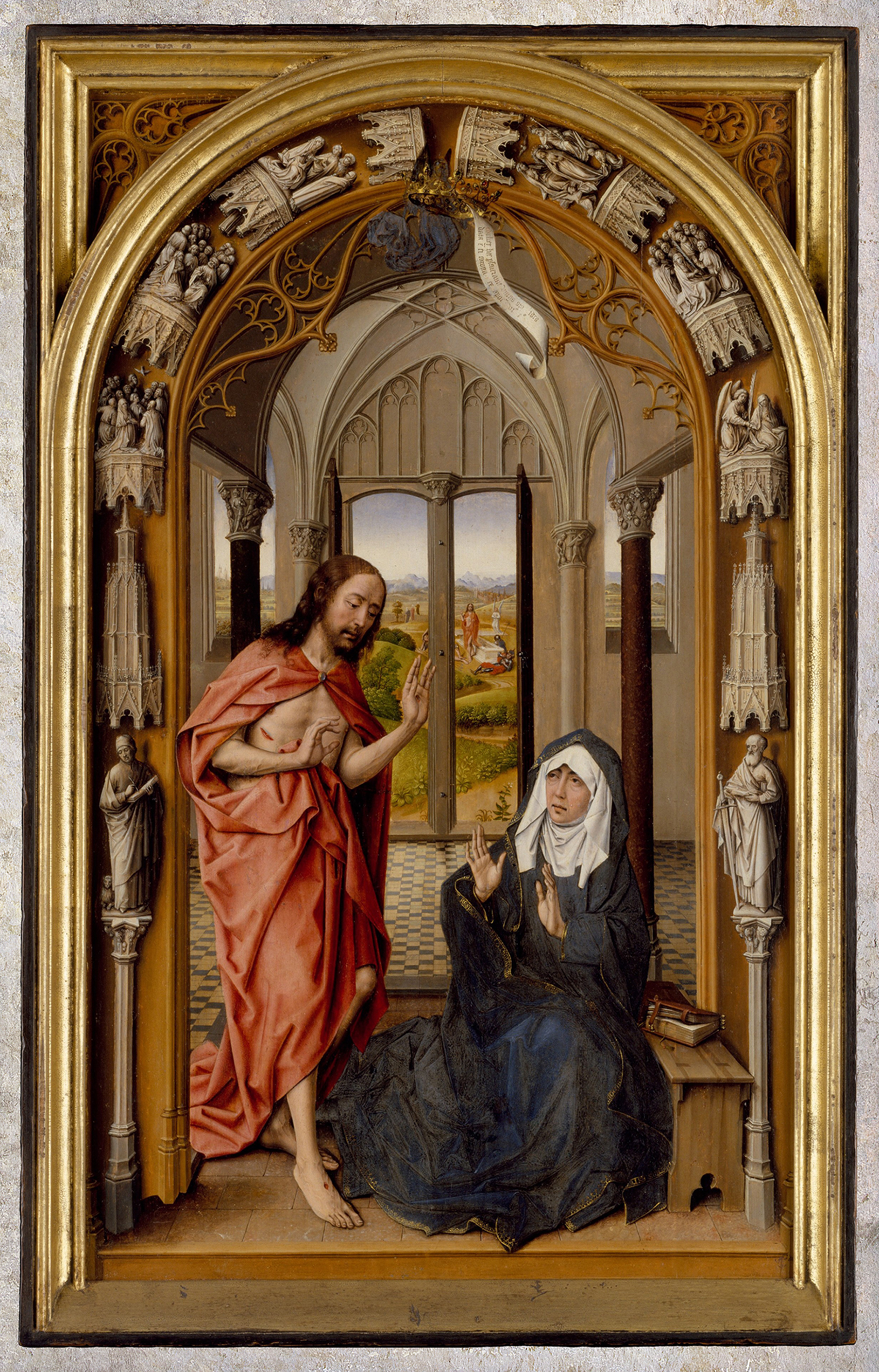
Juan de Flandes (fl.1496-d.1519), Christ appearing to His mother, c.1496, o/panel, 62.2 x 37.1 cm., Metropolitan Museum, New York
A unique example in The Met of the frame as a portal rather than a window is Juan de Flandes’s Christ appearing to His mother, one of three panels which the artist painted for Isabella the Catholic, Queen of Castile and León. Neither the two companion panels in the Capilla Real at Granada, which have been reduced in height, nor the three panels by Rogier van der Weyden in Berlin, which Juan was hired by the Queen to copy, retain their original frames, so that when in 1998 it was decided to find a more sympathetic solution, a prototype was lacking. The challenge was the way in which the original frame, with openings to display the painted tracery in the spandrels, had obviously been conceived as an extension of the painted architecture of the picture. The present frame was based on the fictive gold portals Rogier painted to set off the church interior of his altarpiece of the Seven Sacraments in Antwerp.
In thinking about the fascination of the frame-as-window, which we encounter repeatedly in Renaissance portraits both north and south of the Alps, sometimes overtly and at other times simply hinted at, it’s worth recalling not only Alberti’s ideas as expressed in his treatise on painting, but the convention in chivalric literature of an amatory relationship initiated by the sight of the beloved at a window – present but inaccessible (for an example, see Liberale da Verona’s Scene from a Novella). In the Vita nuova (XXXV) Dante describes such an incident:
‘Then I saw a gentle and very lovely young lady, who was looking at me so pitifully from a window, showing so much in her face that all pity seemed concentrated in her’.
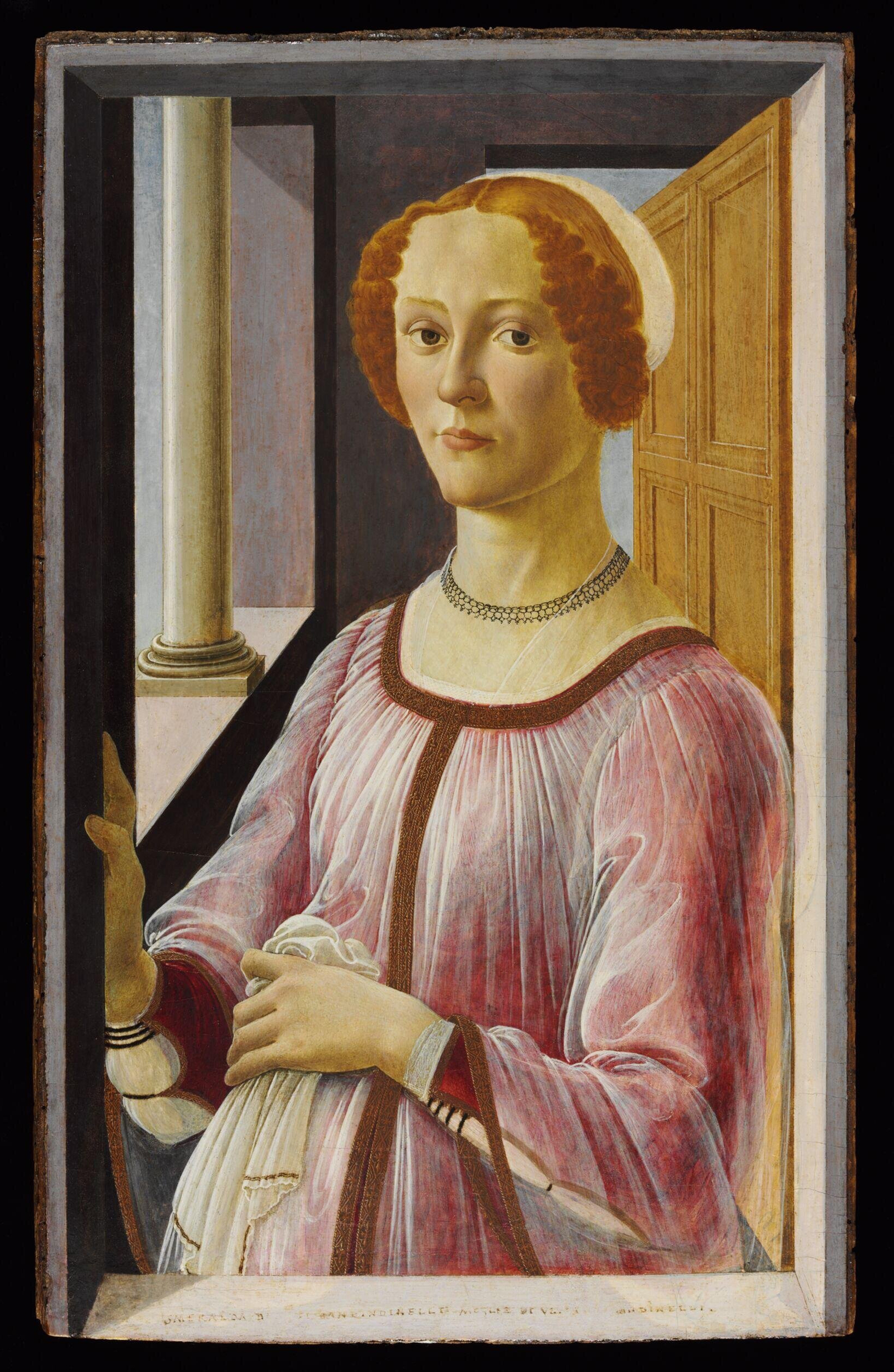
Botticelli (1445-1510), Portrait of a lady known as Smeralda Bandinelli, 1470-80, tempera/panel, 81.1 x 41 cm., V & A
The sonnet has been thought a possible inspiration for Botticelli’s portrait in the Victoria & Albert Museum, in which the female sitter stands modestly behind a window casement which she grasps with her right hand, as though unsure as to whether to acknowledge or ignore the presence of the viewer.
In his altarpiece of the Holy Sacrament in St. Peter’s Church, Leuven, Dieric Bouts placed an interior window on the back wall of the main panel – possibly a hatch through to the kitchen, from which two servants peer out.
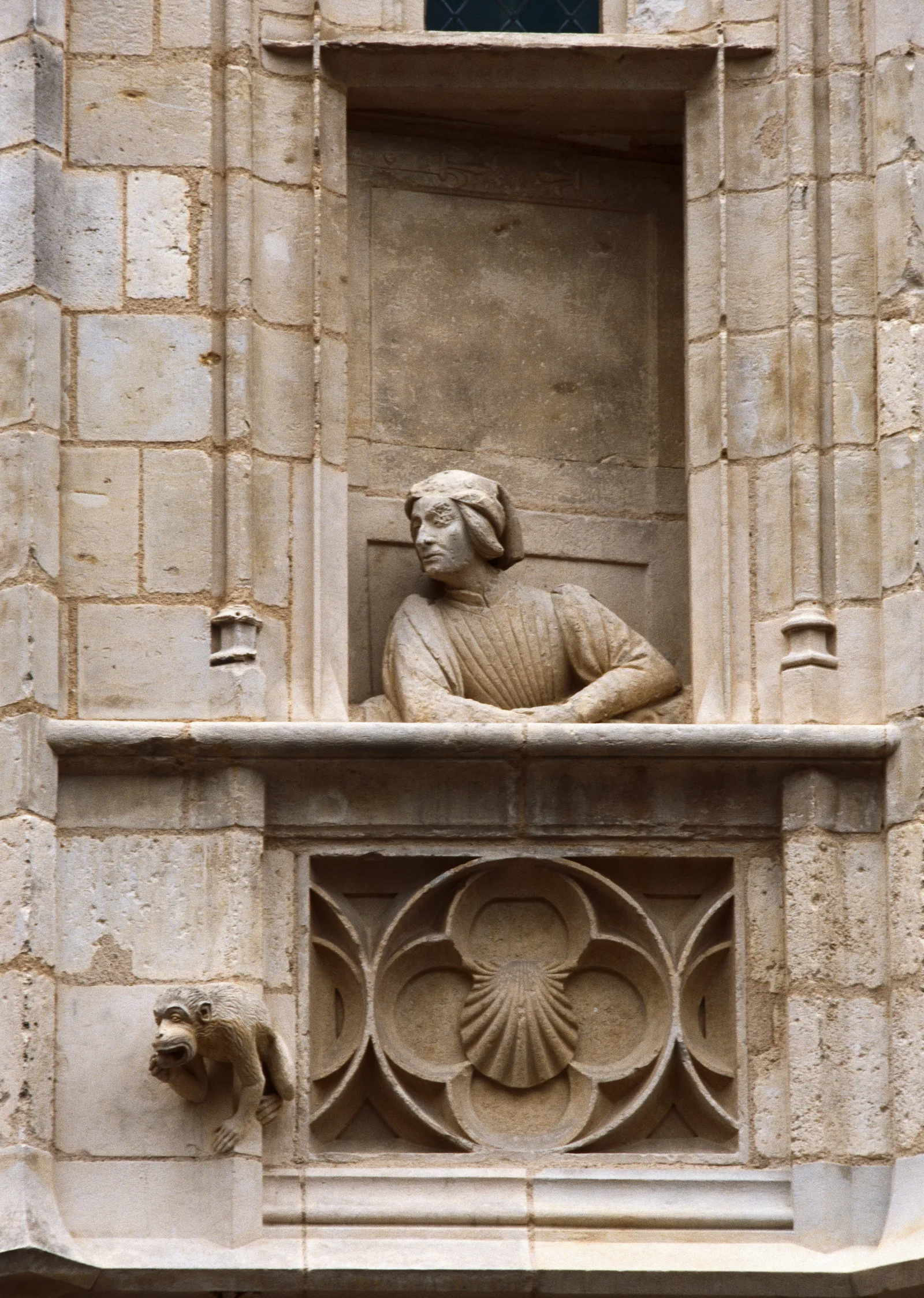
Sculpture of Jacques Coeur on the façade of his palace in Bourges, 1443-54
We also find the idea developed as a decorative motif in secular architecture, for instance on the façade of the 15th century Palais Jacques Coeur in Bourges, where we see two figures – one male and one female – who lean out of balconied windows and look down at the viewer standing in the courtyard below. The sculptor/architect Anton Pilgram memorably portrayed himself holding the tools of his trade as he leans out of a window casement in St Stephen’s cathedral in Vienna; and Giorgio de Chirico consciously referenced this vibrant tradition in his Self-portrait in the Toledo Museum of Art.
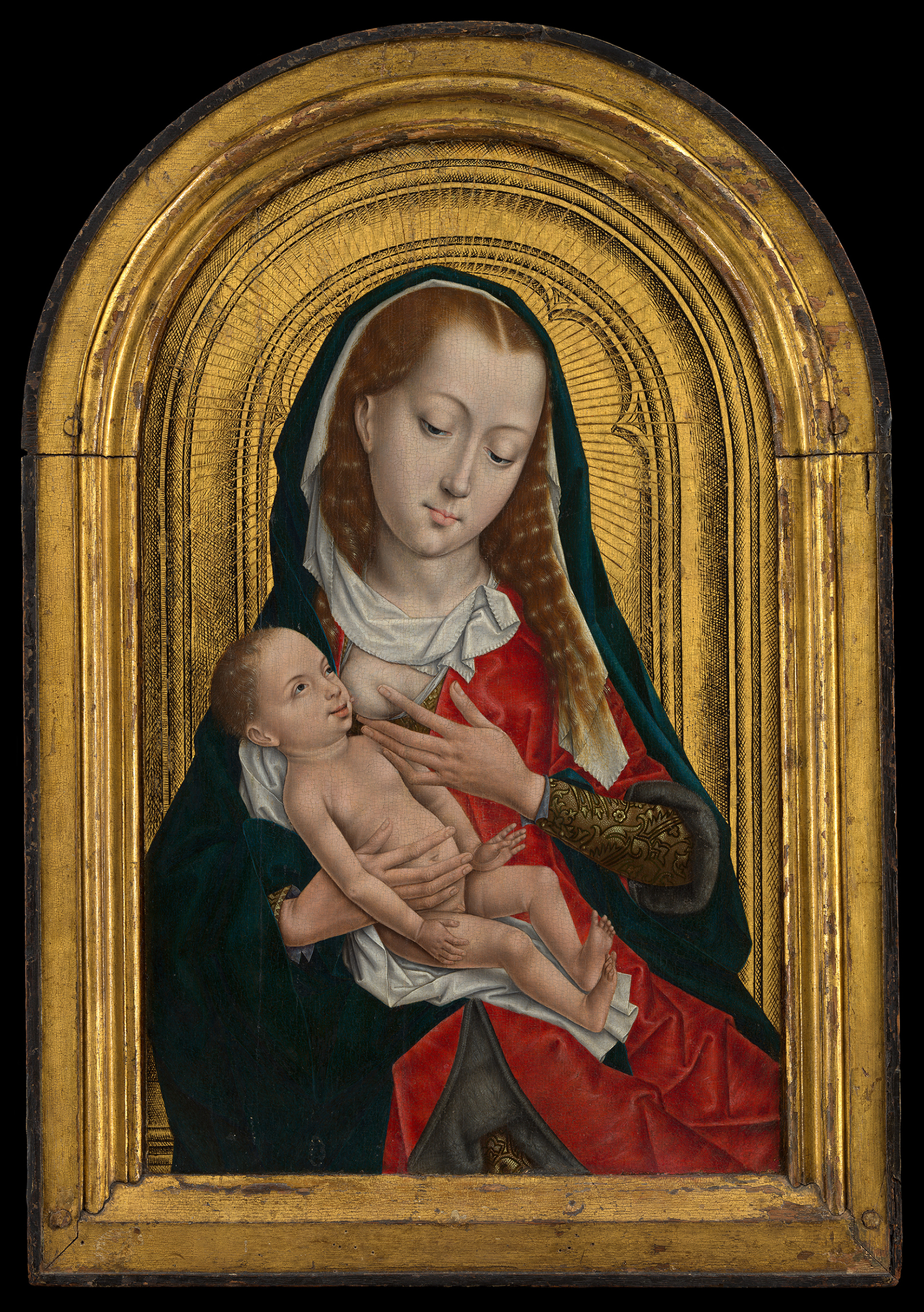
Master of the St Ursula Legend, fl. late 15th century, Madonna & Child, c.1480-90, o/panel, 56.2 x 34.3 cm., Metropolitan Museum, New York
The Madonna and Child by the Master of the St Ursula Legend explores a different convention – one associated with metalwork rather than painting. The gold background of the picture has been drawn and hatched in black in a manner which simulates the working of a prestigious goldsmith’s work. The feigned mouldings in the background merge seamlessly with the actual giltwood mouldings of the engaged frame. By this device, the flat gold background of mediaeval practice is given the illusion of physical dimensionality and the painting is as though transformed into a piece of precious metalwork which, by extension, enhances our perception of the Virgin and Child as physical presences.
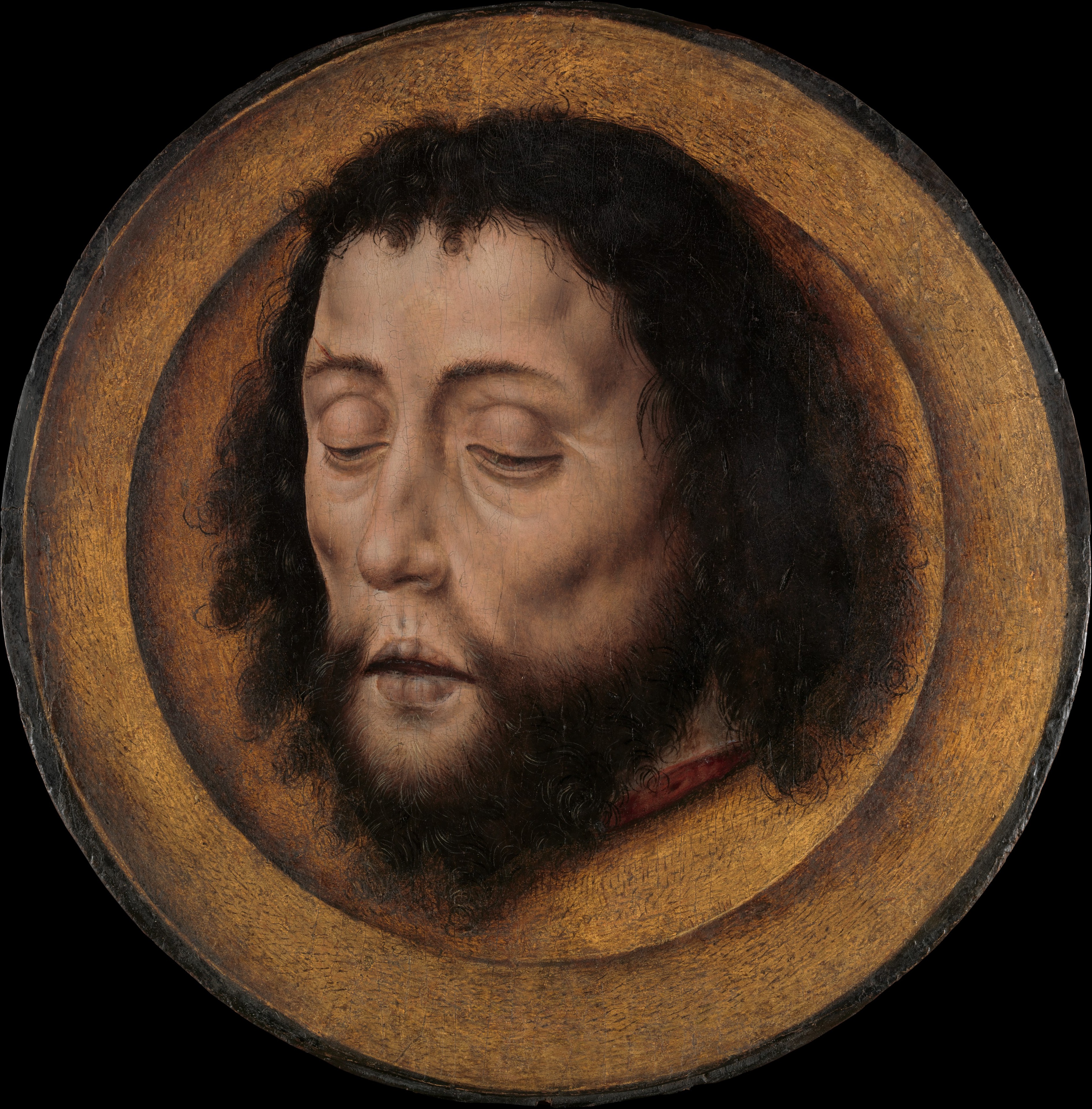
Aelbert Bouts (c.1451/54-1549), The head of St John the Baptist on a charger, c.1500, o/panel, diam. 28.3 cm., Metropolitan Museum, New York
Aelbert Bouts employed a similar trompe l’oeil approach in his depiction of the head of St John the Baptist on a gold charger, with the difference that his painting was meant to be displayed without a frame.
The Northern folding altarpiece
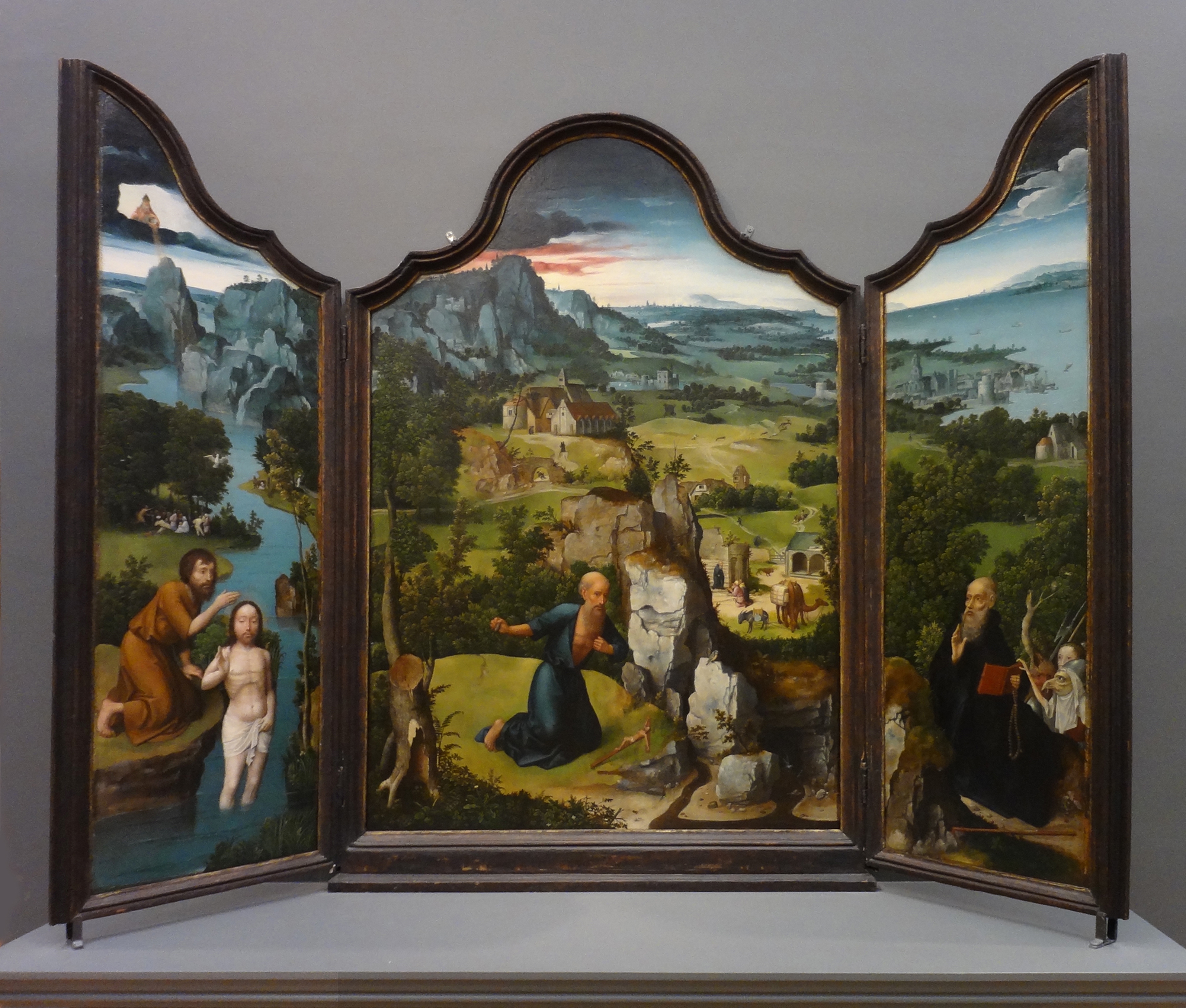
Joachim Patinir (fl.1515-d.1524), The penitence of St Jerome, c.1515, o/panel, left:120.7 x 35.6 cm., centre: 117.5 x 81.3 cm., right: 120.7 x 35.6 cm., all including original engaged frames; Metropolitan Museum, New York
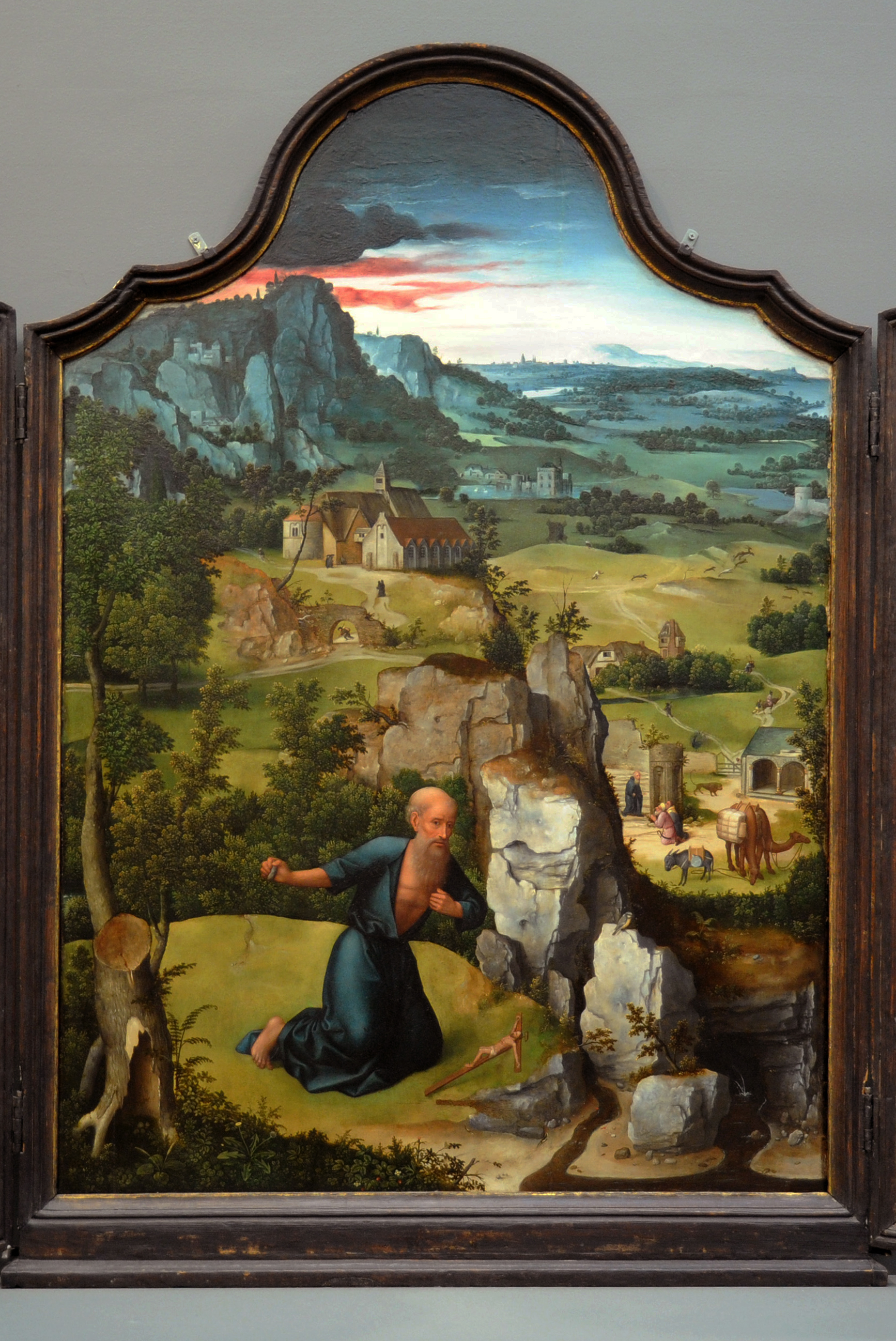
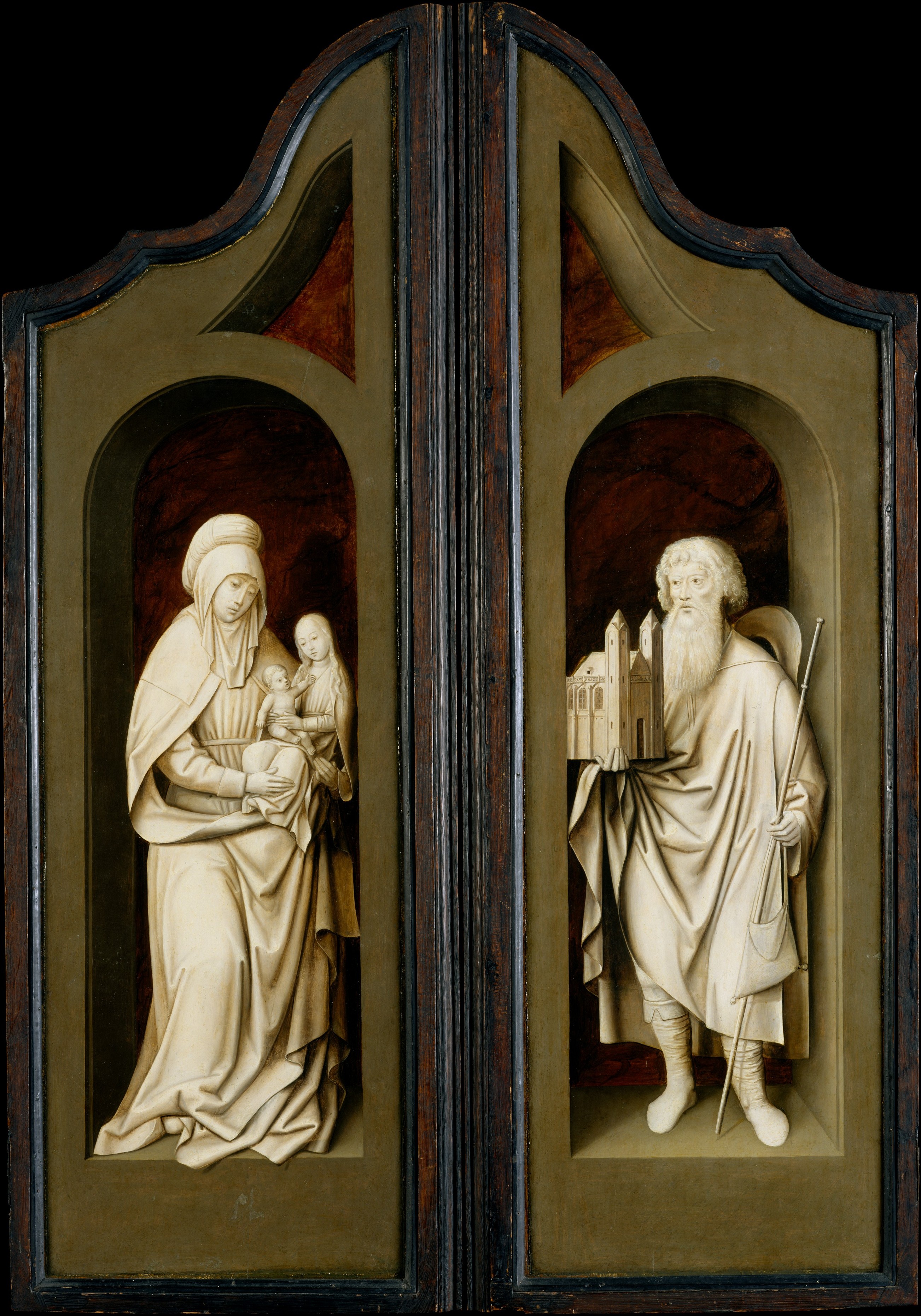
Joachim Patinir, The penitence of St Jerome, detail of centre panel and backs of shutters
Two altarpieces in The Met’s collection – both triptychs with folding wings – stand out for their sophistication and elegance, and both retain their engaged frames intact. The first is Joachim Patinir’s innovative triptych of The penitence of St Jerome, in which the engaged frame with its flowing ogee top serves primarily as a discreetly decorative surround. No attention is deflected from the meticulously-described panoramic landscape which runs continuously across all three panels, transporting the viewer across river valleys and rocky mountains towards a sea stretching to a distant pale horizon. In contrast, the reverse of the wings is treated as a piece of trompe l’oeil, in which the frame becomes the containing border of two architectural niches holding the feigned marble sculptures of saints.
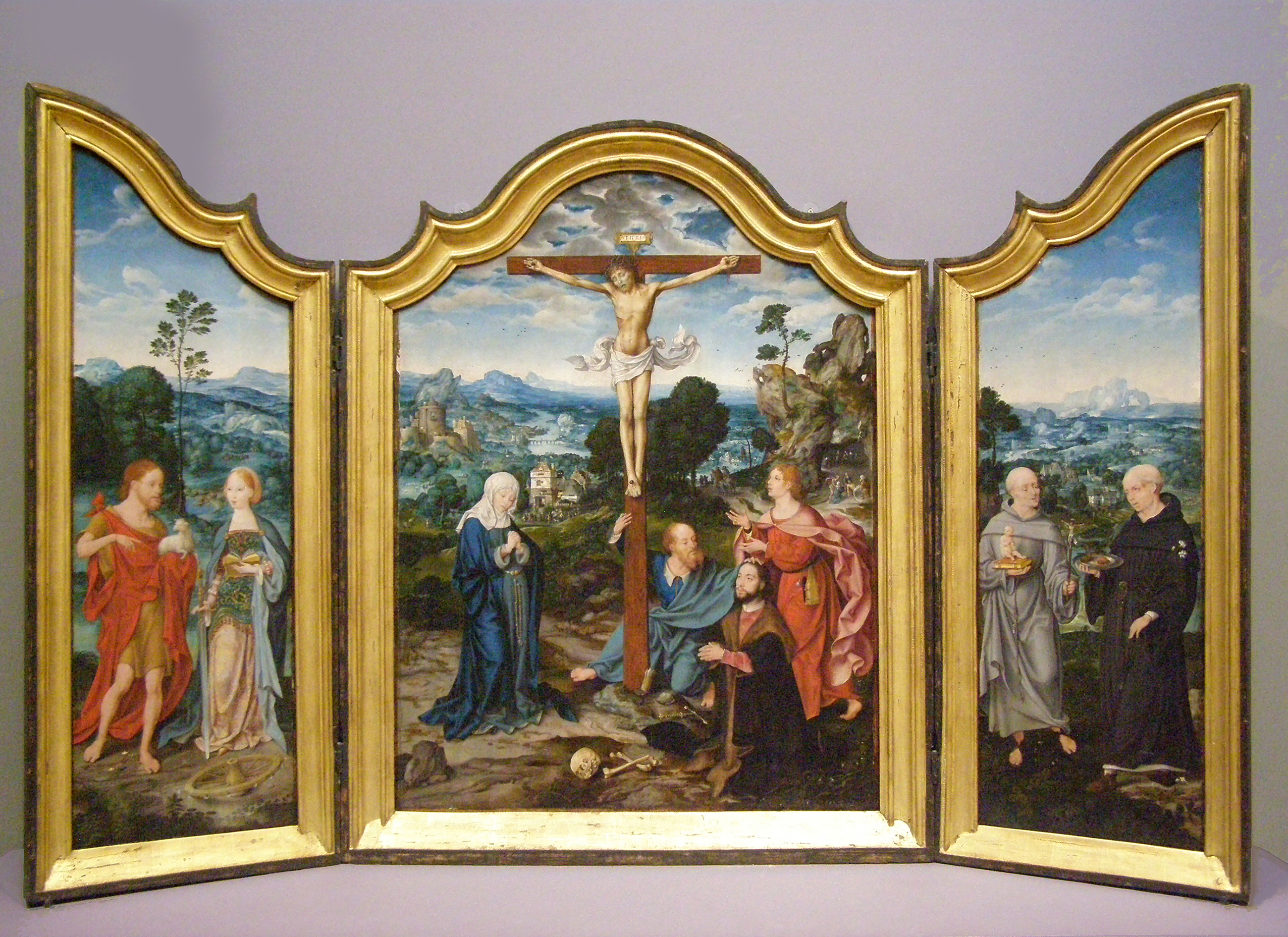
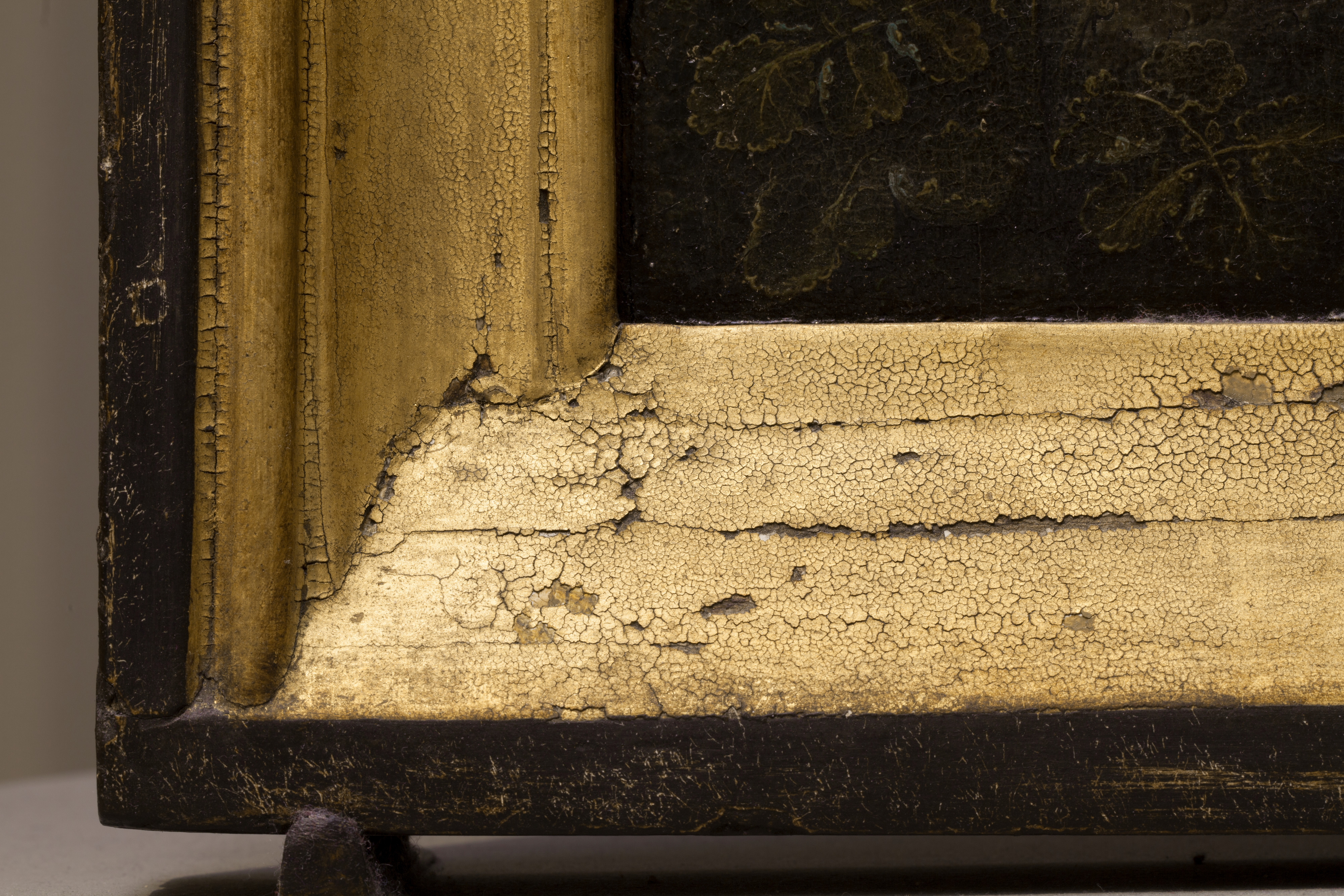
Joos van Cleve (c.1485-1540/41), Crucifixion with saints and a donor, c.1520, o/panel, left: 101 x 32.7 cm., centre: 98.4 x 74.3 cm., right: 101 x 32.7 cm., without frames; and detail of corner of wing, Metropolitan Museum, New York https://www.metmuseum.org/art/collection/search/436792
The frames of Joos van Cleve’s Crucifixion with saints and a donor are boldly gilded with a black outer moulding, and assert their rôle as ornaments to the artist’s artistry. Not only are they original to the paintings, they retain the joinery secured with wooden dowels as well as the original hinges (although the pins have been changed). The triptych seems to have been commissioned by a Genoese patron, possibly a merchant residing in Antwerp – another reminder of the pan-European popularity enjoyed by leading Netherlandish painters. As with other Netherlandish frames already discussed, the lower part of the frame is canted in a rainsill.
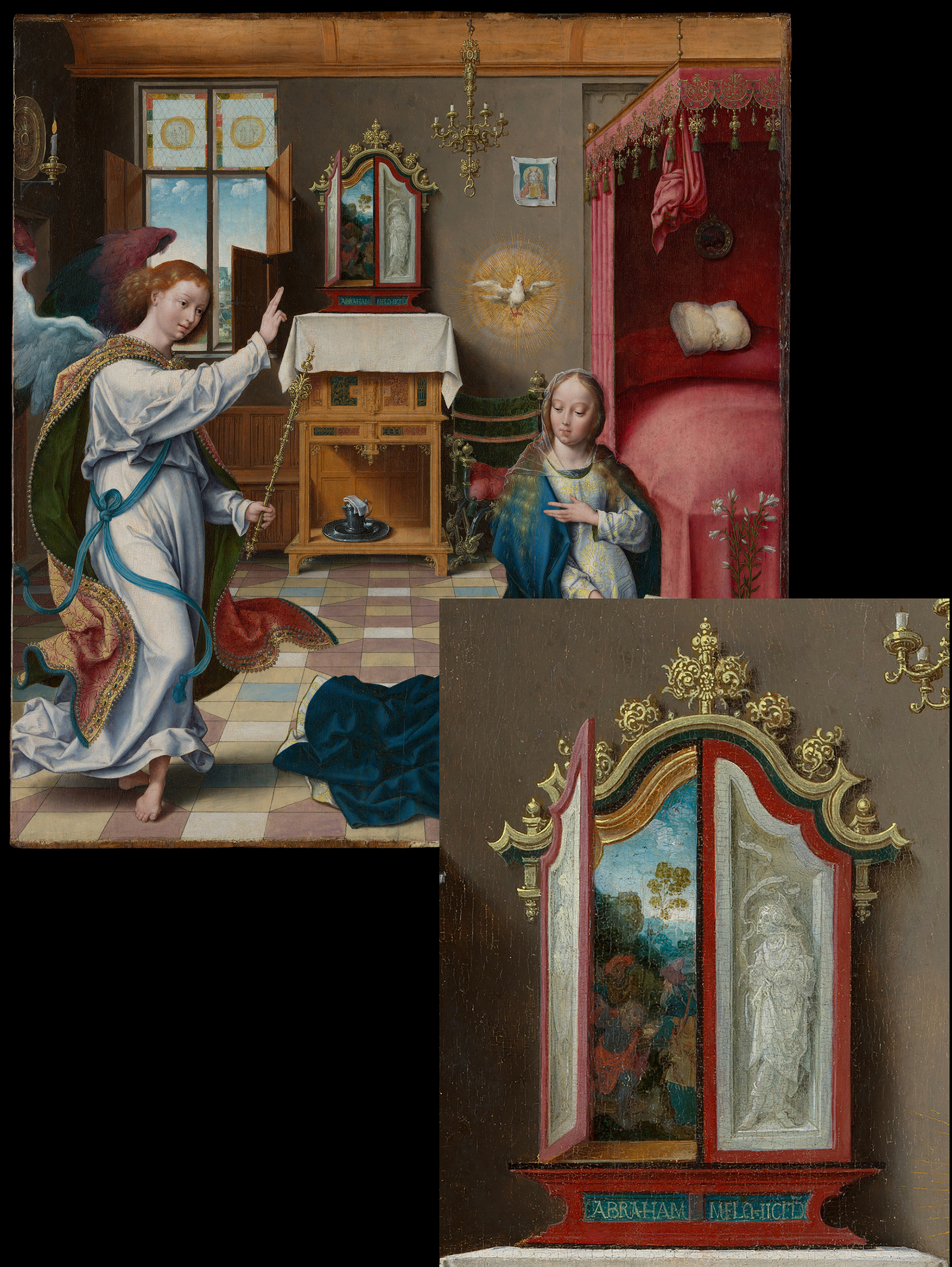
Joos van Cleve (c.1485-1540/41), Annunciation, c.1525, o/panel, 86.4 x 80 cm., and detail, Metropolitan Museum, New York
Frames such as this one became standard: Joos van Cleve included an example in an Annunciation, where it adorns a cabinet in the Virgin’s bedroom, the red moulding of the curvilinear frame set into an aedicule decorated with gilded metal ornaments similar to those of the chandelier.
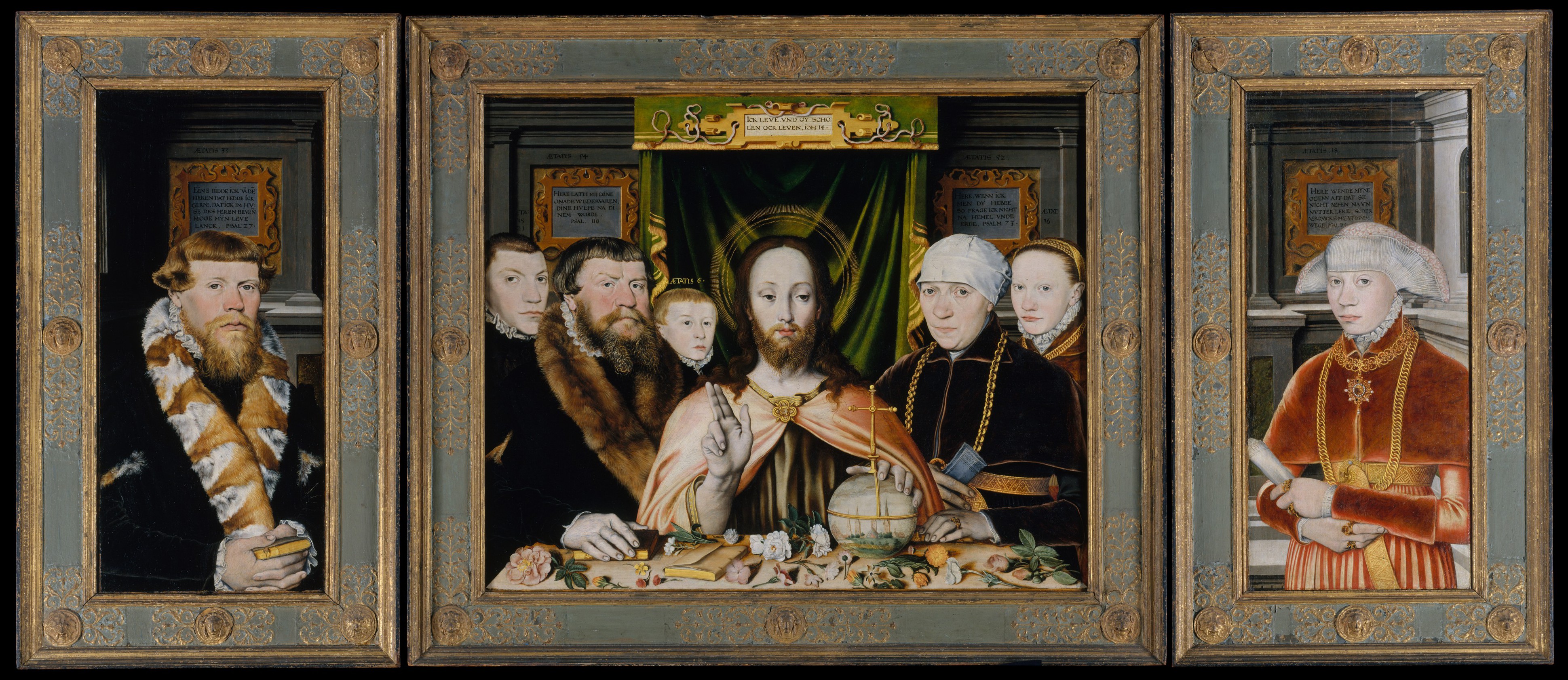
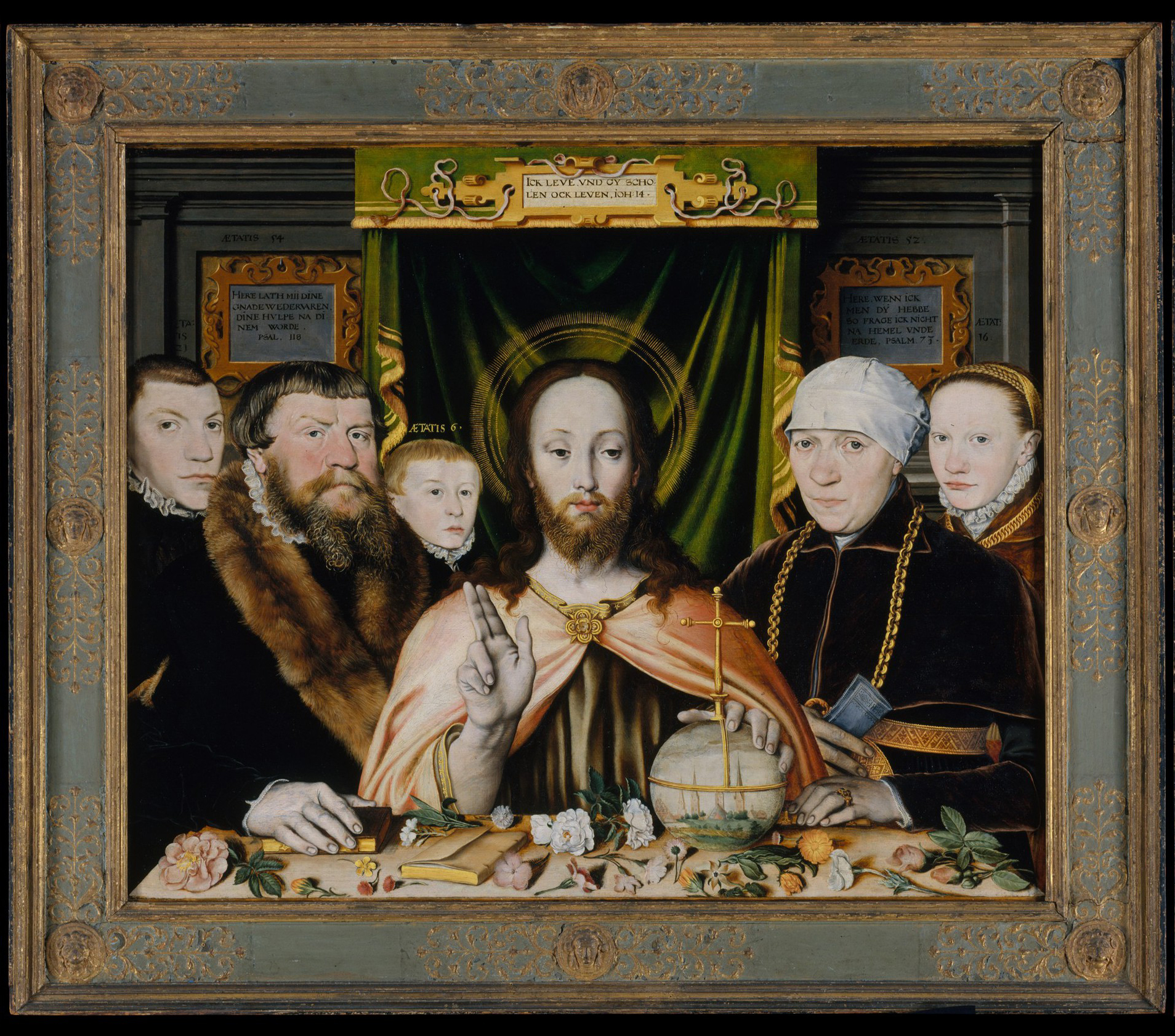
16th century German School, Christ Blessing, surrounded by a donor family, c.1573-82, o/panel, left: 81.3 x 37.1 cm., centre: 79.7 x 95.6 cm., right: 81.3 x 37.1 cm.; and detail of centre panel, Metropolitan Museum, New York
Perhaps the most fascinating example of the folding triptych is by a still anonymous German painter and dating to around 1573-82. The form is that of an altarpiece, where the single divine figure is Christ as Salvator Mundi seated beneath a green baldachin. He is placed behind a table strewn with a variety of flowers (each carrying symbolic meaning [4]) and two closed books, and He raises one hand in blessing, whilst the other is placed on a crystal orb in which can be seen churches in the city of Hamburg. This is a representation of the world which He has come to save. Around Christ, in close proximity, are gathered the members of a family, ranging from a six-year-old boy peering out in the background to the two stern-faced parents positioned next to Jesus.
This extraordinary work would seem to assert the religious convictions of a Lutheran family from northern Germany. The walls of the room in which they stand run continuously across all three panels and are decorated with Biblical verses displayed in elaborate scrollwork frames (one particularly germane verse is taken from Psalm 27: ‘One thing have I desired of the Lord, that will I seek after; that I may dwell in the house of the Lord all the days of my life’).
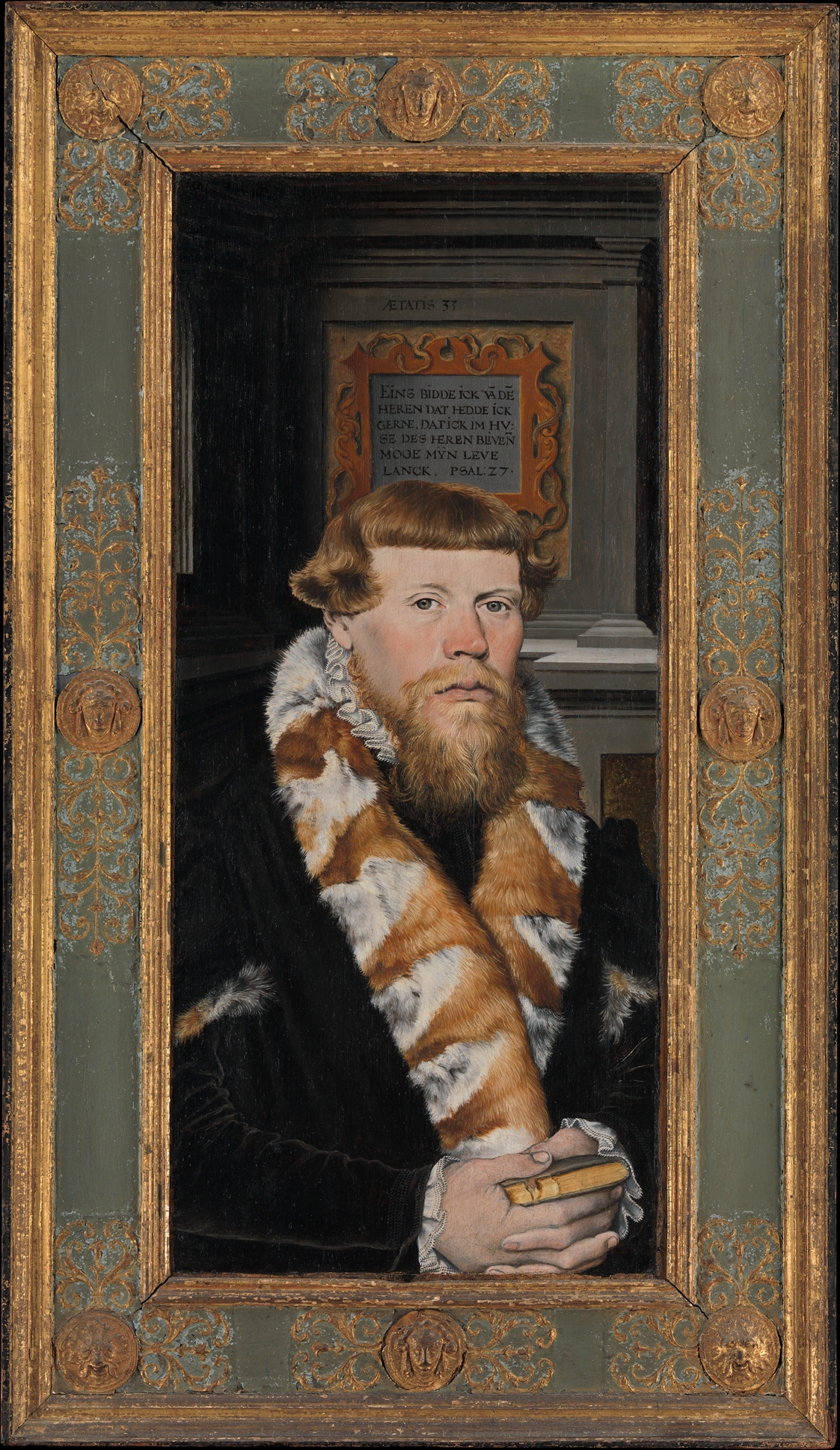
16th century German School, Christ Blessing…, detail of left wing
Just as notable as the frames depicted in the triptych are those which contain it. They are made like an Italian cassetta in style and profile, and, although not engaged, are original. They have been repainted and regilded several times, but the decorative medallions with female and animal busts and stamped paper ornament reflect the Renaissance taste of the period. These frames indicate the transition from frames which extend the space of the picture into that of the viewer to frames which function as ornamental accoutrements.
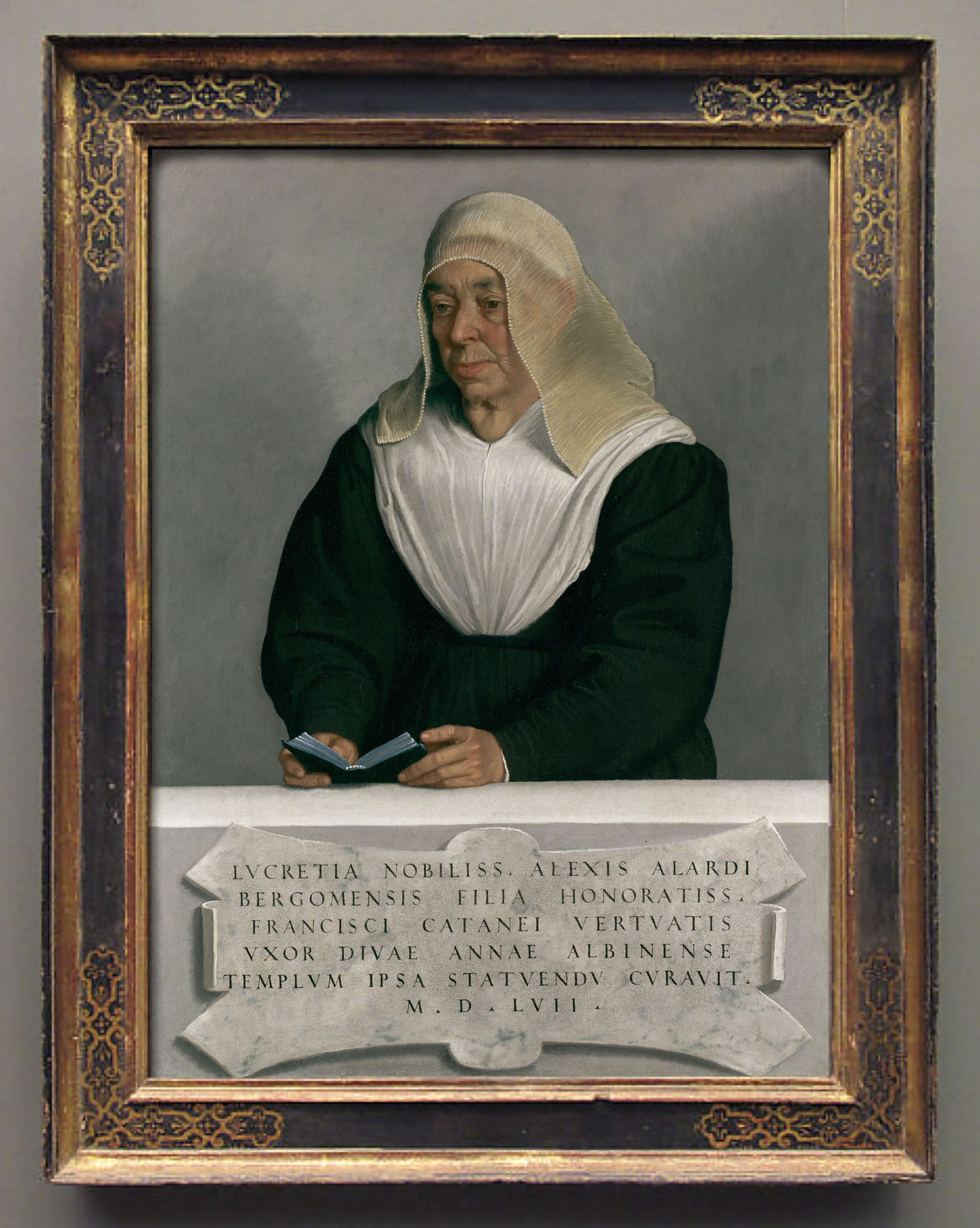
Giovanni Battista Moroni (c.1524-78), The Abbess Lucrezia Agliardi Vertova, 1557, o/c, 91.4 x 68.6 cm., Metropolitan Museum, New York
An Italian analogy is the late 16th century Lombard frame which in 1979 was adapted to hold Moroni’s commemorative portrait of Lucrezia Agliardi Vertova, founder and abbess of the Carmelite convent of Saint Anne at Albino, near Bergamo. Moroni’s portrait originally hung in the convent as a reminder to the nuns of their founder. It has been suggested the German triptych also served as a memorial and was displayed as part of a family epitaph in a church.
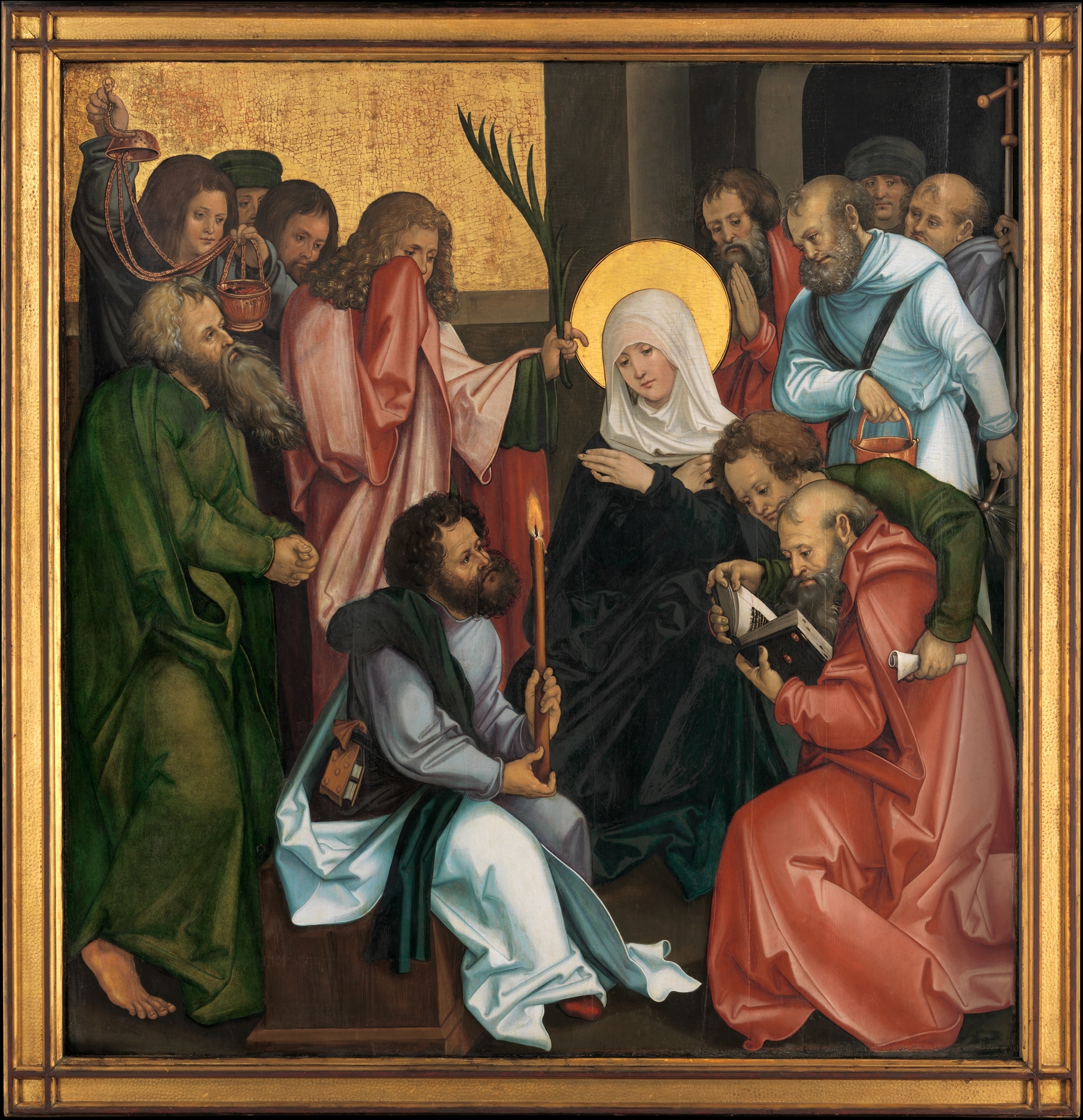
Hans Schäufelein (c.1480-1540) and the Master of Engerda (fl. c.1510-20), The Dormition of the Virgin, c.1510, o/panel, 139.7 x 134.9 cm., Metropolitan Museum, New York
This may appear to be a very general and brief overview of the frames on paintings in The Metropolitan Museum and the stories they tell about taste and collecting; also about the problems which have attended them on reframing. A fitting conclusion to it might be the panel from a large folding triptych, painted around 1510 by the Master of Engerda, and Hans Schäufelein who, having worked with Dürer, moved to Augsburg to assist Hans Holbein the elder. It is painted on both sides, and showed The Dormition of the Virgin when open and Christ carrying the Cross when closed.
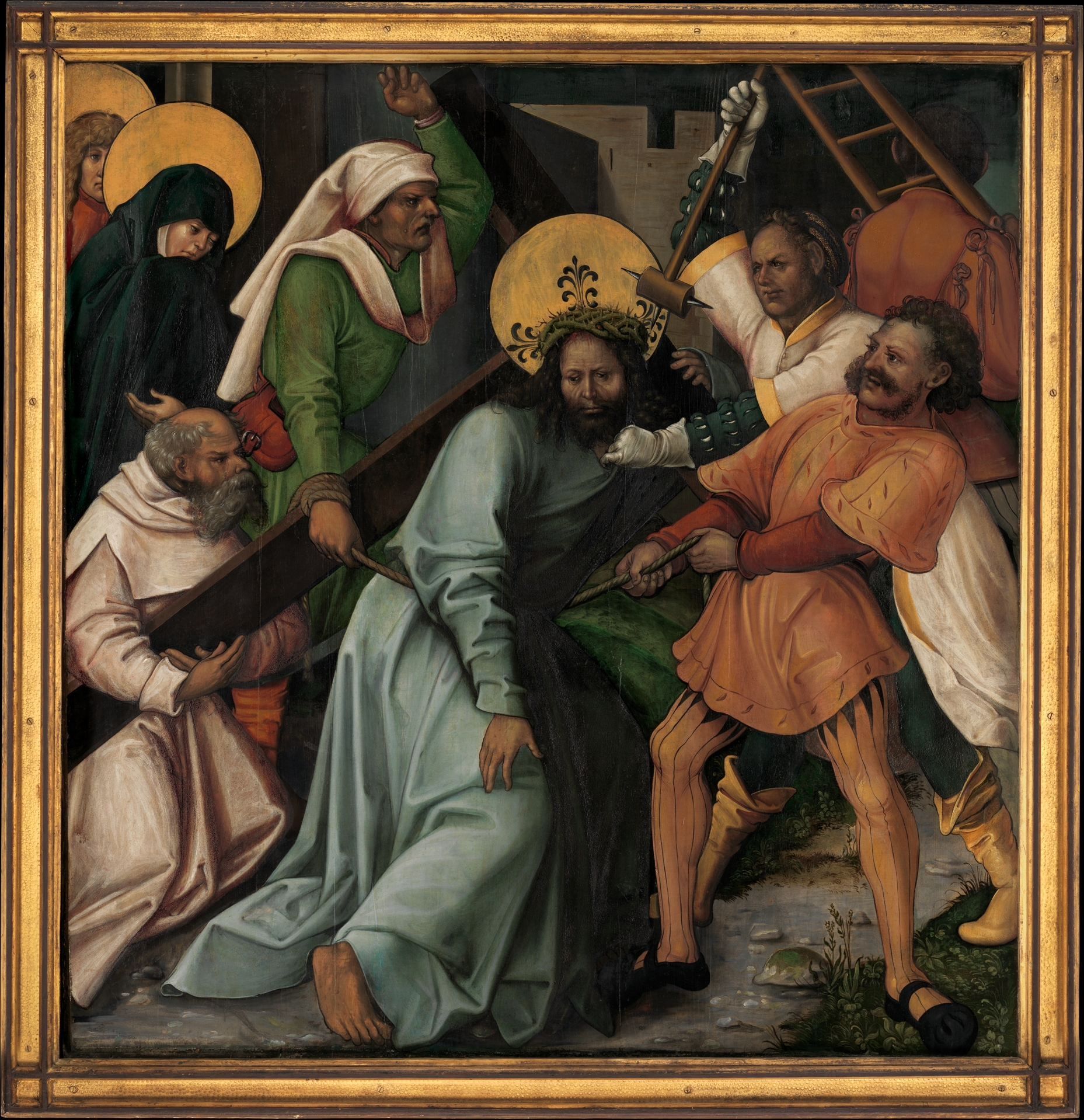
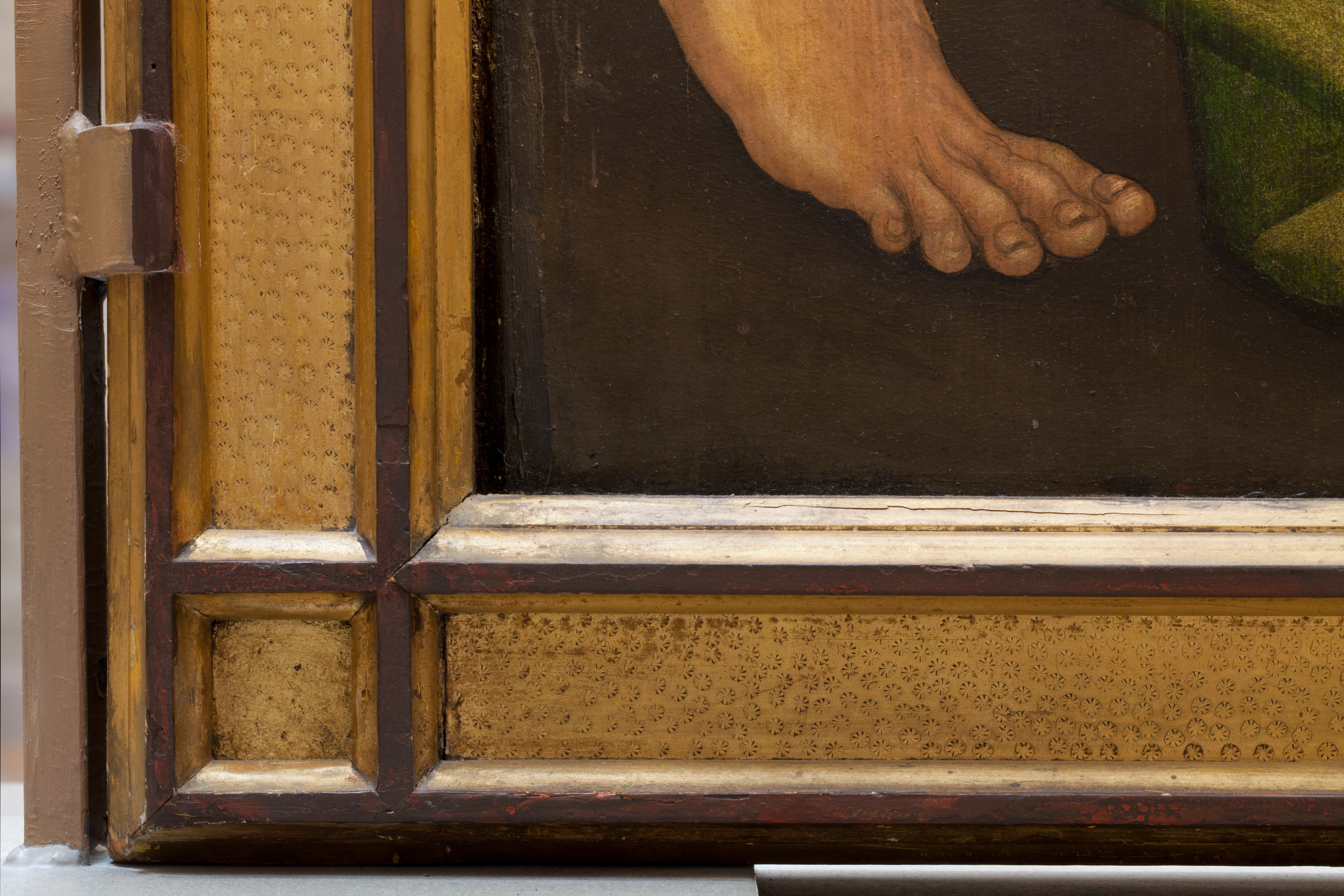
Hans Schäufelein and the Master of Engerda, Christ carrying the cross , and corner detail of the frame on Dormition of the Virgin
The imposing polyptych to which it belonged seems to have been commissioned for the Church of the Holy Cross in Augsburg, and at the centre there may have been, as was often the case, an elaborate sculptural group rather than a painting. Like so many other fragments in the collection, the frame, with its raised mouldings which intersect at the corners, is not original. The Met’s panel was separated from the very large altarpiece to which it belonged by the early 19th century. It was purchased by the British architect, designer, artist and critic, Augustus Welby Pugin, who was employed on the rebuilding of the Palace of Westminster in a NeoGothic style. The present frame of the painting must have been designed by Pugin himself; it is both 19th century modern in appearance and also reminiscent of Perpendicular Gothic, and is covered on the frieze with star-shaped punchwork.
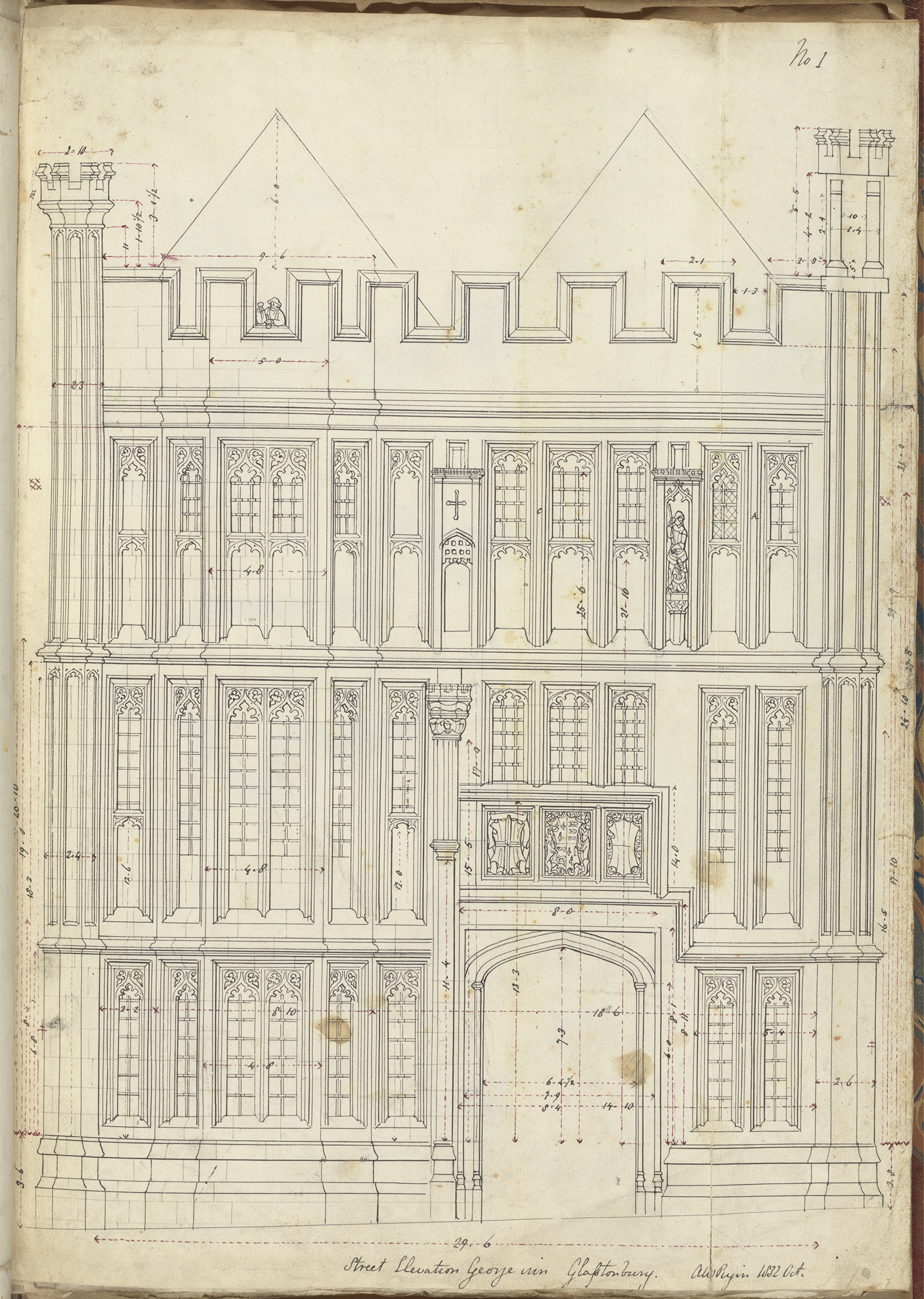
A.W.N. Pugin (1812-52), elevation for the façade of the George Inn, Glastonbury, Somerset, Yale Center for British Art
Indeed, its simple rectilinear features bear comparison with Pugin’s 1832 drawing for the George Inn in Glastonbury. As is so often the case, the frame – although not original to the picture – documents an important moment in the history of taste and collecting, and is a work of art itself.
*************************************
This is the fourth of four essays forming a series under the title: ‘Framing the European paintings at The Met’. The first provides an introduction and explores the 16th -17th century collection, and can be found here. The second looks at the 18th and 19th century paintings: here. The third examines frames from the 14th to 16th century, with a particular focus on Italy: here.
A specialist in Italian Renaissance and Baroque art, Keith Christiansen was curator and, from 2009 to 2021, chairman of the Department of European Paintings at The Metropolitan Museum.
*******************************************
Bibliography:
In addition to the many indispensable essays by various authors on The Frame Blog, the following books and essays have been particularly important sources for these four essays. I would especially like to thank Timothy Newbery for sharing his incomparable knowledge of the frames in The Met’s collection.
Reinier Baarsen, ‘Herman Doomer, ebony worker in Amsterdam’, The Burlington Magazine, vol. 138, no 1124, 1996, pp. 739-49
George Bisacca, ‘The rise of the all’antica altarpiece frame’, The Frame Blog https://theframeblog.com/2015/06/18/the-rise-of-the-allantica-altarpiece-frame/
Isabelle Cahn, ‘Degas’s Frames’, The Burlington Magazine , vol. 131, no 1033, 1989, pp. 289-93
Alessandro Cecchi, ‘The tondo frame in Renaissance Florence: a round-up’, The Frame Blog https://theframeblog.com/2021/02/25/the-tondo-frame-in-renaissance-florence-a-round-up/
Fédéric Destremau, ‘Pierre Cluzel, (1850-1894) encadreur de Redon, Pissarro, Dégas, Lautrec, Anquetin, Gauguin ‘, Bulletin de la Société de l’Histoire de l’Art français, 1995, pp. 239-47
Elizabeth Easton and Jared Bark, ‘ “Pictures Properly Framed”: Degas and Innovation in Impressionist Frames’, The Burlington Magazine, vol. 150, no 1266, 2008, pp. 603-11
‘Frames in paintings: Part 1 – Gothic, Renaissance and Mannerist’, The Frame Blog, February 2023, https://theframeblog.com/2023/02/05/frames-in-paintings-part-1-gothic-renaissance-and-mannerist/
Creighton Gilbert, ‘Peintres et menuisiers au début de la Renaissance en Italie’, Revue de l’art, 37, 1977, pp. 9-28, republished in English as ‘Painters & woodcarvers in early Renaissance Italy’, on The Frame Blog https://theframeblog.com/2015/11/13/painters-woodcarvers-in-early-renaissance-italy/
Helen Gramotnev, ‘Degas’s frames for dancers and bathers’, The Frame Blog https://theframeblog.com/2016/10/03/degass-frames-for-dancers-and-bathers/
Francis Haskell, Rediscoveries in art : some aspects of taste, fashion, and collecting in England and France, Cornell University Press, 1976
Deborah Howard, ‘Bellini and Architecture’, in Peter Humfrey, ed., The Cambridge Companion to Giovanni Bellini, Cambridge University Press, 2004, pp. 143-66
Peter Mallo, ‘Artists’ frames in pâte coulante: history, design, and method’, The Frame Blog https://theframeblog.com/2024/12/13/artists-frames-in-pate-coulante-history-design-and-method/
Claude Mignot, ‘Le cabinet de Jean-Baptiste de Bretagne: un ‘curieux’ parisien oublié (1650)’, Archives de l’art français, n.s. 27, 1984, pp. 71-87
Paul Mitchell & Lynn Roberts, A history of European picture frames, London, P. Mitchell in association with Merrell Holberton, 1996
Timothy Newbery, George Bisacca, Laurence B. Kanter, Italian Renaissance frames, The Metropolitan Museum of Art, 1990
Timothy Newbery, Frames, The Metropolitan Museum of Art, in association with Princeton University Press, 2007
Nicholas Penny, ‘Reynolds and picture frames’, The Burlington Magazine, vol. 128, no 1004, November 1986, pp. 810-25
Nicholas Penny, ‘Notes on frames in the exhibition, Portraits by Ingres’, exhibition review, February 1999, accessible on the National Portrait Gallery website: https://www.npg.org.uk/collections/research/programmes/the-art-of-the-picture-frame/artist-ingres
Nicholas Penny and Karen Serres, ‘Duveen and the decorators’, The Burlington Magazine, vol. 149, 2007, pp. 400–06
Nicholas Penny and Karen Serres, ‘Duveen’s French frames for British pictures’, The Burlington Magazine, vol. 151, 2009, pp. 388–94
Gemma Plumpton, ‘Framing the Renaissance’, on the Harewood website: https://harewood.org/stories/framing-the-renaissance/
Bruno Pons, ‘Les cadres francais du XVIII siècle et leurs ornaments’, Revue de l’Art, no 76, 1987, pp. 41-50, republished in English as ‘18th century French frames and their ornamentation’ on The Frame Blog https://theframeblog.com/2017/07/12/18th-century-french-frames-and-their-ornamentation/
Karen Serres, ‘Duveen’s Italian framemaker, Ferruccio Vannoni’, The Burlington Magazine, vol. 159, May 2017, pp. 366–74; reviewed as ‘19th & 20th century Italian framemakers…’, on The Frame Blog https://theframeblog.com/2017/06/19/review-19th-20th-century-italian-framemakers-articles-in-the-burlington-magazine/ ; further information on Duveen’s reframing can be found in the Duveen Files, available through the Getty website
Antoine Schnapper, ‘Bordures, toiles et couleurs: une révolution dans le marché de la peinture vers 1675’, Bulletin de la Societé de l’histoire de l’art français, 2000, 2001, pp. 85-104
John Shearman, ‘The collections of the younger branch of the Medici’, The Burlington Magazine, vol. 117, no 862, 1975, pp. 12-27
Pieter J.J. van Thiel and C. J. de Bruyn Kops, Prijst de lijst, Rijksmuseum, 1984; translated by Andrew McCormick as Framing in the Golden Age: picture and frame in 17th century Holland, published by John Davies, London, 1995
The entry on John Smith from the website of the National Portrait Gallery: https://www.npg.org.uk/collections/research/programmes/conservation/directory-of-british-framemakers/s/#SM
*******************************************
Footnotes
[1] Timothy Newbery informs me that in his view the frame now on the picture incorporates gilded mouldings possibly made in Turin in the 17th century, which were applied to a back frame for an early 16th century picture; the resulting frame was reduced for the Antonello
[2] For a close comparison of this iconography and the architecture of the frame, see the Betrothal of the Virgin in the Museo del Prado ascribed to Robert Campin
[3] My thanks to Timothy Newbery for this information
[4] These flowers include roses, an attribute of the Virgin as Rosa Mundi; marigolds, also an attribute of the Virgin (Mary’s gold); pinks or carnations, symbolic of the Crucifixion; daisies, which stand for humility; a columbine for the Holy Ghost (because it looks like a group of little doves); see more in ‘Fruit, flowers, foliage: the symbolism of Renaissance frames’
 The Frame Blog