
Sotheby’s: Pauline Karpidas: a sale of surrealist works

A sale to be held by Sotheby’s, London, on 17 & 18 September 2025
Pauline Karpidas assembled an extraordinary collection of 20th-21st century paintings, sculpture and furniture, some of it commissioned directly from the artists or their agents. The house she shared with her husband, until his death, was an organized riot of pictures, pattern and colour, where no object seemed commonplace or mundane, and every individually extravagant piece fell into obedient relationship with the rest. The contents of her house on Hydra were sold in Paris in 2023, and – like the two days’ auction which Sotheby’s is about to hold, along with an online sale – included items such as framed looking-glasses, which cross the line from furniture to sculpture, as well as a few artists’ frames on drawings and paintings.
These are not particularly noted in the catalogue entries online, although a remarkable book on the collection has been published by Sotheby’s, in tandem with the sale.
Sale on 17th September

Lot 12: Claude Lalanne (1925-2019), Structure végetale looking-glass and wall light, 1995, gold patinated bronze, galvanized copper, mirrored glass; looking-glass 297 x 149 cm., wall light 126 x 49 cm.; unique works; and in situ; est.: £350,000-450,000
Looking-glass frames figure largely in the collection, set around windows and doors, hung on corners or facing each other on walls, providing dreamlike enfilades of paintings and photographs glimpsed in iterations of the actual hangs. The various frames by Claude Lalanne have their own being beyond what they mirror; they are sculptures in their own right – delicate climbing vines which burst into scrolling tendrils and naturalistic coloured metal leaves. This is the largest example of her work in the sale, and has a companion side-light: an updated torchère in the same style, which marries light with reflection in a version of the historical looking-glass.
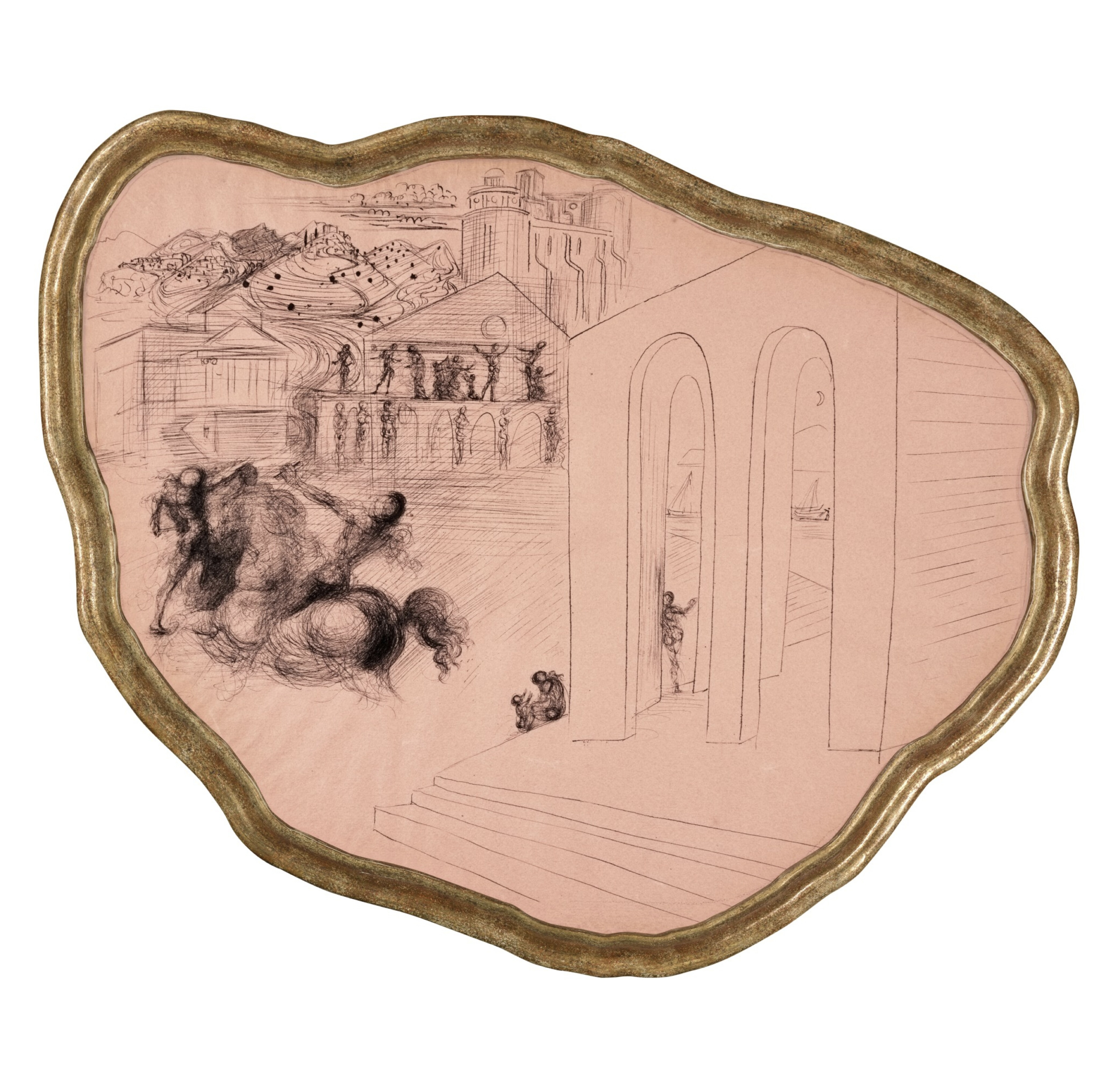
Lot 25: Salvador Dalí (1904-89), Messager dans un paysage Palladien, c.1936, pen-&-ink, 50.2 x 63.2 cm., in artist’s own frame; est.: £200,000-300,000
This drawing went straight from Dalí’s hands into the collection at West Dean of Edward James, who probably
‘acquired it directly from the artist almost immediately after it was completed, around 1936’ [1].

Salvador Dalí (1904-89), Couple with their heads in the clouds, 1936, o/panel, 98.5 x 156.4 cm., Museum Boijmans van Beuningen, Rotterdam
Its frame is Dalí’s own design; it is very similar to the frames of Couple with their heads in the clouds, also from 1936, also owned by Edward James, and now in Rotterdam. In the case of the latter work, it’s the frames themselves which determine the form of the double composition, in a topsy-turvey mastery of the panels by their settings. The drawing here, in the sale, Messager dans un paysage Palladien, does not allow the frame to impose itself on the composition; instead, the melting and formless moulding follows the contour of the paper, creating a cloudlike shape which mirrors the dissolution of the architecture in the image, like the framing of a dream.

Lot 42: Óscar Domínguez (1906-57), Exacte sensibilité, 1935, o/c, 54 x 90 cm., collaged with plaster, iron pipe, metal rod, spatula, plastic and sphere on artist’s frame, 69 x 117 x 12 cm.; and in situ; est.: £600,000-800,000
Domínguez’s frame for Exacte sensibilité is, like Jan Toorop’s frames, an extension of the painted image across the physical woodwork which contains it. But this extension then becomes a three-dimensional sculptural adjunct, emerging into the room at both diagonal corners in a process which seems to be watched by the strangely Auricular Venus in the painting.
At one point the spatula grew from the head of this figure, and the sculpture at the lower left had further stages descending from the sputnik-like apple to a supporting tripod on the floor (illustrated in the Catalogue Note). Perhaps this a resolution of the Renaissance opposition between painting and sculpture; perhaps it is a metaphysical game; perhaps it is something much stranger, and impossible to articulate; but at all events it is a manifestation of the importance placed by the artist on the frame he chooses, as an integral part of the work of art, inseparable and indivisible, able to be played with and undercut.
Sale on 18th September

Lot 101: Picasso (1881-1973), Les Métamorphoses d’Ovide, 1931, eight etchings, black ink, each c.33 x 27 cm.; and in situ; est.: £3,000-5,000
These etchings were also part of Edward James’s collection,
‘…framed in wonderfully eccentric Louis XIV-styled white frames, as per Dalí’s own suggestion’ [2].
They are not actually anything to do with Louis XIV, but (much more appropriately) are versions of Italian Baroque pierced leaf frames, variously deconstructed to left or right as though their leaves have been blown sideways by a passing mythological gale.

Lot 103: Mattia Bonetti (1952-), looking-glass overdoors, 2011, a pair, oak wood, patinated bronze, verre églomisé, each 338 x 295 cm., commissioned by the owner; shown in situ with detail; est.: £8,000-12,000
These are gigantic versions of the Baroque overdoor looking-glass, their undulating lines looking back to the S-scrolling contours of the Rococo, and their flowing extensions down the door frames echoing the forms of mid-18th century chimneypieces. The undulations and the use of verre églomisé produce a hugely enlarged effect like the waterfalls carved in giltwood on Rococo looking-glass frames, and the brackets with lily pads create a decorative correspondence in these interiors with Claude Lalanne’s leafy frames. Light, reflected light and mirrored spaces are integral aspects of the collection as a whole, creating those segments of back-to-front rooms and walls which seem loaded with dreamlike significance, like the reflection of the room where Alice’s adventures through the looking-glass begin.
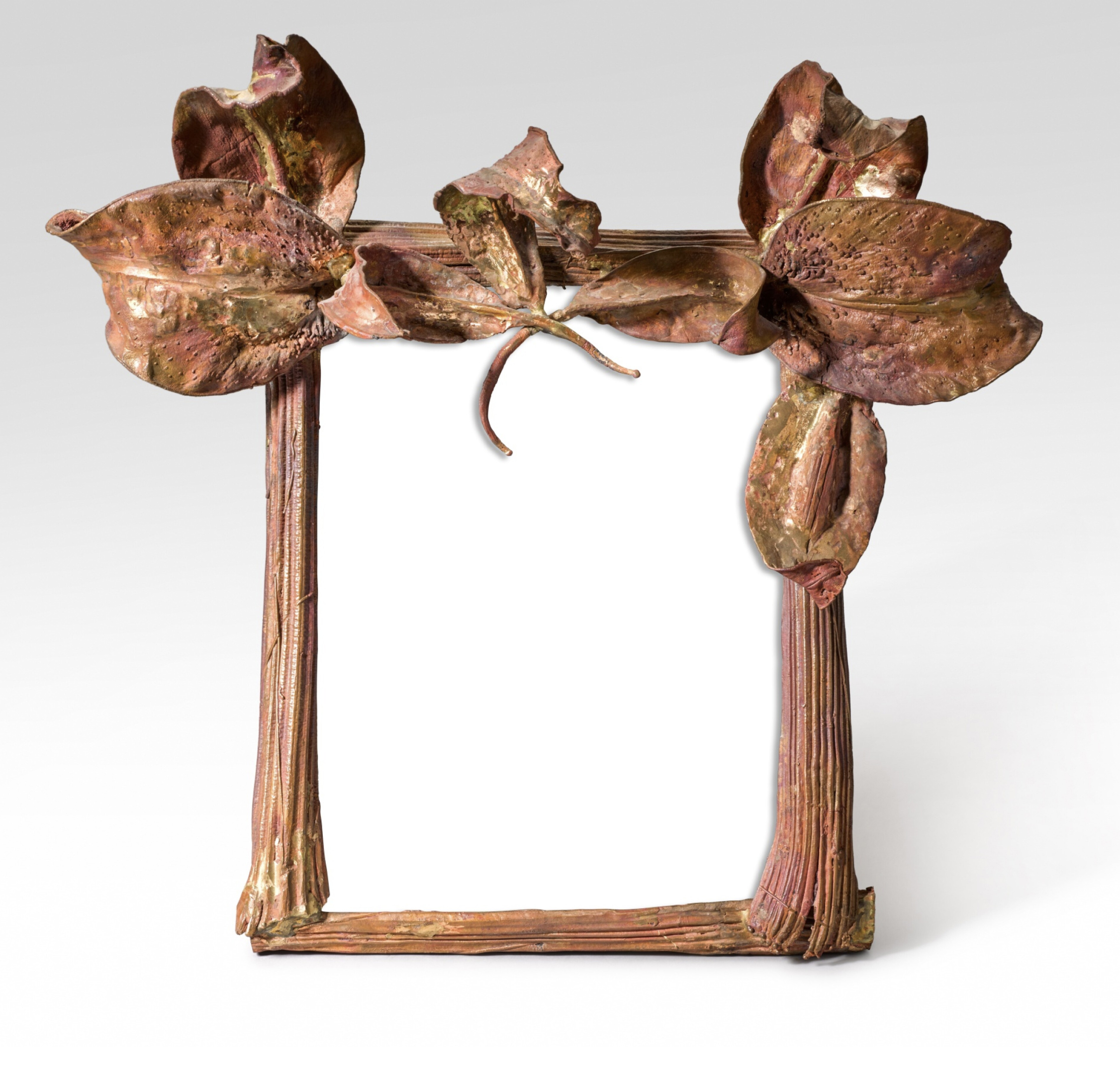
Lot 116: Claude Lalanne (1925-2019), Feuilles frame, 2005, gold patinated bronze and galvanized copper, 36 x 41 cm., commissioned by the owner; est.: £10,000-15,000
The rails of this frame appear to be sticks of celery or hemlock, and the decorative leaves, reproduced with all their flaws and textural imperfections, sit along the top like a sort of Bacchic crown. One of a group of Lalanne leaf frames, it is, like its siblings, both a beautiful object and a jeu d’esprit, perfectly created to hold 20th century photographs.
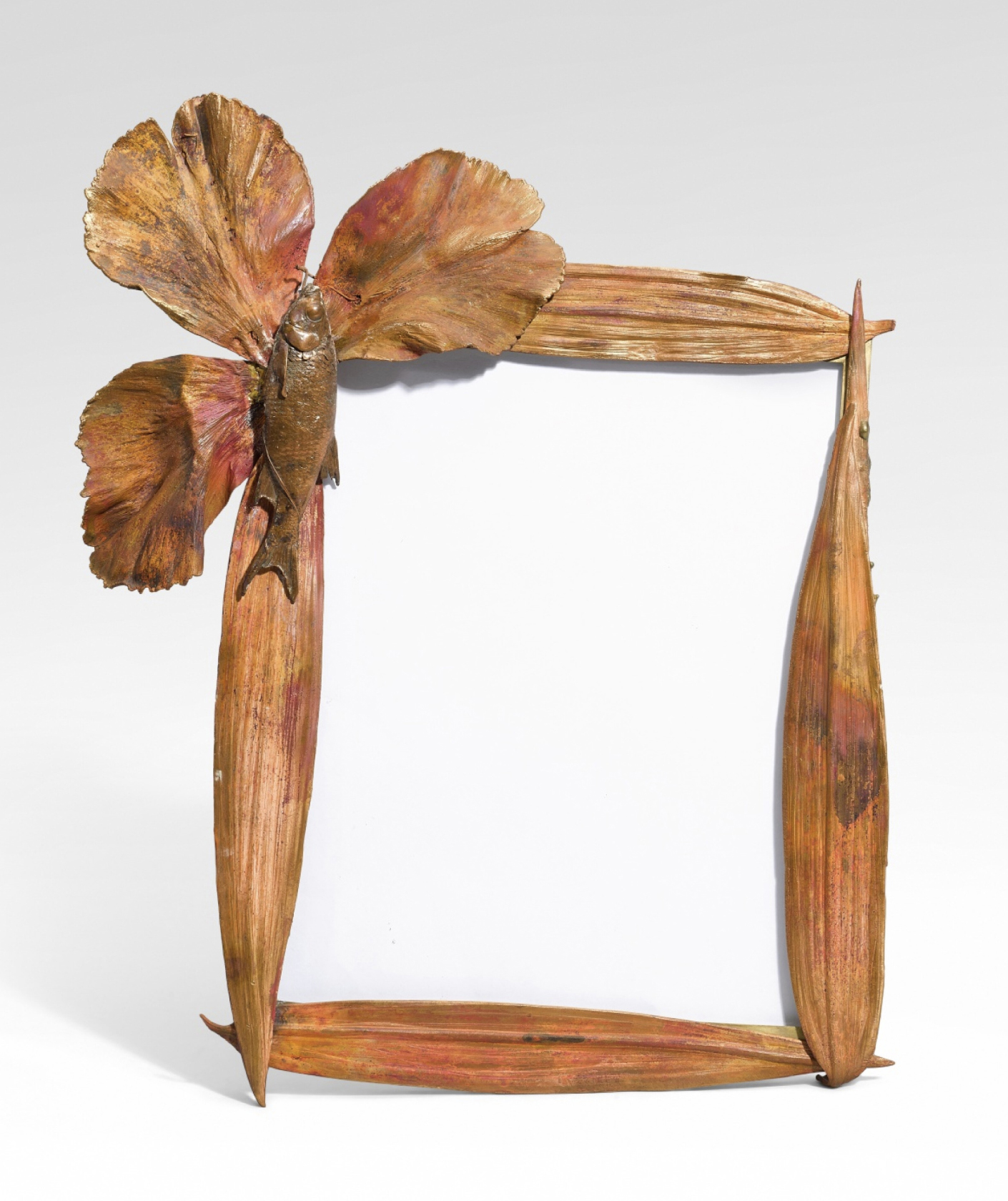 Lot 117: Claude Lalanne (1925-2019), Feuille de roseau frame, galvanized copper and bronze, 36 x 29 cm., commissioned by the owner; est.: £10,000-15,000

Reynolds (1723-92), Francis Beckford, 1755-56, o/c, 128.3 x 101.6 cm., Tate Britain
This small frame, formed from four crossed leaves of reeds or rushes, comments perhaps on the palm leaf frames of Rococo paintings and looking-glasses, which were intended as a symbolic compliment to the sitter or reflected person – since the palm was an attribute of Fame. In the frame of Beckford’s portrait, sprigs of flowers nestle amongst the palms, but in Claude Lalanne’s reed frame, these have become a large trefoil flourish, pinned with a little, impertinent – and very Surreal – fish.
 Lot 118: Claude Lalanne (1925-2019), Feuilles de chou frame, 1997, galvanized copper and bronze, 31 x 31 cm., commissioned by the owner; est.: £10,000-15,000
Claude Lalanne’s husband and working partner, François-Xavier Lalanne, described her use of ruched and ruffled cabbage leaves exactly:
‘The cabbage is to Claude what the acanthus leaf was to Greek art.’ [3]
This is a 20th century leaf frame – miniaturized but Baroque, beautifully naturalistic, and perhaps cocking a tiny snook at the overblown forests of a 17th Italian leaf frame.
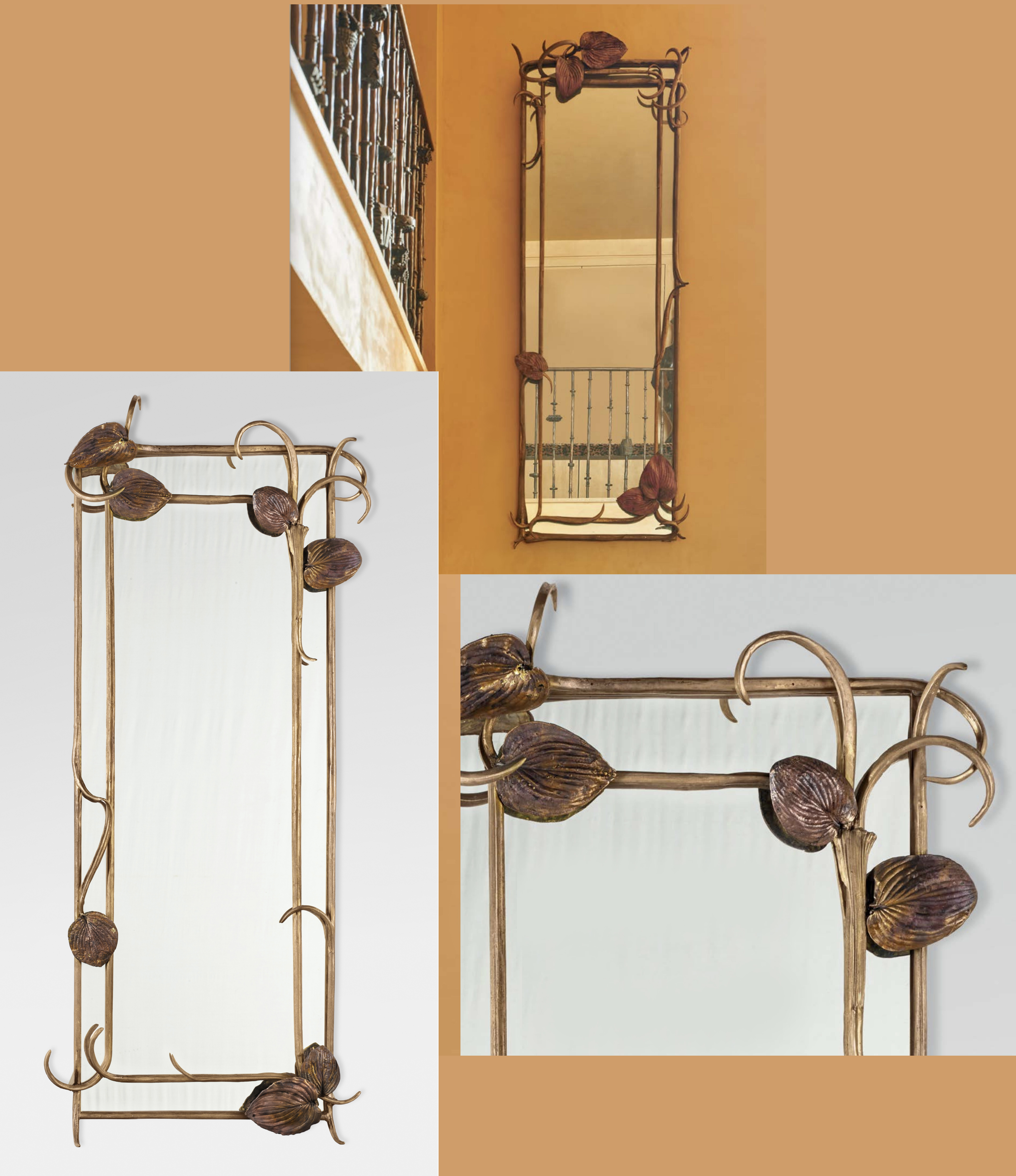
Lot 127: Claude Lalanne (1925-2019), Structure végetale looking-glass, 1996, gold patinated bronze, galvanized copper and mirrored glass, 198 x 87 cm., commissioned by the owner; in situ and detail; est.: £200,000-300,000
The Lalannes’ furniture – beds, stools, lights, benches, consoles, tables, looking-glasses – comprises delicate fantasies of bronze, copper and gold; sculptures which reproduce leaves of different kinds as a ballet of twining branches, in a similar way to the palm leaves and rocailles of a Chippendale pier glass, and like his ho-ho birds, sometimes inhabited by serpents. They are beautiful, playful, and (again like Rococo furniture) also functional. This looking-glass by Claude Lalanne is slender and upright, but sprouts vividly realistic leaves, like waterlily pads; illuminating a length of wall on a stair, it seems to generate its own pure, watery light.
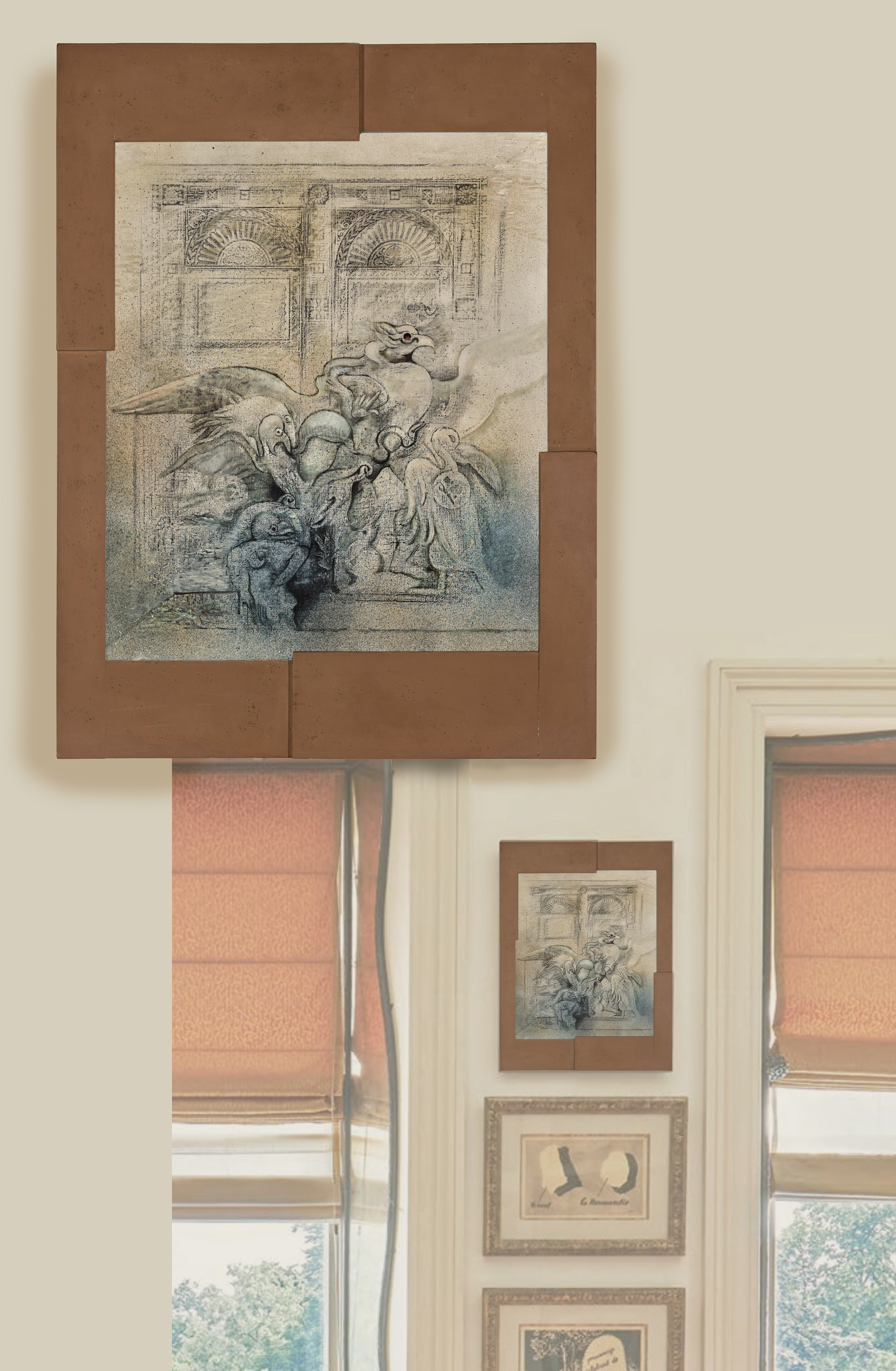
Lot 169: Max Ernst (1891-1976), Composition aux oiseaux, c.1931, o/c, 55 x 46 cm., in artist’s frame, 73.2 x 55.2 cm., and in situ; est.: £70,000-90,000
Unlike a frame with symmetrically outset corners, this artist’s frame has outset centres, formed by the diagonally opposite top left and bottom right corners straying further over the picture plane than their brothers. This has a peculiarly disruptive effect on the painting, where the orderly architectural background is set against a winged and lobed organ-like tangle of birds – parrots, phoenix, dodo and chick. The shift in frame corners seems to suggest that the whole work is gradually moving to the right, along the wall, in a disconcertingly cinematic animation of the whole. No wonder Pauline Karpidas kept it firmly trapped in the pier between two window frames…

Lot 207: Mattia Bonetti (1952-), brisée looking-glass, gold-plated and polished stainless steel, plexiglas, looking-glass, and LED lighting, 2012, 1 of 8 plus proofs, 113 x 105.5 cm.; est.: £4,000-6,000

Lot 208: Mattia Bonetti (1952-), brisée looking-glass, gold-plated and polished stainless steel, plexiglas, looking-glass, and LED lighting, 2012, 1 of 8 plus proofs, 130 x 123 cm., with details; est.: £4,000-6,000
Mattia Bonetti’s furniture designs, like his large looking-glass overdoors for Pauline Karpidas, have something of the playfulness of Les Lalannes, and Jacques Grange’s use of colour; however, these two back-lit looking-glass frames seem to come from a more brutalist stable. Their forebears may be the faceted looking-glasses of Serge Roche, some of which have slipped and protruding segments , but which are also classically regular, subtly punning on their own sources. It is hard to warm to these designs of Bonetti’s, which are more violent than merely ‘broken’, as it were, and hard to see where they fitted into the collection, or even with his own furniture in the collection.

Lot 209: André Dubreuil (1951-2022), looking-glass, painted and enamelled copper, patinated steel and coloured glass beads, 2012, 107 x 153 cm., commissioned by the owner; in situ and details; est.: £15,000-20,000
Dubreuil’s looking-glass frame is far more attractive; decorated with more slipped segments, enamelled with Toorop-like motifs in colours which would fit it perfectly for the Arab Hall at Leighton House, it is exotically splendid whilst managing to remain relatively simple and restrained. The beaded brackets at each side (are they lights? the catalogue entry doesn’t say) spring light-heartedly, like branches of strange flowers or gem-like fruit, in a continuation of the undulating contour.
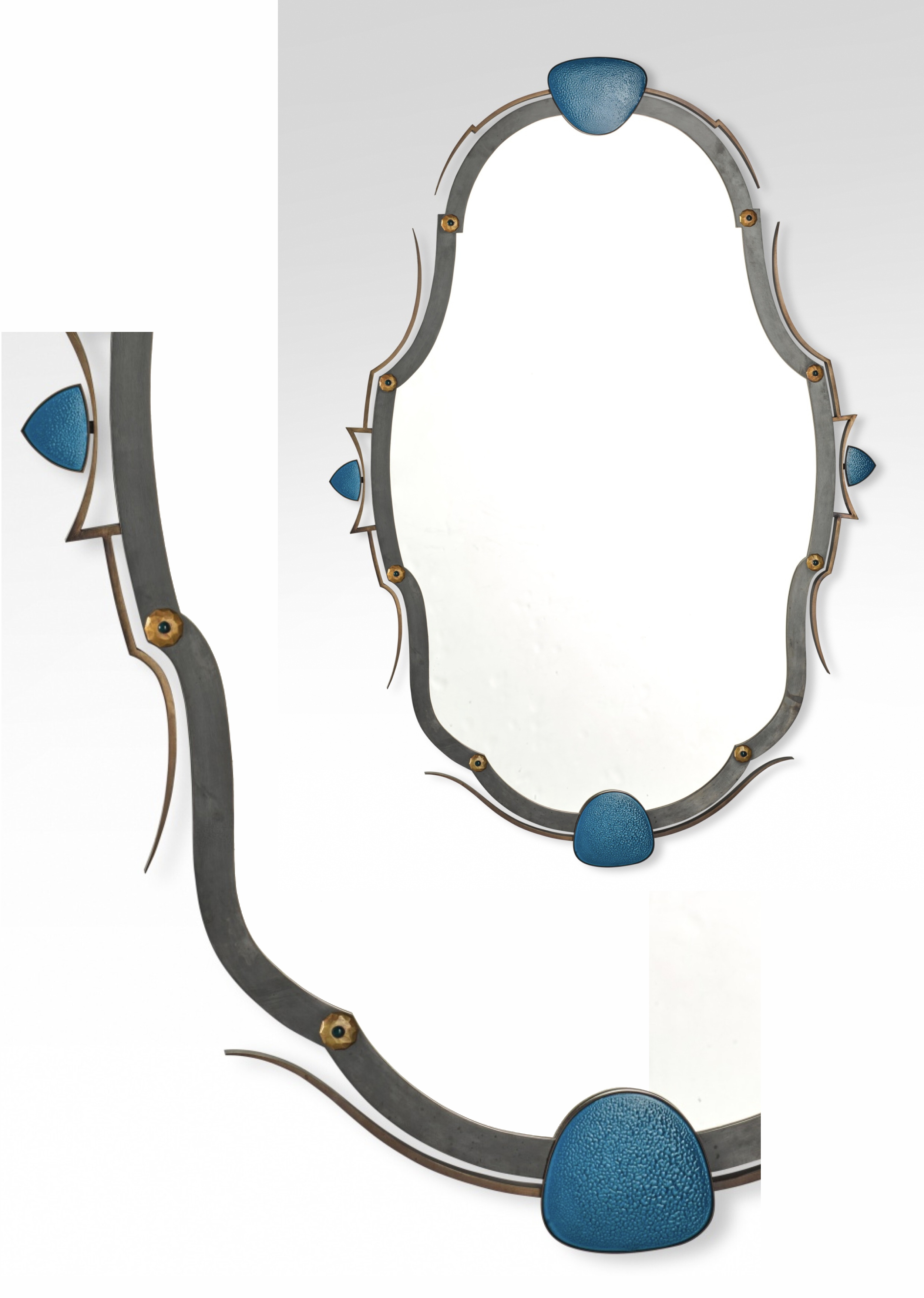
Lot 211: André Dubreuil (1951-2022), looking-glass, patinated steel, enamelled copper and cabochons, 2012, 109.5 x 74.5 cm., commissioned by the owner, with detail; est.: £18,000-25,000
In the Karpidas’s house this looking-glass faced its Dubreuil brother, both of them reflecting each other literally, whilst mirroring their enamelled colours, wave-like contours and curving shoots. And yet they are completely different pieces: this one tall, sparse and art deco – cool and Northern rather than warm and Aegean.

Lot 222: Claude Lalanne (1925-2019), Structure végetale looking-glass, 1987, gold patinated bronze, galvanized copper and mirrored glass, 193 x 67 cm., commissioned by the owner, with detail; est.: £180,000-250,000 [see also Lot 223]
**********************************
Exhibition Information:
8th-16th September
Monday – Friday 9:00 am – 5:00 pm
Saturday & Sunday 12:00 noon – 5:00 pm
34-35 New Bond Street, London W1A 2AA
**********************************
[1] Pauline Karpidas: The London collection, Sotheby’s, 2025, p. 8
[2] Ibid., p. 10
[3] Ibid., p. 220
 The Frame Blog