
Frameless art, boundless Modernism:
by The Frame Blog
A chapter from the history of the clip frame

by Volker M. Welter
In May 1957, the Patent Office of the Federal Republic of Germany extended protection to a new method of hanging artwork which would render unnecessary any traditional picture frame.

The clip, the centrepiece of the Bildträger system as seen from the front and the side. Photo: Content Production
The Bildträger or ‘picture holder’ combined into a simple clip made, for example, from aluminium or acryl glass, the two functions of holding and hanging such art on paper as lithographs, screen prints, and posters, but also display boards, photographs, and even mirrors. The clip pressed the art – with or without a protective passe-partout (mount) or a sheet of glass – against a wooden board of Masonite or similar material.
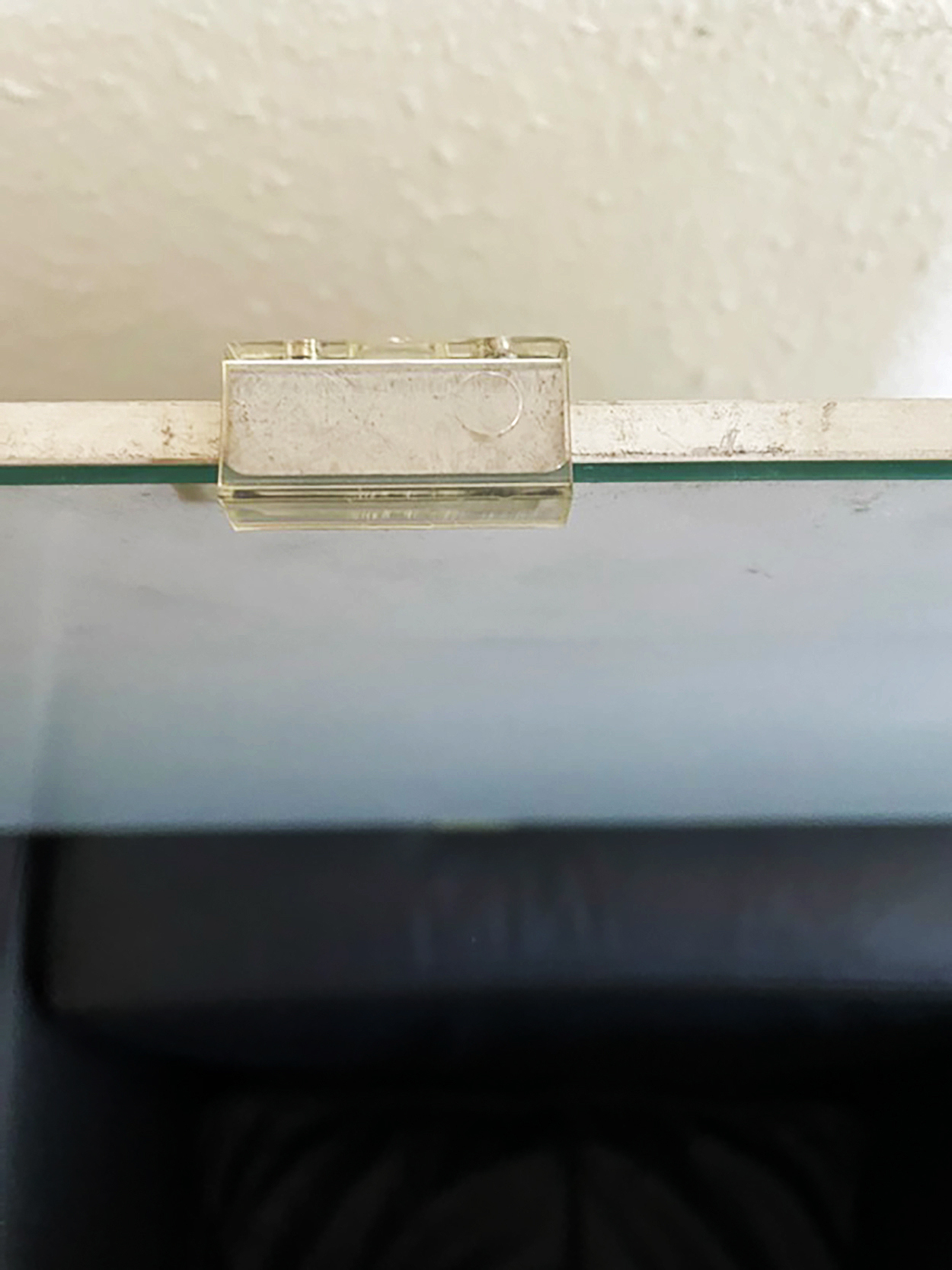
The clip (seen from top) grabbing the backing board from behind, with the protective glass at the front. Photo: Content Production
Towards the front, the clip reached over the backing board, the art piece, and possible mounting and glass.

Reverse side of backing board showing clips snapped into grooves. Photo: Content Production
On the back, the metal clip’s angled lower edge, dovetailed with a correspondingly angled groove, cut into the board five centimetres off the edge. As these grooves ran from side to side along all four edges of the backing board, the necessary clips – smaller pieces usually required one at the top and bottom or one on each side, larger formats at least two on all sides – were either slid into position or clicked into place by pressing them downward from the edge of the backing board. Originally, a hook protruded from the rear of the clip, allowing one to hang assembled pieces on the topmost clip or clips; later versions substitute a triangular hole for the hook.
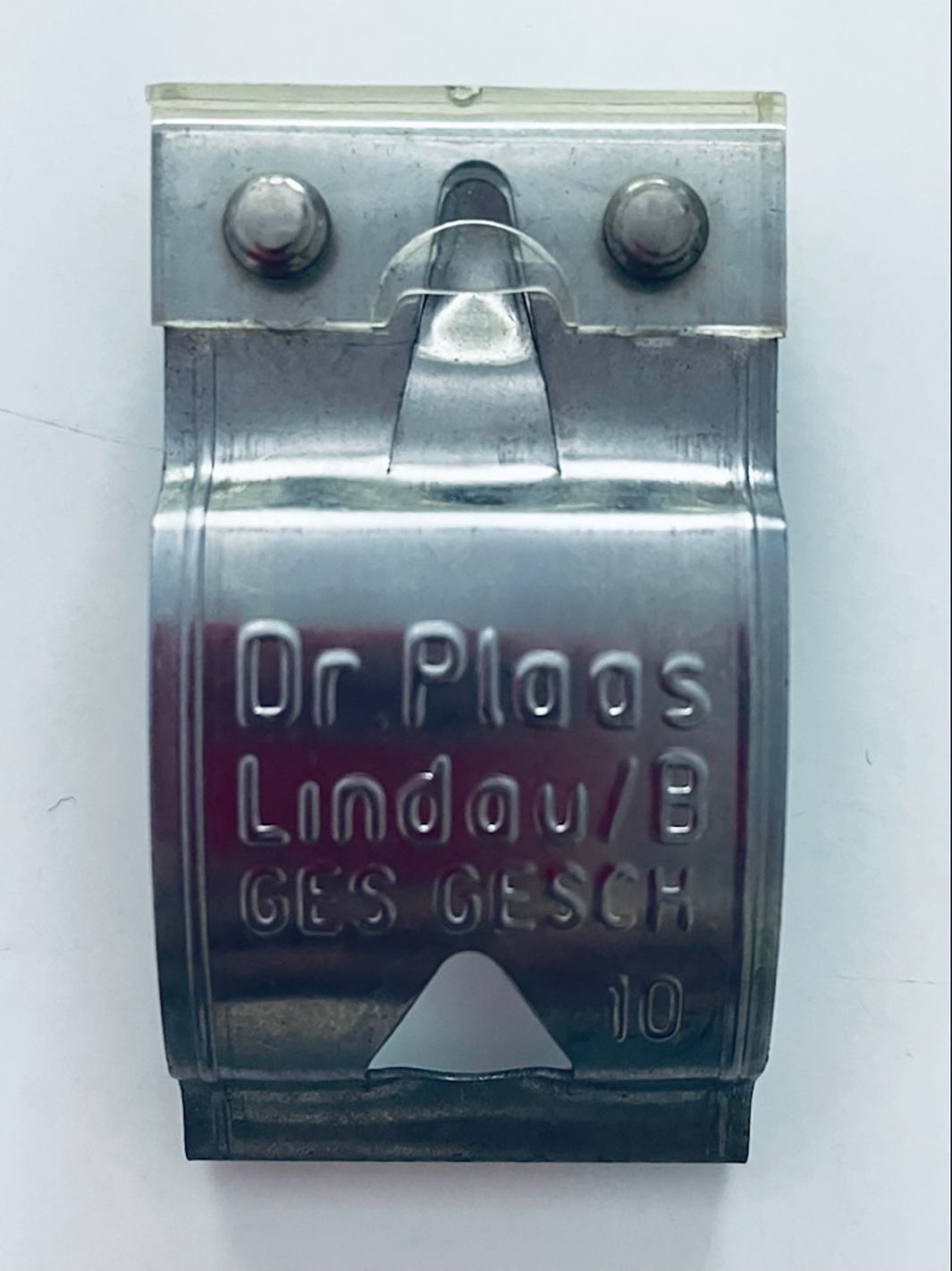
The clip as seen from the rear with, at the lower end, the triangular hole for hanging an art piece and the projecting tongue at upper end. Photo: Content Production
Lastly, a punched-out tongue was bent toward the backing board. It allowed for adjusting the available space to the varying thickness of the art piece plus any mounting and glass, ensuring that the appropriate force pulled the various layers firmly against the backing board (above).

Edith and Dr Karl-Heinz Plaas, Christmas and New Year’s card, 1986, Collection Volker M. Welter
The Bildträger was the idea of Dr. Karl-Heinz Plaas (1908-1999), a lawyer with a doctorate in Jurisprudence from the University of Hamburg. According to Plaas, Bildträger were perfect for galleries because the ease of assembling and disassembling them allowed one to change works of art quickly and repeatedly. They would also facilitate the lending of art as the clip could accommodate protective sleeves of various materials and thicknesses which a lender might not allow a borrower to remove. Most important to Plaas was the Bildträger as a contemporary means of exhibiting modern, abstract art; that is what Plaas often told me when I knew him personally from the late 1970s onward, through my parents and parental friends.
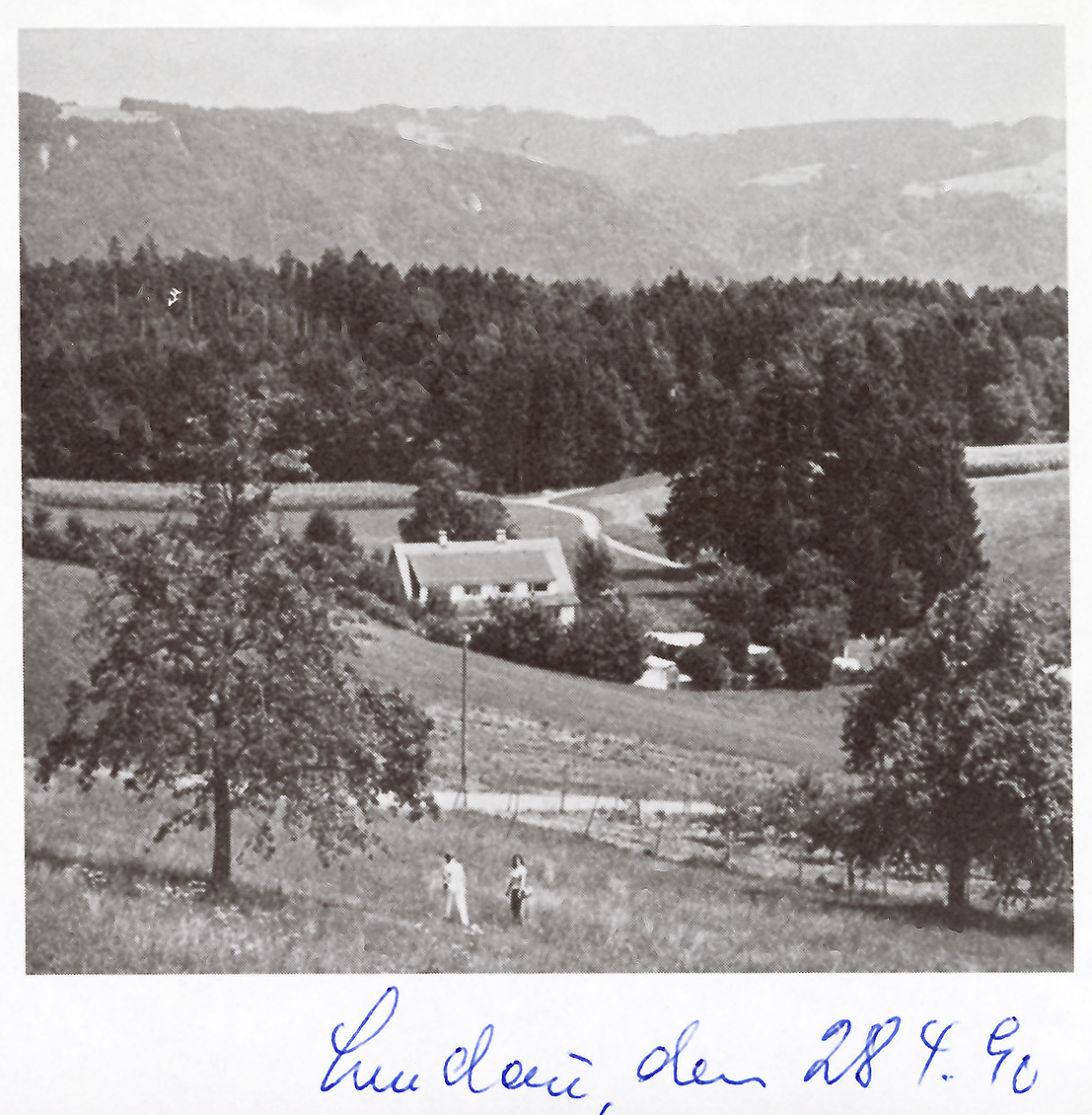
Detail from the letterhead of Art Studio Stiftung Plaas, Lindau, Lake Constance, showing the foundation and the manufactory of the Bildträger, Collection Volker M. Welter
He and his wife, Edith Plaas (1918–2010), lived on the outskirts of Lindau at Lake Constance, where they manufactured Bildträger while running a contemporary art gallery and the Art Studio Stiftung Plaas. The latter was a private foundation offering invitations and residencies to artists, mainly from behind the Iron Curtain and other countries, including the United Kingdom.
As told by Dr. Plaas and largely confirmed from archival files of the Nazi (military) judiciary system, the origin of the Bildträger harks back to the final years of the Nazi dictatorship. Plaas was called up for military service in mid-June 1942, but without ever seeing the front, he was arrested on May 1, 1943, for repeated comments that the war was about to be lost as the British forces would soon reach Hamburg. Plaas expressed to fellow soldiers with whom he shared military quarters in Hamburg his intention to delay his active military service so that when he encountered British troops, he could state that he had never raised a weapon against any of them. Plaas was born in Hamburg, then and now the most English – as in understated – German city. Plaas was imprisoned in Berlin’s infamous Lehrter Straße penitentiary and charged with demoralising the German military (Wehrkraftzersetzung). Late in August 1944, he received a three-year prison sentence to be served in a special penal unit on the Eastern front.
During the initial imprisonment of over fifteen months, Plaas met a fellow prisoner with contacts to the former Bauhaus, which the Nazis had closed in 1933. This prisoner, at present unidentified, suggested that should Plaas survive imprisonment and the war, he could approach the designer Wilhelm Wagenfeld (1900-90), a former student at the Weimar Bauhaus, for support. Wagenfeld was a successful industrial designer before and during the Third Reich (and thereafter), but when he refused to join the NSDAP, he was sent to a penal battalion on the Eastern front [1]. The idea of the Bildträger occurred to Plaas when Wagenfeld mentioned to him that a new system was needed to exhibit modern, abstract art; this recollection may suggest that both men met, though the circumstances remain elusive.

John Bratby (1928-92), example of a label printed for the back of a painting (here, Brian Rix and his wife, Elspet Jeans, 1967). Photo: National Portrait Gallery [2]
Modernist objections against real or imagined limitations of traditional picture frames are manifold, ranging from quasi-philosophical considerations, such as visibly separating the picture plane from the surrounding space to practical concerns such as visually overwhelming the artwork.
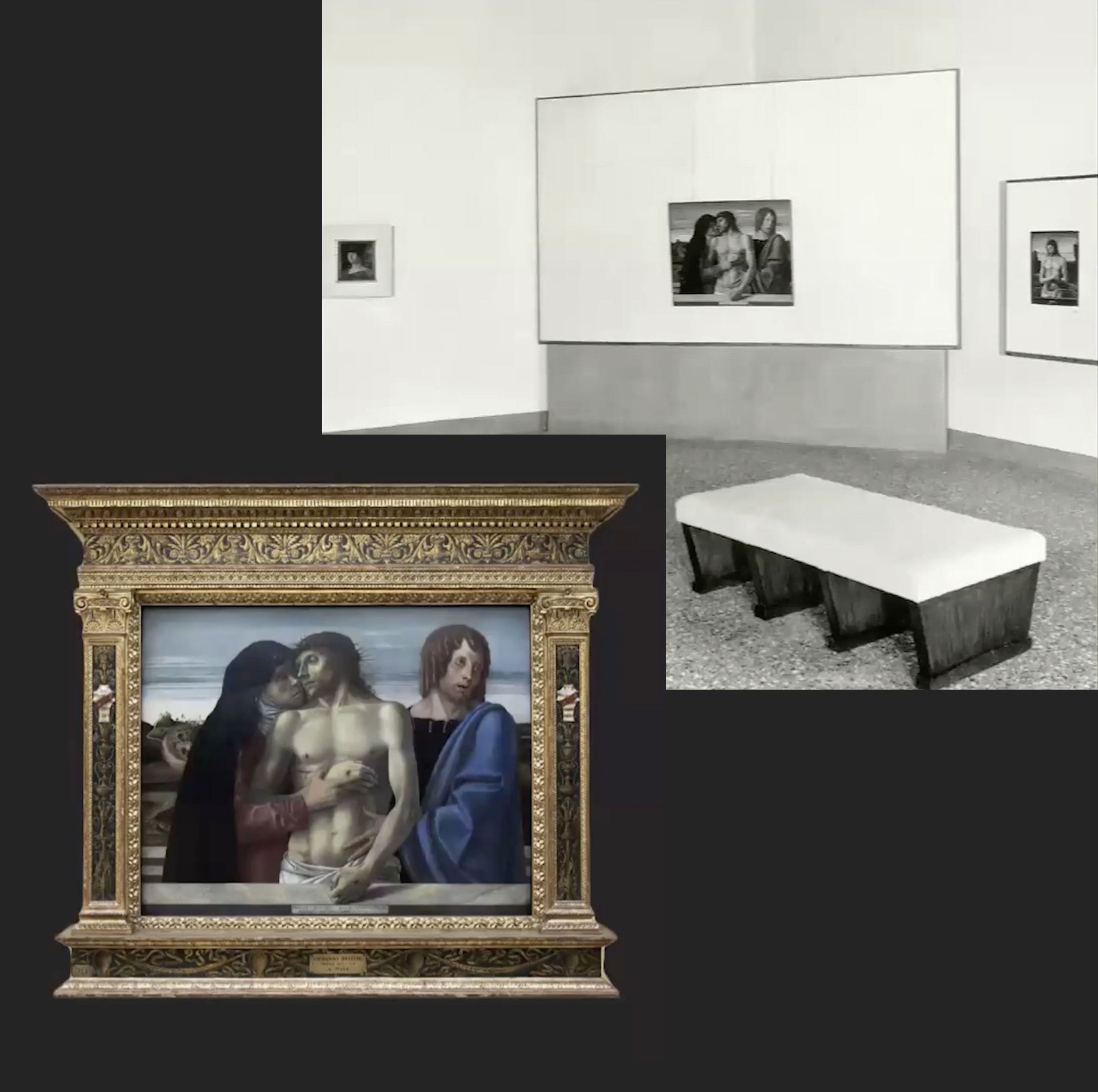
Giovanni Bellini (1430-1516), Pietà, 86 x 107 cm. (Pinacoteca di Brera, Milan) in its replica frame of 1902-04, and displayed without this frame in the exhibition of his work, Palazzo Ducale, Venice, 1949, designed by Carlo Scarpa: from Flavia Crisciotti’s recent paper (see note 2)
Such debates affected historical master paintings, as Flavia Crisciotti recently argued regarding modernist curators’ efforts to exhibit Italian master paintings ‘naked’ without their old-fashioned frames [3].
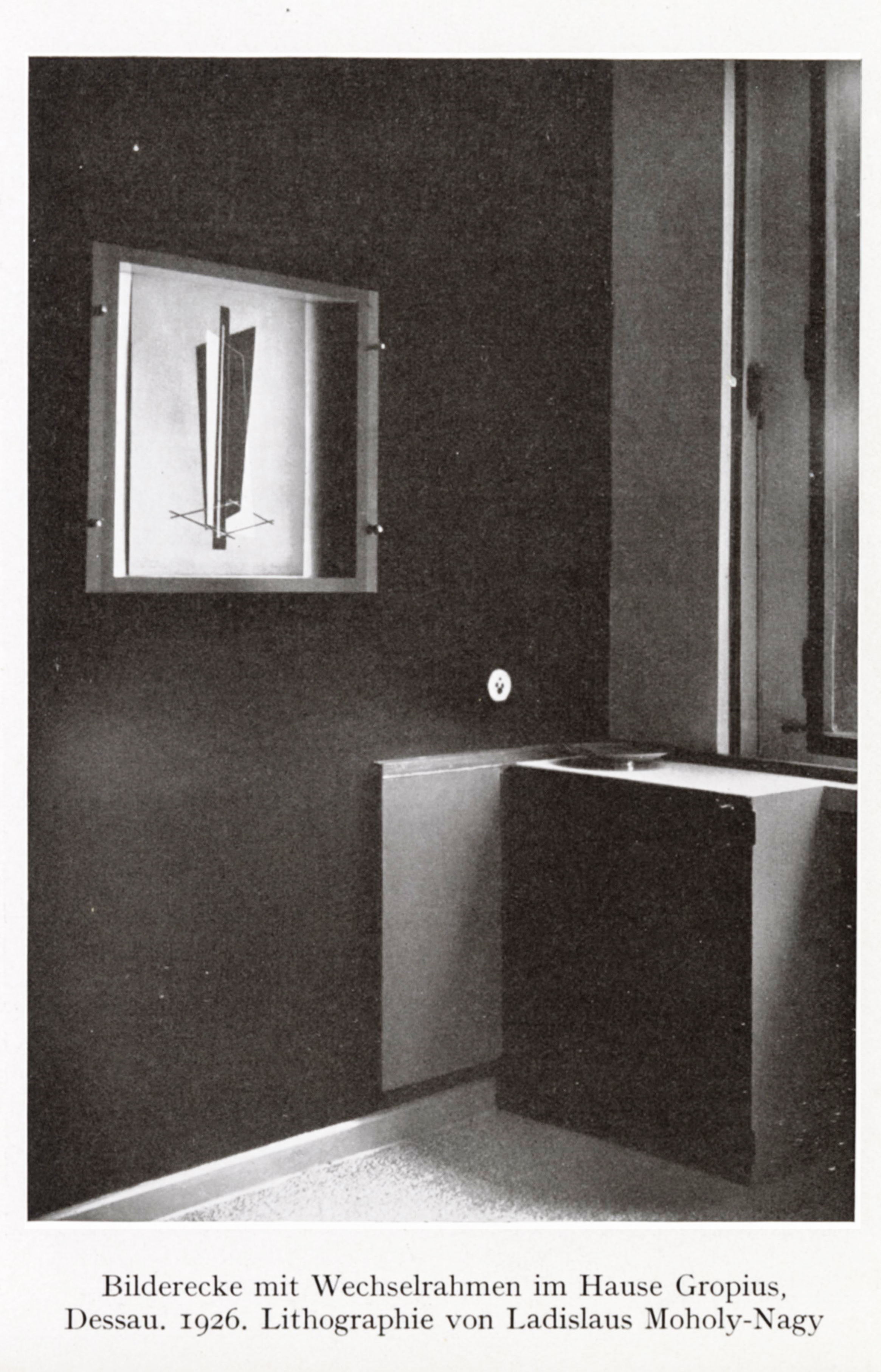
The debates also affected the display and production of modern art. For example, the architect Walter Gropius (1883-1969), the founder of the Bauhaus, decorated a corner in his newly designed house (1925-26, destroyed 1945) at the Bauhaus in Dessau with a lithograph by László Moholy-Nagy. A contemporary photograph shows the print affixed at the back of a box-like frame of noticeable depth [4]. At the front, four projecting fasteners hold a sheet of glass, allowing the artwork to be easily exchanged.

Centre of right-hand wall, El Lissitzky (1890-1941), abstract watercolours displayed in a double sliding frame, 1927-28, ‘Cabinet of Abstraction’, Provinzialmuseum, Hannover
A few years later, in 1929, Sigfried Giedion singled out the interactive display – as we would say today – of abstract watercolours by El Lissitzky using a verschiebbaren Wechselrahmen (‘sliding easy change frame’) which invited visitors to decide which watercolours to view.[5] On one wall of the Gallery of Abstract Art at the Provinzialmuseum Hannover (today Landesmuseum Hannover), an oblong, landscape-format frame held side by side two El Lissitzky pieces. Each piece was individually framed and inserted into the larger frame so that, comparable to a sliding window, visitors could push either smaller frame to the side to reveal a total of two more works in the back of the large frame. This arrangement recalls Sir John Soane’s Museum in London, where layered segments of some walls can be folded open to show further artworks hung within the depth of the walls.

Arthur Segal (1875–1944), The Fall of Man, 1920, o/c, 69.5 x 89.5 cm., in the artist’s painted frame, Art market, 5 February 2009
Or, to name just two modern painters, the Romania-born, Berlin-based Jewish painter Arthur Segal, who lived in exile in London from 1936 onward, and his American colleague Marsden Hartley (1877–1943), occasionally created paintings which spilled over from the canvas onto the surrounding frame. Such works by Segal as The Fall of Man and the City of London (1927, Arts Council Collection, Southbank Centre, London), or Hartley’s Himmel (c. 1914–15, Nelson Atkins Museum of Art), do not make frames invisible or superfluous but illustrate the longstanding tendency in some quarters of modern art and design to overcome the limitations of picture frames.
After the Second World War, Plaas picked up on this tendency. Indeed, the display system in the Gropius house anticipated Plaas’s concerns, right down to the German compound word Wechselrahmen or ‘easy change [picture] frame’, which is echoed in Plaas’s coinage of Wechselbildträger or ‘easy change picture holder’ [6]. Plaas’s Patent Office application referenced a range of existing hanging systems which made ‘framing’ less time-consuming and, of course, less of an art in its own right. They also allowed the exhibited art to be changed quickly. Among them were, for example, clips connected at the rear of the backing with metal rods or wires which could be tightened; or pre-formed pressed metal sheets which gripped art pieces and protective glass along all four edges.

Front of a Wechselbildträger with invisible clips made of acryl glass. Photo: Content Production
In sharp contrast to these products, Plaas claimed that his Bildträger was the first system which did away entirely with frames; not even the smallest frame-like edge would be visible if the front-facing part of the clips were made from acryl glass. Finally, abstract art could hover in space: borderless because without a frame, unsupported for the hanging mechanism was invisible, and perfectly parallel with the vertical plane in front of which it hung as the clips ensured equal distance between the wall and the edges of the art piece.
The absence of business records renders assessing production figures and sales of the Bildträger difficult, if not impossible. Archival records document that the Bauhaus Museum, today the Bauhaus Archiv in Berlin, acquired Bildträger. The former Akademie der Künste in Berlin East was another client, at least a kind of client, as Plaas appears to have supplied merely the clips, while the staff at the academy produced the backing boards. The Museum of Modern Art in New York supposedly purchased the system, but to date, no archival records have been found that could verify this.
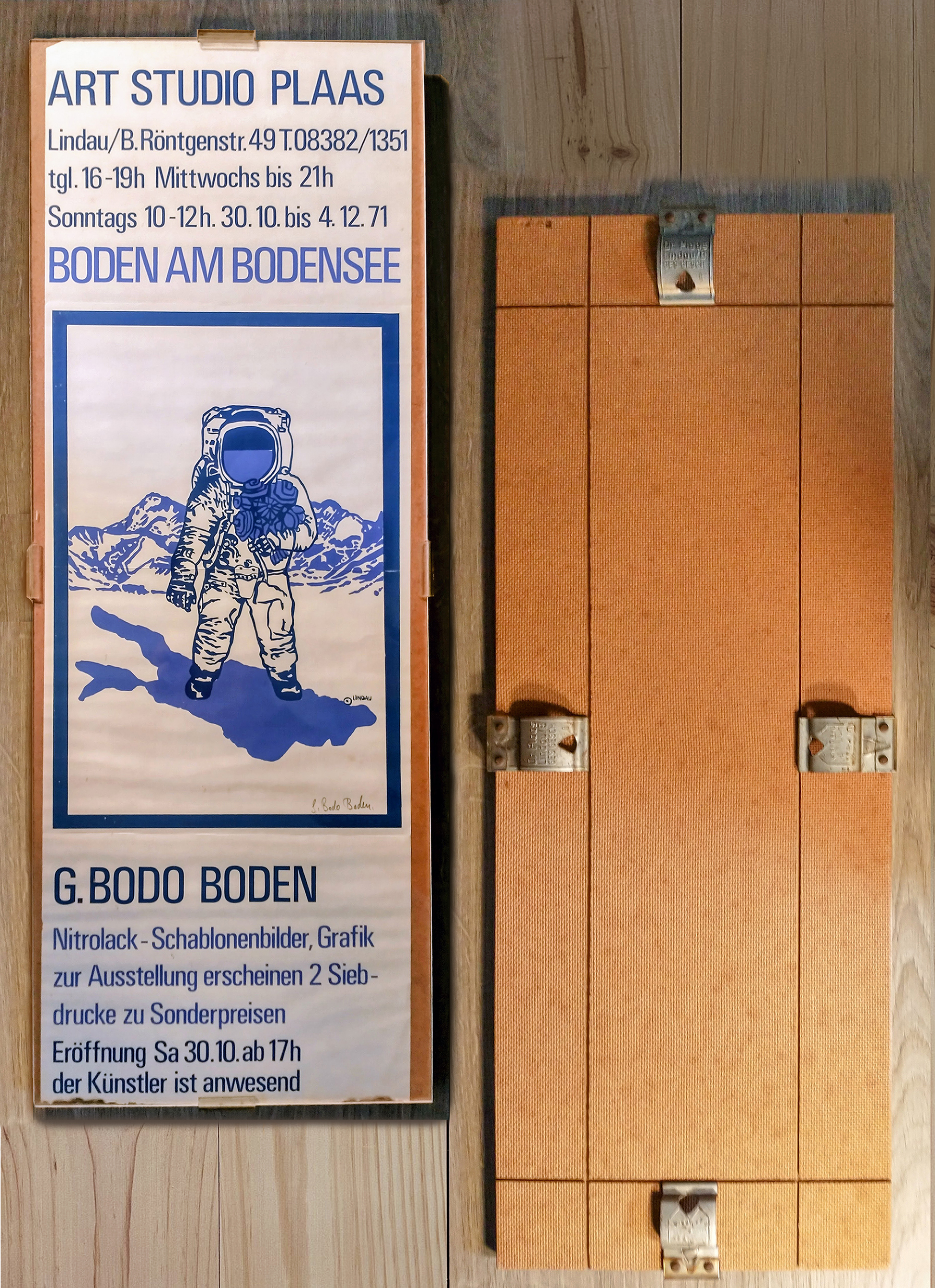
Poster (original screen print) advertising an exhibition by the artist Bodo G. Boden (German, born 1937) at Art Studio Plaas, Lindau, 1971, shown front and back [7]. Photo: Volker M. Welter
The aesthetically pleasing appearance of the Bildträger could not mask its shortcomings. While intended for the frequent exchange of artworks, the Bildträger was often used in private settings to display art permanently. When large-format art on paper was hung with this system, the artwork eventually crinkled or slipped downward. Protective mattings (mounts) somewhat alleviated these issues but at the price of reintroducing a hard edge, however thin and narrow, which reconstituted a boundary, if not a frame, around the art.
Regularly swapping the art on display occasionally caused the edges of protective sheets of glass to splinter, especially if all-metal clips were used instead of those with an acryl glass front part. Usually, Plaas recommended using sheets of acryl glass to protect the artwork; this material, however, also meant sharp angled edges and a surface that might scratch.
The edges between the protective (acryl) glass cover and the backing board proved equally problematic. Because they were left unsealed, dust and other particles penetrated between the layers and affected the appearance and condition of the artwork, especially if the latter was not regularly rotated. Plaas admitted that the affordable aluminium frames that began superseding his Bildträger allowed frequent and easy switching out of art pieces. They also offered superior protection against dust and particles lodging between glass and backing, even if they meant to return to the notion that art had to be framed to be shown.
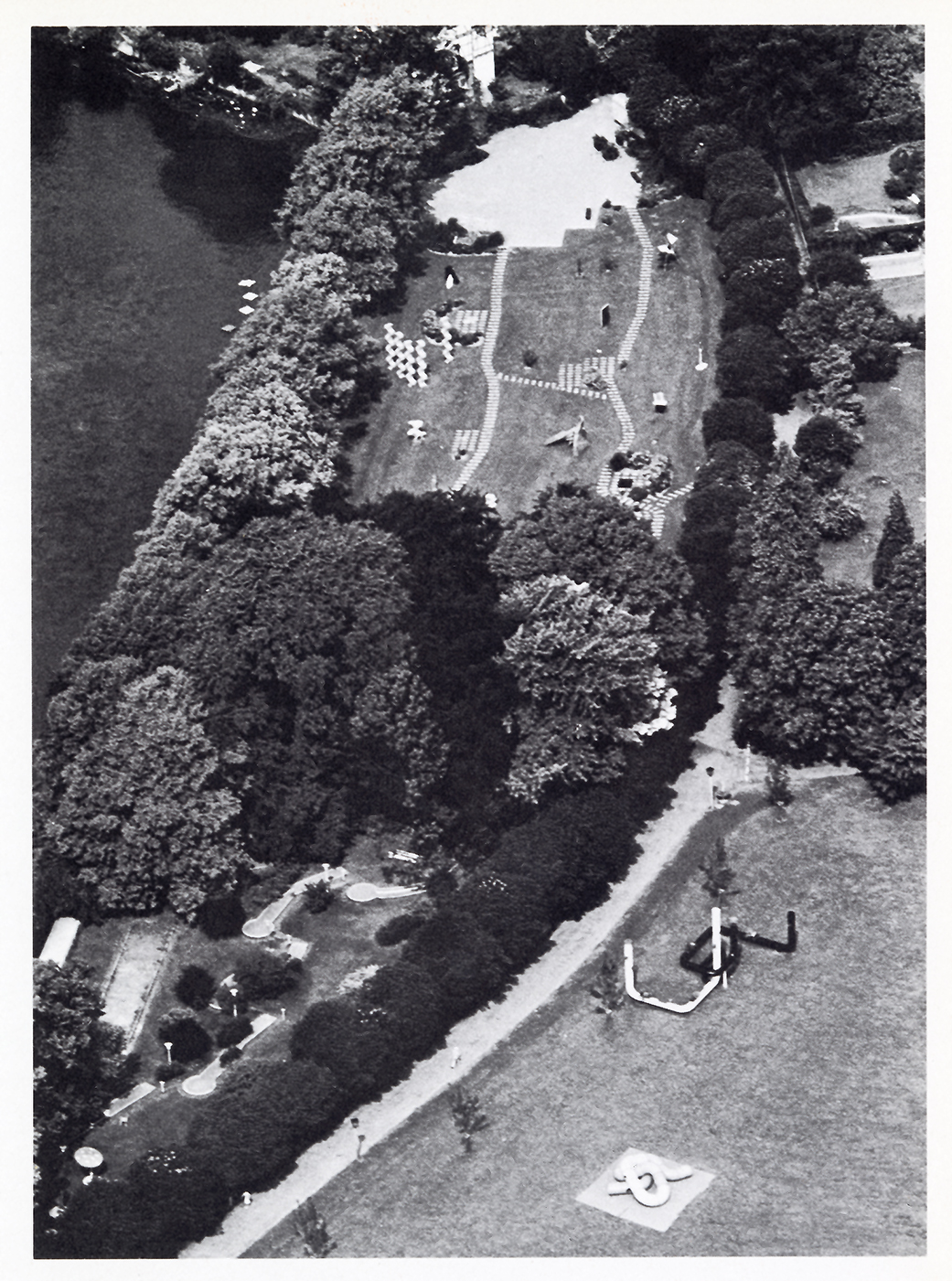
4th Internationales Plastik-Symposion, Lindau, Lake Constance, 1977, outdoor exhibition of large sculptures made from plastic at lakeside park ‘Aeschacher Ufer’, Collection Volker M. Welter[8]
Dust, crinkles, and slippage may have marred the perfection of the frameless Bildträger but did not affect its symbolic expression of the boundless modernism that Dr. Plaas and Edith Plaas cherished so much. Throughout the 1970s and 1980s, the couple organized, for example, Internationale Plastik-Symposia—open-air exhibitions at Lindau’s lakeside park ‘Aeschacher Ufer’ and in the local museum—to which were invited primarily artists who used modern plastics to make art.
During the final years of West Berlin, when I worked in an architecture office which specialized in restoring historic buildings, Plaas reminded me during visits that he and his wife had decades ago already found the perfect solution for stone sculptures decaying in inclement weather: remove the originals, put in their place copies cast from plastic, and no longer would the past impose boundaries on modern life comparable to old frames hindering modern art from unfolding its abstract beauty. An equivalent point of view was expressed when he explained, perhaps with an eye to my architecture studies, that by embracing modern and modernist architecture, Hiroshima and Nagasaki were rebuilt so much more beautiful in form than the old cities which had vanished in 1945. For him, the boundless modernist tomorrow could and would overcome everything, from the limitations of old-fashioned picture frames to memories of the past.

Edith and Dr. Karl-Heinz Plaas with the author at Café Kopenhagen, Kurfürstendamm, Berlin, 1990, Collection Volker M. Welter
*****************
There are coincidences in the career of the French artist in glass, Max Ingrand, born the same year (1908) as Dr Plaas, and imprisoned by the Nazis in 1940. His particular expertise was in making stained glass windows, but he also directed the Milanese company Fontana Arte for thirteen years in the 1950s and 1960s, when it produced glass ‘sandwich’ frames to his design, and looking-glasses with clip frames or with the barest minimum of frames.
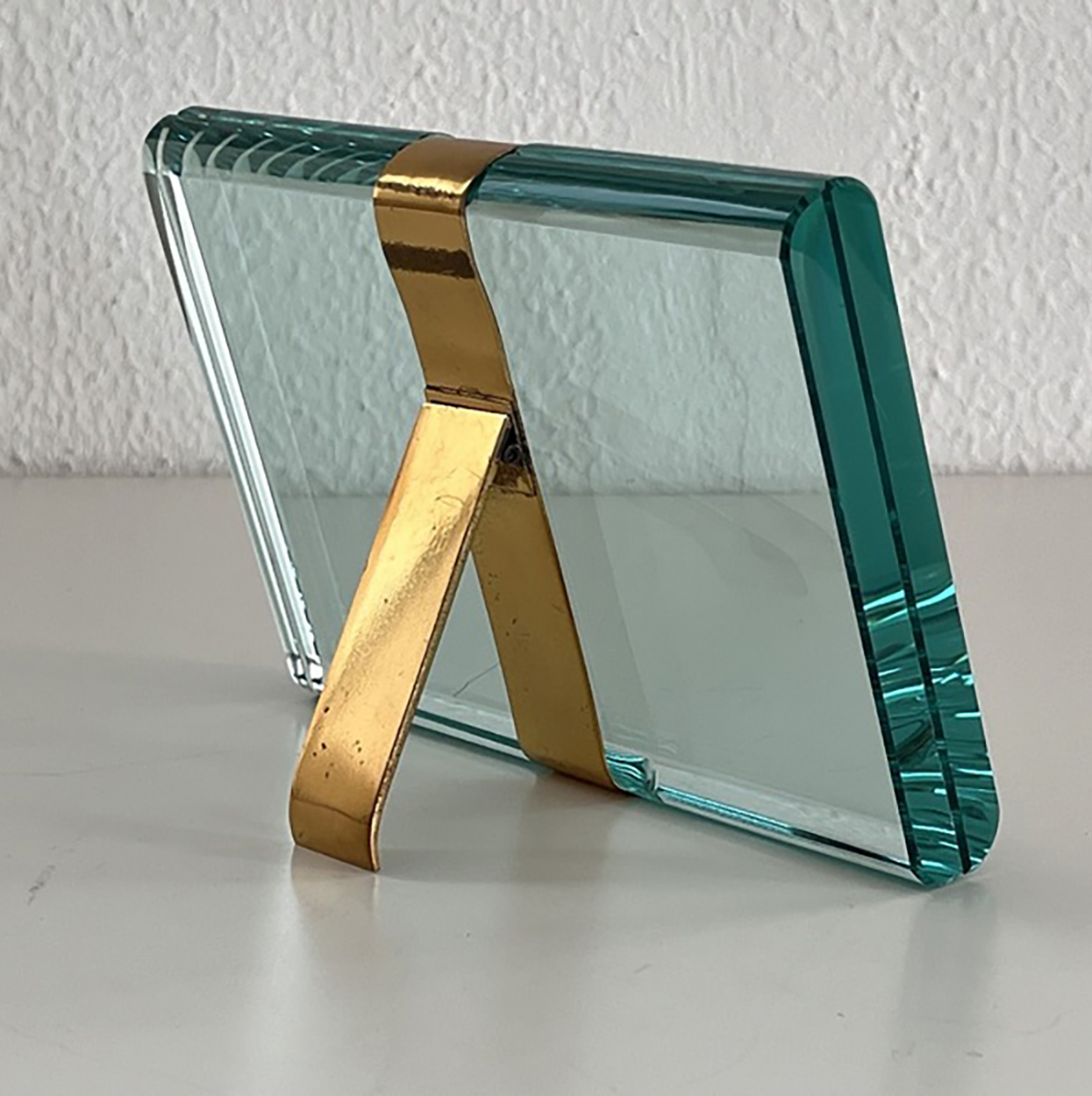
Max Ingrand (1908-69), 1960s glass frame for Fontana Arte

1950s glass frame attributed to Fontana Arte
Another designer of frameless frames – and only a year older than the other two – was Bruno Munari, a Milanese artist, illustrator and art director. He may possibly have known Ingrand when the latter was running Fontana Arte in Milan. In 1970, he also produced ‘Ireland’, a rectilinear band of rubber which held together a sheet of clear methacrylate and an MDF back board, making it extremely easy to change the contents [9].
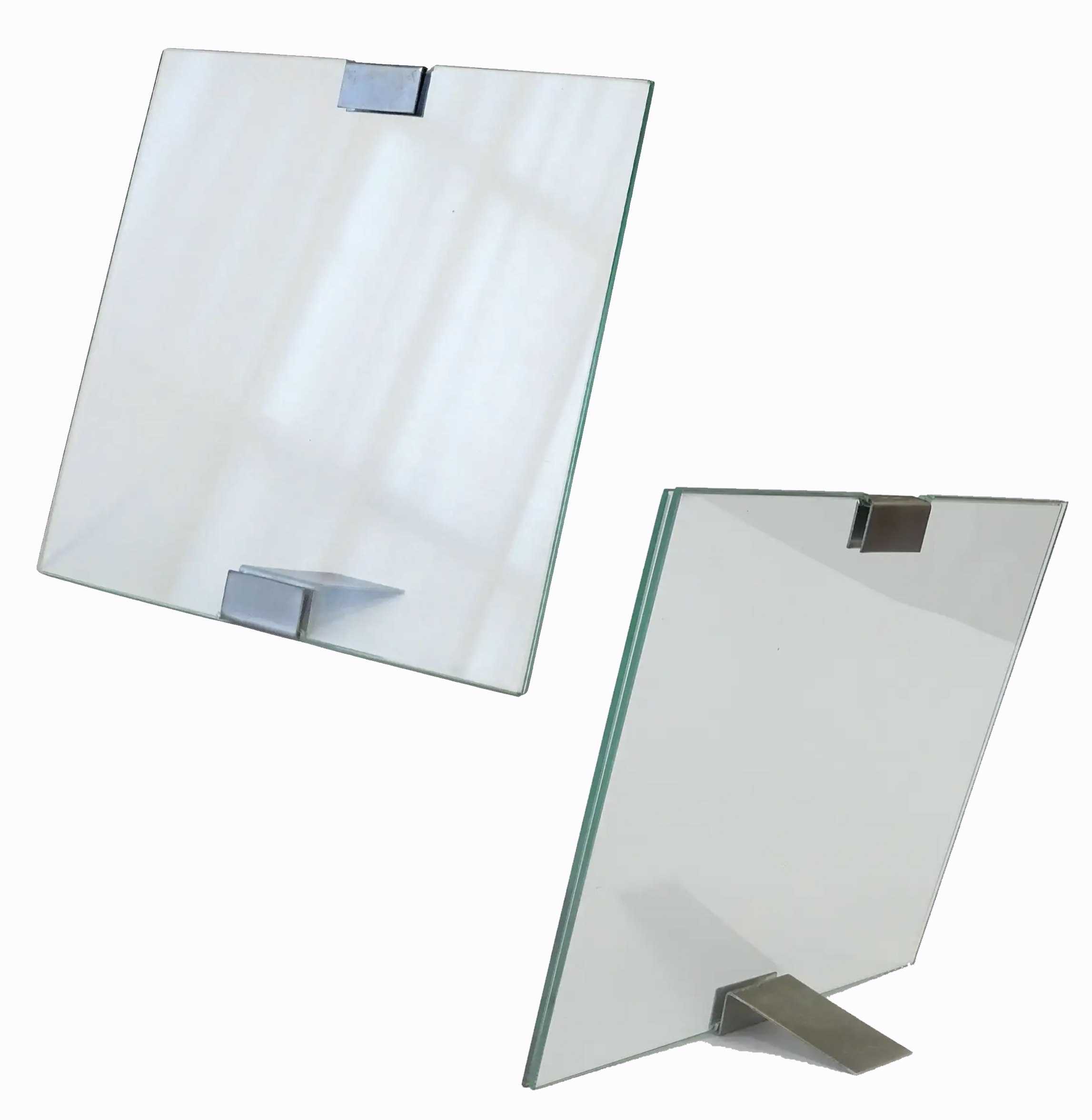
Bruno Munari (1907-98), ‘Galapagos’ glass & stainless steel frame, front and reverse, for Danese, 1961, 1st Dibs
*****************
The author would be interested in hearing from anybody who knows museums, galleries, and private collectors who used or still use Dr. Plaas’s Bildträger. He would also like to hear from and about artists who were residential fellows of the foundation Art Studio Stiftung Plaas or exhibited at the Plastik-Symposia in Lindau, Lake Constance. Please write to welter@arthistory.ucsb.edu
Professor Volker M Welter is an architectural historian who studied and worked in Germany, Scotland, England, and, since 2002, in California. His research focuses on German-speaking émigré architects in California, the UK, and Israel. His newest book, Exiled in L.A.: The Untold Story of Leopold Fischer’s Domestic Architecture, will be published by the Getty Research Institute later in 2025.
*****************
See also:
Jacob Simon, The art of the picture frame, National Portrait Gallery, 1996, pp. 25-26, which considers the rejection or minimization of the frame by artists from Mondrian to Rothko, by architects including Franco Albini and Carlo Scarpa (as illustrated above), and by curators at MOMA and the Metropolitan Museum in New York amongst others.
Ted Loos, ‘At MoMA, “permanent” learns to be flexible’, New York Times, 22 October 2009
Jackie Briggs, ‘What’s in a frame?’, Guggenheim articles, 21 May 2021
*****************
[1] Beate Manske, ‘Wagenfeld, Wilhelm’ in Neue Deutsche Biographie 27 (2020), pp. 193–96 [online version]. For Wagenfeld during the Third Reich and the varying dates the literature notes for his being sent to the Eastern front see, for example, Walter Scheiffele, ‘The Experiment: Schott & Gen in Jena’, in Wilhelm Wagenfeld (1900–1990), ed. Beate Manske (Ostfildern-Ruit: Hatje Cantz, 2000), pp. 38–45 (p. 63), and Beate Manske, ‘Wilhelm Wagenfeld, Biography’ in the same volume, pp. 186–192 (p. 188); Rüdiger Kroll, Zu Tisch mit Wilhelm Wagenfeld. Ein Formenschatz vom Weimarer Bauhaus bis zur WMF, ed. by the Verein für Heimatschutz e.V. (Kranenburg: Museum Katharinenhof, 2014), p. 38; and Daniel Hornuff, Keine Kompromisse? Wilhelm Wagenfeld und der Nationalsozialismus (Berlin: Kulturverlag Kadmos, 2022)
[2] Illustrated in Jacob Simon, The art of the picture frame, National Portrait Gallery, 1996, fig.13, p. 25
[3] Flavia Crisciotti, ‘Cornice and Cornice: Italian Debates around Picture Frames’, in The Cornice: gta papers 6, ed. Maarten Delbeke & Erik Wegerhof (Zurich: gta Verlag, 2021), pp.106-13. Dr Crisciotti’s PhD dissertation Unframed edges: mounting Old Master paintings in Italian Modernism (TU München, 2024) has not yet been published; however, she recently took part in the Art Gallery of Ontario frame conference (25-26 September 2024), and all recordings of the papers given can be accessed here: ‘Many lives: Picture frames in context: an online conference‘. Scroll down to find a summary of the second paper in the morning session of Thursday 26th September, and continue scrolling to the end of that session to find the video recording containing Dr Crisciotti’s contribution
[4] Gustav Adolf Platz, Wohnräume der Gegenwart (Berlin: Propyläen-Verlag, 1933), p. 426
[5] Sigfried Giedion, ‘Lebendiges Museum’, Der Cicerone: Halbmonatsschrift für die Interessen des Kunstforschers & Sammlers, 21 (no. 4, 1929), 103-06
[6] Much later the official name was ‘rahmenloser Wechselbildträger System Dr. Plaas’ or ‘frameless easy change picture holder system Dr. Plaas’
[7] This Bildträger hung for many years outside the Art Gallery Plaas, and was given to the author in 1997
[8] Source of image: 5th Internationales Plastik-Symposion Lindau im Bodensee 1979, ed. by Art Studio Stiftung e.V. (Lindau: Art Studio Stiftung e.V., 1979), p. 6. The exhibition shown is the 4th symposium held in 1977, although the image was scanned from the catalogue of the 5th symposium held in 1979
[9] With thanks to Dr Flavia Crisciotti for the information on Bruno Munari, and pointers to examples of his frameless frames
 The Frame Blog
Great post! One suggestion for enriching the discussion would be to make a clearer distinction between frames for paintings and frames for works on paper. The history of displaying works on paper, particularly drawings and prints, differs significantly from that of paintings, as they were often presented without frames long before the invention of the “Bildträger.” It would have been fascinating to explore how works on paper were displayed historically, as this could add another layer to the conversation about the history and evolution of “frameless” display.
LikeLike
I’m glad that you enjoyed the article, Marei, and thank you for commenting.
The second paragraph does make clear that these particular clip frames were intended only for works on paper, and the reference and links to Dr Flavia Crisciotti’s articles, PhD thesis and recent talk at the Art Gallery of Ontario’s frame conference on the deframing of Renaissance works in the mid-20th century, also takes in the display of paintings without original or contemporary frames.
As well as this, there is an article, ‘Framing the drawing’by Catherine Monbeig Goguel, on The Frame Blog (https://theframeblog.com/2021/03/26/framing-the-drawing/), and another on ‘Print rooms, prints, and their printed borders’ (https://theframeblog.com/2021/04/24/print-rooms-prints-and-their-printed-borders/), which together do, I think, add further dimensions to the discussion of the display of works on paper.
LikeLike